The 2026 Chevy Equinox EV is one of the most accessible long-range electric SUVs on the market, with up to 319 miles of EPA range on the 3LT trim. But for new owners and prospective buyers, one question dominates: can you use Tesla Superchargers with the Chevy Equinox EV? The short answer is yes — and in 2026, it's easier than ever. Here's everything you need to know about charging the Equinox EV at home, on the road, and at the Supercharger network.
The Equinox EV's Charging Hardware: NACS Native in 2026
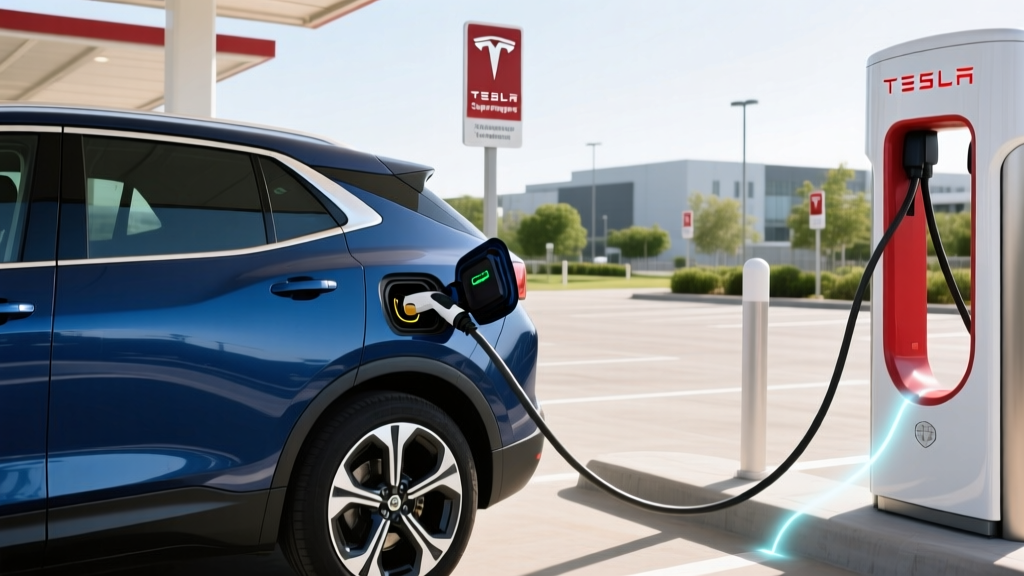
Starting with the 2025 model year, General Motors transitioned its entire EV lineup — including the Equinox EV — to the North American Charging Standard (NACS) connector. This is the same physical connector Tesla has used for over a decade. That means the 2026 Chevy Equinox EV arrives from the factory with a NACS port. No adapter is required to plug into a Tesla Supercharger V3 or V4 stall.
This is a significant practical advantage. The Tesla Supercharger network has over 25,000 stalls across North America, and it consistently ranks highest in reliability among DC fast-charging networks. Equinox EV owners can use the Tesla app or the built-in vehicle navigation to locate, navigate to, and initiate a Supercharger session — though payment and session initiation may require linking your GM vehicle to your Tesla account through the MyChevrolet app.
| Network / Charger Type | Connector | Adapter Required? |
|---|---|---|
| Tesla Supercharger (V3/V4) | NACS (native) | No |
| Tesla Destination Charger (Level 2) | NACS (native) | No |
| Electrify America, EVgo, ChargePoint DCFC | CCS1 | Yes — NACS-to-CCS1 adapter required |
| Public Level 2 (J1772 stations) | J1772 | Yes — NACS-to-J1772 adapter required |
| CHAdeMO stations (legacy) | CHAdeMO | Not practical — no common adapter |
Key takeaway: If you frequently use non-Tesla DC fast chargers (Electrify America, EVgo), you'll want to carry a NACS-to-CCS1 adapter (roughly $150–$250 from manufacturers like Lectron or A2Z). For public Level 2 stations with J1772 cables, a NACS-to-J1772 adapter ($100–$180) is essential. GM includes a dual-level portable charge cord with some trims, but verify what's in the box for your specific model year.
Charging Levels Explained: How Fast Will Each Add Range?
Understanding charging speed requires distinguishing between kW (kilowatts — the rate of power delivery, like water flow from a hose) and kWh (kilowatt-hours — the total energy stored in the battery, like the size of the tank). A higher kW charger fills your battery faster, but the battery's capacity in kWh determines how much energy it holds total.
The 2026 Equinox EV uses an 85 kWh usable battery pack (Ultium platform, NMC chemistry). Here's how each charging level performs:
| Level | Power Source | Max Power (kW) | Miles of Range Added per Hour | Typical Use Case |
|---|---|---|---|---|
| Level 1 | 120V household outlet | 1.2–1.4 kW | 3–5 mi/hr | Emergency / overnight trickle |
| Level 2 | 240V (home or public) | 11.5 kW (vehicle max) | 34–40 mi/hr | Daily home charging |
| DC Fast Charge | 400V public DCFC | 150 kW (peak) | ~200+ mi in 30 min (10–80%) | Road trips |
Real-world DC fast charging note: The Equinox EV peaks at approximately 150 kW on DC fast chargers. However, like all EVs, the charging curve tapers significantly above 80% state of charge (SoC) to protect battery health. Expect a 10–80% session to take roughly 25–30 minutes at a 150+ kW Supercharger V3 stall. Charging from 80–100% can add another 20–30 minutes, so plan to unplug at 80% during road trips for the best time efficiency.
On a 400V architecture (which the Equinox EV uses), you won't see the blistering 18-minute 10–80% times of 800V vehicles like the Hyundai Ioniq 5 or Kia EV6. The difference is roughly 5–10 extra minutes per session — noticeable but not prohibitive for most drivers.
Home Charging Setup: Electrical Requirements and Install Costs
For daily driving, Level 2 home charging is where the Equinox EV shines. The vehicle's onboard charger accepts up to 11.5 kW on Level 2, which translates to a full overnight replenishment for most daily commutes. Here's what your electrical system needs to support this:
- Circuit requirement: A dedicated 60-amp circuit (which delivers up to 48 amps continuous to the vehicle, per NEC 80% derating rule)
- Voltage: 240V single-phase (standard US residential split-phase)
- Wire gauge: 6 AWG copper (or 4 AWG aluminum) for a 60A circuit
- Connector: NACS (for a Tesla Wall Connector or equivalent NACS charger) or hardwired
If you opt for a 40-amp circuit (common in older homes or where panel capacity is limited), you'll get up to 32 amps continuous — roughly 7.7 kW or about 23–27 miles of range per hour. That's still sufficient for most overnight needs.
What Electrical Upgrades Might I Need?
Many homes built before 2000 have 100-amp or 150-amp main electrical panels. Adding a 60-amp EV circuit may push your panel close to its calculated load limit. A licensed electrician will perform a load calculation (per NEC Article 220) to determine if your panel can handle the additional draw. If not, a panel upgrade to 200 amps typically costs $1,500–$3,000 before the charger circuit is even installed.
Some utilities offer load-management devices (like the Span smart panel or a simple CT-clamp monitor) that let you add an EV circuit without a full panel upgrade by dynamically reducing charger amperage when other heavy loads are running. Ask your electrician about this option.
| Component | Typical Cost Range | Notes |
|---|---|---|
| Level 2 Charger (hardware) | $400–$700 | Tesla Wall Connector, ChargePoint Home Flex, Emporia Level 2 |
| Electrician labor (standard install) | $500–$1,500 | Assumes panel is nearby, short conduit run |
| Permit & inspection | $50–$250 | Varies by municipality |
| Electrical panel upgrade (if needed) | $1,500–$3,000 | 200A upgrade for older homes |
| Total (no panel upgrade) | $950–$2,450 | Most homes with 200A service |
| Total (with panel upgrade) | $2,450–$5,450 | Older homes with 100–150A panels |
Always hire a licensed electrician and pull a permit. Unpermitted EV charger installations can void homeowner's insurance claims and cause issues at resale. The NEC requires GFCI protection for outdoor receptacles, and many jurisdictions now require it for EV circuits specifically.
Recommended Home Chargers for the Equinox EV
Since the Equinox EV uses NACS natively, your best home charger options are NACS-equipped units. Here are three proven picks:
Tesla Wall Connector (Gen 4)
- Power output: Up to 11.5 kW (48A on a 60A circuit)
- Connector: NACS (native)
- Cable length: 24 feet
- Smart features: Wi-Fi, OTA updates, power sharing between multiple units, access control
- Price: ~$450
- Best for: Equinox EV owners who also use Superchargers — seamless ecosystem
ChargePoint Home Flex (NACS version)
- Power output: Up to 12 kW (50A on a 60A circuit, configurable down to 16A)
- Connector: NACS (available as of late 2024)
- Cable length: 23 feet
- Smart features: Wi-Fi, app scheduling, energy tracking, Alexa integration
- Price: ~$600
- Best for: Drivers who want flexible amperage settings and detailed energy data
Emporia Vue Level 2 Charger
- Power output: Up to 11.5 kW (48A)
- Connector: NACS (native option available)
- Cable length: 24 feet
- Smart features: Wi-Fi, solar integration, energy monitoring, time-of-use scheduling
- Price: ~$400
- Best for: Budget-conscious buyers and homes with solar panels
All three units are hardwired (preferred for 48A+ operation) or available with a NEMA 14-50 plug for 40A maximum. Hardwired installations are generally more reliable and avoid the common issue of 14-50 receptacle overheating — a concern that has prompted some fire departments and electricians to recommend hardwiring for continuous EV loads.
Charging Cost: Home vs. Supercharger vs. Gas
One of the strongest arguments for the Equinox EV is the per-mile fuel cost. Here's how charging scenarios compare in 2026, using the Equinox EV's efficiency rating of approximately 3.0 miles per kWh (roughly 112 MPGe combined, per fueleconomy.gov):
| Scenario | Rate | Cost per kWh | Cost per Mile |
|---|---|---|---|
| Home charging (off-peak utility rate) | $0.12/kWh | $0.12 | $0.04 |
| Home charging (national avg. residential) | $0.17/kWh | $0.17 | $0.057 |
| Tesla Supercharger (avg. 2026) | $0.30/kWh | $0.30 | $0.10 |
| Electrify America / EVgo (avg.) | $0.38/kWh | $0.38 | $0.127 |
| Gasoline SUV (28 MPG combined, $3.40/gal) | — | — | $0.121 |
At home on off-peak rates, the Equinox EV costs roughly 4 cents per mile — about one-third the cost of a comparable gasoline SUV like the Chevy Equinox gas model. Even at Supercharger prices ($0.30/kWh average), the EV is competitive with or cheaper than gasoline. The savings compound: a driver covering 12,000 miles per year saves $600–$1,000 annually by charging at home versus buying gas, according to DOE estimates.
Pro tip: Many utilities offer time-of-use (TOU) plans that drop rates to $0.08–$0.12/kWh between 10 PM and 6 AM. Set your Equinox EV's scheduled charging to start at midnight and you'll maximize savings. Check with your local utility for EV-specific rate plans — some offer flat $0.07–$0.10/kWh EV rates with a separate meter.
Using Tesla Superchargers with the Equinox EV: What to Expect
Since the Equinox EV has a native NACS port, the Supercharger experience is straightforward. Here's what a typical session looks like:
- Navigate: Use the Equinox EV's built-in navigation or the Tesla app to find a Supercharger station. The vehicle will precondition the battery automatically when a Supercharger is set as the destination — warming or cooling the pack to optimize charge speed.
- Arrive and plug in: Pull into any V3 (250 kW) or V4 stall. Plug the NACS cable directly into your Equinox EV's charge port. No adapter needed.
- Authenticate: Session initiation may happen automatically if you've linked your GM vehicle VIN to your Tesla account. Otherwise, use the Tesla app to start the session.
- Charge: Expect peak speeds of approximately 150 kW. A 10–80% session takes roughly 25–30 minutes. The vehicle's infotainment screen and the MyChevrolet app display real-time charge rate and estimated time to completion.
- Unplug and go: Billing is automatic. You'll receive a receipt via email or in the Tesla app.
Real-world range note: The Equinox EV 3LT's EPA range is 319 miles (FWD, 19-inch wheels). In real-world highway driving at 70 mph, expect approximately 250–275 miles before needing to charge. In cold weather (below 32°F), range can drop an additional 15–25%, so plan for roughly 200–220 miles of usable range in winter highway conditions. This is normal for all EVs and is why DC fast charging access — like the Supercharger network — matters for road trips.
Safety, Code, and Installation Best Practices
EV charging is a continuous high-amperage load — similar to running an electric oven for 8 hours straight. This makes proper installation non-negotiable:
- Dedicated circuit: Your Level 2 charger must be on its own dedicated circuit. Sharing a circuit with other appliances risks tripped breakers or overheating.
- Hardwire vs. receptacle: For circuits above 40 amps, hardwiring is strongly preferred. NEMA 14-50 receptacles installed for EV charging have been associated with overheating and melting in some cases, particularly when installed without a torque screwdriver or with back-stabbed connections. If using a 14-50, insist on a commercial-grade receptacle (Hubbell or Bryant) torqued to spec.
- GFCI protection: NEC 2020 and later require GFCI protection for outdoor EV receptacles. Some jurisdictions extend this to indoor installations. Hardwired chargers typically have built-in ground-fault protection, simplifying compliance.
- Outdoor rating: If your charger is mounted outdoors, ensure it carries a NEMA 4 or IP55+ rating for weather resistance. All three recommended chargers above are outdoor-rated.
- Wi-Fi connectivity: Smart chargers with Wi-Fi enable firmware updates, energy monitoring, and utility demand-response programs that can earn you rebates. Keep your charger within Wi-Fi range or use a Wi-Fi extender in the garage.
Frequently Asked Questions
How much does it cost to install a home EV charger for the Equinox EV?
A standard Level 2 home installation with a 60-amp circuit, hardwired charger, and short conduit run typically costs $950–$2,450 including equipment, electrician labor, and permit. If your home requires a 200-amp panel upgrade, add $1,500–$3,000. Always get 2–3 quotes from licensed electricians and confirm they have EV charger installation experience.
Do I need an adapter to charge my Equinox EV at non-Tesla chargers?
Yes, for CCS1 DC fast chargers (Electrify America, EVgo) you'll need a NACS-to-CCS1 adapter ($150–$250). For public Level 2 J1772 stations, you'll need a NACS-to-J1772 adapter ($100–$180). At Tesla Superchargers and Tesla Destination Chargers, no adapter is needed — plug directly in.
How fast will a Tesla Supercharger charge the Equinox EV?
The Equinox EV peaks at approximately 150 kW on DC fast chargers, including Tesla Superchargers. A 10–80% session takes roughly 25–30 minutes at a V3 (250 kW) Supercharger stall. Charging from 80–100% adds another 20–30 minutes due to the charge-curve taper, so plan to charge to 80% during road trips for optimal time efficiency.
How much does charging the Equinox EV cost per mile versus gas?
At home on average residential electricity rates ($0.17/kWh), the Equinox EV costs about $0.057 per mile. A comparable gas SUV at 28 MPG and $3.40/gallon costs about $0.121 per mile. Over 12,000 miles per year, that's a savings of roughly $770 annually by charging at home. Supercharger rates (~$0.30/kWh) bring the EV cost to about $0.10/mile — still cheaper than gas in most markets.
Can I charge my Equinox EV on a regular 120V outlet?
Yes, but slowly. Level 1 charging on a standard 120V/12A household outlet adds approximately 3–5 miles of range per hour (about 1.2–1.4 kW). A full charge from empty would take roughly 60–70 hours. Level 1 is suitable for emergency top-ups or very low-mileage daily drivers (under 30 miles per day), but a Level 2 home charger is strongly recommended for regular use.
What is the battery warranty on the 2026 Equinox EV?
GM covers the Equinox EV's Ultium battery pack with an 8-year/100,000-mile limited warranty, whichever comes first. The warranty guarantees the battery will retain at least 60% of its original capacity during the coverage period. In practice, NMC Ultium packs have shown degradation of roughly 5–8% over the first 100,000 miles based on early Bolt EV and Lyriq fleet data, well within the warranty threshold.
For the latest federal tax credit eligibility rules that may apply to your Equinox EV purchase, consult the IRS Clean Vehicle Credits page, as income caps, MSRP limits, and battery sourcing requirements are subject to change. For official EPA range and efficiency data, see fueleconomy.gov.