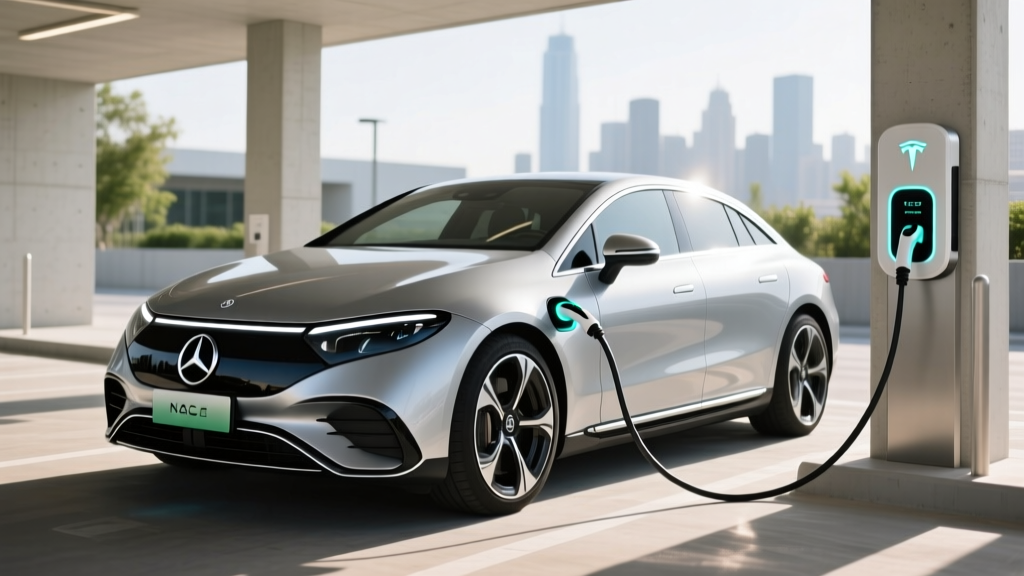
For years, Mercedes-Benz EV owners watched Tesla drivers pull into reliable Supercharger stalls while they navigated a patchwork of CCS1 networks. That era is ending. With the Mercedes-Benz NACS adapter now available across the EQ lineup, owners of the EQS, EQE, EQB, and newer models can tap into Tesla's 17,000+ Supercharger network across North America. But accessing those stalls is only part of the equation — understanding charge speeds, adapter logistics, and your home charging setup determines whether this transition actually saves you time and money.
This guide covers exactly how the Mercedes-Benz NACS adapter works, what charging speeds you can expect, what it costs versus gas, and how to set up a home Level 2 charger that complements your new Supercharger access.
Why Mercedes-Benz Adopted NACS and What It Means for Owners
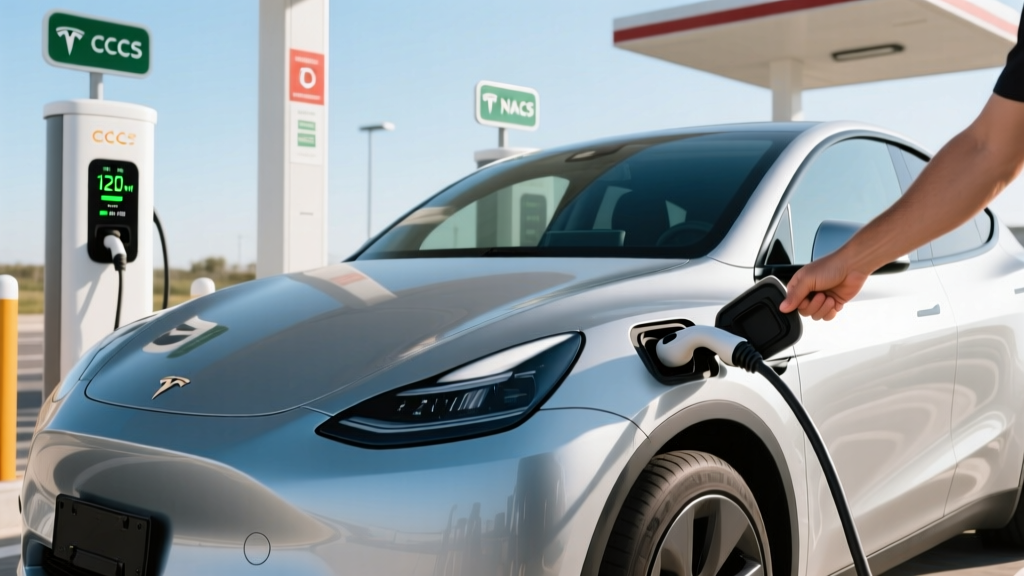
In 2024, Mercedes-Benz joined Ford, GM, Rivian, and a wave of other automakers in committing to the North American Charging Standard (NACS) — Tesla's proprietary connector, now opened as an industry standard. Starting with 2025 model-year vehicles, Mercedes began equipping new EVs with native NACS ports. For existing CCS1-equipped models (roughly 2022–2024 EQS, EQE, EQB, and EQA vehicles), the OEM offers an official Mercedes-Benz NACS adapter that converts the CCS1 port to accept NACS connectors.
The practical upshot: Mercedes-Benz EV owners can now charge at Tesla Supercharger V3 (250 kW) and V4 stalls using Plug & Charge functionality — no app fumbling, no RFID card. The vehicle communicates directly with the stall, billing routes through your Mercedes me Charge account.
Connector Compatibility for Mercedes-Benz EVs (2026)
| Model / Year | Native Port | Adapter Needed | Supercharger Access |
|---|---|---|---|
| 2025+ EQS Sedan/SUV | NACS | None | Direct plug-in |
| 2025+ EQE Sedan/SUV | NACS | None | Direct plug-in |
| 2025+ EQB | NACS | None | Direct plug-in |
| 2022–2024 EQS | CCS1 | Mercedes-Benz NACS Adapter | Via adapter |
| 2022–2024 EQE | CCS1 | Mercedes-Benz NACS Adapter | Via adapter |
| 2022–2024 EQB | CCS1 | Mercedes-Benz NACS Adapter | Via adapter |
If you own a 2022–2024 model, the OEM adapter typically retails between $200–$350 through Mercedes-Benz dealers or the Mercedes me portal. Third-party CCS-to-NACS adapters from brands like A2Z and Lectron are also entering the market, though Mercedes recommends the OEM unit for warranty and communication protocol integrity.
Charging Levels Explained: Speeds in kW and Miles Per Hour
Before we get into specific charge times for Mercedes-Benz battery packs, let's ground the fundamentals. EV charging happens at three tiers, and confusing kW (power, or the rate of energy flow) with kWh (energy, or the battery's total capacity) is the most common mistake new EV owners make. Think of kW as the width of the pipe and kWh as the size of the tank.
| Level | Voltage | Max Power (kW) | Miles of Range Added Per Hour | Best Use Case |
|---|---|---|---|---|
| Level 1 | 120V AC | 1.4–1.9 kW | 3–5 mi/hr | Overnight top-ups, PHEVs, emergencies |
| Level 2 | 240V AC | 7.2–19.2 kW | 20–60 mi/hr | Daily home and workplace charging |
| DC Fast (Level 3) | 400–800V DC | 50–350 kW | 150–800+ mi/hr | Road trips, rapid top-ups |
For a Mercedes-Benz EQS 450+ with its 108.4 kWh usable battery, Level 1 charging is functionally useless for full charges — you'd need over 60 hours from empty. Level 2 at 11.5 kW (the EQS's onboard charger max) adds roughly 30–35 miles per hour, meaning a full 10–100% charge takes about 10 hours — ideal for overnight. DC fast charging at a Tesla Supercharger V3 (250 kW peak) can take the EQS from 10–80% in approximately 31 minutes, though the charge curve tapers significantly above 80%.
Real-World Charging Times for Mercedes-Benz EQ Models
Peak kW ratings are marketing numbers. Sustained charge rates and the taper above 80% State of Charge (SoC) determine how long you actually sit at a stall. Here's what to expect for key models using a NACS-equipped Supercharger or Electrify America CCS station:
| Model | Battery (usable kWh) | Peak DC kW | 10–80% Time | 80–100% Time | EPA Range |
|---|---|---|---|---|---|
| 2026 EQS 450+ | 108.4 kWh (NMC) | 200 kW | ~31 min | ~35 min | 390 mi |
| 2026 EQS 450 4MATIC | 108.4 kWh (NMC) | 200 kW | ~31 min | ~35 min | 365 mi |
| 2026 EQE 350+ | 90.6 kWh (NMC) | 170 kW | ~32 min | ~30 min | 305 mi |
| 2026 EQE 350 4MATIC | 90.6 kWh (NMC) | 170 kW | ~32 min | ~30 min | 279 mi |
| 2026 EQB 300 4MATIC | 66.5 kWh (NMC) | 100 kW | ~32 min | ~25 min | 251 mi |
How Much Does Charging Cost Per Mile vs Gas?
One of the strongest arguments for going electric is fuel cost savings, but the gap varies dramatically depending on where and when you charge. Here's a breakdown using the 2026 EQS 450+ (EPA-rated at roughly 3.0 mi/kWh or 97 MPGe) compared to a similarly sized gas sedan averaging 25 MPG combined.
| Charging Scenario | Cost per kWh | Cost per Mile (EQS 450+) | Gas Equivalent (25 MPG @ $3.40/gal) | Savings per 1,000 Miles |
|---|---|---|---|---|
| Home off-peak (utility rate) | $0.09–$0.14 | $0.03–$0.047 | $0.136 | $89–$106 |
| Home standard rate | $0.16–$0.22 | $0.053–$0.073 | $0.136 | $63–$83 |
| Tesla Supercharger V3 | $0.28–$0.36 | $0.093–$0.12 | $0.136 | $16–$43 |
| Electrify America / EVgo | $0.35–$0.48 | $0.117–$0.16 | $0.136 | -$24 to +$19 |
The takeaway is clear: home charging delivers massive savings — often 70–80% less per mile than gas. Public DC fast charging narrows the gap considerably, and some networks at peak rates can actually exceed the cost of gas per mile. This is why a reliable home Level 2 setup is the financial backbone of EV ownership. The Mercedes-Benz NACS adapter expands your road-trip options enormously, but your daily economics depend on home charging.
Home Level 2 Charger Installation: Costs, Electrical Requirements, and Upgrades
Installing a dedicated Level 2 home charger is the single highest-impact upgrade you can make as a Mercedes-Benz EV owner. Here's exactly what's involved.
Electrical Requirements
A Level 2 charger requires a 240V circuit — the same voltage as your electric dryer or oven. For a Mercedes-Benz EQS or EQE with an 11.5 kW onboard charger, you'll want a 60-amp dedicated circuit to deliver up to 48 amps continuous (NEC code requires circuits rated at 125% of continuous load). This gives you the full 11.5 kW charge rate, adding roughly 30–35 miles of range per hour.
If your EQB has a 7.2 kW onboard charger, a 40-amp circuit (32 amps continuous) is sufficient. Smaller circuits are cheaper to install but limit future-proofing if you upgrade to a larger EV later.
Panel Upgrade Reality
Many homes built before 2000 have 100-amp or 150-amp main service panels. Adding a 60-amp EV circuit may push total load beyond safe capacity, especially if you already run electric heat, a dryer, and an oven. A licensed electrician will perform a load calculation per NEC Article 220. If your panel is maxed out, a service upgrade to 200 amps typically costs $2,000–$4,500 — a significant but one-time investment that also increases your home's resale value.
Home Charger Installation Cost Breakdown (2026)
| Component | Low-End | Typical | High-End |
|---|---|---|---|
| Level 2 charger equipment (hardwired, 48A) | $400 | $600 | $800 |
| Electrician labor (60A circuit run, <50 ft) | $500 | $900 | $1,500 |
| Permit and inspection | $50 | $150 | $350 |
| Panel upgrade (if needed, 200A service) | $2,000 | $3,000 | $4,500 |
| Total (no panel upgrade) | $950 | $1,650 | $2,650 |
| Total (with panel upgrade) | $2,950 | $4,650 | $7,150 |
Safety and Code Considerations
Every Level 2 installation must meet National Electrical Code (NEC) requirements, which your licensed electrician will handle. Key items to verify:
- Dedicated circuit: Your EV charger must have its own breaker — never share a circuit with other large appliances.
- GFCI protection: NEC 2020 and later require GFCI (Ground Fault Circuit Interrupter) for outdoor receptacles. Hardwired chargers may be exempt in some jurisdictions, but built-in GFCI in the charger itself adds a layer of safety.
- Outdoor rating: If your charger is mounted outside or in an unsealed garage, it must carry a NEMA 4 or IP65 rating to withstand rain, dust, and temperature extremes.
- Cable management: A 25-foot cable is standard; ensure it doesn't create a trip hazard. Wall-mount cable holsters or retractable reels keep things tidy.
- WiFi connectivity: Smart chargers let you schedule off-peak charging, monitor kWh usage, and receive firmware updates — essential for utility time-of-use rate optimization.
Recommended Level 2 Chargers for Mercedes-Benz EVs
Not all Level 2 chargers are equal. Here are three top picks for Mercedes-Benz owners in 2026, each selected for compatibility, reliability, and smart features.
ChargePoint Home Flex (NACS or J1772)
- Power: Up to 11.5 kW (48A) on a 60A circuit; adjustable down to 16A
- Connector: Available in NACS (native) or J1772 (use J1772-to-NACS adapter for older EQ models)
- Cable length: 23 feet
- Smart features: WiFi, Alexa integration, scheduled charging, energy dashboard, UL-listed
- Price: ~$550–$650
- Why it's great for Mercedes: Matches the EQS/EQE 11.5 kW onboard charger perfectly; flexible amperage means you can install it on a 40A circuit now and upgrade later.
Wallbox Pulsar Plus (J1772/NACS)
- Power: Up to 11.5 kW (48A) on a 60A circuit
- Connector: J1772 (NACS version shipping 2025+)
- Cable length: 25 feet
- Smart features: WiFi + Bluetooth, Power Sharing (two chargers on one circuit), compact design, NEMA 4X outdoor rated
- Price: ~$450–$550
- Why it's great for Mercedes: One of the smallest wall units available; Power Sharing is ideal for two-EV households with a single 60A circuit.
Tesla Wall Connector (NACS)
- Power: Up to 11.5 kW (48A) on a 60A circuit
- Connector: NACS native
- Cable length: 24 feet
- Smart features: WiFi, firmware OTA updates, access control, load sharing between units
- Price: ~$420–$475
- Why it's great for Mercedes: If you have a 2025+ NACS-native Mercedes, this is the simplest plug-and-charge home solution. For CCS1 models, you'd need a NACS-to-CCS adapter at home (less common) or use a J1772 charger instead.
For 2022–2024 CCS1-equipped Mercedes models, the ChargePoint Home Flex in J1772 configuration is the most practical choice — J1772 is the universal Level 2 standard, and your car's CCS1 port accepts J1772 natively for AC charging (the CCS1 port is J1772 with two extra DC pins below). When you arrive at a Supercharger, you use your Mercedes-Benz NACS adapter for DC fast charging.
Using the Mercedes-Benz NACS Adapter at Tesla Superchargers: What to Expect
Here's a step-by-step of the real-world experience using the adapter at a Supercharger V3 stall:
- Navigate to a Supercharger via your Mercedes-Benz MBUX navigation. The system will automatically begin battery preconditioning — warming or cooling the pack to optimal charge temperature. This is critical: arriving at a DC fast charger without preconditioning can reduce peak charge rates by 30–50%, especially in cold weather.
- Plug in the adapter to your vehicle's CCS1 port first, then connect the Supercharger's NACS cable to the adapter. The connection is secure but adds roughly 4 inches of length to the port area.
- Charging initiates automatically via Plug & Charge (if your Mercedes me Charge account is linked). Billing is handled seamlessly — no app required.
- Monitor the charge curve. The EQS will peak near 200 kW between 10–40% SoC, then taper to ~100 kW by 60%, and ~50 kW above 80%. Plan your stop around the 10–80% window — the 80–100% top-off takes nearly as long as the 10–80% charge.
- Store the adapter in the included carrying case in your frunk or cargo area. The OEM adapter weighs roughly 2.5 lbs and measures about 10 inches long.
One practical limitation: some older Supercharger V2 stalls (150 kW max) have shorter cables that may not reach the CCS1 port on certain Mercedes models when parked in reverse. V3 and V4 stalls generally have sufficient cable length. Tesla's Supercharger map identifies stall types at each location.
Frequently Asked Questions
How much does it cost to install a home EV charger for my Mercedes-Benz?
A typical Level 2 installation with a 60-amp circuit, hardwired charger, and permit runs $1,200–$2,500 if your electrical panel has sufficient capacity. If you need a panel upgrade from 100A or 150A to 200A service, add $2,000–$4,500. Always get a load calculation from a licensed electrician before committing.
How fast will each charging level add range to my EQS or EQE?
Level 1 (120V) adds 3–5 miles per hour — impractical for large packs. Level 2 (240V at 11.5 kW) adds roughly 30–35 miles per hour for the EQS and 25–30 for the EQE. DC fast charging at a Tesla Supercharger V3 adds 150–200+ miles in 15–20 minutes, depending on SoC and battery temperature.
Which connector and charger is compatible with my Mercedes-Benz EV?
2025+ models have native NACS ports and can use Tesla Superchargers directly. 2022–2024 models use CCS1 and require the Mercedes-Benz NACS adapter for Supercharger access. For Level 2 home charging, all models accept J1772 (the AC portion of CCS1), so any J1772 or NACS home charger works — NACS-native chargers require a NACS-to-J1772 adapter for older models.
How much does charging cost per mile compared to gas?
Home off-peak charging costs $0.03–$0.05 per mile in an EQS 450+, versus $0.14 per mile for a comparable gas sedan at $3.40/gallon and 25 MPG. That's a 65–80% savings. Public DC fast charging narrows the gap to 10–30% savings, and some premium-rate networks can exceed gas costs per mile.
What electrical upgrades might I need for a Level 2 charger?
The most common upgrade is a panel service increase from 100A or 150A to 200A, needed if your existing panel can't support an additional 60A continuous load. Older homes may also need wiring upgrades (aluminum to copper), a new sub-panel if the charger is far from the main panel (detached garage), or a smart load-management device that throttles charger amperage when other appliances are running — avoiding a full panel upgrade.
Is the Mercedes-Benz NACS adapter covered under warranty?
The OEM Mercedes-Benz NACS adapter carries a standard 2-year accessory warranty when purchased through an authorized dealer. Using third-party adapters may not void your vehicle warranty, but any charging-system damage traced to a non-OEM adapter may not be covered. Check with your dealer for specifics.
Can I still use Electrify America and other CCS networks with the adapter?
The Mercedes-Benz NACS adapter is a one-way adapter: CCS1 port → NACS plug. It does not convert NACS vehicles to CCS. If you have a 2025+ NACS-native Mercedes, you'll need a separate NACS-to-CCS adapter (sold by Mercedes and third parties) to use Electrify America, EVgo, or other CCS-only networks. Tesla's network has the broadest coverage, but keeping a CCS adapter as backup is wise for redundancy.
The Mercedes-Benz NACS adapter represents a meaningful quality-of-life upgrade for EQ owners — Tesla's Supercharger network consistently ranks highest for reliability and uptime in J.D. Power EV charging studies. Pair it with a properly installed home Level 2 charger, and you've built a charging ecosystem that covers daily commuting at pennies per mile and road trips with minimal downtime. The adapter itself is a small investment; the home electrical infrastructure behind it is where the real planning pays off.