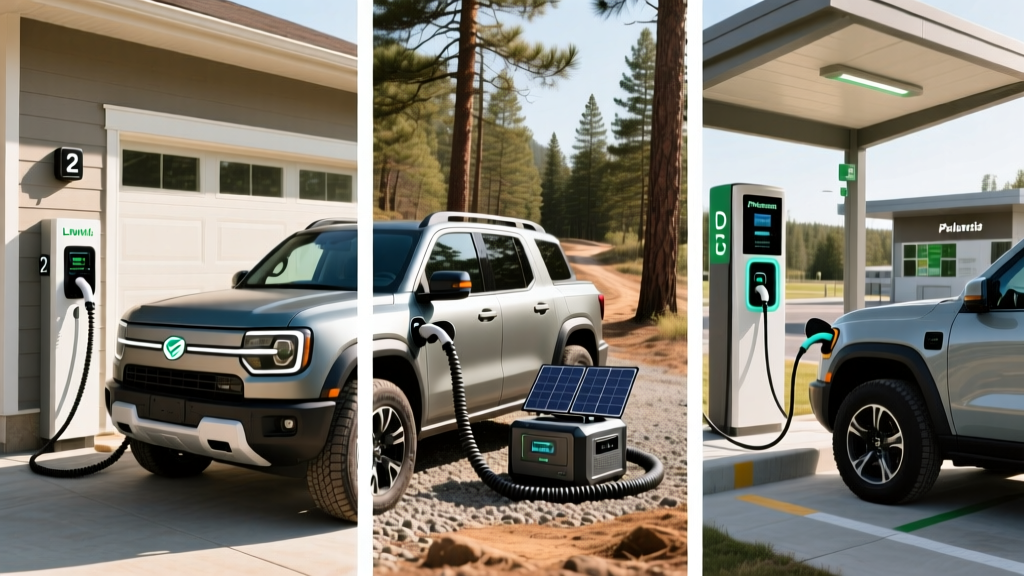
Most EV owners fixate on battery size and range, but the single biggest predictor of daily charging satisfaction is where the charger lives and how intelligently you plan around charging geography. Location intelligence for EV charging is the practice of using spatial data — electrical panel proximity, utility rate zones, public charger density, traffic patterns, and even sun exposure for solar-tied systems — to minimize cost, maximize convenience, and eliminate range anxiety before it starts.
After installing Level 2 chargers in four different homes and road-tripping over 40,000 electric miles, I've learned that a $600 charger in the wrong spot costs you more in wasted time and electrical upgrades than a $1,200 unit placed with precision. This guide shows you how to apply location intelligence at three scales: your garage wall, your neighborhood, and the open highway.
The Three Charging Levels: Speed, Power, and Real-World Range Gains
Before you pick a location, you need to know what you're installing. EV charging is measured in kW (kilowatts), which is the rate of power delivery — think of it as the width of a pipe. The battery itself is measured in kWh (kilowatt-hours), which is the total energy stored — the size of the tank. Never confuse the two.
| Level | Voltage | Power (kW) | Miles Added/Hour | Typical Use Case |
|---|---|---|---|---|
| Level 1 | 120V | 1.0–1.4 kW | 3–5 mi/hr | Overnight top-ups, PHEVs, low-mileage drivers |
| Level 2 | 240V | 7.2–19.2 kW | 22–75 mi/hr | Home daily charging, workplace, hotels |
| DC Fast (Level 3) | 400–800V DC | 50–350 kW | 150–1,200 mi/hr (peak) | Road trips, highway corridors, fleet depots |
Real-world charging time examples (10% to 80% SoC):
- 77 kWh battery (Hyundai Ioniq 5 / Kia EV6 class): ~18 minutes at a 240 kW DCFC; ~7.5 hours on a 9.6 kW Level 2.
- 84 kWh battery (Tesla Model Y Long Range class): ~22 minutes at a 250 kW Supercharger; ~8.5 hours on a 9.6 kW Level 2.
- 100 kWh battery (Ford F-150 Lightning Extended Range): ~35 minutes at a 150 kW DCFC; ~10 hours on a 9.6 kW Level 2.
Note that DC fast charging follows a charge curve: peak kW is sustained only up to roughly 40–55% SoC, after which the rate tapers to protect the battery. That's why 10–80% time is the industry-standard metric — charging from 80–100% can take as long as 10–80%.
Applying Location Intelligence to Home Charger Placement
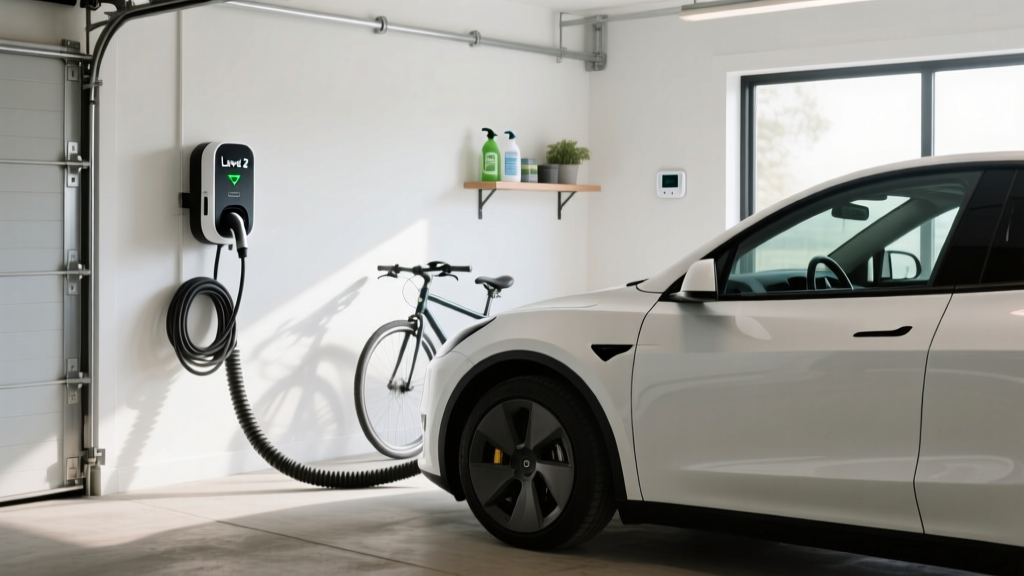
The cheapest, fastest home install is one where the charger mounts on the wall directly behind the electrical panel. Every additional foot of conduit run between the panel and the charger adds $8–$15 in materials and labor. Location intelligence starts with a simple audit:
- Map your panel. Identify the main service panel's amperage (100A, 150A, 200A) and available breaker slots. A 48A Level 2 charger requires a dedicated 60A circuit (NEC 80% continuous-load rule).
- Measure the run. Distance from panel to desired charger location, including any wall penetrations, attic crawls, or trenching for detached garages.
- Assess parking geometry. Where does the charge port sit on your EV? A driver-side port (Tesla, most Hyundai/Kia) wants the charger on the left wall as you pull in; a passenger-side port (some Ford, GM) wants it on the right.
- Check Wi-Fi signal. Smart chargers need 2.4 GHz coverage for scheduling, load management, and OTA firmware updates. A weak signal means a $30 Wi-Fi extender or a hardwired Ethernet run.
- Solar and TOU alignment. If you have rooftop solar, place the charger on the same electrical leg as the solar inverter to minimize conversion losses. Pair with your utility's time-of-use (TOU) rate plan to charge at off-peak rates.
Home Installation Costs: The Full Breakdown
The question every buyer asks: How much does it cost to install a home EV charger? The honest answer spans a wide range, and location intelligence is what pushes you toward the lower end.
| Item | Simple Install (panel adjacent) | Complex Install (long run or upgrade) |
|---|---|---|
| Level 2 Charger (hardware) | $400–$700 | $500–$1,200 |
| Electrician labor (licensed) | $400–$800 | $1,200–$3,500 |
| Permit & inspection | $50–$200 | $100–$400 |
| Panel upgrade (100A → 200A) | $0 (not needed) | $1,500–$4,000 |
| Conduit/wire (per foot over 10 ft) | $0–$50 | $200–$800 |
| Total | $850–$1,750 | $3,500–$9,900 |
Panel upgrade gotcha: Homes built before 1990 often have 100A service. Adding a 60A EV circuit on a 100A panel may exceed the panel's bus-bar rating (the NEC 120% rule). A licensed electrician will perform a load calculation; if your panel can't handle it, a service upgrade to 200A is mandatory. Budget $2,000–$4,000 and 2–4 weeks for utility coordination.
Federal incentive: The IRS Residential Clean Energy Credit (IRC §25C) covers 30% of home charging equipment and installation costs, up to $1,000 per year. Confirm eligibility with a tax professional — rules are subject to change and vary by tax year.
Connector Compatibility: NACS, CCS, and CHAdeMO in 2026
The connector landscape has consolidated dramatically. Here's where things stand for the 2026 model year:
| Connector | Brands Using It (2026) | Public Network Support | Adapter Needed? |
|---|---|---|---|
| NACS (Tesla / SAE J3400) | Tesla, Ford, GM, Rivian, Hyundai, Kia, Volvo, Polestar, Nissan (new models) | Tesla Supercharger, Electrify America (new stalls), ChargePoint | No for new EVs; CCS-to-NACS adapters available for legacy CCS vehicles |
| CCS1 (Combined Charging System) | Legacy models: VW ID.4 (pre-2025), BMW i4/iX (pre-2025), some older Ford/GM | Electrify America, EVgo, ChargePoint | NACS-to-CCS adapter needed for Tesla Superchargers (~$200–$250) |
| CHAdeMO | Nissan Leaf (legacy), Mitsubishi Outlander PHEV (older) | Limited; being phased out at most networks | No direct adapter to NACS; CHAdeMO infrastructure declining |
Location-intelligence takeaway: Before buying a home charger, confirm your EV's native connector. For 2026 purchases, NACS is the dominant standard. If you own a CCS-vehicle and plan to use Tesla Superchargers, budget for a Tesla-approved adapter and verify your vehicle's firmware supports Supercharger handshaking.
The True Cost to Charge: Home vs. Public vs. Gas
Electricity pricing varies enormously by location, time of day, and charging speed. Here's a realistic cost-per-mile analysis using a 3.5 mi/kWh efficiency average (typical for a midsize crossover EV):
| Scenario | Rate ($/kWh) | Cost per Mile | Annual Cost (12,000 mi) |
|---|---|---|---|
| Home off-peak (TOU plan) | $0.08–$0.12 | $0.023–$0.034 | $275–$410 |
| Home standard rate | $0.14–$0.18 | $0.040–$0.051 | $480–$615 |
| Public Level 2 (network) | $0.25–$0.49 | $0.071–$0.140 | $855–$1,680 |
| DC Fast Charging (public) | $0.35–$0.65 | $0.100–$0.186 | $1,200–$2,230 |
| Gasoline (28 MPG avg, $3.40/gal) | — | $0.121 | $1,455 |
Key insight: Home off-peak charging delivers fuel costs 70–80% below gasoline. But if you rely exclusively on DC fast charging, your per-mile cost can exceed gasoline. Location intelligence means structuring your routine so that 85–95% of charging happens at home or workplace Level 2, reserving DCFC for road trips.
Check your utility's EV-specific TOU rate — many utilities (PG&E, SCE, ConEd, Xcel) offer plans with super-off-peak rates of $0.05–$0.09/kWh between midnight and 6 AM. According to fueleconomy.gov, EVs convert over 77% of electrical energy to motion, compared to 12–30% for gasoline vehicles.
Equipment Picks: 2026 Home Chargers Worth Installing
These are the units I'd recommend based on build quality, smart features, connector flexibility, and real-world reliability data:
ChargePoint Home Flex (NACS or CCS)
- Power output: Up to 19.2 kW (80A circuit) or configurable down to 16A
- Connector: NACS (native) or CCS1; 25-foot cable
- Smart features: Wi-Fi, app scheduling, Alexa/Google integration, load sharing with second unit, energy dashboard
- Price: $550–$700 (hardware)
- Best for: Homes with 200A panels wanting maximum charge speed; dual-EV households using load-sharing mode
WallConnector (Tesla, 3rd Gen)
- Power output: Up to 11.5 kW (48A / 60A circuit) on NACS; also available with J3400 (NACS) connector
- Connector: NACS native; J1772 adapter included for non-Tesla EVs
- Smart features: Wi-Fi, OTA updates, Tesla app integration, Powerwall integration for solar homes, load sharing
- Price: $425–$475
- Best for: Tesla owners; solar + Powerwall homes; budget-conscious installs
Emporia Vue Level 2 Charger
- Power output: Up to 11.5 kW (48A) or 19.2 kW (80A) depending on model
- Connector: J1772 (NACS adapter available); 24-foot cable
- Smart features: Whole-home energy monitoring integration, solar-aware scheduling, TOU optimization, app control
- Price: $350–$500
- Best for: Solar homes wanting deep energy analytics; budget pick with excellent smart features
Hardwired vs. plug-in: Chargers rated above 40A (9.6 kW+) typically require hardwiring to a junction box — a NEMA 14-50 outlet maxes at 50A (40A continuous). If you want portability (taking the charger when you move), stick with a 32A or 40A unit on a NEMA 14-50 receptacle and have the electrician install a GFCI breaker per NEC 2023 code.
Safety, Code, and the Location Details That Matter
EV chargers draw sustained high current for hours — more like an electric furnace than a phone charger. Proper installation isn't optional:
- Dedicated circuit: NEC Article 625 requires a dedicated breaker for EVSE. No sharing with dryers, HVAC, or outlets.
- GFCI protection: Required for receptacle-based (plug-in) installations; hardwired units often exempt per local code, but many inspectors now require it universally.
- Outdoor rating: If mounting outside, the charger must be NEMA 4 rated (rain/sleet resistant). Look for UL or ETL listing — never buy an uncertified unit from overseas marketplaces.
- Cable management: A 25-foot cable on a driveway creates trip hazards and wear. Wall-mounted retractors ($30–$60) extend cable life and keep your installation clean.
- Ventilation: Indoor garage installs don't require ventilation for Level 2 (unlike lead-acid battery charging), but ensure the charger isn't mounted near a gas water heater's air intake.
Always pull a permit. Unpermitted EV charger installs can void homeowner's insurance claims and complicate future home sales. Most jurisdictions process EV permits in 1–5 business days, and inspection typically takes 20 minutes.
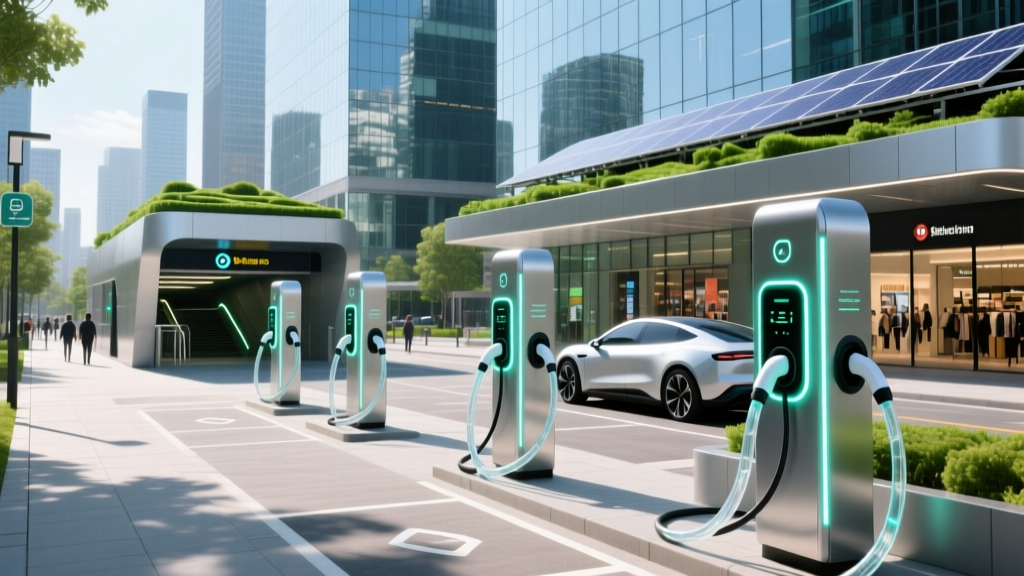
Public Charging Location Intelligence: Route Planning That Works
Home charging solves 90% of your needs. The remaining 10% — road trips — is where public-charging location intelligence pays dividends:
- Precondition your battery. When you navigate to a DCFC in your EV's built-in nav (Tesla, Hyundai, Ford), the car warms the battery to ~95°F for optimal charge acceptance. Arriving without preconditioning can cut peak charge rate by 30–50% in cold weather.
- Target chargers at amenities. The best DCFC locations pair with restrooms, food, and Wi-Fi. Apps like PlugShare and A Better Routeplanner (ABRP) let you filter by stall count, max kW, and user reliability scores.
- Avoid single-stall locations. A location with one 150 kW stall is a single point of failure. Prefer sites with 4+ stalls and mixed power levels (150 kW + 350 kW).
- Plan around the charge curve. It's faster to charge from 10–60% at two stops than from 10–90% at one. The taper above 80% adds disproportionate time for minimal range gain.
- Check NHTSA and network apps for outage reports before departing. Electrify America and EVgo publish real-time stall status in their apps.
Frequently Asked Questions
How much does it cost to install a home EV charger?
A straightforward install (panel-adjacent, 200A service, no upgrade) runs $850–$1,750 including hardware, electrician labor, and permit. A complex install requiring a panel upgrade, long conduit run, or trenching can reach $3,500–$9,900. The IRS §25C credit covers 30% up to $1,000 of the cost.
How fast will each charging level add range?
Level 1 (120V): 3–5 miles per hour. Level 2 (240V, 9.6 kW): ~30 miles per hour. DC Fast Charging (150 kW+): 150–1,200 miles per hour at peak, tapering significantly above 80% SoC.
Which connector is compatible with my EV?
For 2026 models, NACS (J3400) is the dominant standard across Tesla, Ford, GM, Hyundai, Kia, Rivian, and others. Legacy CCS1 vehicles can use a NACS-to-CCS adapter (~$200–$250) for Tesla Supercharger access. CHAdeMO is being phased out; adapters to NACS are not widely available.
How much does charging cost per mile vs. gas?
Home off-peak charging costs $0.023–$0.034 per mile — roughly 75% less than gasoline at $3.40/gal and 28 MPG ($0.121/mi). Public DC fast charging at $0.48/kWh averages $0.137/mi, slightly above gasoline. The economic case for EVs depends on maximizing home charging.
What electrical upgrades might I need?
If your home has a 100A service panel, you'll likely need a 200A upgrade ($1,500–$4,000) to support a 48A EV charger. Homes with 150A or 200A panels typically need only a new 60A breaker and conduit run. An electrician's load calculation determines the exact requirement.
Do I need a smart charger, or will a basic unit work?
A basic (dumb) charger works fine for charging, but a smart charger ($50–$150 more) enables TOU scheduling, energy monitoring, load sharing for two-EV homes, and OTA firmware updates that can unlock higher amperage or new features. The ROI is clear if your utility offers time-of-use rates.