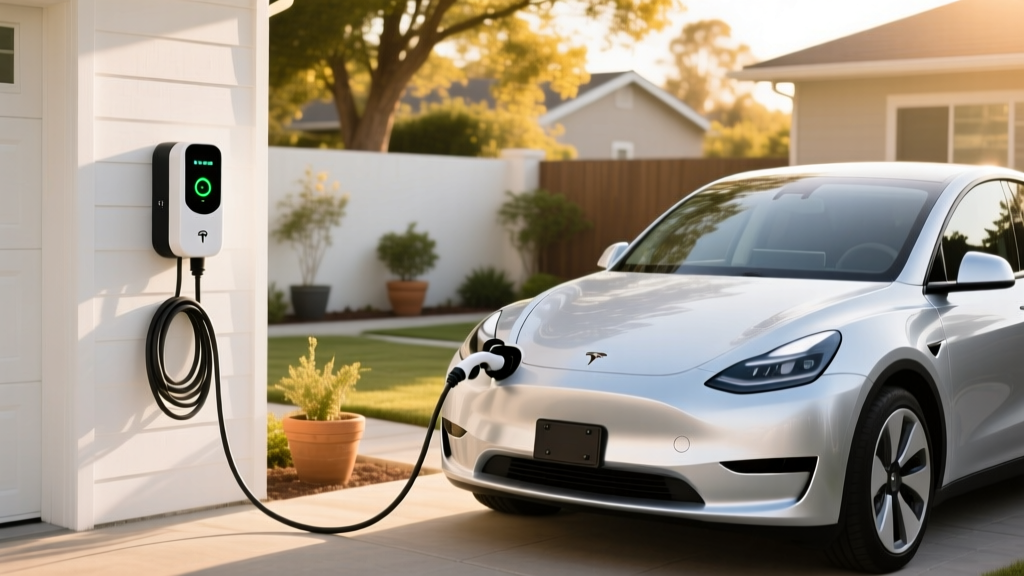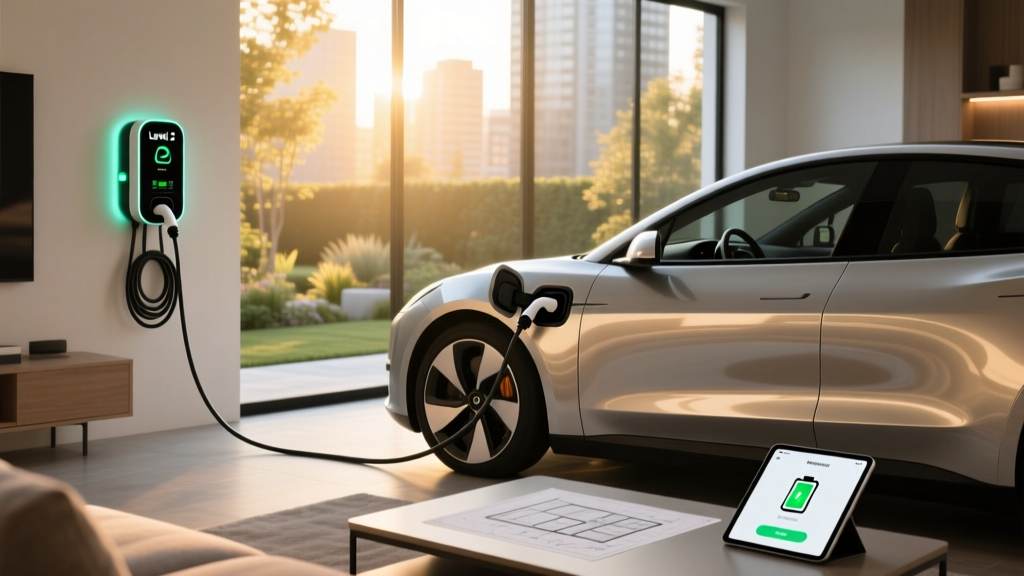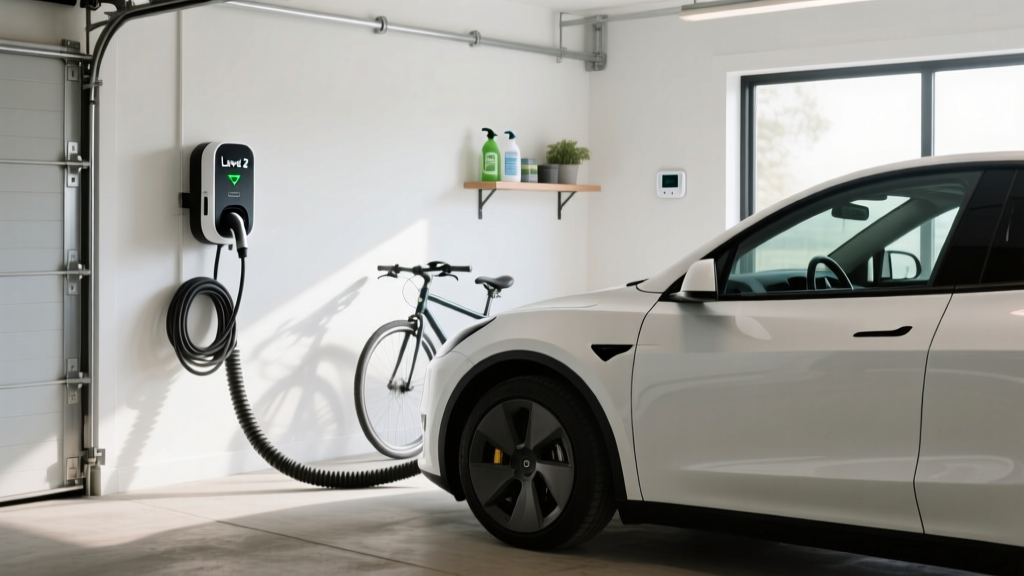
Setting up electric car charging at home is the single most impactful upgrade you can make as an EV owner. Over 80% of EV charging happens at home, and getting the hardware, electrical circuit, and rate plan right determines whether you wake up to a full battery every morning or scramble for public chargers. This guide covers the exact speeds, costs, equipment, and electrical requirements you need to plan a home charging setup in 2026 — with real numbers, not marketing fluff.
Charging Levels Explained: Speeds, Power, and Range Added
EV charging falls into three tiers, defined by power delivery in kilowatts (kW). Remember: kW measures power (the rate of energy flow), while kWh measures energy (the total capacity of your battery). A 10 kW charger delivers 10 kWh of energy in one hour under ideal conditions. Here is how each level performs in practice:
| Level | Voltage | Power (kW) | Miles of Range per Hour | Typical Use Case |
|---|---|---|---|---|
| Level 1 | 120V (standard outlet) | 1.0–1.4 kW | 3–5 miles | Overnight top-up; PHEVs; low-mileage drivers |
| Level 2 | 240V (dryer-style outlet or hardwired) | 3.3–19.2 kW | 12–75 miles | Primary home charging; daily full replenishment |
| DC Fast Charging | 400V–800V+ (public stations) | 50–350 kW | 150–1,000+ miles (peak) | Road trips; rapid top-ups; not for daily use |
Real-world note: Those miles-per-hour figures assume a vehicle efficiency of roughly 3–4 miles per kWh. A heavy electric truck like the Ford F-150 Lightning (averaging ~2 mi/kWh) will gain fewer miles per hour than a Hyundai Ioniq 6 (averaging ~4 mi/kWh) on the same charger.
How Much Does It Cost to Install a Home EV Charger?
The total cost of installing a Level 2 home charger depends on three variables: the charger unit, the electrical work, and local permitting. If your electrical panel has spare capacity and is close to your garage, costs stay low. If you need a panel upgrade, costs climb significantly.
| Cost Component | Simple Install (Panel Nearby, Spare Capacity) | Complex Install (Long Run, Panel Upgrade Needed) |
|---|---|---|
| Level 2 Charger Unit (240V, 32A–48A) | $350–$650 | $350–$650 |
| Electrician Labor | $300–$800 | $1,000–$3,000 |
| Electrical Panel Upgrade (100A → 200A) | $0 (not needed) | $1,500–$4,000 |
| Permit & Inspection Fees | $50–$200 | $50–$300 |
| Total Estimated Cost | $700–$1,650 | $2,900–$7,950 |
Panel upgrade reality: Homes built before 2000 often have 100-amp or 150-amp service. Adding a 40-amp dedicated EV circuit may require upgrading to 200 amps. This is not optional — the National Electrical Code (NEC) requires that a continuous load like an EV charger use no more than 80% of a circuit's rated capacity. A 48A charger requires a 60A circuit. Always have a licensed electrician perform a load calculation before purchasing equipment.
Federal incentive: Under IRS Form 8911, the Alternative Fuel Vehicle Refueling Property Credit covers 30% of home charging equipment and installation costs, up to $1,000. Eligibility depends on your census tract meeting specific low-income or non-urban criteria. Check the latest IRS guidance, as qualifying-tract maps have been updated for 2026.
Electrical Requirements: What Your Home Needs
Before ordering a charger, understand the circuit you will need:
- Level 1 (120V): Uses a standard 15A or 20A household outlet. No electrical work needed, but charging is slow — roughly 4 miles of range per hour. Adequate only if you drive under 30 miles daily or own a PHEV with a small battery (10–18 kWh).
- Level 2 (240V, plug-in): Uses a NEMA 14-50 outlet (the same as an electric dryer or range). Requires a dedicated 50A circuit for a 40A charger (80% rule). The outlet must be on a circuit with no other major loads.
- Level 2 (240V, hardwired): Wired directly into your panel with no plug. Supports up to 48A–80A continuous draw on a 60A–100A circuit. Hardwired installs avoid the GFCI breaker requirement that the NEC now mandates for 240V receptacles in garages — saving $50–$150 on a specialty breaker and reducing nuisance trips.
Safety essentials:
- The circuit must be dedicated — no sharing with HVAC, water heaters, or dryers.
- Outdoor installs require a NEMA 4-rated (weatherproof) enclosure and outdoor-rated cable.
- Your electrician should pull a permit and schedule an inspection. Unpermitted work can void home insurance claims and create fire risk.
- For NEMA 14-50 outlets, use a commercial-grade receptacle (Hubbell, Bryant) — inexpensive residential-grade outlets have shown overheating issues under continuous EV-charging loads.
Connector Compatibility: NACS, CCS1, and CHAdeMO
The connector on your EV determines which home charger you buy. As of 2026, the North American market has largely converged on NACS (the Tesla-designed connector, now an SAE standard), but millions of CCS1-equipped vehicles remain on the road.
| Connector | Brands Using It (2026 Models) | Home Charger Availability |
|---|---|---|
| NACS (SAE J3400) | Tesla (all), Ford, GM, Rivian, Hyundai, Kia, BMW, Mercedes, Volvo, Polestar, and most others transitioning in 2025–2026 | Tesla Wall Connector, ChargePoint Home Flex (NACS), Emporia J1772 + adapter |
| CCS1 | Older-model Volkswagen ID.4, Ford Mustang Mach-E (pre-2025), Hyundai Ioniq 5 (pre-2025), Kia EV6 (pre-2025), BMW i4 (pre-2025) | ChargePoint Home Flex, Emporia Vue, JuiceBox, Grizzl-E |
| CHAdeMO | Nissan Leaf (legacy, discontinued after 2025 model year) | Very limited home options; most home chargers use J1772/NACS. Use a CHAdeMO adapter or replace charger. |
| J1772 | All non-Tesla EVs for Level 1/2 (pre-2025); adapters available for NACS vehicles | Universal standard for Level 2 home chargers; widely available |
Adapter strategy: If you drive a CCS1 vehicle but want to future-proof for NACS, or vice versa, several options exist. Tesla sells a J1772-to-NACS adapter (~$250) for charging NACS vehicles on J1772 chargers. Lectron and A2Z make CCS-to-NACS adapters. For home Level 2 charging, the simplest path is buying a charger that matches your vehicle's native port.
Best Home EV Chargers for 2026: Equipment Picks
Here are three proven Level 2 chargers, selected for reliability, features, and value. Each is available in NACS or J1772 configurations.
ChargePoint Home Flex (NACS or J1772)
- Power output: Up to 12 kW (50A on a 60A circuit) — configurable down to 16A for weaker panels
- Cable length: 23 feet
- Smart features: Wi-Fi, scheduling, Alexa/Google integration, energy tracking, utility demand-response programs
- Price: ~$549 (NACS), ~$499 (J1772)
- Best for: Most buyers; flexible amperage accommodates older panels
Tesla Wall Connector (NACS)
- Power output: Up to 11.5 kW (48A on a 60A circuit)
- Cable length: 24 feet
- Smart features: Wi-Fi, over-the-air updates, power-sharing between two units on one circuit, access control
- Price: ~$425
- Best for: Tesla owners and NACS-adopting brands; best price-to-power ratio
Emporia Level 2 Smart Charger (J1772)
- Power output: Up to 11.5 kW (48A on a 60A circuit)
- Cable length: 24 feet
- Smart features: Wi-Fi, solar-integration with Emporia Vue energy monitor, time-of-use scheduling, load management
- Price: ~$399
- Best for: Budget-conscious buyers; solar-home integration
Charging time examples (Level 2, 48A / 11.5 kW):
- Chevrolet Equinox EV (85 kWh battery): 10%–80% in approximately 5 hours 30 minutes
- Hyundai Ioniq 5 (84 kWh battery): 10%–80% in approximately 5 hours 15 minutes
- Tesla Model Y Long Range (75 kWh battery): 10%–80% in approximately 4 hours 30 minutes
- Toyota RAV4 Prime PHEV (18.1 kWh battery): 0%–100% in approximately 1 hour 40 minutes (at 32A / 7.7 kW onboard charger limit)
For overnight charging, even a 32A / 7.7 kW setup replenishes 200+ miles in 8 hours — more than sufficient for nearly all daily driving.
How Much Does Charging Cost Per Mile vs. Gas?
Electricity pricing varies widely by region and rate plan, but the math almost always favors home charging over gasoline. Here is a realistic comparison using a midsize electric SUV averaging 3 miles per kWh (33 kWh per 100 miles) versus a gas SUV averaging 26 MPG combined.
| Scenario | Cost per kWh | Cost per 100 Miles | Cost per Mile |
|---|---|---|---|
| Home — Off-Peak Rate (Time-of-Use plan) | $0.08–$0.12 | $2.64–$3.96 | $0.03–$0.04 |
| Home — Standard Residential Rate (national avg.) | $0.17 | $5.61 | $0.056 |
| Public Level 2 (ChargePoint, EVgo) | $0.25–$0.49 | $8.25–$16.17 | $0.08–$0.16 |
| DC Fast Charging (Electrify America, Tesla Supercharger) | $0.35–$0.58 | $11.55–$19.14 | $0.12–$0.19 |
| Gasoline (26 MPG, $3.40/gal national avg.) | — | $13.08 | $0.13 |
The takeaway: Home off-peak charging delivers fuel at roughly one-quarter the cost of gasoline. Even at standard residential rates, you save about 57% per mile. Public DC fast charging narrows the advantage — it costs roughly the same as gasoline per mile — which is why home charging is the economic backbone of EV ownership.
To maximize savings, enroll in your utility's time-of-use (TOU) rate plan and schedule charging between 11 PM and 6 AM when rates are lowest. Most smart chargers and EVs support scheduled charging natively.
Public Charging: When You Cannot Charge at Home
For apartment dwellers, renters, or high-mileage drivers, public charging supplements or replaces home charging. Key networks in 2026:
- Tesla Supercharger network: Now open to NACS-equipped Ford, GM, Rivian, Hyundai, and other brands via the Tesla app. Speeds: 150–250 kW. Pricing: ~$0.28–$0.36/kWh. According to fueleconomy.gov, Tesla Superchargers maintain some of the highest uptime rates in the industry.
- Electrify America: CCS1 and NACS connectors at newer stations. Speeds: 50–350 kW. Pricing: ~$0.38–$0.52/kWh. Reliability has improved but remains inconsistent at older sites.
- ChargePoint / EVgo: Extensive Level 2 and DC fast networks. Pricing varies by location; expect $0.25–$0.49/kWh.
Real-world DC fast charging caveat: Advertised peak speeds (e.g., 250 kW) apply only at low states of charge and optimal battery temperature. Expect the charge curve to taper significantly above 80% SoC. A "10%–80% in 18 minutes" claim rarely extends linearly to 100% — the final 20% can take as long as the first 70%.
Frequently Asked Questions
Can I charge my EV with a regular 120V outlet?
Yes, but slowly. Level 1 charging on a standard 120V outlet delivers roughly 1.2 kW, adding 3–5 miles of range per hour. For a 75 kWh battery, a full charge from empty takes 60+ hours. Level 1 is practical only for PHEVs with small batteries or BEV owners who drive fewer than 30 miles per day and can charge overnight (10–12 hours).
Do I need a permit to install a Level 2 charger?
In most jurisdictions, yes. A licensed electrician must pull an electrical permit and the work must pass inspection. Skipping the permit risks code violations, insurance claim denials, and potential fire liability. Permit fees typically run $50–$200.
Will a home charger work with any EV I buy in the future?
Not necessarily. If you buy a J1772-based charger today but your next EV uses NACS, you will need an adapter (or a new charger). As of 2026, most new EVs from major manufacturers are adopting NACS. If you are buying a charger now and plan to keep it 5+ years, consider a NACS-native unit or a dual-standard option.
How much does it cost to install a home EV charger?
A straightforward Level 2 install with an existing 240V circuit or nearby panel with spare capacity typically costs $700–$1,650 total (equipment + electrician + permit). A complex install requiring a panel upgrade, long conduit runs, or trenching can cost $2,900–$7,950. Always get two to three quotes from licensed electricians.
What electrical upgrades might I need?
The most common upgrade is a service panel increase from 100A or 150A to 200A, costing $1,500–$4,000. You may also need a new 240V circuit run (if the garage is far from the panel), a GFCI breaker (required for plug-in 240V receptacles under current NEC), or a sub-panel. Your electrician will perform a load calculation to determine what is required.
Is it safe to charge an EV in a garage overnight?
Yes. EV chargers are designed for continuous unattended operation and include thermal protection, ground-fault detection, and overcurrent protection. Ensure the charger is UL-listed (or ETL-listed), the circuit is dedicated, and the installation has been inspected. Never use extension cords or plug adapters with a Level 2 charger.
Can my solar panels power my EV charger?
Directly in real time — rarely, since most EV charging happens at night. But a solar-plus-battery system (like Tesla Powerwall) can store daytime solar generation for overnight EV charging. Smart chargers from Emporia and ChargePoint can integrate with solar inverters to optimize charging when solar production is high, reducing grid dependence.
Home charging transforms EV ownership from a logistics challenge into a convenience advantage. With a properly installed Level 2 charger on a dedicated 240V circuit, you refuel at one-quarter the cost of gasoline, add 200+ miles of range overnight, and eliminate most public-charging dependency. The upfront investment — typically $700–$1,650 for a standard install — pays back within 1–3 years through fuel savings alone. Get a load calculation from a licensed electrician, choose a UL-listed charger matched to your EV's connector, and enroll in your utility's off-peak rate plan to maximize the economics.