Shell has quietly built one of the most recognizable names in public EV charging, and its Shell Recharge network now spans thousands of DC fast chargers across North America and Europe. But for most EV owners, the real question isn't just where to charge on a road trip — it's whether a Shell-branded home charger makes sense for the garage, what installation actually costs, and how the per-mile economics compare to filling up with gas. This guide breaks down Shell Recharge EV charger hardware, public network pricing, home installation requirements, and the real numbers behind every charging level.
Shell Recharge at a Glance: Home Hardware and Public Network
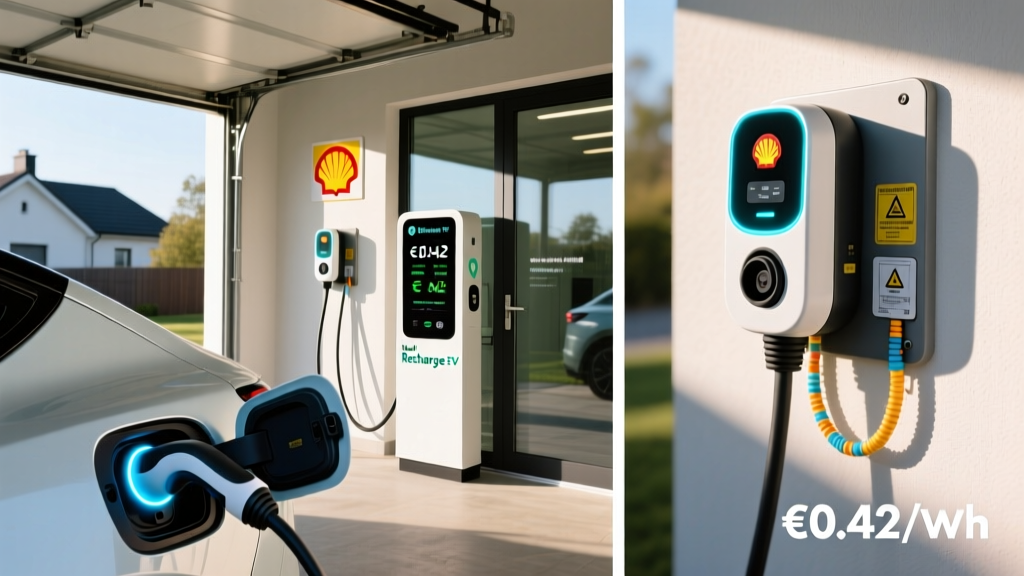
Shell's EV charging footprint operates on two fronts. The Shell Recharge public network consists primarily of DC fast charging stations (50 kW to 350 kW) located at Shell gas stations, shopping centers, and highway corridors. In the U.S., Shell has partnered with providers like EVgo and has deployed its own branded ultra-fast chargers capable of 175 kW and 350 kW output. The Shell Recharge home charger lineup includes WiFi-enabled Level 2 wall-box units designed for residential 240V installation — competing directly with ChargePoint Home Flex, Emporia Vue, and the Tesla Wall Connector.
Shell also acquired Greenlots (now integrated into Shell Recharge Solutions), which provides the commercial and fleet charging management platform behind many of its public deployments. For the home buyer, the relevant product is the Shell Recharge home Level 2 charger — a smart, connected wallbox typically rated at up to 11.5 kW (48 amps on a 60-amp circuit) or a lower-output 7.4 kW variant for homes with limited electrical capacity.
Charging Levels Explained: kW Speeds and Miles Per Hour
Before evaluating any specific charger, you need to understand the three charging tiers and how they translate to actual range recovery. The critical distinction: kW (kilowatts) measures power — the rate at which energy flows into your battery. kWh (kilowatt-hours) measures energy — the total capacity of your battery. Think of kW as the width of a hose and kWh as the size of the bucket.
| Level | Voltage | Max Power (kW) | Miles of Range Per Hour | Typical Use Case |
|---|---|---|---|---|
| Level 1 | 120V AC | 1.4–1.9 kW | 3–5 mi/hr | Overnight trickle; PHEVs or emergencies |
| Level 2 (Home) | 240V AC | 3.3–19.2 kW | 12–75 mi/hr | Daily home and workplace charging |
| DC Fast Charge | 400–800V DC | 50–350 kW | 150–1,000+ mi/hr (peak) | Road trips and rapid top-ups |
For context, a typical EV with a 75 kWh battery and 300 miles of EPA range consumes roughly 25 kWh per 100 miles. A Level 2 charger delivering 11.5 kW will add approximately 46 miles of range per hour — enough to fully replenish most daily driving in a few hours of overnight charging. DC fast charging is measured differently: a 150 kW charger can take that same vehicle from 10% to 80% state of charge in roughly 25–30 minutes, though the charge curve tapers significantly above 80% to protect battery health.
Shell Recharge Home Charger: Specs, Features, and Equipment Options
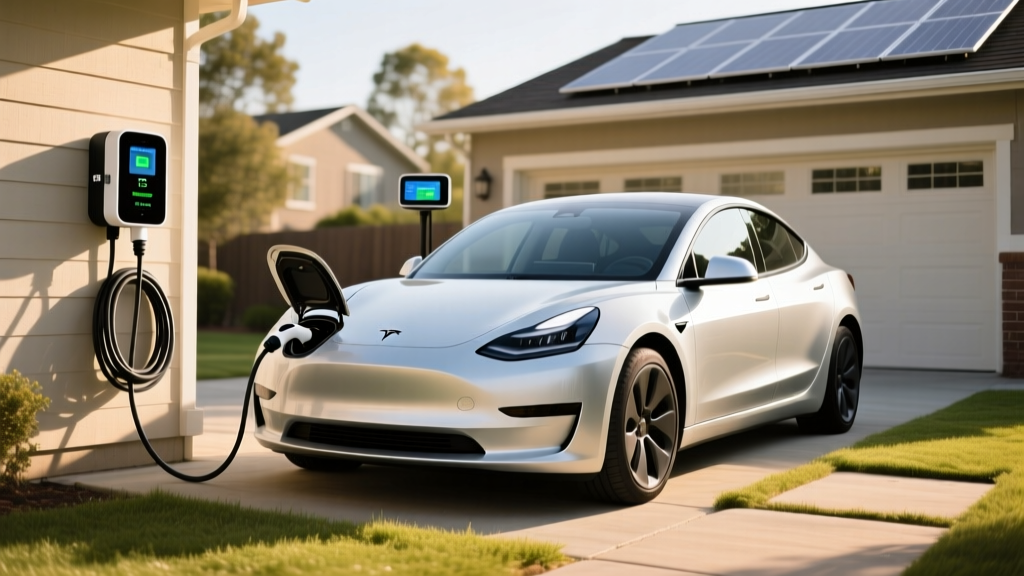
Shell's residential Level 2 charger is a smart, WiFi-connected wallbox designed for indoor or outdoor installation. Here's how it compares to the leading home chargers on the market in 2026:
Shell Recharge Home Charger
- Max Output: 11.5 kW (48A) / 7.4 kW (32A) variants
- Connector: J1772 (NACS adapter available for Tesla-ported vehicles)
- Cable Length: 20 ft (standard), 25 ft option
- Smart Features: Shell Recharge app scheduling, energy monitoring, solar integration, OTA updates
- Outdoor Rating: NEMA 4 (weatherproof)
- Price: ~$549–$649 (hardware only)
ChargePoint Home Flex
- Max Output: 12 kW (50A)
- Connector: J1772 (NACS adapter sold separately)
- Cable Length: 23 ft
- Smart Features: ChargePoint app, Alexa, flexible amperage dial
- Outdoor Rating: NEMA 4
- Price: ~$599–$699
Tesla Wall Connector
- Max Output: 11.5 kW (48A)
- Connector: NACS native (J1772 adapter available)
- Cable Length: 24 ft
- Smart Features: Tesla app, power sharing between units, OTA updates
- Outdoor Rating: NEMA 3R (limited weather resistance)
- Price: ~$475
The Shell Recharge home charger holds its own on output and smart features, particularly if you value integration with the Shell Recharge app ecosystem for tracking both home and public charging sessions in one place. The NACS transition is important: as of 2025, most new EVs from Ford, GM, Rivian, Hyundai, Kia, and others have adopted the North American Charging Standard (NACS) connector. If your EV has a NACS port, you'll need a J1772-to-NACS adapter for the Shell charger unless Shell ships a NACS-native variant by the time you purchase.
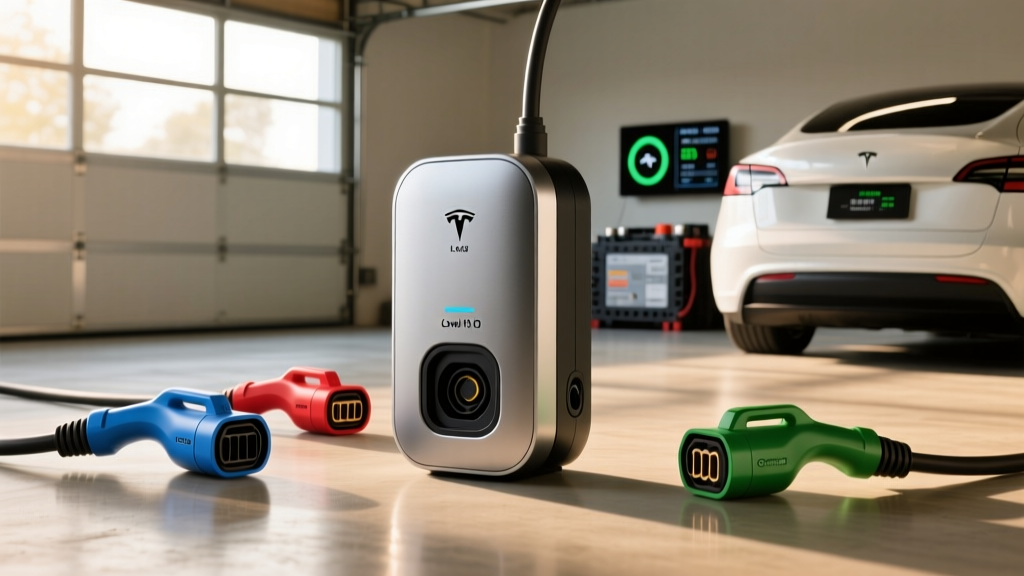
Connector Compatibility: NACS, CCS1, and CHAdeMO
The connector landscape has shifted dramatically. Here's what you need to know for both home and public Shell Recharge stations:
| Connector | Type | Compatible Brands | Adapter Needed? |
|---|---|---|---|
| NACS (Tesla) | AC + DC | Tesla, Ford, GM, Rivian, Hyundai, Kia, Volvo, Polestar (2025+ models) | J1772→NACS for non-Tesla home chargers |
| CCS1 | AC + DC | VW, BMW, older Ford/GM/Hyundai/Kia models (pre-2025) | NACS→CCS1 for Tesla Superchargers |
| CHAdeMO | DC only | Nissan Leaf, Mitsubishi Outlander PHEV (legacy) | Limited availability; no home adapter |
| J1772 | AC only (L1/L2) | All EVs (universal for Level 1/2 AC charging) | NACS vehicles need J1772→NACS adapter |
For public Shell Recharge DC fast stations, most U.S. locations now offer both CCS1 and NACS cables, reflecting the industry-wide transition. CHAdeMO connectors are increasingly rare at new installations. Before relying on any public station, check the Shell Recharge app or PlugShare for the specific connector types available at your destination.
Home Installation: Electrical Requirements, Panel Upgrades, and Costs
The hardware price is only part of the equation. Installing a Level 2 home charger typically requires a dedicated 240V circuit — the same voltage your electric dryer or oven uses. Here's what determines your total cost:
Electrical Requirements
An 11.5 kW (48-amp) charger requires a 60-amp dedicated circuit on a 240V supply (the National Electrical Code requires circuits rated at 125% of the continuous load: 48A × 1.25 = 60A). A 7.4 kW (32-amp) charger needs a 40-amp circuit. Your home's main electrical panel must have sufficient spare capacity — typically 200 amps total for modern homes — to accommodate this new load.
Panel Upgrade Reality
Homes built before the 1990s often have 100-amp or 150-amp panels that are already near capacity. Adding a 60-amp EV circuit may require a panel upgrade to 200 amps, which is a significant additional cost. Signs you may need an upgrade: frequent breaker trips, a panel with no open slots, or an existing 100-amp service. A licensed electrician will perform a load calculation before recommending whether an upgrade is necessary.
| Component | Low Estimate | High Estimate | Notes |
|---|---|---|---|
| Charger Hardware (Level 2, 11.5 kW) | $475 | $699 | Shell Recharge, ChargePoint, Tesla, Emporia |
| Electrician Labor (simple install) | $500 | $1,200 | Short run from panel, same wall or garage |
| Electrician Labor (complex install) | $1,200 | $3,000 | Long conduit run, trenching, attic crawl |
| Permit & Inspection | $50 | $300 | Varies by municipality; required by NEC |
| Electrical Panel Upgrade (if needed) | $1,500 | $4,000 | 100A→200A service upgrade by licensed electrician |
| Total (no panel upgrade) | $1,025 | $5,199 | Most homes fall in $1,200–$2,500 range |
| Total (with panel upgrade) | $2,525 | $9,199 | Older homes with 100A panels |
Safety and Code Requirements
Per the National Electrical Code (NEC Article 625), your installation must include:
- Dedicated circuit: The EV charger cannot share a breaker with other appliances
- GFCI protection: Required for outdoor installations and recommended for garages (NEC 2023+ requires GFCI on all EV receptacles)
- NEMA 4 rating: For any outdoor-mounted charger to withstand rain, dust, and temperature extremes
- Proper wire gauge: 6 AWG copper for a 60-amp circuit; 8 AWG for a 40-amp circuit
- Local permit and inspection: Skipping this risks insurance denial in the event of an electrical fire
Always hire a licensed electrician. The National Fire Protection Association (NFPA) maintains the NEC standards governing EV charger installation, and your local jurisdiction will enforce the latest adopted version.
Charging Cost Per Mile: Home vs. Public vs. Gas
This is where EV ownership economics crystallize. The cost to charge depends on electricity rates, which vary enormously by state, time of day, and whether you're at home or on a public network.
| Scenario | Rate ($/kWh) | Cost to Add 100 Miles* | Cost Per Mile |
|---|---|---|---|
| Home (off-peak, avg U.S.) | $0.12–$0.16 | $3.00–$4.00 | $0.03–$0.04 |
| Home (peak, avg U.S.) | $0.20–$0.30 | $5.00–$7.50 | $0.05–$0.075 |
| Shell Recharge DC Fast (public) | $0.35–$0.55 | $8.75–$13.75 | $0.087–$0.14 |
| Gasoline vehicle (30 MPG, $3.40/gal) | — | $11.33 | $0.113 |
| Gasoline vehicle (25 MPG, $3.40/gal) | — | $13.60 | $0.136 |
*Based on an EV efficiency of 25 kWh per 100 miles (approximately 120 MPGe combined), typical of vehicles like the Hyundai Ioniq 5, Tesla Model Y, and Ford Mustang Mach-E. Per fueleconomy.gov, efficiency varies by model from 24–35 kWh/100mi.
The takeaway is clear: home charging at off-peak rates delivers the lowest per-mile cost of any fueling option — typically one-third to one-quarter the cost of gasoline. Public DC fast charging at Shell Recharge stations is more expensive and can approach or even exceed gas costs in high-price states like California, but it remains a convenience option for road trips rather than a daily fueling strategy.
Shell Recharge Public Network Pricing
Shell Recharge DC fast stations typically charge between $0.35 and $0.55 per kWh in the U.S., with some locations offering lower rates during off-peak hours or through subscription plans. Pricing is displayed in the Shell Recharge app before you initiate a session. Many Shell stations also offer 50 kW chargers at slightly lower rates than the 175–350 kW ultra-fast units.
Charging Time Examples: 10% to 80% by Battery Size
Charging time depends on battery capacity, the vehicle's maximum charge acceptance rate, and the charger's output. Most EVs taper charge speed significantly above 80% state of charge to protect the battery — which is why road-trip charging typically targets 10–80% rather than a full charge.
| Vehicle (Battery Size) | Level 2 Home (11.5 kW) | DC Fast 150 kW | DC Fast 350 kW (if vehicle supports) |
|---|---|---|---|
| Chevy Equinox EV (85 kWh) | ~5.5 hours | ~28 min | ~22 min (150 kW max acceptance) |
| Hyundai Ioniq 5 (84 kWh) | ~5.2 hours | ~25 min | ~18 min (800V architecture) |
| Tesla Model Y (75 kWh) | ~4.6 hours | ~24 min | N/A (250 kW max acceptance) |
| Ford F-150 Lightning (131 kWh ext.) | ~8 hours | ~42 min | ~35 min (limited acceptance) |
Important caveats: these times assume optimal battery temperature (preconditioning engaged) and a charger capable of sustaining its rated output. In cold weather, charge acceptance drops significantly until the battery warms — always precondition your battery via the vehicle's app before arriving at a DC fast charger. Real-world sustained power is typically 60–80% of the peak kW rating across the full 10–80% session due to the charge curve taper.
Federal Tax Credit for Home Charger Installation
The IRS Alternative Fuel Vehicle Refueling Property Credit (IRC §30C) offers a credit of up to 30% of the cost of home EV charger hardware and installation, capped at $1,000. Key eligibility requirements for 2026:
- The charger must be installed at your primary residence in the United States
- The property must be located in an eligible census tract (designated low-income or non-urban areas — check the IRS census tract tool)
- The credit covers both equipment and labor costs
- This is a non-refundable credit — it reduces your tax liability but won't generate a refund beyond what you owe
Always consult a tax professional to confirm eligibility based on your specific situation and current-year IRS guidance.
Frequently Asked Questions
How much does it cost to install a home EV charger?
For a Shell Recharge or comparable Level 2 home charger, expect $1,025–$5,200 total (hardware + electrician + permit) if your electrical panel has adequate capacity. If a panel upgrade from 100A to 200A is needed, add $1,500–$4,000. Most modern homes with 200A service and an accessible garage panel fall in the $1,200–$2,500 range. Always get at least two quotes from licensed electricians.
How fast will each charging level add range?
Level 1 (120V) adds 3–5 miles per hour — adequate only for plug-in hybrids with small batteries or emergency trickle charging. Level 2 (240V, 11.5 kW) adds roughly 40–46 miles per hour, fully replenishing most EVs overnight. DC fast charging (150–350 kW) adds 150–1,000+ miles per hour at peak, with a typical 10–80% session taking 18–42 minutes depending on battery size and vehicle architecture.
Which connector and charger is compatible with my EV?
For Level 2 home charging, all EVs use the J1772 standard — except Tesla and 2025+ NACS-equipped vehicles from Ford, GM, Hyundai, Kia, and others, which require a J1772-to-NACS adapter (or a NACS-native charger like the Tesla Wall Connector). For public DC fast charging, verify whether your vehicle has a CCS1 or NACS port and check the Shell Recharge app for connector availability at your destination station.
How much does charging cost per mile compared to gas?
Home charging at off-peak rates costs roughly $0.03–$0.04 per mile — about one-third the cost of gasoline at $3.40/gallon in a 30 MPG vehicle ($0.11/mile). Public Shell Recharge DC fast charging at $0.35–$0.55/kWh costs $0.09–$0.14 per mile, which is comparable to or slightly above gas. The economic advantage of EVs is maximized by charging at home, not at public fast chargers.
What electrical upgrades might I need for a home charger?
The most common upgrade is a panel capacity increase from 100A to 200A service, costing $1,500–$4,000. You may also need a new breaker slot (your panel must have open positions), upgraded service wiring from the utility, or a sub-panel if the charger is far from the main panel (detached garage, for example). A licensed electrician's load calculation will determine what's required before any work begins.