Why Level 2 Charging Speed Is the Metric That Actually Matters
If you own or are shopping for an electric vehicle, Level 2 charging speed is the single most practical number to understand. Unlike DC fast charging (which you'll use on road trips a handful of times a year) or Level 1 trickle charging (which adds roughly 3–5 miles per hour and is best reserved for plug-in hybrids with small batteries), a Level 2 home charger is where 80–90% of all EV charging happens. It's the difference between waking up to a full battery every morning and making inconvenient detours to public stations.
But "Level 2" covers a wide range of actual speeds. A 16-amp Level 2 circuit delivers about 3.8 kW of power, while a 48-amp circuit pushes 11.5 kW — roughly three times the speed. The right setup depends on your EV's onboard charger capacity, your home's electrical panel, and how many miles you drive daily. This guide breaks down every number you need: charging speeds in kW and miles per hour, realistic installation costs with panel-upgrade scenarios, connector compatibility across 2026 models, and what you'll actually pay per mile compared to gasoline.
Charging Levels Compared: kW, Miles Per Hour, and Real-World Timing
Before we get into equipment and installation, let's establish what each charging level actually delivers. The critical distinction: kW (kilowatts) measures power — how fast energy flows into your battery. kWh (kilowatt-hours) measures energy — the total capacity of your battery. Think of kW as the width of a hose and kWh as the size of the bucket.
| Charging Level | Voltage / Amperage | Power (kW) | Miles of Range Per Hour | Typical 10–80% Time (75 kWh Battery) |
|---|---|---|---|---|
| Level 1 (standard outlet) | 120V / 12A | 1.4 kW | 3–5 mi/hr | ~38 hours |
| Level 2 (16A) | 240V / 16A | 3.8 kW | 11–14 mi/hr | ~14 hours |
| Level 2 (32A) | 240V / 32A | 7.7 kW | 23–28 mi/hr | ~7 hours |
| Level 2 (40A) | 240V / 40A | 9.6 kW | 29–35 mi/hr | ~5.5 hours |
| Level 2 (48A) | 240V / 48A | 11.5 kW | 34–42 mi/hr | ~4.5 hours |
| DC Fast Charge (Level 3) | 400–800V DC | 50–350 kW | 150–1,000+ mi/hr | 18–45 minutes |
Note: Miles-per-hour figures assume an average EV efficiency of 3.0–3.5 miles per kWh (typical for a mid-size crossover like the Hyundai Ioniq 5 or Tesla Model Y). Larger, heavier vehicles like the Ford F-150 Lightning will see lower miles-per-hour figures at the same kW rate.
Home Installation: Electrical Requirements, Panel Upgrades, and Total Cost
The sticker price of a Level 2 charger ($300–$700 for quality smart units) is only part of the equation. Installation costs vary enormously based on your home's electrical infrastructure. Here's what determines the final bill:
Core Electrical Requirements
A Level 2 charger requires a dedicated 240-volt circuit — the same type of outlet your electric dryer or oven uses. The National Electrical Code (NEC) requires that continuous loads (like EV charging, which runs for hours) use only 80% of a circuit's rated capacity. This means:
- 40-amp circuit → supports up to 32A continuous charging (7.7 kW)
- 50-amp circuit → supports up to 40A continuous charging (9.6 kW)
- 60-amp circuit → supports up to 48A continuous charging (11.5 kW)
Do You Need a Panel Upgrade?
This is the cost variable that catches many homeowners off guard. Most homes built after 2000 have a 200-amp main electrical panel, which can usually accommodate a 50- or 60-amp EV circuit without issue. However, older homes with 100-amp or 150-amp panels may need a panel upgrade to 200 amps before adding a high-amperage EV charger — especially if you already have electric heating, an electric water heater, and an electric dryer competing for capacity.
An electrician will perform a load calculation to determine whether your existing panel can handle the additional draw. If an upgrade is needed, expect to add $1,500–$3,500 to your total project cost.
| Cost Component | Simple Install (Panel Has Capacity) | Complex Install (Long Wire Run or Subpanel) | Panel Upgrade Required |
|---|---|---|---|
| Level 2 Charger (hardware) | $350–$650 | $350–$650 | $350–$650 |
| Electrician labor (2–4 hrs typical) | $300–$600 | $600–$1,200 | $400–$800 |
| Materials (wire, conduit, breaker) | $100–$250 | $250–$600 | $150–$300 |
| Permit fee | $50–$150 | $50–$200 | $100–$250 |
| Panel upgrade (if needed) | — | — | $1,500–$3,500 |
| Total Estimated Cost | $800–$1,650 | $1,250–$2,650 | $2,500–$5,500 |
According to the U.S. Department of Energy, most homeowners spend between $1,000 and $2,500 for a complete Level 2 installation when no panel upgrade is required. Always get at least two quotes from licensed electricians and confirm they pull a local permit — unpermitted work can void home insurance claims and create fire-risk liability.
Federal Tax Credit for Home Charging Equipment
The IRS Alternative Fuel Vehicle Refueling Property Credit (IRC §30C) covers 30% of the cost of home EV charging equipment and installation, up to $1,000. This applies to both the charger hardware and electrician labor. Eligibility depends on your census tract meeting certain income or access criteria — check the latest IRS guidance or consult a tax professional to confirm qualification.
Connector Compatibility: NACS, CCS, and CHAdeMO in 2026
The connector landscape has shifted dramatically. Following Ford, GM, Rivian, Volvo, and most major automakers adopting the North American Charging Standard (NACS) for their vehicles starting in 2025, NACS is now the dominant connector for new EVs sold in North America. Here's where things stand for the 2026 model year:
| Connector | Brands Using It (2026) | Notes |
|---|---|---|
| NACS (Tesla-style) | Tesla, Ford, GM (Chevrolet/Cadillac/GMC), Rivian, Volvo, Polestar, Mercedes-Benz, BMW, Hyundai/Kia (select 2026 models), Honda (2026+), Nissan (Ariana refresh) | Now the SAE J3400 standard. Compact, no CCS locking mechanism. |
| CCS1 (Combo) | Hyundai/Kia (carryover 2024–2025 models), Stellantis (Jeep/Chrysler), VW ID.4 (2025 and earlier), legacy EVs | Still supported by Electrify America and most public DC networks. Adapters available. |
| CHAdeMO | Nissan Leaf (legacy/discontinued), Mitsubishi Outlander PHEV (older model years) | Effectively discontinued for new vehicles. Network support declining. |
For home Level 2 charging: All Level 2 chargers use a J1772 connector for non-Tesla vehicles or a NACS connector for Tesla and the growing NACS-native fleet. If your 2026 EV has a NACS port but you already own a J1772 Level 2 charger, a J1772-to-NACS adapter ($100–$200) solves the problem. If you're buying a new charger, match the connector to your vehicle's port to avoid adapter clutter.
Charging Cost Per Mile: Home Electricity vs. Gasoline
One of the strongest economic arguments for EVs is the fuel-cost advantage — but only if you're charging at home on a Level 2 circuit at residential electricity rates. Public DC fast charging has closed the gap significantly in many markets.
| Scenario | Rate | Cost Per Mile (at 3.2 mi/kWh) | Annual Fuel Cost (12,000 mi/yr) |
|---|---|---|---|
| Home Level 2 (national avg. electricity) | $0.17/kWh | $0.053/mile | $636 |
| Home Level 2 (off-peak TOU rate) | $0.09/kWh | $0.028/mile | $338 |
| Public Level 2 (network average) | $0.30/kWh | $0.094/mile | $1,125 |
| DC Fast Charge (Electrify America, avg.) | $0.48/kWh | $0.150/mile | $1,800 |
| Gasoline vehicle (28 MPG combined) | $3.40/gallon | $0.121/mile | $1,457 |
Electricity rates from EIA data (2025–2026 average). Gasoline prices from EIA weekly retail survey. Actual rates vary significantly by state and utility.
The takeaway: home Level 2 charging at standard residential rates saves roughly $800–$1,100 per year versus a comparable gasoline vehicle. Off-peak time-of-use (TOU) rates can push annual savings above $1,100. But exclusive reliance on DC fast charging actually costs more than gasoline — another reason a home Level 2 installation is the keystone of EV ownership economics.
Recommended Level 2 Chargers: Power Output, Features, and Price
We've tested and tracked reliability data on the major home Level 2 chargers available in 2026. Below are top picks across common amperage tiers. Every recommendation lists exact power output, connector type, cable length, and smart features — no vague "fast charging" claims.
Emporia Vue Level 2 (Best Value — 48A)
- Power: 11.5 kW (48A / 240V)
- Connector: J1772 (NACS version available)
- Cable length: 24 ft
- Smart features: Wi-Fi, app scheduling, solar integration, energy monitoring
- Price: ~$399
- Best for: Maximum Level 2 speed on a budget; solar-panel owners
ChargePoint Home Flex (Most Flexible — up to 50A)
- Power: Up to 12 kW (50A / 240V), configurable down to 16A
- Connector: J1772 (NACS adapter included in 2026 kit)
- Cable length: 23 ft
- Smart features: Wi-Fi, Alexa/Google Home, flexible amperage dial for panel-limited homes
- Price: ~$599
- Best for: Homes where you may need to dial amperage down to match panel capacity
Tesla Wall Connector (Best for NACS Vehicles — 48A)
- Power: 11.5 kW (48A / 240V)
- Connector: NACS native
- Cable length: 24 ft
- Smart features: Wi-Fi, OTA updates, power sharing between two units, load management
- Price: ~$420
- Best for: Tesla owners and NACS-native 2026 EVs (Ford, GM, Rivian)
Grizzl-E Smart (Most Durable — 40A)
- Power: 9.6 kW (40A / 240V)
- Connector: J1772
- Cable length: 24 ft
- Smart features: Wi-Fi, OCPP compatibility, adjustable amperage (16/24/32/40A)
- Price: ~$449
- Best for: Outdoor installations in extreme climates (rated to -40°F); Canadian-built
Key buying tip: Match the charger's maximum amperage to your EV's onboard charger capacity. For example, the 2026 Tesla Model 3 Highland accepts up to 11.5 kW (48A) on Level 2, so a 48A charger is ideal. But the 2026 Chevrolet Equinox EV accepts up to 11.5 kW as well, while the base 2026 Nissan Ariya is limited to 7.2 kW (30A) — meaning a 48A charger would still work but you'd never use more than 7.2 kW of its capacity.
Safety, Code Compliance, and Installation Best Practices
EV charging is a continuous high-draw electrical load — it runs at near-maximum capacity for hours at a time. This makes proper installation non-negotiable. Here's what to verify:
- Dedicated circuit: Your Level 2 charger must be on its own dedicated circuit with no other outlets or appliances sharing it.
- GFCI protection: The 2020 NEC and later require GFCI (Ground Fault Circuit Interrupter) protection for all EV charging outlets. Many modern hardwired chargers have built-in GFCI; if you're installing a receptacle (NEMA 14-50), the breaker must be GFCI-rated.
- Outdoor rating: If your charger will be mounted outside or in an unconditioned garage, verify it carries at minimum a NEMA 4 (weather-resistant) rating. Units rated NEMA 4X also resist corrosion from salt air.
- Wire gauge: A 50-amp circuit requires 6 AWG copper wire (THHN in conduit or NM-B cable). A 60-amp circuit requires 4 AWG. Your electrician will size this correctly — but verify if you're getting a quote that seems unusually cheap, as undersized wire is a fire hazard.
- Hardwired vs. plug-in: Hardwired installations (no plug, direct wire connection) are generally preferred for 48A chargers because NEMA 14-50 receptacles are rated for 50A and continuous 48A draw approaches the limit. Hardwired also eliminates the risk of a loose plug connection over time. If you want plug-in flexibility for portability, a 40A charger on a 50-amp NEMA 14-50 outlet is the safest configuration.
- Permit and inspection: Most jurisdictions require an electrical permit for EV charger installation. The inspection ensures code compliance and protects your home insurance coverage. A reputable electrician will handle permitting as part of the job.
Charging Time Examples: How Long for Common 2026 EVs?
Here's what Level 2 charging looks like in practice for several popular 2026 EVs, using a 48-amp (11.5 kW) home charger and charging from 10% to 80% State of Charge:
| Vehicle | Battery (kWh usable) | Onboard Charger Limit | 10–80% Time at 48A | EPA Range |
|---|---|---|---|---|
| Tesla Model 3 Long Range | 75 kWh | 11.5 kW | ~4.5 hours | 363 mi |
| Tesla Model Y Long Range | 75 kWh | 11.5 kW | ~4.5 hours | 320 mi |
| Hyundai Ioniq 5 (Long Range AWD) | 77.4 kWh | 10.9 kW | ~4.8 hours | 290 mi |
| Ford Mustang Mach-E Extended Range | 91 kWh | 10.5 kW | ~5.9 hours | 312 mi |
| Chevrolet Equinox EV RS | 85 kWh | 11.5 kW | ~5.2 hours | 319 mi |
| Rivian R1S (Dual Motor, Max Pack) | 141 kWh | 11.5 kW | ~8.5 hours | 400 mi |
EPA range figures from fueleconomy.gov. Real-world highway range at 70+ mph typically runs 10–15% below EPA; cold weather (below 30°F) can reduce range an additional 15–30% depending on heat pump availability.
For daily driving of 30–50 miles, even the Rivian R1S with its massive 141 kWh battery will fully replenish overnight on a 48A Level 2 charger — you simply won't deplete enough to need the full 8.5 hours. Level 2 speed is best thought of as "overnight readiness" rather than a race against the clock.
Frequently Asked Questions
How much does it cost to install a home Level 2 EV charger?
Most installations cost between $800 and $1,650 when your electrical panel has sufficient capacity. This includes the charger ($350–$650), electrician labor ($300–$600), materials ($100–$250), and a permit ($50–$150). If your panel needs an upgrade to 200 amps, total cost can reach $2,500–$5,500. The IRS §30C credit may offset 30% of equipment and installation costs up to $1,000.
How fast will Level 2 charging add range to my EV?
A 48-amp Level 2 charger at 11.5 kW adds approximately 34–42 miles of range per hour for an average EV crossover. A 32-amp unit at 7.7 kW adds 23–28 miles per hour. The exact figure depends on your vehicle's efficiency (miles per kWh) and its onboard charger's maximum acceptance rate.
Which connector and charger are compatible with my EV?
For 2026 model-year vehicles, most new EVs from Tesla, Ford, GM, Rivian, Volvo, and select Hyundai/Kia models use the NACS connector. Older or carryover models from Hyundai, Kia, Volkswagen, and Stellantis may still use CCS1. Check your vehicle's charge port or owner's manual. For Level 2 home charging, match the charger's connector to your vehicle's port — or use a J1772-to-NACS adapter if needed.
How much does EV charging cost per mile compared to gasoline?
Home Level 2 charging at the national average electricity rate of $0.17/kWh costs roughly $0.053 per mile for a typical EV (3.2 mi/kWh). A gasoline vehicle averaging 28 MPG at $3.40/gallon costs about $0.121 per mile. That's a savings of roughly $820 per year for 12,000 miles of driving. Off-peak electricity rates can widen the gap further.
What electrical upgrades might I need for a Level 2 charger?
You'll need a dedicated 240V circuit (50-amp or 60-amp, depending on charger amperage). If your home has a 100-amp or 150-amp main panel that is already heavily loaded with electric appliances, a panel upgrade to 200 amps may be required — adding $1,500–$3,500 to installation cost. An electrician's load calculation (per NEC Article 220) determines whether your panel can handle the additional draw.
Should I get a hardwired or plug-in Level 2 charger?
Hardwired chargers are generally recommended for 48A units because they avoid the thermal stress on a NEMA 14-50 receptacle during continuous high-draw sessions. Plug-in (NEMA 14-50) installations offer portability — you can take the charger when you move — but are best limited to 40A or below. Many electricians now recommend hardwiring as the default for reliability and safety.
Can I charge two EVs on one Level 2 circuit?
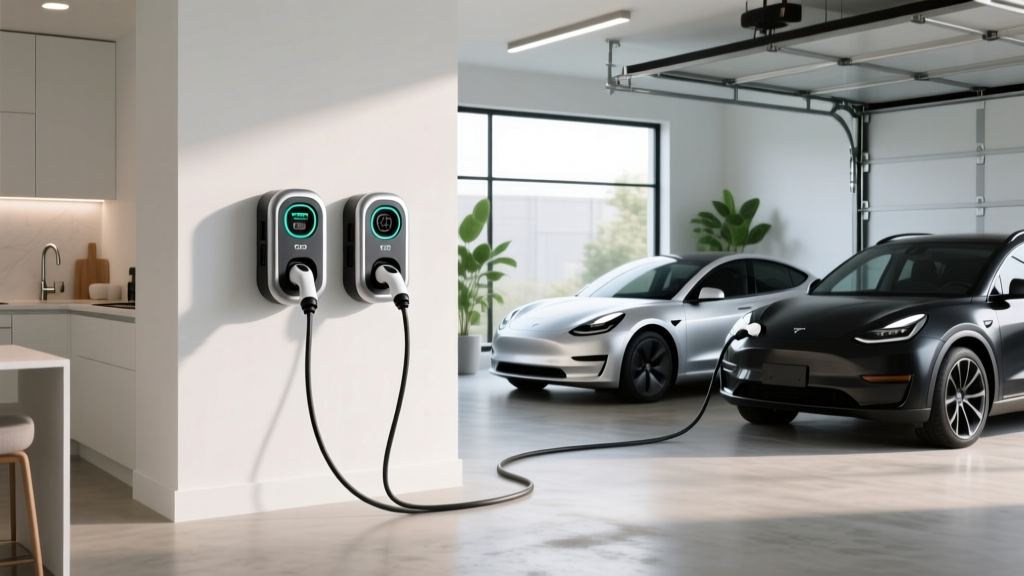
Yes, with load-sharing chargers like the Tesla Wall Connector (supports power sharing between two units on a single circuit) or smart panels that manage dual-charger draw. Alternatively, install a second dedicated circuit if your panel has capacity. Two 40A chargers on separate 50-amp circuits is the most straightforward approach for two-EV households.