Quick Verdict: How Long Does It Take to Charge a Hyundai EV?
If you own or are shopping for a Hyundai electric vehicle, charging time depends on three variables: your battery size, the charger's power output (measured in kW), and your battery's state of charge. Here's the short answer for Hyundai's current U.S. EV lineup:
- Ioniq 5 (84 kWh battery): 10–80% in ~18 minutes on a 350 kW DC fast charger; ~7 hours on a 240V/48A Level 2 home charger.
- Ioniq 6 (77.4 kWh battery): 10–80% in ~18 minutes on a 350 kW DC fast charger; ~6.5 hours on Level 2.
- Kona Electric (64.8 kWh battery): 10–80% in ~43 minutes on a 100 kW DC fast charger; ~6 hours on Level 2.
Those DC fast-charging numbers assume ideal conditions: a battery preconditioned to optimal temperature, a charger capable of delivering peak power, and starting at 10% state of charge. In real-world use — especially in cold weather or at chargers shared with other vehicles — expect 20–30% longer charge sessions. Let's break down exactly why, and what you need to know to charge efficiently at home and on the road.
Charging Levels Explained: kW, Miles Per Hour, and What Each Level Means
Before we map charging times to specific Hyundai models, it's critical to understand the three charging levels. The single most common EV confusion is mixing up kW (kilowatts) and kWh (kilowatt-hours). Think of it like plumbing: kW is the flow rate of water through the pipe (power), while kWh is the total volume of water in the tank (energy). Your Hyundai's battery capacity is measured in kWh; the charger's speed is measured in kW.
| Level | Voltage | Power (kW) | Miles of Range Added Per Hour | Typical Use Case |
|---|---|---|---|---|
| Level 1 | 120V AC | 1.0–1.4 kW | 3–5 miles | Overnight trickle; emergency top-up |
| Level 2 | 240V AC | 3.3–11.5 kW | 12–44 miles | Home daily charging; workplace; shopping centers |
| DC Fast Charge | 400V–800V DC | 50–350 kW | 150–700+ miles (peak rate) | Road trips; rapid top-ups on highways |
For daily driving, Level 2 is the sweet spot. Most Hyundai EV owners who charge at home plug in overnight and wake up to a full battery — no gas station detours required. DC fast charging is your road-trip tool, designed to get you from 10% to 80% quickly so you can minimize stop time.
Hyundai EV Charging Time by Model: Ioniq 5, Ioniq 6, and Kona Electric
Hyundai's 2026 U.S. EV lineup includes three battery-electric models, each with different battery capacities and charging architectures. The Ioniq 5 and Ioniq 6 use Hyundai's E-GMP platform with an 800V electrical architecture, enabling ultra-fast DC charging. The Kona Electric uses a conventional 400V system, which limits its peak DC charge rate.
| Spec | Ioniq 5 (Long Range AWD) | Ioniq 6 (SEL/Limited RWD) | Kona Electric (SEL/Limited) |
|---|---|---|---|
| Battery Capacity (usable) | 84.0 kWh (NMC) | 77.4 kWh (NMC) | 64.8 kWh (NMC) |
| EPA Range | 290 mi (AWD) / 315 mi (RWD) | 361 mi (RWD) | 261 mi |
| Real-World Range (highway, 70 mph) | ~240–265 mi | ~295–320 mi | ~215–235 mi |
| Max DC Fast Charge Rate | ~240 kW peak (800V) | ~240 kW peak (800V) | ~100 kW peak (400V) |
| 10–80% DC Fast Charge Time | ~18 min (350 kW charger) | ~18 min (350 kW charger) | ~43 min (100 kW+ charger) |
| Max Level 2 AC Rate | 10.9 kW | 10.9 kW | 7.2 kW (onboard charger limit) |
| Level 2 0–100% Time (est.) | ~7.5 hrs at 11.5 kW | ~7 hrs at 11.5 kW | ~9 hrs at 7.2 kW |
| Level 1 0–100% Time (est.) | ~60+ hrs at 1.4 kW | ~55+ hrs at 1.4 kW | ~46+ hrs at 1.4 kW |
Understanding the DC Fast Charge Curve
The "10–80% in 18 minutes" figure for the Ioniq 5 and Ioniq 6 is accurate — but only if you're plugged into a 350 kW-capable charger and your battery is preconditioned. Here's what actually happens during a DC fast-charge session:
- 10–40% SoC: The battery accepts near-peak power (~220–240 kW). This is where the 800V architecture shines.
- 40–65% SoC: Charge rate tapers to roughly 150–180 kW as the battery management system protects cell health.
- 65–80% SoC: Further taper to ~80–120 kW.
- Above 80% SoC: Dramatic taper to under 50 kW. Charging from 80–100% on DC fast can take as long as 10–80%. This is why road-trip strategy favors multiple short stops (10–80%) over one long stop (10–100%).
For the Kona Electric, the charge curve is flatter but the peak rate is lower. It sustains roughly 70–100 kW from 10–55% before tapering. On a 50 kW charger, all three Hyundais will charge at the charger's maximum rate for most of the session — making 50 kW stations perfectly usable, just slower.
Home Charger Installation: Electrical Requirements, Costs, and Gotchas
Charging at home is where EV ownership pays off — both in convenience and cost. But installing a Level 2 home charger isn't just about buying a wall box. You need the right electrical infrastructure, and in older homes, that may mean a panel upgrade.
Electrical Requirements for a Level 2 Hyundai Charger
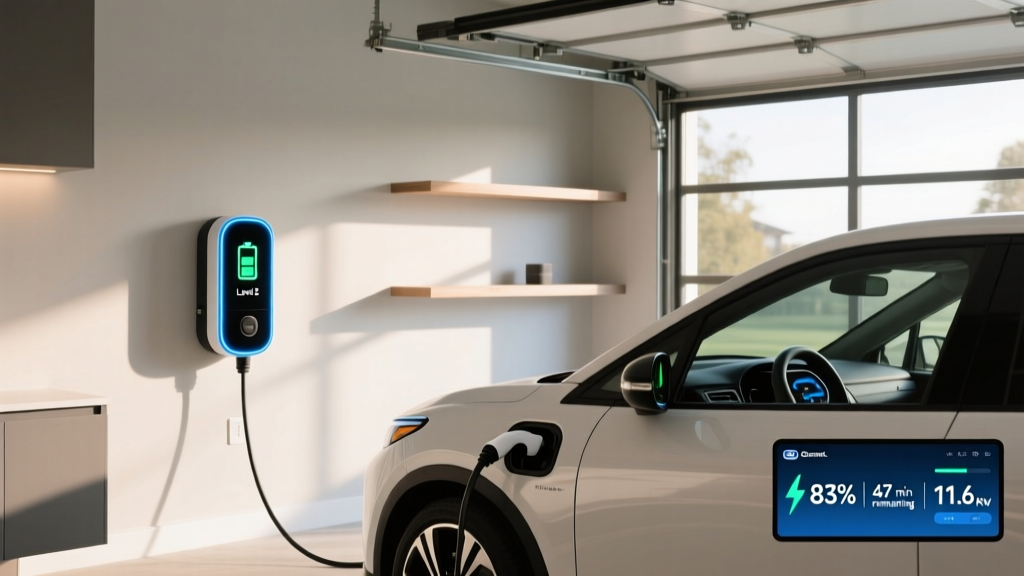
To get the most from your Hyundai's 10.9 kW onboard charger (Ioniq 5/6) or 7.2 kW (Kona Electric), you'll want a 240V circuit. Here's what's required:
- Ioniq 5 / Ioniq 6: A 240V / 48A dedicated circuit (NEMA 14-50 outlet or hardwired) to deliver up to 11.5 kW. A 60A breaker is required for a 48A continuous load per NEC 80% rule.
- Kona Electric: A 240V / 32A circuit (NEMA 14-50 or hardwired) to deliver the Kona's maximum 7.2 kW. A 40A breaker suffices.
If your electrical panel is 200A and has spare capacity, a straightforward install typically involves running conduit from the panel to your garage or driveway, installing the outlet or hardwired connection, and adding the dedicated breaker. If your panel is 100A, heavily loaded, or has no spare slots, you may need a panel upgrade — which is the single biggest variable in install cost.
| Component | Simple Install (panel has capacity, short run) | Complex Install (panel upgrade, long conduit run) |
|---|---|---|
| Level 2 Charger Equipment | $400–$700 | $400–$700 |
| Electrician Labor | $300–$800 | $1,200–$2,500 |
| Permit & Inspection | $50–$200 | $50–$200 |
| Electrical Panel Upgrade (if needed) | $0 | $1,500–$3,500 |
| Conduit, Wiring, Misc. Materials | $100–$300 | $300–$800 |
| Total Estimated Cost | $850–$2,000 | $3,450–$7,700 |
Pro tip: Many utilities offer rebates of $200–$500 for Level 2 charger installation, and some states offer additional incentives. Check with your local utility before scheduling the electrician. Also, the federal Alternative Fuel Vehicle Refueling Property Credit (IRS §30C) may cover up to 30% of home charging equipment and installation costs (capped at $1,000) — eligibility depends on your census tract and tax situation, so consult a tax professional.
Connector Compatibility: NACS, CCS, and the Hyundai Transition
Hyundai's 2026 U.S. EVs ship with the CCS1 (Combined Charging System) connector for DC fast charging and a J1772 inlet for Level 1/Level 2 AC charging. However, the industry is rapidly transitioning to the NACS (North American Charging Standard, originally Tesla's connector), and Hyundai has committed to adopting NACS on new vehicles.
| Connector | Use | Compatibility with 2026 Hyundai EVs |
|---|---|---|
| J1772 | Level 1 / Level 2 AC charging | Native — all Hyundai EVs use this for AC charging |
| CCS1 | DC fast charging | Native — built-in on Ioniq 5, Ioniq 6, Kona Electric |
| NACS (Tesla) | DC fast + AC charging | Requires adapter for current CCS-equipped Hyundais; native on future models |
| CHAdeMO | DC fast charging (legacy) | Not compatible — CHAdeMO is effectively discontinued in the U.S. |
What this means for you: If you buy a 2026 Ioniq 5 or Ioniq 6, you'll charge natively at Electrify America, EVgo, and other CCS-equipped networks. To access Tesla Superchargers — the largest and most reliable DC fast-charging network in the U.S. — you'll need a CCS-to-NACS adapter. Hyundai has indicated it will provide or sell adapters for existing CCS vehicles; check with your dealer for availability. When shopping for a home Level 2 charger, a J1772 connector will work with all current Hyundai EVs out of the box.
Charging Cost Per Mile: Home vs. Public vs. Gas
One of the strongest arguments for EV ownership is lower fueling cost — but the savings depend heavily on where you charge. Let's run the numbers for a Hyundai Ioniq 5, which has an EPA-rated efficiency of roughly 30 kWh per 100 miles (or 112 MPGe combined, per fueleconomy.gov).
| Scenario | Rate | Cost Per 100 Miles | Cost Per Mile |
|---|---|---|---|
| Home (off-peak utility rate) | $0.12/kWh | $3.60 | $0.036 |
| Home (average U.S. residential) | $0.17/kWh | $5.10 | $0.051 |
| Public Level 2 (e.g., ChargePoint) | $0.25–$0.35/kWh | $7.50–$10.50 | $0.075–$0.105 |
| DC Fast Charge (e.g., Electrify America) | $0.35–$0.55/kWh | $10.50–$16.50 | $0.105–$0.165 |
| Gas car (25 MPG avg, $3.40/gal) | $3.40/gallon | $13.60 | $0.136 |
The takeaway: If you charge primarily at home on an off-peak rate, your Hyundai Ioniq 5 costs roughly $0.04/mile to "fuel" — about one-quarter the cost of a comparable gas SUV. Even at average residential rates, you're saving 60%+ per mile. Public DC fast charging is the most expensive option and, at peak rates, can approach or even exceed the cost of gasoline on a per-mile basis. This is why home charging access is the single biggest factor in EV ownership satisfaction and economics.
Best Home Chargers for Hyundai EVs: Equipment Picks
Not all Level 2 chargers are equal. Below are three well-regarded options for Hyundai owners, selected for reliability, power output, and smart features. All use the J1772 connector compatible with current Hyundai EVs.
Emporia Vue Level 2 Charger
- Power Output: Up to 11.5 kW (240V / 48A)
- Connector: J1772 (NACS adapter available separately)
- Cable Length: 24 feet
- Smart Features: Wi-Fi, app scheduling, energy monitoring, solar integration
- Price: ~$400
- Best For: Budget-conscious buyers who want full smart features and maximum charge rate for the Ioniq 5/6.
ChargePoint Home Flex
- Power Output: Up to 12 kW (240V / 50A, adjustable down)
- Connector: J1772
- Cable Length: 23 feet
- Smart Features: Wi-Fi, app with scheduling and charge history, Alexa integration, amperage configurable via dip switches
- Price: ~$550–$650
- Best For: Owners who want a proven brand with a polished app and flexible amperage settings for different panel capacities.
Grizzl-E Smart
- Power Output: Up to 10 kW (240V / 40A)
- Connector: J1772
- Cable Length: 24 feet
- Smart Features: Wi-Fi, OCPP-compatible, app scheduling, built-in load balancing
- Price: ~$450–$550
- Best For: Cold-climate owners — rated to -40°F, built in Canada with a rugged aluminum enclosure. Slightly lower max output (10 kW) means an Ioniq 5 charges about 10% slower than on an 11.5 kW unit.
If you plan to charge a Kona Electric exclusively, any of these chargers will work fine — the Kona's 7.2 kW onboard charger is the bottleneck, not the wall box. For Ioniq 5 or Ioniq 6 owners, choose a charger rated at 48A or higher to take full advantage of the 10.9 kW onboard charger.
Safety, Electrical Code, and Installation Best Practices
EV charging draws significant sustained current — comparable to running an electric oven for hours. Cutting corners on installation is a fire risk. Here's what proper installation requires:
- Dedicated circuit: Your Level 2 charger must have its own dedicated breaker. Never share the circuit with other high-draw appliances.
- NEC 80% rule: Continuous loads (defined as 3+ hours) must not exceed 80% of the breaker rating. A 48A charger requires a 60A breaker; a 40A charger requires a 50A breaker.
- GFCI protection: The 2020 and 2023 National Electrical Code require GFCI protection for EV charging outlets in garages and outdoor locations. Hardwired installations may not require a separate GFCI breaker if the charger has built-in ground-fault protection — your electrician will determine this.
- Outdoor rating: If your charger is installed outside (driveway or exterior wall), it must carry a NEMA 4 or NEMA 4X weather-resistance rating. All three chargers recommended above meet this standard.
- Permit and inspection: Most jurisdictions require an electrical permit for a new 240V circuit. The inspection ensures the work meets code and protects your home insurance coverage. Do not skip this step.
- Wire gauge: For a 60A circuit, 6 AWG copper wire is typically required (some jurisdictions allow 4 AWG aluminum). Your electrician will size wire based on run length and local code.
Always hire a licensed electrician familiar with EV charger installations. Ask for references and confirm they'll pull a permit. The NHTSA and your local fire marshal both recommend professional installation over DIY for 240V EV circuits.
Frequently Asked Questions
How much does it cost to install a home EV charger for my Hyundai?
A straightforward Level 2 installation on an existing 200A panel with a short wire run typically costs $850–$2,000 total (equipment, labor, and permit). If your home needs an electrical panel upgrade to 200A, total costs can reach $3,500–$7,700. Get at least two quotes from licensed electricians, and check with your utility for rebates before scheduling work.
How fast will each charging level add range to my Hyundai EV?
Level 1 (120V) adds roughly 3–5 miles of range per hour — suitable only for overnight trickle charging or PHEVs. Level 2 (240V) adds 12–44 miles per hour depending on amperage and your Hyundai's onboard charger capacity. DC fast charging adds range at 150–700+ miles per hour at peak rates, though the charge curve tapers significantly above 80% state of charge.
Which connector and charger are compatible with my Hyundai EV?
All 2026 Hyundai EVs (Ioniq 5, Ioniq 6, Kona Electric) use a J1772 inlet for AC charging and a CCS1 inlet for DC fast charging. Any J1772 Level 2 home charger will work. For Tesla Supercharger access, you'll need a CCS-to-NACS adapter. CHAdeMO chargers are not compatible.
How much does charging a Hyundai EV cost per mile compared to gas?
At home on an average U.S. electricity rate of $0.17/kWh, a Hyundai Ioniq 5 costs roughly $0.05 per mile to charge — about 63% less than a gas vehicle getting 25 MPG at $3.40/gallon ($0.14/mile). Off-peak home rates can drop the cost to $0.036/mile. Public DC fast charging at $0.45/kWh costs roughly $0.135/mile, approaching gas-car costs.
What electrical upgrades might I need for a home charger?
If your home has a 200A electrical panel with spare breaker slots and capacity, you likely need only a new dedicated circuit. If your panel is 100A, is near its load limit, or has no open slots, you'll need a panel upgrade ($1,500–$3,500). Homes with older wiring (knob-and-tube, aluminum branch circuits) may need additional remediation. Your electrician will perform a load calculation to determine what's required.
Does cold weather affect Hyundai EV charging time?
Yes, significantly. Lithium-ion batteries charge more slowly when cold because the battery management system limits charge current to protect cell health. In sub-freezing temperatures, a DC fast-charge session can take 30–50% longer unless you precondition the battery. Both the Ioniq 5 and Ioniq 6 support navigation-based battery preconditioning — set the charger as your destination in the navigation system, and the car will warm the battery en route for faster charging on arrival.
Can I use a Tesla Supercharger with my Hyundai Ioniq 5 or Ioniq 6?
Not natively — current Hyundai EVs use CCS1 connectors, while Tesla Superchargers use NACS. However, Hyundai has committed to providing CCS-to-NACS adapters, and Tesla has opened select Supercharger locations to non-Tesla EVs via the Magic Dock built-in adapter. Check Hyundai's electrified vehicle page for the latest adapter availability and Supercharger compatibility.