If you own or are shopping for a Chevrolet, GMC, Cadillac, or BrightDrop electric vehicle, understanding your charging ecosystem is just as critical as understanding range. General Motors has made sweeping changes to its charging strategy since adopting the North American Charging Standard (NACS) across its lineup, and the hardware, software, and network landscape in 2026 looks very different from even two years ago.
This guide breaks down every layer of the General Motors EV chargers ecosystem — from the Level 2 wall unit in your garage to DC fast charging on a road trip — with exact numbers on cost, speed, and compatibility.
GM's Charging Ecosystem in 2026: What Changed and Why It Matters
Starting with the 2025 model year, GM transitioned its North American EVs to the NACS (J3400) connector, replacing CCS1. By 2026, every new Chevrolet Equinox EV, Blazer EV, Silverado EV, GMC Sierra EV, Cadillac Lyriq, and Cadillac Optiq ships with a NACS charge port. This single change reshaped where and how GM owners charge.
The practical implications:
- Tesla Supercharger access: GM EVs can now use Tesla's Supercharger network natively (no adapter required for 2025+ models), adding over 25,000 fast-charging stalls to your route options.
- Ultium Charge Network: GM's aggregated public charging network — which pulls together EVgo, Electrify America, ChargePoint, and others — still functions through the myChevrolet/myCadillac app, but the physical connector at non-Tesla stations may require a CCS-to-NACS adapter for older CCS-equipped chargers.
- Home charging hardware: GM offers its branded PowerUp Charger (Level 2) and continues to support third-party NACS-compatible wall units.
If you own a 2022–2024 GM EV (first-generation Lyriq, Bolt EUV, early Blazer EV), your vehicle has a CCS1 port. You will need a NACS-to-CCS adapter (available from GM dealers and Tesla) to use Superchargers. Keep this in mind when planning road trips.
Charging Levels Explained: Speeds, Power, and What They Mean for Your GM EV
Before evaluating specific General Motors EV chargers, you need clarity on the three charging tiers. The critical distinction: kW (kilowatts) measures power — how fast energy flows into your battery. kWh (kilowatt-hours) measures energy — the total capacity of your battery. A 19.2 kW charger fills an 85 kWh battery at a specific rate; confusing the two leads to wildly wrong expectations.
| Level | Voltage | Max Power (kW) | Miles of Range Added Per Hour | Typical Use Case |
|---|---|---|---|---|
| Level 1 | 120V AC | 1.2–1.9 kW | 3–5 miles/hr | Emergency / overnight trickle |
| Level 2 | 240V AC | 7.2–19.2 kW | 20–56 miles/hr | Home daily charging, workplace |
| DC Fast Charge | 400–800V DC | 50–350 kW | 150–800+ miles/hr (peak) | Road trips, rapid top-ups |
Real-World Charging Times for Popular GM EVs
Here is what these numbers translate to in practice, based on EPA battery data and manufacturer specs for 2026 models:
| Vehicle | Battery (kWh usable) | Level 2 at 11.5 kW (0–100%) | DC Fast 10–80% | Peak DC kW |
|---|---|---|---|---|
| Chevrolet Equinox EV (2LT) | 85 kWh | ~8.5 hours | ~24 min | 150 kW |
| Chevrolet Blazer EV (SS) | 102 kWh | ~10 hours | ~28 min | 190 kW |
| Cadillac Lyriq (AWD) | 102 kWh | ~10 hours | ~26 min | 190 kW |
| Chevrolet Silverado EV (4WT) | 200 kWh | ~18 hours (11.5 kW) | ~40 min | 350 kW |
| GMC Sierra EV (Denali) | 200 kWh | ~10.5 hours (19.2 kW) | ~38 min | 350 kW |
Real-world caveat: DC fast charging speeds peak between 10–30% State of Charge and taper significantly above 80%. A "24-minute 10–80%" claim assumes optimal battery preconditioning and a charger capable of sustaining the vehicle's peak rate. In cold weather (below 32°F), add 20–40% to these times unless your GM EV has actively preconditioned the battery via navigation-routed charging.
Home Level 2 Charging: Installation Costs, Electrical Requirements, and Panel Upgrades
Home Level 2 charging is where most GM EV owners will do 85–95% of their charging. Getting the installation right is essential — and the costs vary widely depending on your home's electrical infrastructure.
GM PowerUp Charger and Third-Party Options
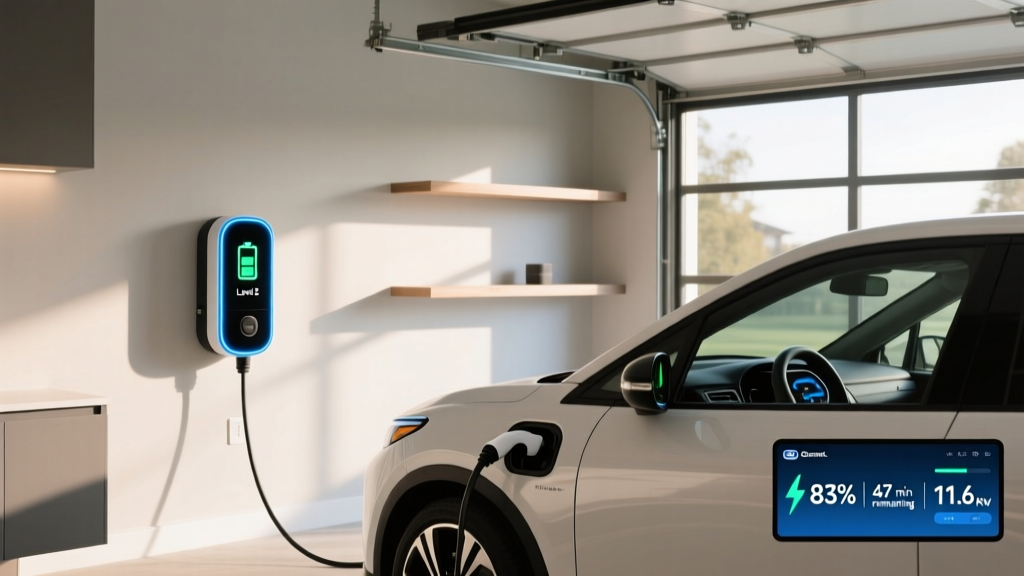
GM's official home charging hardware is the GM PowerUp Charger, a NACS-equipped Level 2 wall unit rated at 11.5 kW (48A on a 60A circuit). It features Wi-Fi connectivity, scheduled charging via the GM app, and a 25-foot cable. MSRP is approximately $799.
Third-party NACS-compatible chargers worth considering:
ChargePoint Home Flex (NACS)
- Power: Up to 12 kW (50A) — adjustable down to 16A
- Cable: 23 feet
- Smart features: App scheduling, Alexa, energy tracking
- Price: ~$649
Emporia Level 2 Smart Charger (NACS)
- Power: Up to 11.5 kW (48A)
- Cable: 24 feet
- Smart features: Real-time energy monitoring, solar integration
- Price: ~$399
Tesla Wall Connector (NACS native)
- Power: Up to 11.5 kW (48A)
- Cable: 24 feet
- Smart features: Wi-Fi updates, load sharing with Powerwall
- Price: ~$450
Any of these will fully charge a Lyriq or Blazer EV overnight. The key spec to match: your charger's amperage should not exceed 80% of your dedicated circuit breaker rating (a 60A breaker supports a 48A continuous load).
Electrical Requirements and What Your Electrician Will Assess
A Level 2 charger installation is not simply plugging into an existing outlet. Here is what is involved:
- Dedicated circuit: A 240V, 60A breaker on your main electrical panel, wired with 6 AWG copper (or 4 AWG aluminum) to the charger location.
- Panel capacity: Most homes built after 1990 have a 200A main panel. Adding a 60A EV circuit is usually feasible — but if your panel is already near capacity (common in homes with electric ranges, dryers, and HVAC), you may need a panel upgrade to 300–400A or a smart load-management device like the Emporia Smart Panel that throttles charger draw when other appliances cycle on.
- GFCI protection: The 2023 NEC (National Electrical Code) requires GFCI protection for EV charging circuits in garages. Your electrician will use a GFCI breaker or a charger with integrated ground-fault protection.
- Outdoor rating: If your charger mounts outside, it must carry a NEMA 4 or IP65 weather rating. All three units above qualify.
- Permit: Nearly every jurisdiction requires an electrical permit for a new 240V circuit. Your electrician typically pulls this; inspection follows within 1–2 weeks.
Installation Cost Breakdown
| Component | Low-End Estimate | High-End Estimate | Notes |
|---|---|---|---|
| Charger unit (Level 2, NACS) | $399 | $799 | Emporia to GM PowerUp |
| Electrician labor (standard install) | $500 | $1,500 | Short run from panel, accessible attic/crawlspace |
| Electrical materials (wire, conduit, breaker) | $150 | $400 | Varies by run length |
| Permit and inspection fee | $50 | $250 | Varies by municipality |
| Total (no panel upgrade) | $1,099 | $2,949 | Most homes fall in $1,500–$2,200 range |
| Panel upgrade (if needed: 200A → 400A) | $2,500 | $5,000+ | Required when panel lacks spare capacity |
Key insight: Get a load calculation from your electrician before purchasing a charger. A $200–$300 consultation can save you from discovering a $4,000 panel upgrade requirement after the fact. Homes with existing 200A panels and gas appliances (furnace, water heater, range) almost always have room for a 60A EV circuit. All-electric homes are tighter.
Connector Compatibility: NACS, CCS1, and What Your GM EV Needs
The connector transition is the single most important compatibility issue for GM EV owners in 2026. Here is where each model stands:
| Vehicle / Model Year | Native Connector | Tesla Supercharger | CCS1 Public Stations | NACS Public Stations |
|---|---|---|---|---|
| 2025+ Equinox EV, Blazer EV, Silverado EV, Lyriq, Optiq | NACS (J3400) | Native — no adapter | Requires CCS-to-NACS adapter | Native |
| 2022–2024 Lyriq | CCS1 | Requires NACS-to-CCS adapter | Native | Requires adapter |
| 2022–2023 Bolt EV / Bolt EUV | CCS1 | Requires NACS-to-CCS adapter | Native | Requires adapter |
| 2024 Blazer EV (early production) | CCS1 | Requires NACS-to-CCS adapter | Native | Requires adapter |
Adapter cost: GM-branded CCS-to-NACS adapters run approximately $200–$250. Tesla sells a compatible adapter for similar pricing. Keep one in your frunk at all times — public charging infrastructure is still in transition, and you will encounter CCS1-only stations on Electrify America and some EVgo corridors.
Public DC Fast Charging: Where GM Owners Charge on the Road
GM's Ultium Charge Network aggregates over 130,000 charging points across North America through partnerships with EVgo, Electrify America, ChargePoint, and — critically as of 2025 — Tesla Superchargers. You access and pay through your GM vehicle's infotainment system or the myChevrolet/myCadillac app.
Charging Speed Reality on Public Networks
Not all DC fast chargers are created equal. A charger's posted peak kW rarely reflects sustained delivery across a full session:
| Network | Typical Peak kW | Sustained 10–80% Avg kW (Est.) | Connector Availability |
|---|---|---|---|
| Tesla Supercharger V4 | 250–350 kW | ~140–180 kW | NACS native |
| Electrify America | 150–350 kW | ~100–150 kW | CCS1 (NACS via adapter) |
| EVgo | 100–350 kW | ~80–130 kW | CCS1 + NACS at newer sites |
| ChargePoint Express | 62.5–400 kW | ~60–120 kW | CCS1 (NACS at select new sites) |
Pro tip: Always use your GM's built-in navigation to route to a DC fast charger. This triggers battery preconditioning — the thermal management system warms or cools the battery to optimal temperature before you arrive, which can shave 5–10 minutes off your 10–80% session. Without preconditioning (drive-up charging in cold weather), you may see peak rates cut by 30–50%.
Cost to Charge: Home vs. Public vs. Gas — The Real Numbers
The economic case for a GM EV hinges on where you charge. Here is a concrete comparison using the 2026 Chevrolet Equinox EV (85 kWh battery, EPA efficiency of ~3.0 mi/kWh or 100 MPGe combined, per fueleconomy.gov):
| Scenario | Cost per kWh | Cost to Add 200 Miles | Cost Per Mile |
|---|---|---|---|
| Home Level 2 (national avg residential) | $0.16/kWh | $10.67 | $0.053 |
| Home Level 2 (off-peak TOU rate) | $0.09/kWh | $6.00 | $0.030 |
| Public Level 2 (ChargePoint/EVgo) | $0.28/kWh | $18.67 | $0.093 |
| DC Fast Charging (EVgo/Electrify America) | $0.42/kWh | $28.00 | $0.140 |
| Tesla Supercharger (avg 2026) | $0.30/kWh | $20.00 | $0.100 |
| Gas equivalent (28 MPG combined, $3.40/gal) | — | $24.29 | $0.121 |
The takeaway: Home charging — especially on a time-of-use (TOU) plan with off-peak rates — delivers fuel costs at roughly one-quarter the price of gasoline. Public DC fast charging, however, can exceed gasoline cost per mile. If more than 30% of your charging happens on public DC fast networks, the total cost of ownership advantage narrows significantly. Plan your home setup accordingly.
Federal and Utility Incentives for Home Charger Installation
The federal Alternative Fuel Vehicle Refueling Property Credit (IRC §30C) provides a tax credit of up to 30% of the cost of home EV charger equipment and installation, capped at $1,000. This credit is subject to eligibility requirements including placement in a qualifying census tract. Consult a tax professional and review current IRS guidance before claiming.
Beyond federal incentives, many utilities offer rebates:
- Utility rebates: Commonly $250–$500 off the charger unit or installation. Check with your local provider.
- TOU rate plans: Most utilities now offer time-of-use plans that price electricity at $0.07–$0.12/kWh during overnight off-peak windows (typically 10 PM – 6 AM), dramatically reducing your per-mile cost.
- GM Energy partnerships: GM has partnered with select utilities (including PG&E and DTE Energy) to offer bundled charger + installation discounts for new EV buyers.
Safety, Code, and Best Practices for GM EV Home Charging
Level 2 charging draws significant continuous current — up to 48 amps for hours at a time. This is not a DIY project. Follow these guidelines:
- Hire a licensed electrician. Unpermitted or substandard EV charger wiring is a documented fire risk and may void your homeowner's insurance coverage.
- Never use an extension cord with a Level 1 or Level 2 EV charger. Voltage drop over distance degrades charging speed and creates heat.
- Hardwire vs. plug: Hardwired installations (no NEMA 14-50 outlet) eliminate one failure point and are required by some jurisdictions for circuits above 40A. If you use a 14-50 receptacle, ensure it is an industrial-grade unit (Hubbell, Bryant) — consumer-grade 14-50 outlets have been linked to overheating incidents.
- Cable management: Keep the charging cable off the garage floor to prevent trip hazards and abrasion damage. A simple wall-mounted holster solves this.
- Smart scheduling: Use your GM vehicle's built-in delayed charging or your charger's app to schedule sessions during off-peak utility hours. This alone can save $400–$600/year.
Frequently Asked Questions About General Motors EV Chargers
How much does it cost to install a home EV charger for a GM electric vehicle?
A standard Level 2 installation with a 60A dedicated circuit typically costs $1,500–$2,200 including the charger unit, electrician labor, materials, and permit. If your home needs an electrical panel upgrade (from 200A to 400A), add $2,500–$5,000. Get a load calculation first to determine if your panel can handle the additional circuit.
How fast will each charging level add range to my GM EV?
Level 1 (120V) adds 3–5 miles per hour — adequate only for plug-in hybrids or emergency top-ups. Level 2 (240V, 11.5 kW) adds roughly 30–38 miles per hour, enough to fully replenish a Chevrolet Equinox EV overnight. DC fast charging at 150–350 kW can add 100+ miles in 10 minutes at peak delivery, though sustained rates are lower as the battery fills past 80%.
Which connector is compatible with my 2026 GM EV?
All 2025 and newer GM electric vehicles use the NACS (J3400) connector natively. This means direct compatibility with Tesla Superchargers and a growing number of NACS-equipped public stations. If you own a 2022–2024 GM EV with CCS1, you will need a NACS-to-CCS adapter (~$200–$250) for Supercharger access.
How much does charging a GM EV cost per mile compared to gas?
At home on a national average rate of $0.16/kWh, a 2026 Equinox EV costs about $0.053 per mile — less than half the $0.121/mile cost of a 28 MPG gas vehicle at $3.40/gallon. On off-peak utility rates ($0.09/kWh), the cost drops to $0.03 per mile. Public DC fast charging at $0.42/kWh pushes cost to $0.14/mile, which exceeds gasoline.
What electrical upgrades might I need for a home Level 2 charger?
The most common upgrade is a panel capacity increase if your existing 200A service lacks headroom for a new 60A circuit. Homes with gas appliances (furnace, water heater, stove) typically have ample capacity. All-electric homes with electric heat, dryer, and range are more likely to need an upgrade. A smart load management device (~$300–$500 installed) can sometimes avoid a panel upgrade by dynamically sharing capacity between the EV charger and other loads.
Can I use a Tesla Wall Connector with my Chevrolet or Cadillac EV?
Yes. The Tesla Wall Connector uses a NACS plug, which is the native connector on all 2025+ GM EVs. For 2022–2024 GM EVs with CCS1 ports, you will need a NACS-to-CCS adapter. The Wall Connector delivers up to 11.5 kW (48A) and works identically to GM's PowerUp Charger for home use.
Does GM's Ultium Charge Network give me free charging?
GM has periodically offered complimentary charging credits with new EV purchases (e.g., 1,000 kWh of EVgo or Electrify America credit). These promotions vary by model year and trim. Check current offers on chevrolet.com or your dealer. After credits expire, you pay the network's standard per-kWh rate.
Understanding the full General Motors EV chargers landscape — from the NACS connector on your charge port to the 60A breaker in your panel — is what separates a smooth ownership experience from one plagued by range stress and unexpected costs. Invest in a proper home Level 2 setup, learn your public network options, and your GM EV will deliver on its promise of lower running costs and effortless daily driving.