The 100-Amp Bottleneck: Why Older Homes Struggle with Level 2 EVSE
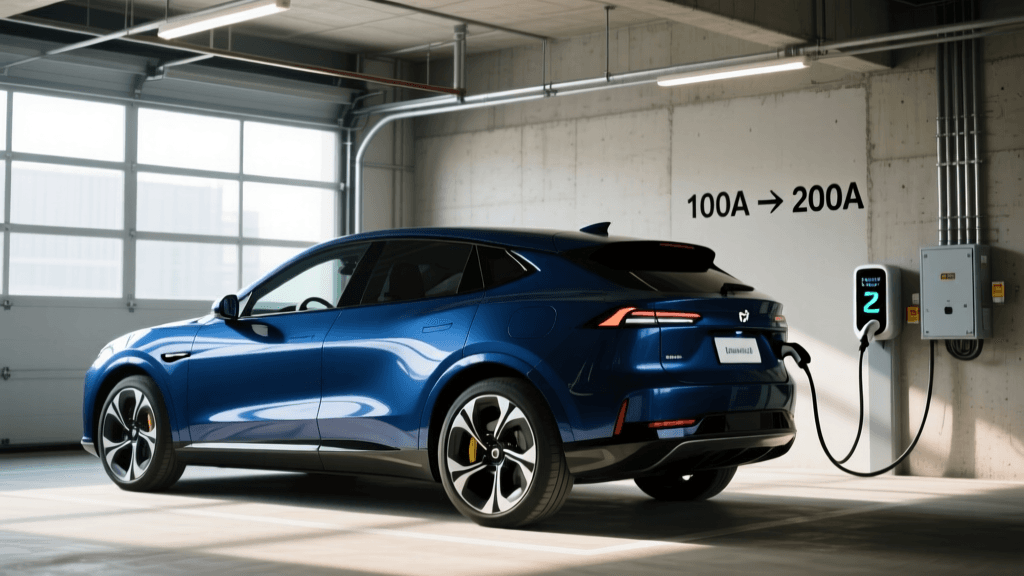
As electric vehicle (EV) adoption accelerates globally, homeowners are increasingly installing Level 2 Electric Vehicle Supply Equipment (EVSE) to achieve faster, more reliable overnight charging. However, according to the U.S. Department of Energy, a significant percentage of homes built before 1980 frequently feature 100-amp electrical service panels. While a 100-amp panel was considered state-of-the-art decades ago and remains sufficient for legacy household appliances, introducing a high-draw Level 2 EV charger—such as a 48-amp Tesla Wall Connector, a ChargePoint Home Flex, or a Grizzl-E Smart—often pushes the aging electrical system far beyond its safe operational limits. This data-driven analysis compares the technical metrics, load capacities, hardware requirements, and financial implications of upgrading a 100-amp panel to a 200-amp service to support modern EV charging infrastructure.
NEC Load Calculations: The 125% Rule and Available Capacity
To understand precisely why a 100-amp panel is mathematically inadequate for many Level 2 installations, we must examine the National Electrical Code (NEC). The National Fire Protection Association (NFPA) outlines strict, non-negotiable guidelines for continuous loads in the NEC. Because EV charging sessions routinely exceed three hours, the NEC classifies EVSE as a continuous load. Article 210.20 and 220.14 mandate that continuous loads must be derated by 125%.
This mathematical derating means a 40-amp EV charger requires a 50-amp breaker and 50 amps of allocated panel capacity. A 48-amp charger requires a 60-amp breaker. When you add 50 to 60 amps of continuous EV load to a 100-amp panel that is already servicing an electric range, central HVAC system, and electric water heater, the aggregate load calculation routinely exceeds the panel's 80-amp safe continuous threshold. This over-subscription necessitates either a severe reduction in charging speed or a comprehensive service upgrade.
Deconstructing the NEC Article 220 Standard Load Calculation
Electricians do not simply add up the amperage of every breaker to determine if a panel is overloaded; instead, they use the NEC Article 220 Standard Load Calculation method. This formula assigns specific Volt-Ampere (VA) values to different areas and circuits of the home. For a 2,500-square-foot home, the general lighting load is calculated at 3 VA per square foot (7,500 VA). Add two 1,500 VA small-appliance circuits and one 1,500 VA laundry circuit, and the baseline general load reaches 10,500 VA.
After applying NEC demand factors (which assume not all lights and outlets run simultaneously), the baseline load is reduced. However, major fixed appliances like electric dryers (5,000 VA), ranges (8,000+ VA), and HVAC systems (often 10,000+ VA) are added at 100% of their nameplate ratings. By the time these major loads are summed, a 100-amp panel (which provides 24,000 VA total) is often already sitting at 18,000 to 21,000 VA. Introducing a 11,500 VA (48-amp) EV charger mathematically breaks the calculation, forcing the electrical contractor to recommend a 200-amp upgrade to pass municipal inspection.
Data Comparison: 100A vs. 200A Panel Load Capacity Analysis
The following table illustrates the maximum theoretical and usable continuous load capacities for 100-amp and 200-amp residential panels operating at standard 240 volts.
| Metric | 100-Amp Panel (Legacy) | 200-Amp Panel (Upgraded) |
|---|---|---|
| Max Theoretical Power | 24,000 Watts (24 kW) | 48,000 Watts (48 kW) |
| Safe Continuous Limit (80%) | 19,200 Watts (19.2 kW) | 38,400 Watts (38.4 kW) |
| Average Base Home Load | ~12,000 Watts (12 kW) | ~14,000 Watts (14 kW) |
| Remaining Capacity for EVSE | 7,200 Watts (30 Amps) | 24,400 Watts (101 Amps) |
| Max Supported EV Charger | 24A (Requires 30A Breaker) | 80A (Requires 100A Breaker) |
Note: Base home loads vary significantly by climate, insulation, and appliance efficiency. The data above represents a standardized baseline for a modern 2,500 sq. ft. home with central electric HVAC and an electric water heater.
The Anatomy of a 200-Amp Service Upgrade
Upgrading from a 100-amp to a 200-amp electrical service is a capital-intensive, multi-stage project. It involves far more than simply swapping the metal box on your wall. The physical hardware requirements include:
- Service Entrance Conductors: Upgrading to 200 amps requires thicker wiring from the utility pole or underground transformer to your panel. Contractors typically pull 4/0 AWG aluminum or 2/0 AWG copper conductors, which are significantly more expensive than legacy wiring.
- Meter Base and Main Breaker: The exterior meter socket must be rated for 200 amps continuous service. Modern upgrades often utilize a 200-amp main breaker panel with 40 to 80 individual circuits to accommodate future smart home expansions.
- Grounding Electrode System: NEC code requires an updated grounding system, often necessitating the installation of two 8-foot copper-clad grounding rods driven into the earth, bonded with a continuous #4 AWG bare copper wire.
Cost-Benefit Analysis: Panel Upgrade vs. Smart Load Management
Based on national electrical contractor averages, a full 200-amp service upgrade costs between $1,800 and $3,500 for materials and labor, excluding the EV charger installation itself. When you factor in the cost of a premium Level 2 charger and trenching, the total project cost can easily exceed $5,000.
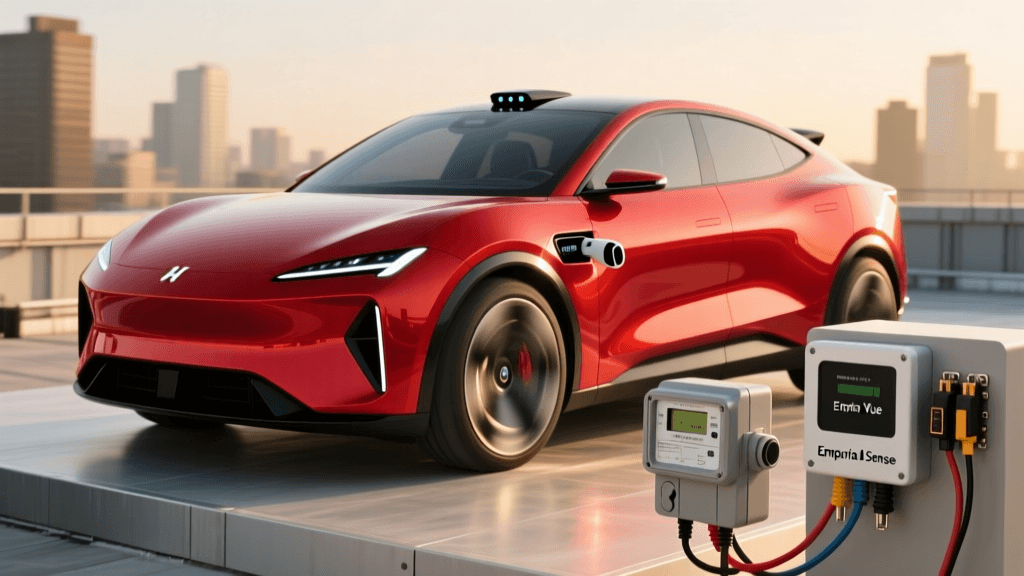
However, an alternative has emerged in the market: Automatic Load Management Systems (ALMS) or EVSE with dynamic load sharing. Devices like the Wallbox Pulsar Plus paired with a Power Meter, or the Emporia Level 2 charger, monitor the home's real-time electrical consumption via CT clamps on the main service lines. These systems dynamically throttle the EV charging speed to prevent the main 100-amp breaker from tripping, allowing you to keep your existing panel.
| Solution | Average Installed Cost | Max Charging Speed | Future-Proofing |
|---|---|---|---|
| 200A Panel Upgrade + 48A EVSE | $3,200 - $5,500 | 48 Amps (11.5 kW) | High (Supports heat pumps, V2H, 2nd EV) |
| Keep 100A + Smart ALMS EVSE | $1,100 - $1,800 | Variable (12A - 32A) | Low (Limits concurrent heavy appliance use) |
| Keep 100A + Level 1 (120V) | $0 - $300 | 12 Amps (1.4 kW) | None (Adds ~4 miles of range per hour) |
Installation Variables: Timelines, Permitting, and Hardware
A data-driven approach must also account for project timelines and permitting friction. A standard Level 2 installation on an existing 200-amp panel typically requires a single municipal electrical permit and can be completed in 4 to 8 hours. Conversely, a 100-amp to 200-amp service upgrade introduces significant logistical variables.
- Utility Coordination: The local utility company must disconnect power, approve the new meter socket, and potentially upgrade the overhead service drop or underground transformer. This adds 2 to 6 weeks to the project timeline depending on municipal backlog.
- Permitting & Inspections: Service upgrades require rigorous municipal inspections. The utility will not reconnect power until the city inspector signs off on the new panel, wire gauge, and grounding electrode system.
- Physical Space Constraints: Upgrading to 200 amps requires physical clearance. NEC Article 110.26 mandates a minimum 30-inch width and 36-inch depth clearance in front of the panel. Older homes often require structural modifications or panel relocation to meet this code.
Conclusion: What the Data Tells Us
The decision to upgrade a 100-amp panel to a 200-amp service for EV charging ultimately hinges on the homeowner's long-term electrification roadmap and budget constraints. If the data shows that your household plans to add electric heat pumps, induction cooktops, or a second EV in the next five years, the $3,000 average investment in a 200-amp upgrade yields a superior ROI by entirely eliminating electrical bottlenecks and increasing property value. However, for single-EV households with predictable overnight charging windows and lower daily mileage requirements, leveraging a 100-amp panel paired with a smart load-managing EVSE provides a mathematically sound, cost-effective bridge. This approach delivers adequate daily range without the heavy capital expenditure and logistical delays of a full utility service upgrade.