The EV Subpanel Dilemma: Why You Need Dedicated Metering
Upgrading to a Level 2 EV charger is one of the most impactful home improvements an electric vehicle owner can make. However, when your main service panel (MSP) is full, located on the opposite side of the house, or lacks the capacity for a new 60-amp double-pole breaker, installing a dedicated electrical subpanel in your garage becomes mandatory. While a subpanel solves your capacity and routing issues, it introduces a new challenge: accurately tracking the energy consumed by your EV charger to calculate your true charging costs and optimize for time-of-use (TOU) utility rates.
According to the U.S. Department of Energy, understanding your home's electrical load and charging habits is critical for maximizing EV efficiency and minimizing grid strain. This is where dedicated home energy monitors step in. But not all energy monitors are created equal, especially when a subpanel is involved. In this head-to-head showdown, we pit the two titans of home energy monitoring—the Emporia Vue 2 and the Sense Home Energy Monitor—against each other to determine which system reigns supreme for EV subpanel installations.
The Contenders: Emporia Vue 2 vs. Sense
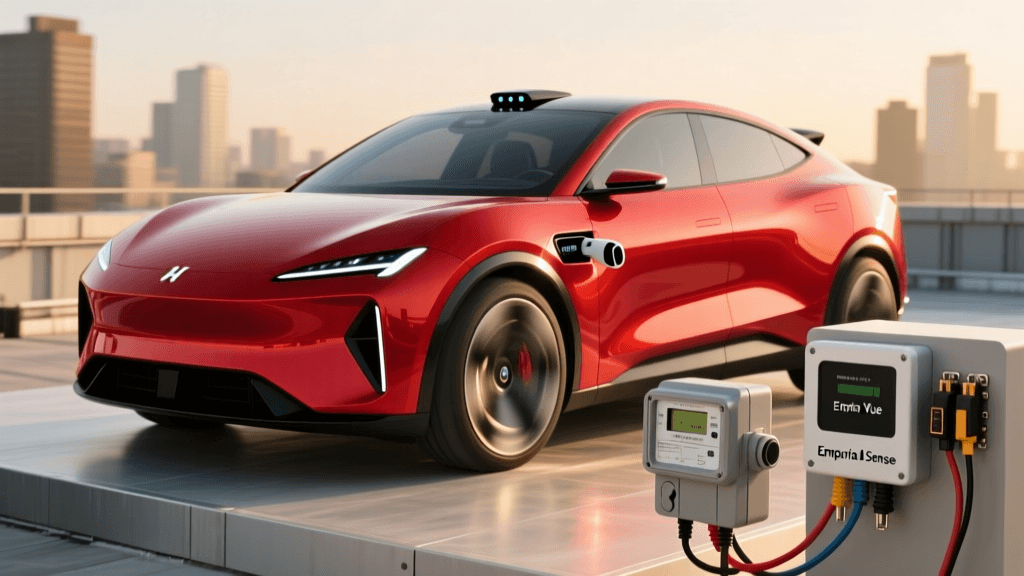
Emporia Vue 2 utilizes a hardware-heavy approach. It connects directly to your panel's neutral bar and uses individual Current Transformer (CT) clamps on specific breakers. This allows for granular, circuit-by-circuit energy tracking.
Sense takes an AI-driven approach. It uses just two main CT clamps on your primary service feeders and relies on machine learning algorithms to identify the unique electrical "signatures" of devices turning on and off in your home.
Head-to-Head Comparison Chart
| Feature | Emporia Vue 2 | Sense Energy Monitor |
|---|---|---|
| Subpanel EV Tracking | Excellent (Individual CT on EV breaker) | Poor (AI struggles with subpanel isolation) |
| CT Clamps Included | Up to 16 individual + 2 main | 2 main CT clamps only |
| Installation Complexity | High (Requires routing 16+ CT wires) | Low (Only 2 main CTs to route) |
| Hardware Cost | ~$150 - $200 | ~$300 |
| Data Accuracy | 99.9% (Hardware measured) | Varies (AI estimation for 240V loads) |
Subpanel Installation & Wiring: The Emporia Vue Setup
When installing a new 60-amp subpanel in your garage to accommodate an EV charger, the physical wiring requires precision and adherence to local codes. For the Emporia Vue, the installation process is deeply integrated into the panel work.
Step 1: Feeder Wire and Conduit Routing
Your electrician will run 6 AWG copper THHN/THWN-2 wires through 3/4-inch EMT (Electrical Metallic Tubing) conduit from the MSP to the new garage subpanel. This includes two hot wires (black and red), one neutral (white), and one ground (green/bare). In the subpanel, the neutral and ground bars must remain strictly isolated—a critical code requirement for subpanels.
Step 2: CT Clamp Placement
This is where Emporia shines. Because the Vue supports individual circuit monitoring, your installer can route a dedicated 50A CT clamp directly onto the hot wire feeding your EV charger's breaker inside the new subpanel. Alternatively, you can place a larger 200A CT clamp on the main feeder wires supplying the entire garage subpanel. The physical wire from the CT clamp must be routed back through the conduit to the main panel where the Emporia Vue monitoring hub is mounted.
Step 3: Torque and Termination
Modern electrical codes require the use of a calibrated torque screwdriver for all breaker and lug terminations. The Emporia hub requires a dedicated 15-amp or 20-amp breaker in the main panel. Once the CT wires are plugged into the Vue hub and the Wi-Fi is configured, the app immediately displays the exact wattage flowing to the EV subpanel, with zero AI guesswork.
Subpanel Installation & Wiring: The Sense Setup
The Sense monitor installation is physically simpler but functionally problematic for subpanel EV tracking.
Step 1: Main Panel CT Installation
The Sense device mounts inside your MSP. The installer clamps the two main CT rings around the primary service entrance conductors. Because Sense relies on reading the aggregate electrical noise of the home, it does not require individual wires routed to specific breakers.
Step 2: The Subpanel Blindspot
Herein lies the critical flaw for EV owners. When your Level 2 charger is installed on a new subpanel, Sense's AI must detect the 240V load signature through the main panel's feeders. However, Level 2 chargers draw a continuous, steady resistive load that lacks the distinct "startup spike" or motor harmonics that Sense's AI uses to identify devices like HVAC systems or refrigerators. Furthermore, if you have solar inverters or other noisy electronics, Sense frequently misidentifies the EV charger's draw or lumps it into an "Unknown" or "Always On" category. You are left paying $300 for a monitor that cannot reliably tell you how much energy your newly installed subpanel EV charger is using.
Cost Analysis: Hardware, Subpanel, and Labor
Understanding the total cost of ownership is vital when planning your EV infrastructure. Below is a breakdown of estimated costs for a typical 60-amp subpanel installation with energy monitoring.
- Subpanel & EV Charger Install (Labor & Materials): $1,200 - $2,500 (Includes 60A subpanel, 50A EV breaker, 6 AWG wire, 3/4" EMT conduit, and permits).
- Emporia Vue 2 Hardware: $150 - $200.
- Sense Hardware: $299.
- Additional Labor for Emporia: $150 - $300 (Due to the extra time required to route and organize up to 16 individual CT clamp wires inside the panel).
- Additional Labor for Sense: $50 - $100 (Quick installation of just two main CTs).
While Sense saves a small amount on electrician labor, the Emporia Vue provides vastly superior data accuracy for a lower total hardware cost, making it the clear financial winner for EV-specific monitoring.
Code Compliance and Permit Requirements
Whether you choose Emporia or Sense, the subpanel and EV charger installation must comply with the National Electrical Code (NEC). As outlined by the National Fire Protection Association (NFPA 70), EV charging falls under NEC Article 625.
Critical Code Rule: EV charging is considered a "continuous load" (operating for 3 hours or more). Therefore, a 40-amp EV charger requires a breaker rated for at least 50 amps (125% of the continuous load). Never undersize your subpanel feeder or breakers.
Additionally, your local municipality will require a permit for both the subpanel installation and the energy monitor integration. The Alternative Fuels Data Center recommends consulting with your local utility provider before installation, as some utilities offer rebates for installing verified smart metering and load-management systems alongside your EV charger.
Final Verdict: Which System Wins?
For homeowners installing a dedicated EV subpanel, the Emporia Vue 2 is the undisputed champion. Its ability to utilize a dedicated CT clamp on the EV circuit guarantees 100% accurate energy tracking, allowing you to perfectly calculate your cost-per-mile and automate charging during off-peak utility hours.
The Sense Energy Monitor is a fantastic product for general home energy curiosity and tracking 120V appliances, but its AI-driven architecture fundamentally fails to isolate 240V continuous EV loads on a subpanel. When it comes to serious EV charging infrastructure, hardware-based circuit monitoring beats AI guesswork every time. Choose Emporia, torque your lugs to spec, and enjoy total visibility into your EV charging costs.