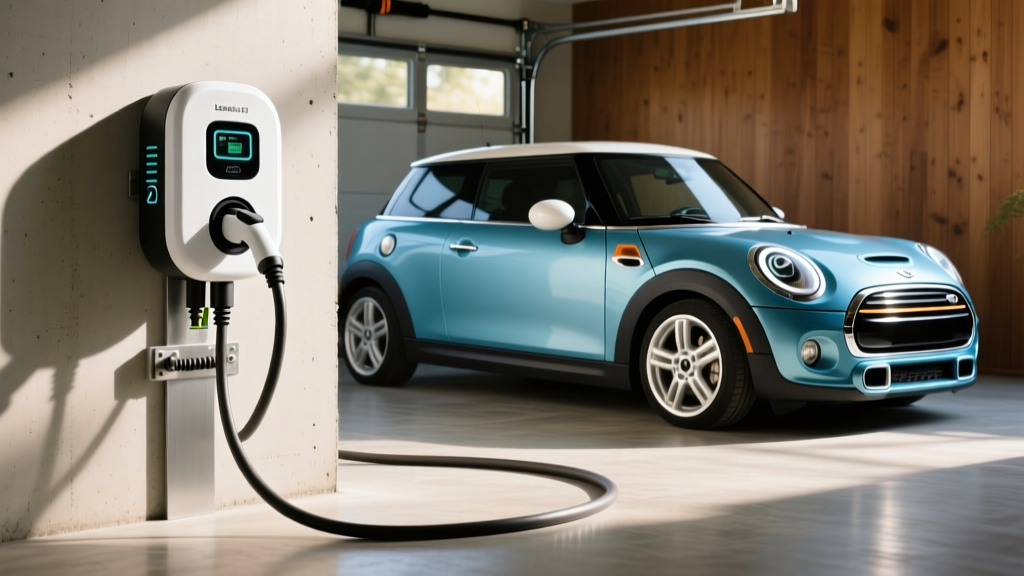
If you've ever owned or researched a 2006 Mini Cooper S with the R170 supercharger, you already understand one thing intimately: forced induction changes how you think about power delivery. That 1.6L Tritec engine pushed 168 hp and 162 lb-ft of torque through a 6-speed manual, delivering a 0–60 mph time of roughly 6.6 seconds and an EPA-rated 25/32 mpg (city/highway). You fueled it in three minutes at any gas station, and the supercharger's whine was part of the charm.
Switching to an electric vehicle means rethinking that entire fueling paradigm. Instead of gas stations, you'll rely on electrons measured in kWh (kilowatt-hours) — the unit of energy stored in your battery — delivered at rates measured in kW (kilowatts) — the unit of power flowing into it. Confusing the two is the single most common mistake new EV owners make. Think of it this way: kW is how fast water flows from a hose; kWh is how much water fills the bucket.
This guide walks you through every aspect of EV charging — from home installation to public networks — using the 2006 Mini Cooper Supercharged as a baseline for what you're leaving behind, and exactly what replaces it.
Charging Levels Explained: Level 1, Level 2, and DC Fast Charging
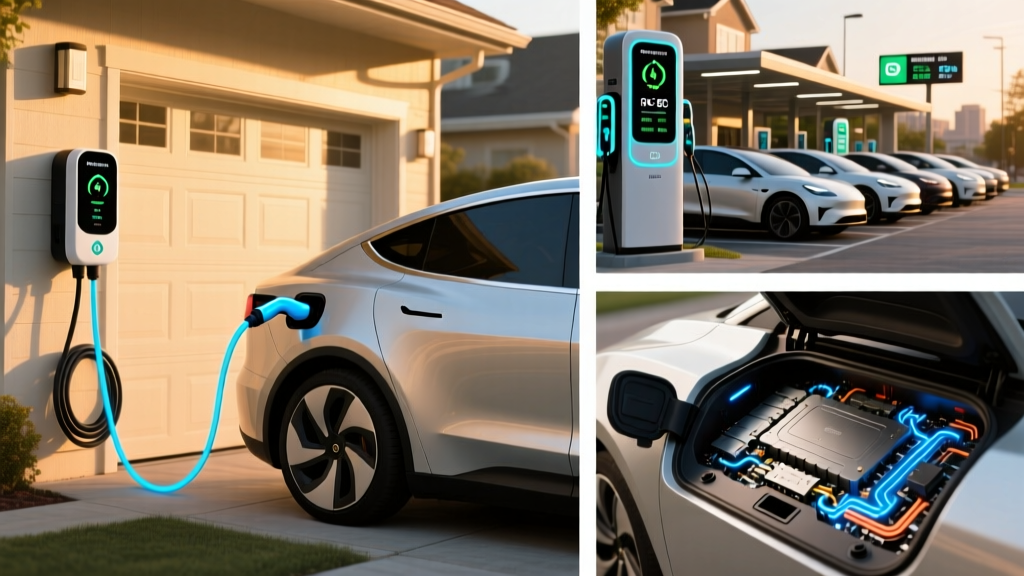
EV charging is divided into three tiers. Each differs in voltage, power output (kW), and how quickly it replenishes your battery. Here's what you need to know, with real-world charge times for a typical 75 kWh battery pack (like a Tesla Model Y Long Range or Hyundai Ioniq 5).
| Level | Voltage | Max Power (kW) | Miles of Range Added per Hour | 10–80% Time (75 kWh battery) | Best For |
|---|---|---|---|---|---|
| Level 1 | 120V AC | 1.4–1.9 kW | 3–5 mi/hr | ~30+ hours | Overnight top-ups, PHEVs, emergencies |
| Level 2 | 240V AC | 7.2–19.2 kW | 20–60 mi/hr | ~5–8 hours (at 11.5 kW) | Daily home charging, workplace |
| DC Fast Charge | 400–800V DC | 50–350 kW | 150–1,000+ mi/hr (peak) | ~18–40 min (varies) | Road trips, rapid replenishment |
Why Your 2006 Mini Cooper Supercharged Got 32 MPG but Your EV Uses MPGe
The 2006 Mini Cooper S supercharged achieved 32 mpg highway on gasoline. Modern EVs use MPGe (miles per gallon equivalent), which converts electrical energy into the energy-equivalent of a gallon of gasoline (33.7 kWh = 1 gallon gas equivalent). A 2026 Hyundai Ioniq 5 achieves 117 MPGe combined (source: fueleconomy.gov). That means it uses roughly 29 kWh per 100 miles — far cheaper per mile than the Mini's 8.7 octane-guzzling gallons per 100 miles at highway speeds.
Home EV Charger Installation: Electrical Requirements and Real Costs
Most EV owners do 80% or more of their charging at home. A Level 2 home charger is the single biggest quality-of-life upgrade in EV ownership. But installation isn't just plugging something in — it involves your home's electrical panel, local permitting, and potentially significant upgrades.
What Your Electrician Needs to Know
A typical Level 2 home charger requires:
- 240V dedicated circuit (same voltage as your dryer or oven)
- 40A or 50A breaker (for 32A or 40A continuous charging, respectively — NEC code requires breakers rated at 125% of continuous load)
- NEMA 14-50 outlet (for plug-in chargers) or hardwired connection (for higher-power units above 48A)
- GFCI protection if the outlet is outdoors or in a garage (per 2020 NEC and later)
- Sufficient panel capacity — your main electrical panel must have room for the new breaker and enough total amperage headroom
The Panel Upgrade Question — The Cost Most Guides Ignore
If your home has a 100A main panel (common in homes built before 1990), adding a 50A EV circuit may require a panel upgrade to 200A. This is the single biggest variable in installation cost. A panel upgrade alone can run $1,500–$3,500 before the charger circuit is even installed. Homes with existing 200A panels usually have sufficient capacity, but your electrician will perform a load calculation to confirm.
| Component | Basic Install (Panel OK) | Complex Install (Panel Upgrade) |
|---|---|---|
| Level 2 Charger Equipment | $400–$700 | $400–$700 |
| Electrician Labor (2–4 hrs basic / 6–10 hrs complex) | $500–$1,200 | $1,500–$3,500 |
| Electrical Permit | $50–$200 | $100–$300 |
| Panel Upgrade (if needed) | $0 | $1,500–$3,500 |
| Conduit/Wiring Materials | $100–$400 | $200–$600 |
| Total Estimated Range | $1,050–$2,500 | $3,700–$8,600 |
Connector Compatibility: NACS, CCS1, CHAdeMO, and Adapters
Unlike the universal gas pump nozzle, EV connectors vary by manufacturer and charging level. As of 2026, the North American market has largely converged on NACS (North American Charging Standard) — the connector Tesla developed and opened to other automakers starting in 2024–2025.
| Connector | Used By | DC Fast Charge Capable? | Notes |
|---|---|---|---|
| NACS (Tesla) | Tesla (all), Ford, GM, Rivian, Volvo, Polestar, BMW, Hyundai/Kia (2025+), Mercedes, Nissan (2025+) | Yes | Now the dominant standard; access to Tesla Supercharger network |
| CCS1 | Legacy VW/Audi (pre-2026), Stellantis, some Honda, older Hyundai/Kia | Yes | Being phased out; CCS-to-NACS adapters available |
| CHAdeMO | Nissan Leaf (legacy), Mitsubishi Outlander PHEV | Yes | Effectively discontinued in North America; very few new stations |
| J1772 | All EVs (Level 1/2 AC charging) | No (AC only) | Universal for slow charging; NACS vehicles use built-in or plug adapter |
Do You Need an Adapter?
If you buy a 2025–2026 EV with a NACS port, you'll charge natively at Tesla Superchargers and most new public DC fast stations. For Level 2 public chargers (which still predominantly use J1772 connectors), your EV either comes with a J1772-to-NACS adapter in the trunk or you'll need to purchase one ($50–$150). If you own an older CCS1 vehicle, a CCS-to-NACS adapter ($200–$300) grants access to Tesla's Supercharger network — now the largest and most reliable in North America.
Cost to Charge: Per-Mile Economics vs. the 2006 Mini Cooper Supercharged
The 2006 Mini Cooper S supercharged required premium unleaded (91 octane recommended). At today's fuel prices and its 25/32 mpg rating, let's compare the per-mile fueling cost against a typical 2026 EV.
| Scenario | 2006 Mini Cooper S (Supercharged) | 2026 EV (e.g., Ioniq 5, 29 kWh/100mi) |
|---|---|---|
| Home Charging (Off-Peak, $0.13/kWh) | N/A | $0.038/mile |
| Home Charging (Peak, $0.25/kWh) | N/A | $0.073/mile |
| Public Level 2 ($0.35/kWh) | N/A | $0.102/mile |
| DC Fast Charging ($0.48/kWh avg) | N/A | $0.139/mile |
| Gasoline ($3.80/gal, 28 mpg combined avg) | $0.136/mile | N/A |
At home off-peak rates, an EV costs roughly $0.04 per mile to "fuel" — about one-quarter the cost of the Mini Cooper S on premium gas. Even DC fast charging on road trips is roughly cost-competitive with gasoline, and you're getting a smoother, quieter ride with zero tailpipe emissions.
Annual Fuel Savings Estimate
Driving 12,000 miles per year:
- 2006 Mini Cooper S: ~12,000 mi ÷ 28 mpg × $3.80 = $1,629/year
- 2026 EV (home off-peak): 12,000 mi × 29 kWh/100mi × $0.13 = $452/year
- Annual savings: ~$1,177 (before accounting for any time-of-use plan optimization)
Equipment Recommendations: Best Home Level 2 Chargers for 2026
Not all Level 2 chargers are equal. The critical specs are power output (kW or amps), connector type, cable length, and smart features (Wi-Fi, scheduling, energy monitoring). Here are three proven picks across budget tiers:
Best Overall: ChargePoint Home Flex (NACS)
- Power: Up to 12 kW (50A circuit) — adjustable down to 16A for lower-capacity panels
- Connector: NACS (2025+ models); CCS1/J1772 older versions available
- Cable: 23 feet
- Smart Features: Wi-Fi, app scheduling, Alexa integration, energy tracking, utility demand-response programs
- Price: ~$599 (charger only)
- Why: Flexible amperage means it works with almost any panel; NACS native for new EVs
Best Value: Emporia Level 2 EV Charger
- Power: Up to 11.5 kW (48A)
- Connector: J1772 (NACS adapter included with 2025+ models)
- Cable: 24 feet
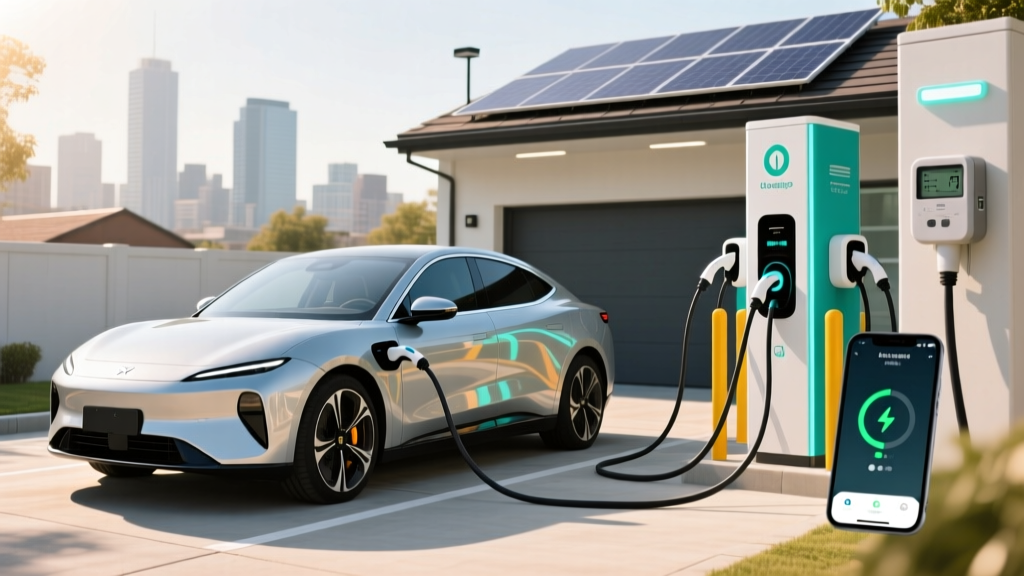
- Smart Features: Wi-Fi, app control, solar integration, real-time cost tracking, load management
- Price: ~$399
- Why: Excellent energy monitoring pairs with Emporia's home energy monitor; ideal for solar homes
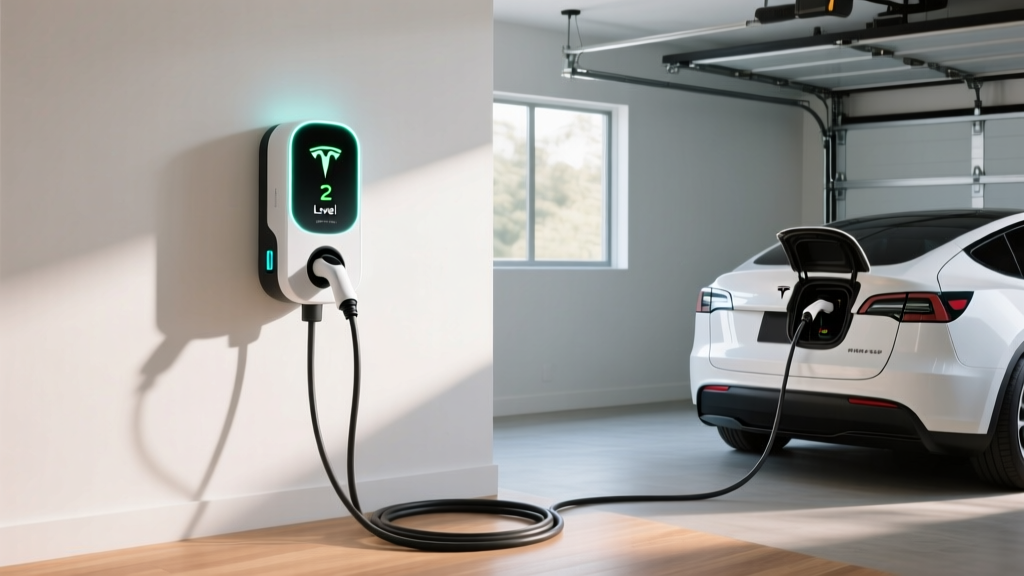
Best for Tesla Owners: Tesla Wall Connector (Gen 4)
- Power: Up to 11.5 kW (48A)
- Connector: NACS native
- Cable: 24 feet
- Smart Features: Wi-Fi, over-the-air updates, Powerwall integration, load sharing (multiple units on one circuit)
- Price: ~$475
- Why: Seamless Tesla ecosystem integration; clean design; load-sharing allows two chargers on a single 60A circuit
DC Fast Charging Reality: Charge Curves, Tapering, and Road-Trip Times
When manufacturers advertise "250 kW DC fast charging," that's a peak rate — not a sustained one. Every EV battery exhibits a charge curve: charging speed is fastest between roughly 10–50% State of Charge (SoC), then progressively tapers as the battery fills to protect cell longevity.
Here's what real-world DC fast charging looks like for popular 2026 EVs:
- Hyundai Ioniq 5 (84 kWh, NMC): Peaks at 240 kW on a 350 kW charger; 10–80% in ~18 minutes; tapers to ~60 kW above 80%
- Tesla Model Y Long Range (~75 kWh, NMC): Peaks at 250 kW at V3 Superchargers; 10–80% in ~22 minutes
- Ford F-150 Lightning Extended Range (131 kWh, NMC): Peaks at 150 kW; 10–80% in ~41 minutes (larger battery = longer absolute time despite similar C-rate)
- Chevrolet Equinox EV (85 kWh, NMC): Peaks at 150 kW; 10–80% in ~30 minutes
Safety, Code Compliance, and Installation Best Practices
EV chargers draw sustained high current for hours — a duty profile most household circuits never experience. Cutting corners on installation isn't just a code violation; it's a fire risk.
Non-Negotiable Safety Requirements
- Dedicated circuit: Your Level 2 charger must be on its own breaker — never shared with other appliances
- Correct wire gauge: 6 AWG copper for 50A circuits; 8 AWG for 40A circuits (NEC Table 310.16)
- GFCI protection: Required for all outdoor receptacles and recommended for garage installations (NEC 2020+ Article 625)
- Outdoor-rated equipment: If your charger is mounted outside, both the unit and the receptacle must carry a NEMA 4 (weatherproof) rating
- Proper grounding: Your electrician should verify ground integrity at the panel — older homes sometimes have inadequate grounding
- Cable management: Use a holster or retractable reel to keep the charging cable off the garage floor and away from vehicle tires
The National Electrical Code (NEC) Article 625 governs EV charging installations. Your local jurisdiction may enforce NEC 2020, 2023, or 2026 editions — each with progressively stricter GFCI and load-management requirements. Always hire a licensed electrician familiar with EV-specific installations.
From Supercharger Whine to Silent Torque: Making the Transition
The 2006 Mini Cooper S supercharged was a driver's car — 168 hp, precise steering, a 6-speed manual, and that distinctive Eaton M45 supercharger whine spooling up at 3,000 RPM. Its EPA ratings of 25 city / 32 highway mpg were respectable for a performance hatchback of its era.
A 2026 EV delivers a fundamentally different experience: instant torque (no supercharger lag), regenerative braking that recaptures energy the Mini's brakes wasted as heat, and fueling that happens in your garage while you sleep. The trade-off is upfront planning — choosing the right charger, budgeting for installation, and understanding your home's electrical capacity.
With a properly installed Level 2 home charger, you'll wake up every morning with a "full tank" for roughly $0.04 per mile — a fraction of what premium gas cost the Mini. And unlike a supercharger that needs belt replacements at 80,000 miles, an EV's electric drivetrain has far fewer moving parts to maintain.
Frequently Asked Questions
How much does it cost to install a home EV charger?
A basic Level 2 installation in a home with an adequate 200A electrical panel typically costs $1,050–$2,500 (equipment + electrician + permit + materials). If your home needs a panel upgrade from 100A to 200A, total costs can reach $3,700–$8,600. Always get at least two quotes from licensed electricians who have EV-charger-specific experience.
How fast will each charging level add range?
Level 1 (120V) adds 3–5 miles of range per hour — adequate for plug-in hybrids with small batteries but painfully slow for full EVs. Level 2 (240V) adds 20–60 miles per hour depending on amperage — enough to fully replenish most EVs overnight. DC fast charging adds 150–1,000+ miles per hour at peak rates, with a typical 10–80% session taking 18–40 minutes depending on the vehicle and charger.
Which connector/charger is compatible with my EV?
Check your vehicle's charge port. For 2025–2026 models, most new EVs use NACS. Older (2020–2024) non-Tesla EVs typically use CCS1. The Nissan Leaf uses CHAdeMO. For Level 1 and Level 2 AC charging, all vehicles can use J1772 with the appropriate adapter. Your EV's manufacturer includes adapter information in the owner's manual.
How much does charging cost per mile vs. gas?
At home off-peak electricity rates (~$0.13/kWh), a typical EV costs $0.04/mile. A 2006 Mini Cooper S supercharged on premium gas at $3.80/gallon costs roughly $0.14/mile. Even public DC fast charging at $0.48/kWh comes in at ~$0.14/mile — comparable to gas. The savings are largest when you can charge at home overnight on a time-of-use plan.
What electrical upgrades might I need?
The most common upgrade is a panel upgrade from 100A to 200A service, required if your existing panel lacks capacity for a 40–50A dedicated EV circuit. Some homes also need a meter base upgrade or new conduit runs from the panel to the garage. Your electrician's load calculation (per NEC Article 220) will determine this. Budget an extra $1,500–$3,500 if a panel upgrade is needed.
Can I use the federal tax credit for a home charger?
The Alternative Fuel Vehicle Refueling Property Credit (IRS §30C) offers up to $1,000 (30% of cost, capped) for home EV charger equipment and installation. This is separate from the §30D new EV purchase credit. Eligibility depends on your census tract meeting certain criteria — check the IRS guidance or consult a tax professional for your specific situation.