When you search for the Go Sun EV charger, you're usually looking at the GoSun PowerGo — a portable solar generator bundled with a Level 1 (120V) EV charging cable. It's a compelling concept: charge your car from the sun, anywhere, off-grid. But how does it stack up against a conventional hardwired Level 2 home charger when the goal is actually adding usable range to your EV? Let's break down the physics, the costs, and the real-world charging math so you can decide which setup — or combination — makes sense for your driving life.
Understanding the Go Sun EV Charger: What You're Actually Buying
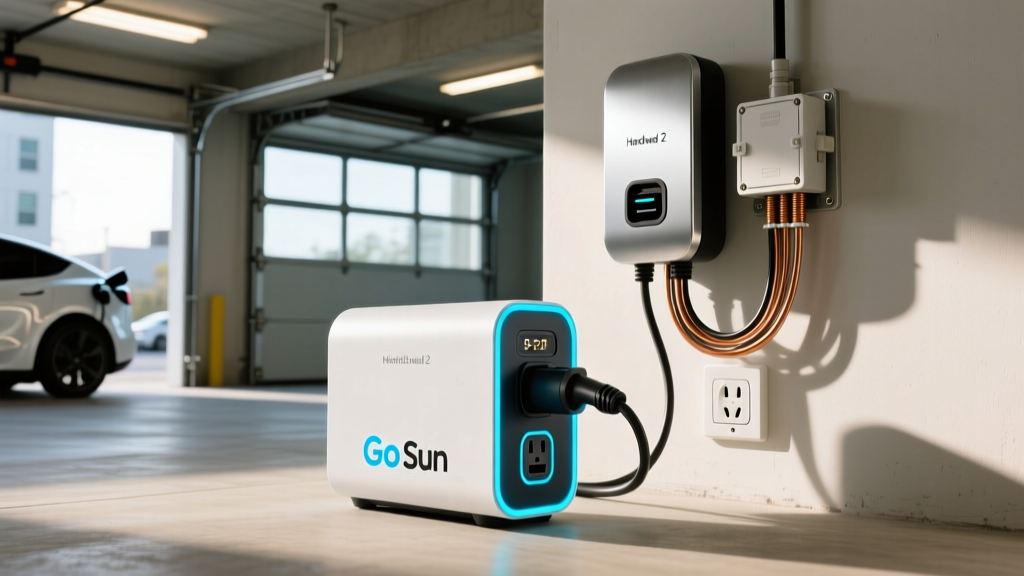
The GoSun PowerGo is a portable power station (roughly 2.4 kWh of usable battery capacity) paired with foldable solar panels (typically 120W–240W of peak solar input). It includes a standard 120V AC outlet, which means you can plug in the OEM Level 1 charging cable that came with your EV. It does not provide Level 2 (240V) charging. This is the single most important thing to understand before comparing it to a wall-mounted home charger.
Here's what that means in practice:
- Battery capacity: ~2.4 kWh (usable). That's enough to add roughly 6–9 miles of range to a typical EV (at 3–4 mi/kWh).
- Solar recharge rate: With two 120W panels in full, unobstructed sun, you might recover 150–200W of input — meaning it takes 12–16 hours of perfect sunlight to fully recharge the PowerGo itself.
- EV charging output: Level 1, 120V, ~1.4 kW (12 amps). This adds roughly 3–5 miles of range per hour of charging, depending on your EV's efficiency.
- Price: The GoSun PowerGo + solar panel kit typically retails between $1,500 and $2,500, depending on configuration.
It's a legitimate emergency backup and off-grid tool. It is not a daily-charging replacement for a Level 2 home setup.
Charging Levels Explained: Speed, Power, and Range Per Hour
Before comparing equipment, you need a firm grasp of EV charging levels. The critical distinction: kW (kilowatts) measures power — the rate at which energy flows into your car. kWh (kilowatt-hours) measures energy — the total amount stored in your battery. Think of kW as the width of the hose and kWh as the size of the bucket.
| Level | Voltage / Amps | Power (kW) | Miles of Range Added Per Hour | Typical Use Case |
|---|---|---|---|---|
| Level 1 | 120V / 12A | ~1.4 kW | 3–5 mi/hr | Overnight top-up, GoSun PowerGo, emergencies |
| Level 2 | 240V / 32–48A | 7.7–11.5 kW | 22–44 mi/hr | Daily home charging (primary method for most owners) |
| DC Fast Charge | 400–800V DC | 50–350 kW | 150–300+ mi in 20–30 min | Road trips, highway corridors |
A few real-world examples to make this concrete:
- Tesla Model Y (75 kWh usable battery, ~310 mi EPA): Level 1 (1.4 kW) adds ~4 mi/hr — a full overnight session (10 hours) nets about 40 miles. A Level 2 charger at 11.5 kW (48A) adds ~38 mi/hr — that same 10-hour window fills the battery completely. At a 250 kW DC fast charger, 10–80% takes roughly 15–20 minutes.
- Hyundai Ioniq 5 (77.4 kWh, ~303 mi EPA): Thanks to its 800V architecture, it can peak at ~240 kW on a compatible DC charger, achieving 10–80% in approximately 18 minutes. On Level 2 at 11.5 kW, it adds ~36 mi/hr.
- Ford F-150 Lightning Extended Range (131 kWh, ~320 mi EPA): Its massive battery means Level 1 charging is almost impractical — ~3 mi/hr would take 44 hours for a full charge. Level 2 at 11.5 kW adds ~23 mi/hr, and a 150 kW DC fast charge does 15–80% in about 45 minutes.
Where does the Go Sun EV charger fit? It's Level 1 — so expect 3–5 mi/hr, constrained further by its 2.4 kWh internal battery. If you drain the PowerGo into your car, you'll get about 7 miles of range before the PowerGo itself needs a recharge (which takes all day via solar).
Home Level 2 Installation: Electrical Requirements and Real Costs
If you're a daily driver, a hardwired Level 2 home charger is the backbone of EV ownership. Here's what an installation actually involves.
Electrical Specifications
A typical Level 2 home charger requires a dedicated 240V circuit, similar to what powers an electric dryer or oven. The two most common configurations:
- 40-amp circuit → delivers 32 amps continuous to the car (NEC code requires circuits rated at 125% of continuous load) → 7.7 kW output
- 60-amp circuit → delivers 48 amps continuous → 11.5 kW output
Most modern EVs accept up to 11.5 kW on Level 2 (48A), though some — like the base Tesla Model 3 — are limited to 7.7 kW (32A) onboard. Check your vehicle's onboard charger spec before overspending on a 48A unit.
Panel Capacity and the Upgrade Question
Many older homes have a 100-amp electrical panel that's already near capacity. Adding a 60-amp EV circuit may require a panel upgrade to 200 amps, which is the single biggest variable in installation cost. Signs you may need an upgrade:
- Your panel is 100A or less
- You already have multiple large-draw appliances (electric range, dryer, HVAC, hot tub)
- Your electrician's load calculation shows less than 20% spare capacity
Some utilities and states offer rebates for panel upgrades tied to EV adoption — check with your local utility or the Alternative Fuels Data Center for current programs.
Installation Cost Breakdown
| Component | Basic Install (40A, short run) | Complex Install (60A, long run + panel upgrade) |
|---|---|---|
| Level 2 Charger Unit (hardwired, 32–48A) | $400–$650 | $500–$750 |
| Electrician Labor (permit, wiring, breaker) | $500–$1,200 | $1,500–$3,000 |
| Electrical Panel Upgrade (if needed) | $0 (not needed) | $1,500–$3,500 |
| Permit Fees | $50–$150 | $100–$300 |
| Total Estimated Cost | $950–$2,000 | $3,600–$7,550 |
The wide range is real. A homeowner with a 200A panel and a garage outlet 10 feet from the panel might spend under $1,200 all-in. A 1970s home needing a service upgrade and a 60-foot conduit run to a detached garage could exceed $7,000. Always get a load calculation and itemized quote from a licensed electrician before committing.
Note: The federal Alternative Fuel Vehicle Refueling Property Credit (IRC §30C) offers up to $1,000 (30% of cost, capped) for home charger installation through 2032, subject to census-tract eligibility. Confirm your address qualifies on the IRS site before assuming you'll receive it.
Connector Compatibility: NACS, CCS, and CHAdeMO in 2026
The North American EV charging connector landscape has consolidated significantly. Here's where things stand for the 2026 model year:
| Connector | Brands Using It (Native) | Notes |
|---|---|---|
| NACS (Tesla / J3400) | Tesla, Ford, GM, Rivian, Volvo, Polestar, Mercedes-Benz, BMW, Hyundai, Kia (select 2026+ models) | Becoming the dominant standard; access to Tesla Supercharger network |
| CCS1 | VW ID.4 (legacy), older BMW iX, Stellantis models | Being phased out on new models; adapters available for Supercharger access |
| CHAdeMO | Nissan Leaf (discontinued in US), Mitsubishi Outlander PHEV | Effectively deprecated for new vehicles; limited public infrastructure |
For Level 2 home charging, the connector is less of a concern — all Level 2 chargers use a J1772 plug, and every NACS-equipped vehicle ships with (or can use) a J1772-to-NACS adapter. When shopping for a home charger, confirm:
- Does the charger have a J1772 plug (universal for Level 2)? Most do.
- If you drive a Tesla, does the charger include a NACS plug, or will you use the adapter? Dedicated NACS chargers like the Tesla Wall Connector eliminate adapter fumbling.
- For public DC fast charging, confirm your vehicle's native connector and whether you need a CCS-to-NACS adapter (Tesla sells one for ~$250) for Electrify America or EVgo stations.
Cost to Charge: Home vs. Public vs. Gas Per Mile
The economics of EV charging depend heavily on where you plug in. Here's a realistic comparison using 2026 average rates.
| Charging Scenario | Avg Cost ($/kWh) | Cost Per Mile (at 3.5 mi/kWh) | Annual Cost (12,000 mi) |
|---|---|---|---|
| Home, off-peak utility rate | $0.08–$0.14 | $0.023–$0.040 | $275–$480 |
| Home, standard residential rate | $0.14–$0.18 | $0.040–$0.051 | $480–$615 |
| Public Level 2 (ChargePoint, etc.) | $0.25–$0.49 | $0.071–$0.140 | $855–$1,680 |
| DC Fast Charging (EA, EVgo, Tesla) | $0.35–$0.65 | $0.100–$0.186 | $1,200–$2,230 |
| GoSun PowerGo (solar, amortized) | ~$0.00 marginal (sunlight) | ~$0.00 | $0 (but ~6–9 mi/day max) |
| Gasoline (25 MPG avg, $3.50/gal) | — | $0.140 | $1,680 |
Key takeaways:
- Home charging is where the savings live. If 80%+ of your charging happens at home on an off-peak rate, your per-mile fuel cost is roughly one-quarter to one-third of a gas car's.
- Exclusive DC fast charging erases the advantage. If you live in an apartment without home charging and rely entirely on public DC fast chargers at $0.50/kWh, your per-mile cost can approach or exceed that of a fuel-efficient gas car.
- The GoSun PowerGo offers "free" energy — but in tiny quantities. The solar input costs nothing, but the hardware cost ($1,500–$2,500) amortized over its lifespan, plus the severe output limitation (~7 miles per full discharge), means it's a supplement, not a strategy.
Recommended Level 2 Home Chargers for 2026
Here are proven, widely available Level 2 units that outperform the GoSun PowerGo for daily charging by orders of magnitude:
Tesla Wall Connector (J3400/NACS or J1772)
- Power output: Up to 11.5 kW (48A) on a 60A circuit
- Cable length: 24 feet
- Smart features: Wi-Fi, OTA updates, power-sharing between units, access control
- Price: ~$475
- Best for: Tesla, Ford, GM, and other NACS-native vehicles; cleanest install with no adapter needed
ChargePoint Home Flex
- Power output: Configurable up to 12 kW (50A) on a 60A circuit, or down to 16A for smaller circuits
- Cable length: 23 feet
- Smart features: App scheduling, energy tracking, Alexa integration, flexible amperage setting
- Price: ~$550–$650
- Best for: Homes with varying circuit capacities; J1772 connector works with all EVs (NACS cars use adapter)
Emporia Level 2 EV Charger
- Power output: Up to 11.5 kW (48A) on a 60A circuit
- Cable length: 24 feet
- Smart features: App control, energy monitoring, solar-integration capable (pairs with Emporia Vue panel monitor), load management
- Price: ~$400–$500
- Best for: Budget-conscious buyers who want smart features; solar-home owners who want to prioritize excess solar for EV charging
Compared to the GoSun PowerGo ($1,500–$2,500 for ~1.4 kW), any of these Level 2 chargers deliver 5–8× the charging power at a fraction of the hardware cost — though they do require professional electrical installation.
Where the Go Sun EV Charger Actually Makes Sense
Despite its limitations for daily use, the GoSun PowerGo fills a genuine niche:
- Emergency backup: If your grid goes down during a storm, the PowerGo can add 6–9 miles of range — potentially enough to reach a shelter or charging station.
- Off-grid and boondocking: For overlanders and campers who park far from grid power, solar trickle-charging an EV is genuinely novel.
- Apartment dwellers (limited use): If you have a sunny balcony and no access to Level 2 charging, the PowerGo can slowly top up your car — though it's agonizingly slow compared to even a basic 120V wall outlet.
- Supplementing, not replacing: Pair a Level 2 home charger for daily driving with the PowerGo as a road-trip emergency kit. That's the practical use case.
Safety, Permits, and Code Requirements for Home Charging
Whether you install a Level 2 charger or use a portable unit, electrical safety is non-negotiable. Key requirements per the National Electrical Code (NEC):
- Dedicated circuit: Your Level 2 charger must be on its own dedicated breaker — never shared with other outlets or appliances.
- GFCI protection: NEC 2020 and later require GFCI (Ground Fault Circuit Interrupter) protection for all EV charging outlets. Hardwired chargers with built-in ground-fault protection may satisfy this; your electrician will confirm.
- Outdoor rating: If your charger is installed outdoors (driveway, carport), the unit must carry a NEMA 4 or IP55+ weather resistance rating. All three chargers recommended above are outdoor-rated.
- Permit required: Most jurisdictions require an electrical permit for a new 240V circuit. Your electrician typically pulls this. Expect an inspection after installation — don't skip it; unpermitted work can void homeowner's insurance.
- Cable management: Use a holster or retractable reel to keep the charging cable off the ground, especially outdoors. Tripping hazards and cable damage are the most common residential EV charging complaints.
For the GoSun PowerGo specifically, since it outputs standard 120V AC, no electrical permit is needed — you're essentially plugging into a portable generator. However, never use an extension cord between the PowerGo and your EV's Level 1 cable; voltage drop over distance can cause charging faults or overheating.
Frequently Asked Questions
How much does it cost to install a home EV charger?
A basic Level 2 installation (40A circuit, short wire run, no panel upgrade) typically costs $950–$2,000 all-in, including the charger unit ($400–$650), electrician labor ($500–$1,200), and permit ($50–$150). If your home needs a 200A panel upgrade, total costs can reach $3,600–$7,550. Get a load calculation from a licensed electrician before committing.
How fast will each charging level add range?
Level 1 (120V, 1.4 kW): 3–5 miles per hour. Level 2 (240V, 7.7–11.5 kW): 22–44 miles per hour. DC Fast Charging (50–350 kW): 150–300+ miles in 20–30 minutes, though speed tapers significantly above 80% state of charge. The GoSun PowerGo operates at Level 1 speeds.
Which connector/charger is compatible with my EV?
For 2026 model-year vehicles, NACS (J3400) is the dominant standard, used by Tesla, Ford, GM, Rivian, Hyundai, Kia, and others. CCS1 is being phased out but still appears on some models. All Level 2 home chargers use a J1772 plug; NACS vehicles include a J1772-to-NACS adapter. For DC fast charging, verify your vehicle's native connector and whether you need an adapter for networks like Electrify America.
How much does charging cost per mile vs gas?
Home charging on an off-peak utility rate ($0.08–$0.14/kWh) costs roughly $0.02–$0.04 per mile for a typical EV — about one-quarter to one-third the cost of gasoline at $3.50/gal and 25 MPG ($0.14/mile). Public DC fast charging at $0.35–$0.65/kWh can push per-mile costs to $0.10–$0.19, narrowing the gap significantly.
What electrical upgrades might I need?
If your home has a 100-amp electrical panel that's already near capacity, adding a 40–60 amp dedicated EV circuit may require a panel upgrade to 200 amps ($1,500–$3,500). An electrician performs a load calculation to determine this. Homes built after 2000 with 200A service rarely need an upgrade. Some utilities offer rebates for panel upgrades tied to EV adoption.
Can the Go Sun EV charger replace a Level 2 home charger?
No. The GoSun PowerGo outputs Level 1 power (~1.4 kW) and is limited by its 2.4 kWh internal battery — yielding roughly 6–9 miles of range per full charge, with a full solar recharge taking 12–16 hours. A Level 2 home charger delivers 7.7–11.5 kW and can fully recharge most EVs overnight. The PowerGo is a supplemental or emergency tool, not a primary charging solution.