The Shift Toward Detached Garage EV Charging
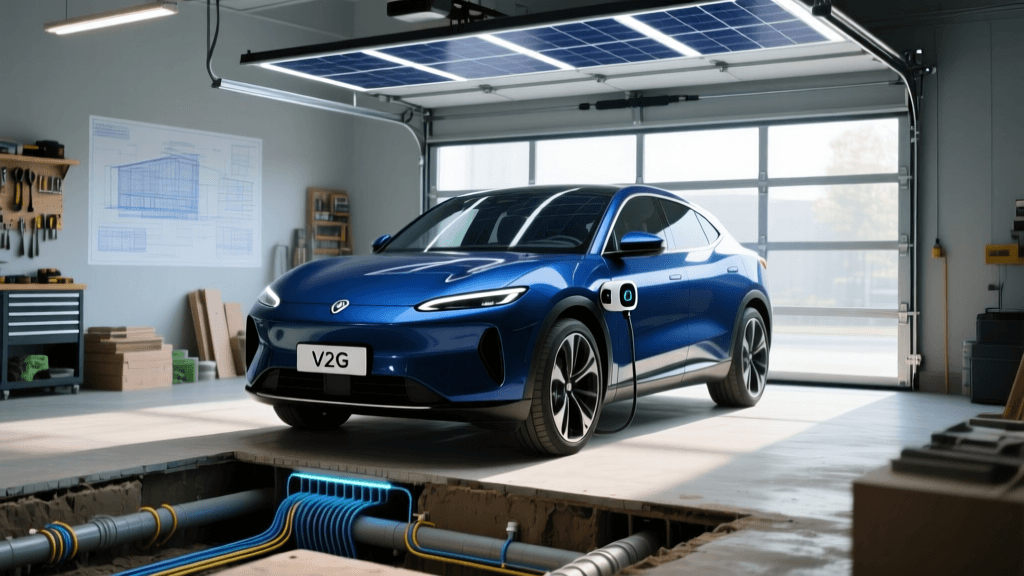
As electric vehicle adoption accelerates, homeowners with detached garages, workshops, and rural carports face unique infrastructure challenges. Unlike attached garages where a simple drywall punch-through can connect an EVSE (Electric Vehicle Supply Equipment) to the home's main panel, detached structures require underground trenching, long wire runs, and independent grounding. However, looking through the lens of future industry trends, a detached garage is no longer just a place to park—it is evolving into a decentralized energy hub. From bidirectional charging (V2H) to solar-integrated microgrids and wireless inductive charging pads, the way we power EVs is changing rapidly. To avoid costly re-trenching in the next decade, your EV charger installation must be future-proofed today.
The Underground Conduit Run: Sizing for the Next Decade
The most critical mistake homeowners make when wiring a detached garage for an EV charger is sizing the conduit for today's needs rather than tomorrow's. Currently, a standard Level 2 charger like the ChargePoint Home Flex requires a 60-amp breaker and 6 AWG copper wire for a 48-amp continuous charge. However, as battery capacities grow and DC fast-charging architectures trickle down to residential setups, power demands will increase.
Why 2-Inch PVC is the New Standard
Most electricians will default to 1-inch or 1.25-inch Schedule 40 PVC conduit for a 60-amp subpanel feed. From a future-proofing perspective, this is a bottleneck. We strongly recommend installing a minimum 2-inch Schedule 40 or Schedule 80 PVC conduit. The material cost difference is negligible (often less than $50 for a 100-foot run), but it provides the physical space required to pull thicker 2 AWG or 1/0 AWG aluminum wiring in the future, or to run a secondary line for a heavy-duty welder or automotive lift. Furthermore, a 2-inch conduit allows you to pull a dedicated direct-burial Cat6a ethernet cable alongside your electrical wires, ensuring hardwired connectivity for smart home integrations.
Voltage Drop and the 100-Foot Rule
According to the U.S. Department of Energy, maintaining optimal voltage is critical for EV battery health and charging speed. Over a 100-foot run from the main house to a detached garage, standard 6 AWG copper wire can experience a voltage drop exceeding 3%, which triggers thermal throttling in smart chargers like the EnelX JuiceBox or Wallbox Pulsar Plus. To future-proof against this, upsize your wiring to 4 AWG copper or 2 AWG aluminum for any detached run exceeding 75 feet. Always use sweeping bends (long-radius elbows) rather than sharp 90-degree angles, and install a pull box if your conduit run exceeds 100 feet or has more than 360 degrees of total bends, per National Electrical Code (NEC) guidelines.
Preparing for Bidirectional Charging (V2H and V2G)
The most significant industry trend on the horizon is Vehicle-to-Home (V2H) and Vehicle-to-Grid (V2G) technology. Vehicles like the Ford F-150 Lightning, Chevrolet Silverado EV, and Hyundai Ioniq 5 are capable of powering a home during an outage or selling energy back to the grid during peak pricing hours. The National Renewable Energy Laboratory (NREL) highlights that V2G integration will be a cornerstone of future grid stability, effectively turning your EV into a rolling residential battery.
Grounding and Subpanel Requirements for V2H
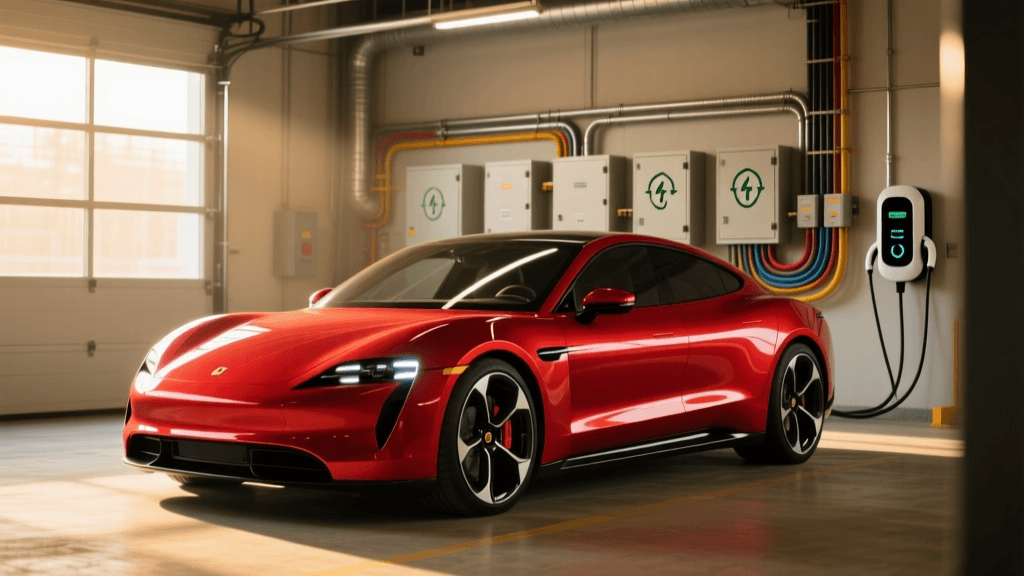
To support bidirectional charging in a detached garage, your electrical setup must be flawless. You cannot rely on a simple 3-wire feed. You must install a 4-wire feed (two hots, one neutral, one isolated ground) to a detached subpanel. Furthermore, NEC Article 250 requires a separate grounding electrode system (typically two 8-foot copper ground rods driven 6 feet apart) at the detached structure. When bidirectional chargers like the upcoming Ford Charge Station Pro are installed, they act as a secondary service disconnect. Ensuring your detached garage subpanel has a main breaker and proper isolated grounding is non-negotiable for future V2H compatibility.
Solving the Detached Garage Connectivity Gap
Modern smart chargers rely on Wi-Fi to receive over-the-air (OTA) firmware updates, participate in utility demand-response programs, and manage solar-load balancing. However, detached garages are notorious Wi-Fi dead zones. A weak 2.4GHz signal can cause a charger to drop offline, halting scheduled charging sessions.
- Point-to-Point Wireless Bridges: Install a dedicated outdoor bridge (like the Ubiquiti NanoStation or TP-Link CPE510) on the exterior of your home, aimed at a receiver on the detached garage. This creates a dedicated, high-bandwidth data link.
- Buried Fiber or Cat6a: If you are already trenching a 2-inch conduit, pull a shielded, direct-burial Cat6a cable or a fiber-optic line. This guarantees zero latency for smart panel load managers like the Emporia VUE or Span smart panels, which require real-time data to prevent main breaker trips when the EV charger and HVAC run simultaneously.
Installation Methods: Trenching vs. Directional Boring
How you get the conduit from the main house to the detached garage impacts your landscaping and future upgradeability. Below is a comparison of current installation methods and their viability for future-proofing.
| Installation Method | Avg Cost (per 100ft) | Landscape Disruption | Future-Proofing Score | Best Application |
|---|---|---|---|---|
| Open Trenching (18-24 inches deep) | $800 - $1,500 | High (destroys sod/driveways) | Excellent (easy to access/upgrade) | New construction or unfinished yards |
| Directional Boring (Underground boring) | $1,500 - $3,000 | Low (preserves driveways/roots) | Good (requires pull-boxes for upgrades) | Long runs under existing concrete/asphalt |
| Micro-Trenching (Saw-cutting) | $600 - $1,200 | Moderate (thin line in asphalt) | Poor (limited to shallow, small conduit) | Temporary or low-voltage data lines only |
For future-proofing, open trenching at a depth of 24 inches remains the gold standard. It allows you to lay a 2-inch electrical conduit alongside a 1-inch conduit reserved exclusively for future low-voltage data or water lines. If you must cross a paved driveway, directional boring is highly recommended to avoid structural weakening of the concrete.
Emerging Tech: Wireless Inductive Charging Pads
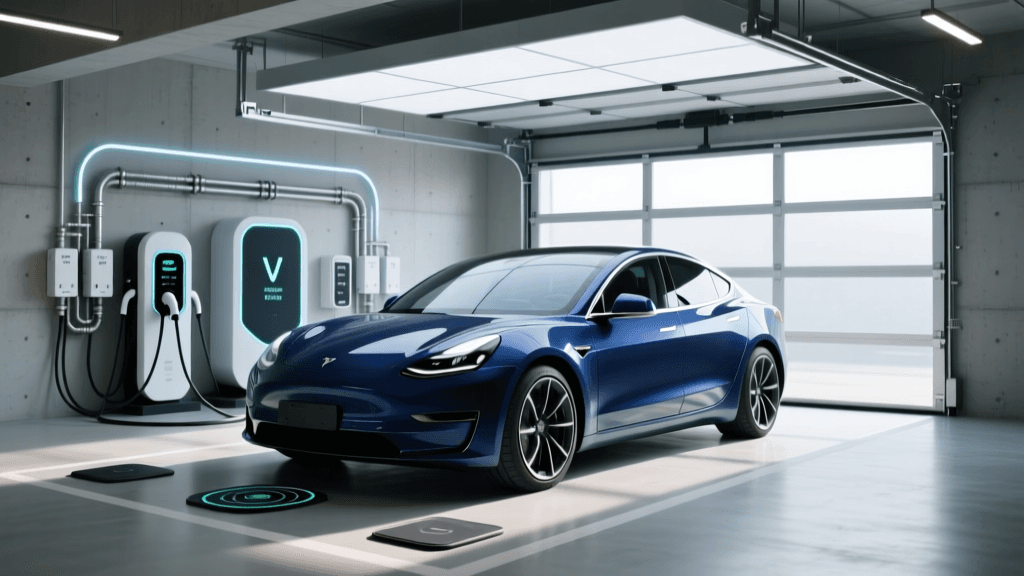
Looking further ahead, the industry is moving toward wireless inductive charging. Companies like WiTricity are developing high-efficiency magnetic resonance pads embedded directly into the ground. According to the Alternative Fuels Data Center, while wireless charging is currently limited to specific fleet and luxury models, residential adoption is expected to rise as standardized SAE J2954 protocols mature. If you are pouring a new concrete slab for your detached garage or extending your driveway pad to reach it, consider installing an empty, capped 1-inch conduit terminating in the exact center of the EV parking space. This 'ghost conduit' will allow you to easily wire an in-ground wireless charging pad in the future without jackhammering your new concrete.
Integrating Solar Carports and Microgrids
Many homeowners with detached garages are opting to turn them into solar carports. If your detached structure has a south-facing roof, installing a dedicated solar array paired with a stationary battery (like the Tesla Powerwall) creates an independent microgrid. In this scenario, your EV charger should be wired directly to this critical loads subpanel rather than the main house. This ensures that during a grid outage, your EV can still charge off the sun, or conversely, power your detached workshop via V2H. Always ensure your electrician installs a smart load-shedding relay, which will automatically throttle the EV charger's amperage if the solar array's production drops due to cloud cover, preventing the microgrid inverter from faulting.
Conclusion
Installing an EV charger in a detached garage is a significant investment that requires looking beyond today's 48-amp Level 2 standards. By oversizing your underground conduit to 2 inches, upping your wire gauge to mitigate voltage drop, ensuring NEC-compliant isolated grounding for bidirectional V2H readiness, and solving the Wi-Fi connectivity gap, you insulate your property from the costly upgrades of tomorrow. As the grid evolves and vehicles become mobile power plants, your detached garage will be perfectly positioned to serve as the ultimate smart-energy hub.