The Evolution of the Detached Garage: From Storage to Energy Hub
As electric vehicle (EV) adoption accelerates, the traditional detached garage is undergoing a radical transformation. No longer just a space for storage or woodworking, outbuildings are evolving into localized energy hubs. According to the Alternative Fuels Data Center (AFDC), over 80% of EV charging occurs at home, but for homeowners with detached garages, the logistics of running power across a yard present unique challenges. Looking ahead, future trends in residential electrical infrastructure are shifting away from simple point-to-point charging toward resilient, bidirectional microgrids. This guide explores the future of detached garage EV charger installations, providing actionable advice on trenching, sub-panel sizing, and emerging technologies like Vehicle-to-Home (V2H) integration.
Future Trends Shaping Outbuilding EV Infrastructure
1. Bidirectional Charging (V2H and V2G) Readiness
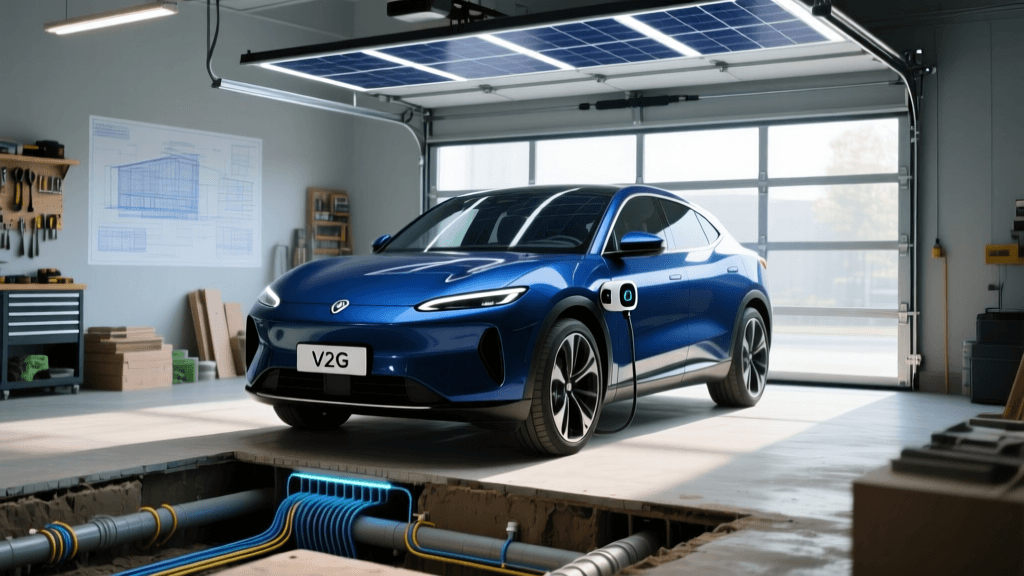
The most significant trend in EV infrastructure is the shift toward bidirectional charging. Vehicles like the Ford F-150 Lightning, Hyundai Ioniq 5, and upcoming Tesla Cybertruck are capable of Vehicle-to-Home (V2H) and Vehicle-to-Grid (V2G) power transfer. The U.S. Department of Energy highlights that V2G technology allows EVs to act as mobile battery storage, feeding power back into the grid or a home during peak demand or outages. For a detached garage, this means the outbuilding could theoretically power the main house during a blackout. However, this requires a strict 4-wire feeder connection (two hots, one neutral, one ground) and a specialized sub-panel setup that separates the neutral and ground bars—a massive departure from older 3-wire outbuilding codes.
2. Solar Canopies and Localized Battery Storage
Trenching hundreds of feet from a main house panel to a detached garage is expensive and disruptive. The future outlook favors localized generation. Homeowners are increasingly installing solar carports over the driveway leading to the detached garage, or mounting solar arrays directly on the outbuilding's roof. By pairing a local solar array with a stationary battery (like the Tesla Powerwall or Enphase IQ 5P) inside the garage, owners can create an off-grid capable charging station. This reduces the need for massive underground feeder wires and bypasses main service panel limitations entirely.
3. Advanced Trenching and Directional Boring
When grid connection is necessary, the method of getting wire to the garage is evolving. Traditional open trenching destroys landscaping, hardscaping, and sprinkler systems. The industry is rapidly adopting horizontal directional boring (HDD) and micro-trenching for residential EV projects. Directional boring allows electricians to pull conduit under driveways, patios, and tree root systems without tearing up the surface, preserving property value while future-proofing the pathway for fiber optics or additional power lines.
Technical Guide: Wiring and NEC Compliance for Detached Structures
Installing power in a detached garage is governed by strict National Electrical Code (NEC) regulations, specifically NFPA 70 (NEC) Article 225, which covers Outside Branch Circuits and Feeders. To future-proof your installation for high-amperage Level 2 chargers or bidirectional setups, you must exceed current minimum requirements.
Sizing the Conduit and Feeder Wire
Most electricians will pull 6 AWG copper wire through a 1-inch PVC conduit to support a standard 60-amp breaker and a 48-amp continuous EV charger. This is a short-sighted approach. The future-proof standard is to bury a 2-inch Schedule 80 PVC conduit. This allows you to pull 4/0 AWG XHHW-2 aluminum wire, which is vastly more cost-effective than copper and can safely support a 200-amp sub-panel. Upgrading the conduit size adds less than $200 to a typical trenching job but saves thousands in future upgrades.
Grounding and Disconnect Requirements
A detached garage requires its own Grounding Electrode System. This typically involves driving two 5/8-inch copper-clad steel ground rods, at least 8 feet long, spaced a minimum of 6 feet apart, and bonding them to the sub-panel's ground bar. Furthermore, NEC Article 225 requires a disconnecting means at the outbuilding. Installing a main breaker sub-panel (e.g., a 100A or 200A panel with a main shutoff) satisfies this requirement while providing ample space for future circuits like welders, air compressors, or secondary chargers.
Cost Analysis: Standard vs. Future-Proofed Installation
When planning a detached garage installation, homeowners must weigh immediate costs against long-term utility. Below is a comparison between a standard minimum-code installation and a future-proofed setup designed for V2H and heavy-duty tool usage.
| Feature | Standard Install (60A) | Future-Proof Install (200A) |
|---|---|---|
| Conduit Size & Type | 1-inch Schedule 40 PVC | 2-inch Schedule 80 PVC |
| Feeder Wire | 6 AWG Copper (4-wire) | 4/0 AWG Aluminum (4-wire) |
| Sub-Panel | 60A Main Lug | 200A Main Breaker |
| Charger Compatibility | ChargePoint Home Flex (48A) | Emporia VUE / Bidirectional Ready |
| Trenching Method | Open Trench (18" depth) | Directional Boring / Micro-trench |
| Estimated Material Cost | $600 - $900 | $1,200 - $1,800 |
| Estimated Labor Cost | $1,500 - $2,500 | $2,500 - $4,500 |
Step-by-Step Action Plan for Homeowners
To ensure your detached garage is ready for the next decade of EV innovation, follow these actionable steps when contracting your installation:
- Step 1: Survey the Route with a Boring Contractor. Before digging, use a private utility locator and consult with a contractor who specializes in directional boring to map a path that avoids tree roots and existing irrigation.
- Step 2: Mandate 4-Wire Feeder and Isolated Grounds. Explicitly instruct your electrician that this sub-panel will be used for sensitive EV electronics and potential V2H backfeed. The neutral and ground must be isolated at the sub-panel, with a dedicated grounding rod system installed outside the garage.
- Step 3: Install Smart Load Management. If your main house panel is maxed out at 200A, utilize a smart charger like the Emporia VUE or a ChargePoint Home Flex paired with an automatic load management sensor. This allows the detached garage to draw high amperage when the house is asleep, but automatically throttles the charger if the main house turns on the HVAC or electric oven.
- Step 4: Pre-Wire for Solar and Battery. Even if you are not buying solar today, run an extra 1-inch flexible conduit from the garage roof to the sub-panel location. This allows a future solar installer to pull DC wires down the wall without tearing open the drywall.
Conclusion
The detached garage is no longer an afterthought in residential electrical design; it is the frontier of home energy resilience. By embracing future trends like bidirectional charging, localized solar storage, and advanced trenching techniques, homeowners can transform their outbuildings into powerful, self-sustaining energy hubs. While the upfront cost of a 200-amp, 4-wire future-proofed installation is higher than a basic 60-amp run, the return on investment—measured in grid independence, increased property value, and seamless EV integration—makes it an essential upgrade for the modern electric vehicle owner.