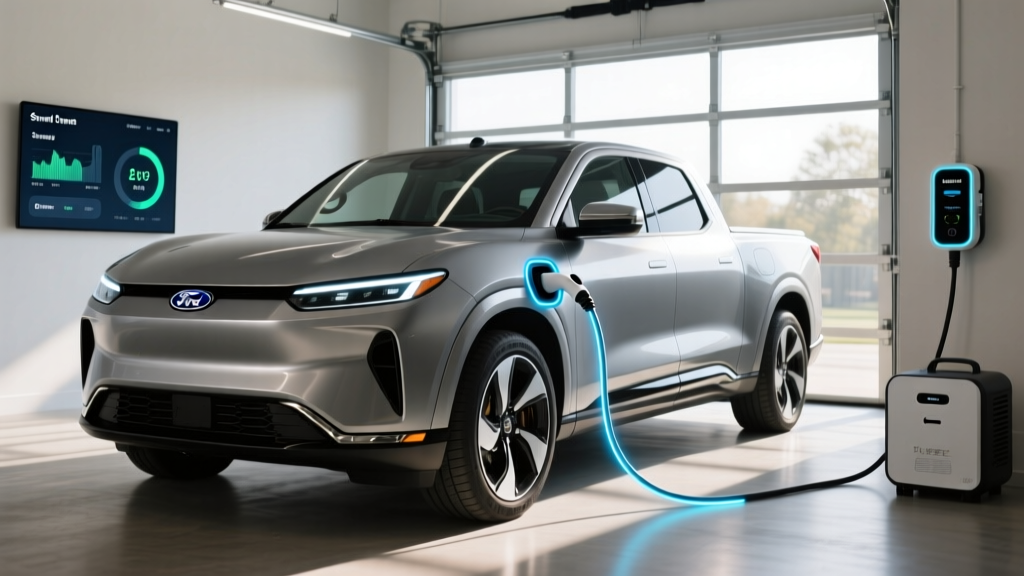
Ford Lightning Charging at a Glance: What Owners Need to Know
The Ford F-150 Lightning packs a massive battery — either 98 kWh usable (Standard Range) or 131 kWh usable (Extended Range) — and that capacity directly dictates how you charge it, how long it takes, and what electrical infrastructure you'll need at home. Whether you're shopping for a Lightning or already have one parked in your driveway, understanding the charging ecosystem is the difference between effortless daily driving and frustrating sessions at underpowered public stations.
This guide breaks down every charging scenario for the F-150 Lightning: Level 1 trickle charging from a standard outlet, Level 2 home and destination charging, and DC fast charging on road trips. We'll cover exact kW figures, real-world charging times, home installation costs with electrician breakdowns, connector compatibility (including Ford's transition to NACS), and what you'll actually pay per mile compared to a gas F-150.
- Standard Range: 98 kWh usable (LFP chemistry, 2024+ models) — EPA 240 miles; expect ~190–210 miles highway or loaded
- Extended Range: 131 kWh usable (NMC chemistry) — EPA 320 miles; expect ~250–280 miles highway or loaded
- Max DC Fast Charge Rate: 150 kW (Standard Range), 150 kW (Extended Range, 2022–2023) / up to 155 kW (2024+ Extended Range)
- Onboard Charger (Level 2): 10.5 kW standard / 19.2 kW available (80A dual-charger option, 2022–2023; 19.2 kW standard on some 2024+ trims)
Charging Levels Explained: Speeds, kW, and Miles Per Hour
The single most important distinction in EV charging is between kW (kilowatts), which measures power — how fast energy flows into your battery — and kWh (kilowatt-hours), which measures energy capacity — how much total energy the battery stores. Think of kW as the width of the pipe and kWh as the size of the tank. A wider pipe (higher kW) fills the tank faster.
| Level | Power (kW) | Miles of Range Added Per Hour | Typical Use Case |
|---|---|---|---|
| Level 1 (120V, 12A) | ~1.4 kW | ~2–3 miles/hr | Emergency top-up, overnight trickle |
| Level 2 (240V, 48A) | ~10.5 kW | ~16–19 miles/hr | Daily home charging (standard onboard charger) |
| Level 2 (240V, 80A) | ~19.2 kW | ~29–33 miles/hr | Fast home charging (dual onboard charger / 19.2 kW option) |
| DC Fast (peak) | Up to 155 kW | ~150–190 miles in ~41 min (15–80%) | Road trips, highway corridor charging |
Real-world charging curve reality: The Lightning's peak DC fast-charge rate of 150–155 kW only holds roughly between 10% and 40% State of Charge (SoC). Above 60%, the rate tapers significantly — often dropping below 60 kW past 80%. This is normal battery-management behavior to protect cell health, but it means charging from 80% to 100% on a DC fast charger can take nearly as long as the 15% to 80% portion. For road trips, plan to charge from 10–80% and move on rather than waiting for a full battery.
Home Charger Installation: Electrical Requirements and Cost Breakdown
Installing a Level 2 home charger for the F-150 Lightning is the single highest-impact upgrade you can make for EV ownership. The Lightning's massive battery makes Level 1 (120V) charging impractical for daily use — at ~2 miles of range per hour, fully replenishing the Extended Range 131 kWh pack would take over 90 hours. A properly installed Level 2 station restores a full overnight charge.
Electrical Requirements by Charger Amperage
The National Electrical Code (NEC) requires that continuous loads (like EV charging) use only 80% of a circuit's rated capacity. This means:
- 48A charger (10.5 kW): Requires a 60-amp dedicated circuit with 6 AWG copper wire
- 80A charger (19.2 kW): Requires a 100-amp dedicated circuit with 3 AWG copper wire
Your home's electrical panel must have sufficient spare capacity. Many older homes with 100A or 150A main service panels may not have headroom for a 60A or 100A dedicated EV circuit, especially if you're already running central A/C, an electric dryer, and an electric range.
Do You Need a Panel Upgrade?
If your home has a 200-amp main panel with adequate spare breaker slots and load capacity, you can typically add a 60A EV circuit without a panel upgrade. If you have a 100A or 150A panel, or if a load calculation shows you're near capacity, you'll need a panel upgrade to 200A (or occasionally 400A for homes with multiple high-draw appliances and an 80A EV charger).
A panel upgrade adds significant cost but also increases your home's electrical capacity for future needs (heat pumps, solar, additional EVs). Some utility companies offer rebates for panel upgrades tied to EV adoption — check with your local provider.
| Component | 48A / 60A Circuit | 80A / 100A Circuit |
|---|---|---|
| Level 2 Charger (Equipment) | $400–$750 | $550–$900 |
| Electrician Labor (run circuit, mount charger) | $600–$1,500 | $900–$2,200 |
| Permit & Inspection | $100–$300 | $100–$300 |
| Panel Upgrade (if needed) | $1,500–$3,500 | $1,500–$4,000 |
| Total (no panel upgrade) | $1,100–$2,550 | $1,550–$3,400 |
| Total (with panel upgrade) | $2,600–$6,050 | $3,050–$7,400 |
Key variable: The distance from your electrical panel to the charger location dramatically affects labor cost. A panel in the garage next to the parking spot keeps costs low. A panel in the basement requiring a 60-foot wire run through finished walls can double the labor portion. Always get at least three quotes from licensed electricians who will perform a load calculation per NEC Article 220.
Safety and Code Considerations
- Dedicated circuit: Your EV charger must be on its own dedicated breaker — never shared with other appliances
- GFCI protection: NEC 2020 and later requires GFCI protection for outdoor receptacles; many jurisdictions now require it for indoor EV circuits as well. Hardwired chargers (no plug) can sidestep some GFCI nuisance-trip issues that plague NEMA 14-50 receptacles
- Outdoor rating: If your charger mounts outdoors, ensure it carries a NEMA 4 or IP65 rating for weather resistance
- Hardwired vs. plug-in: Hardwired installations (direct wire, no plug) are generally more reliable for 48A+ circuits and avoid the known issue of NEMA 14-50 receptacles overheating under continuous EV loads. Many electricians now recommend hardwiring for any circuit above 40A
- Permit required: Virtually all jurisdictions require an electrical permit for EV charger installation. Skipping the permit risks insurance claim denial if an electrical fire occurs
Connector Compatibility: NACS, CCS1, and the Ford Lightning
The F-150 Lightning's charging connector situation has evolved significantly. Here's where things stand for current owners and new buyers:
| Model Year | Built-In Connector | Tesla Supercharger Access | Adapter Needed |
|---|---|---|---|
| 2022–2024 | CCS1 (J1772 + DC pins) | Yes (since early 2024 via Ford-provided adapter) | CCS1-to-NACS adapter (provided free by Ford to eligible owners) |
| 2025+ | NACS (native Tesla-style) | Yes (direct plug-in, no adapter) | NACS-to-CCS adapter (for non-Tesla DCFC stations; available from Ford/third parties) |
For 2022–2024 Lightning owners: Ford began shipping free CCS1-to-NACS adapters to registered owners in early 2024, enabling access to Tesla's Supercharger network (V3 stalls at up to 150 kW, which aligns with the Lightning's peak acceptance rate). If you haven't received yours, check your FordPass app or contact your dealer. Third-party adapters from companies like Lectron and A2Z are also available for $150–$250.
For 2025+ Lightning buyers: The native NACS port means you plug directly into any Tesla Supercharger or NACS-equipped station (Electrify America, EVgo, and others are adding NACS cables). For CCS1-equipped stations, you'll need a NACS-to-CCS adapter — keep one in the truck.
Level 2 (home/destination) charging uses the J1772 standard for CCS1-equipped trucks, which is compatible with virtually all Level 2 chargers sold in North America. NACS-equipped 2025+ models use the NACS connector for Level 2 as well; most charger manufacturers now offer NACS-connector versions or include a J1772-to-NACS adapter.
DC Fast Charging Times: 10–80% for Standard and Extended Range
Here's what to expect at a DC fast charger for both Lightning battery packs. Ford's official claim is approximately 15% to 80% in 41 minutes on a 150 kW+ charger; we've broken this down further with real-world context:
| Metric | Standard Range (98 kWh) | Extended Range (131 kWh) |
|---|---|---|
| Peak Charge Rate | ~150 kW | ~155 kW (2024+) |
| 10%–80% Time | ~38–44 minutes | ~41–48 minutes |
| Miles Added in 30 Min | ~100–120 miles | ~130–155 miles |
| 80%–100% Additional Time | ~30–40 minutes | ~40–55 minutes |
Preconditioning matters: The Lightning's battery thermal management system performs best when the battery is warm. In cold weather (below 40°F), DC fast charging speeds can be significantly reduced until the battery warms up. Use the FordPass app to set a departure time or initiate preconditioning 20–30 minutes before arriving at a DC fast charger. The truck will warm the battery to optimize charge acceptance, potentially shaving 10–15 minutes off your session in winter conditions.
Station power reality: Not all DC fast stations deliver their rated power consistently. A "150 kW" station may deliver less if multiple vehicles share a power cabinet, if ambient temperatures are extreme, or if the station's utility feed is constrained. Tesla V3 Superchargers (250 kW capable) will still be limited by the Lightning's 150–155 kW acceptance rate, so you won't see faster charging on a 250 kW stall versus a 150 kW one.
Cost to Charge: Home vs. Public vs. Gas F-150
The F-150 Lightning's efficiency is rated at approximately 2.0–2.3 kWh per mile (varies by trim, battery, and driving conditions). This is the key figure for calculating your actual cost per mile.
| Scenario | Rate | Cost Per Mile | Cost for 300 Miles |
|---|---|---|---|
| Home (off-peak utility rate) | $0.09/kWh | $0.019 | $5.70 |
| Home (national avg. residential) | $0.16/kWh | $0.034 | $10.20 |
| Public Level 2 (network avg.) | $0.25/kWh | $0.054 | $16.20 |
| DC Fast Charging (avg. network) | $0.38/kWh | $0.082 | $24.60 |
| DC Fast Charging (peak pricing) | $0.55/kWh | $0.119 | $35.70 |
| Gas F-150 (4x4, 19 MPG combined, $3.50/gal) | $3.50/gallon | $0.184 | $55.20 |
| Gas F-150 (4x4, 19 MPG combined, $4.25/gal) | $4.25/gallon | $0.224 | $67.20 |
The takeaway: Home charging is where the Lightning delivers massive savings — typically 75–90% less per mile than a gas F-150. Even at the national average residential rate of ~$0.16/kWh, you're paying about $0.034 per mile versus $0.18–$0.22 for gas. However, exclusive reliance on DC fast charging at peak pricing narrows the gap considerably. The economics strongly favor home or workplace Level 2 charging for daily use, with DC fast charging reserved for road trips.
Pro tip: Many utilities offer time-of-use (TOU) rates with off-peak electricity as low as $0.05–$0.09/kWh between 10 PM and 6 AM. Schedule your Lightning's charging via FordPass or your charger's app to take advantage of these rates. According to fueleconomy.gov, the F-150 Lightning Extended Range achieves 70 MPGe combined, translating to roughly $0.03–$0.05 per mile on average residential electricity.
Recommended Home Chargers for the F-150 Lightning
The Lightning's 10.5 kW standard onboard charger means any 48A Level 2 station will max out its AC charging capability. If your truck has the 19.2 kW (80A) dual onboard charger option, you can take advantage of higher-amperage stations. Here are our top picks based on reliability, features, and value:
ChargePoint Home Flex
- Power Output: Up to 12 kW (50A) / configurable down to 16A
- Connector: J1772 (CCS1 trucks) or NACS (2025+ models)
- Cable Length: 23 feet
- Smart Features: Wi-Fi, app scheduling, Alexa, energy tracking
- Price: ~$550–$650
- Best For: Standard 48A charging, flexible amperage for older panels
Wallbox Pulsar Plus
- Power Output: Up to 11.5 kW (48A)
- Connector: J1772 or NACS
- Cable Length: 25 feet
- Smart Features: Wi-Fi + Bluetooth, app control, Power Sharing (two units on one circuit)
- Price: ~$450–$550
- Best For: Budget-conscious buyers, compact form factor
Tesla Wall Connector (NACS)
- Power Output: Up to 11.5 kW (48A)
- Connector: NACS (native for 2025+ Lightning)
- Cable Length: 24 feet
- Smart Features: Wi-Fi, OTA updates, Power Sharing, integrated cable management
- Price: ~$425–$475
- Best For: 2025+ NACS-equipped Lightning owners, Tesla ecosystem users
Emporia Vue + EV Charger
- Power Output: Up to 11.5 kW (48A)
- Connector: J1772 or NACS
- Cable Length: 24 feet
- Smart Features: Whole-home energy monitoring integration, solar-aware charging, app scheduling
- Price: ~$400–$500 (charger); ~$500 additional for Vue energy monitor
- Best For: Solar-equipped homes, energy monitoring enthusiasts
For 80A / 19.2 kW charging: If your Lightning has the dual onboard charger, the Ford Connected Charge Station (80A, hardwired, ~$700–$800) is the factory option designed specifically for the truck. It requires a 100A dedicated circuit and a 200A+ main panel. The ClipperCreek HCS-80 (80A, ~$800–$900) is a reliable third-party alternative. Confirm your truck's onboard charger specification before investing in an 80A home station — most 2024+ Lightnings with the standard 10.5 kW charger won't benefit from the extra amperage.
Public Charging Networks: Where to Charge Your Lightning
The F-150 Lightning's access to public charging has expanded considerably. Here's how the major networks stack up for Lightning owners:
- Tesla Supercharger Network: 2022–2024 CCS1 Lightnings use the Ford-provided adapter; 2025+ NACS models plug in directly. V3 stalls deliver up to 150 kW to the Lightning (matching its peak acceptance). This is currently the most reliable DCFC network in the US, with consistent uptime and straightforward plug-and-charge billing via the FordPass app.
- Electrify America: CCS1-native for 2022–2024 models (direct plug); 2025+ NACS models need an adapter. Stations offer 150–350 kW chargers, though the Lightning caps at ~150–155 kW. Reliability has improved but remains inconsistent at older stations.
- EVgo: Growing NACS availability alongside CCS1. Offers 100–350 kW stalls. FordPass integration enables plug-and-charge at many locations.
- ChargePoint: Primarily Level 2 destination charging (retail, workplace, parking garages). Useful for topping up while parked for hours. DCFC locations are limited but expanding.
According to Ford's official EV resources, the FordPass app aggregates real-time availability across all major networks and supports plug-and-charge activation at compatible stations, eliminating the need for multiple network apps or RFID cards.
Frequently Asked Questions
How much does it cost to install a home EV charger for the Ford Lightning?
A typical 48A / 60A circuit installation costs between $1,100 and $2,550 if your electrical panel has sufficient capacity (no upgrade needed). This includes the charger unit ($400–$750), electrician labor ($600–$1,500), and permits ($100–$300). If your home needs a panel upgrade from 100A/150A to 200A, add $1,500–$3,500. An 80A / 100A circuit installation runs $1,550–$3,400 without a panel upgrade, or up to $7,400 with one. Get a load calculation from a licensed electrician before committing to an amperage level.
How fast will each charging level add range to my Lightning?
Level 1 (120V) adds about 2–3 miles per hour — essentially useless for the Lightning's large battery except for emergency trickle charging. Level 2 at 48A (10.5 kW) adds 16–19 miles per hour, fully replenishing the Extended Range pack overnight in roughly 13 hours. Level 2 at 80A (19.2 kW, if equipped) adds 29–33 miles per hour, cutting that to about 7 hours. DC fast charging at 150 kW+ adds 100–155 miles in 30 minutes depending on battery size and SoC.
Which connector and charger is compatible with my F-150 Lightning?
2022–2024 Lightnings use a CCS1 connector (J1772 for Level 2, CCS1 for DC fast). You can access Tesla Superchargers using a Ford-provided CCS1-to-NACS adapter. 2025+ Lightnings use a native NACS connector and plug directly into Tesla Superchargers. For Level 2 home charging, any J1772 charger works with CCS1 models; NACS-equipped chargers (like the Tesla Wall Connector) work with 2025+ models. For CCS1 stations with a 2025+ NACS truck, carry a NACS-to-CCS adapter.
How much does charging the Lightning cost per mile compared to a gas F-150?
At the national average residential electricity rate (~$0.16/kWh), the Lightning costs approximately $0.034 per mile. A gas F-150 4x4 getting 19 MPG combined at $3.50/gallon costs about $0.184 per mile — roughly 5.4× more. Even DC fast charging at $0.38/kWh ($0.082/mile) remains cheaper than gas. The savings are largest when you charge at home on off-peak rates ($0.05–$0.09/kWh), dropping to $0.01–$0.02 per mile.
What electrical upgrades might I need for a Lightning home charger?
The most common upgrade is a panel upgrade from 100A or 150A to 200A service, costing $1,500–$3,500. You may also need to replace aging wiring, add a sub-panel if the main panel is full, or upgrade your utility service drop if your home's total load exceeds what the utility line provides. A licensed electrician will perform an NEC Article 220 load calculation to determine your panel's spare capacity. Homes with existing 200A service and space in the panel typically need no upgrade for a 48A charger.
Does the Ford Lightning qualify for the federal EV tax credit?
The F-150 Lightning's eligibility under IRS §30D depends on the model year, battery sourcing, your income, and MSRP caps. The credit can be up to $7,500 for qualifying new vehicles and may be transferred to the dealer as a point-of-sale discount. However, critical-mineral and battery-component sourcing requirements have tightened annually, and some trims or model years may qualify for only $3,750 or may not qualify at all. MSRP must not exceed $80,000 for trucks/vans, and buyer modified adjusted gross income must not exceed $150,000 (single) / $300,000 (joint). Always verify current eligibility on the IRS website and consult a tax professional before relying on the credit in your purchase decision.
Can I use a NEMA 14-50 outlet instead of hardwiring my charger?
Yes, but with caveats. A NEMA 14-50 receptacle on a 50A breaker supports up to 40A continuous (9.6 kW), which is slightly below the Lightning's 10.5 kW maximum. More importantly, many electricians and fire investigators have documented overheating failures in residential-grade NEMA 14-50 receptacles under sustained EV charging loads. If you choose a plug-in setup, use a high-quality industrial-grade receptacle (Hubbell or Bryant), ensure it's torqued to spec, and consider having your electrician inspect it annually. For 48A or higher circuits, hardwiring is strongly recommended for safety and reliability.