Why 2008-Era EVs Need a Different Charging Playbook
If you're searching for a charger car 2008 solution, you're likely dealing with one of the earliest modern electric vehicles — the original Tesla Roadster (2008–2012), the Th!nk City, the Mitsubishi i-MiEV prototype, or a converted neighborhood EV. These vehicles predate the CCS and CHAdeMO standards, use proprietary or J1772-legacy connectors, and often have onboard chargers limited to 3.3 kW or less. In 2026, the public charging network has largely standardized around NACS and CCS1, leaving legacy owners to navigate adapter chains, aging batteries, and slower charge acceptance rates.
This guide covers everything you need to keep a 2008-era EV charged safely and economically: charging level speeds, connector compatibility, home installation costs, and per-mile energy pricing compared to gasoline.
Charging Levels Explained: Speeds, kW, and Miles Per Hour
Before plugging in, clarify the single most important distinction in EV charging: kW (kilowatts) measures power — how fast energy flows into the car. kWh (kilowatt-hours) measures energy — how much the battery stores. A 40 kW charger delivers energy faster than a 7 kW charger, but both fill the same kWh battery.
Here's how each level performs, with real-world miles-per-hour estimates for a typical 2008-era EV (small battery, ~16–37 kWh usable, ~3–4 mi/kWh efficiency):
| Level | Voltage / Amps | Power (kW) | Miles Added Per Hour | Typical Use Case |
|---|---|---|---|---|
| Level 1 | 120V / 12A | 1.4 kW | 4–5 mi/hr | Overnight trickle, emergency top-off |
| Level 2 | 240V / 16–48A | 3.3–11.5 kW | 11–40 mi/hr | Home daily charging, workplace |
| DC Fast Charge | 200–500V DC | 25–50 kW (legacy) | 60–120 mi/hr | Road trips, quick top-ups |
Real-world caveat: A 2008 Tesla Roadster has a 53 kWh battery (usable ~48 kWh) and an onboard charger limited to 16.8 kW AC maximum. Even on a 48A Level 2 circuit (11.5 kW), you're limited by the car's onboard charger. DC fast charging was never supported on the original Roadster — the fastest fill is Level 2 at ~16.8 kW, yielding roughly 45–50 miles of range per hour.
Connector Compatibility: What Plugs Into a 2008 EV?
The connector landscape has shifted dramatically since 2008. Here's where legacy EVs stand in 2026:
| Connector | Standard Era | 2008-Era Compatibility | Adapter Needed? |
|---|---|---|---|
| Tesla Roadster Proprietary | 2008–2012 | Original Roadster only | Custom adapter to J1772 or NACS |
| J1772 (Level 1/2) | 2009–present | Th!nk City, i-MiEV (later), most conversions | None for Level 2; NACS-to-J1772 adapter for Tesla Superchargers |
| CHAdeMO (DC) | 2010–present | Not on 2008 models | N/A — no CHAdeMO inlet on 2008 EVs |
| CCS1 (DC) | 2013–present | Not on 2008 models | N/A |
| NACS (Tesla) | 2022–present | Not on 2008 models | J1772-to-NACS or proprietary adapter |
The original Tesla Roadster used a proprietary connector that predates even J1772 standardization. Tesla offered a Mobile Connector with adapters for 120V and 240V outlets. In 2026, third-party adapters (such as those from JDapter or Quick Charge Power) can bridge the Roadster's inlet to modern J1772 Level 2 stations. For non-Tesla 2008 EVs with J1772, a Tesla NACS-to-J1772 adapter (~$200) unlocks access to the Supercharger network for Level 2 charging — though DC fast charging remains unsupported on most 2008 platforms.
Home Charger Installation: Costs, Electrical Requirements, and Panel Upgrades
Most 2008-era EV owners charge at home, and for good reason: Level 2 at 240V is 5–8x faster than a wall outlet and far cheaper per kWh than public stations. But installation costs vary widely depending on your home's electrical panel.
Electrical Requirements for a Level 2 Home Charger
- Circuit: Dedicated 240V circuit, typically 40A or 50A breaker
- Wire gauge: 6 AWG copper for 50A; 8 AWG for 40A
- Outlet vs hardwired: NEMA 14-50 outlet (plug-in) or hardwired junction box — hardwired is preferred for continuous 40A+ loads per NEC 625
- GFCI protection: Required by NEC 2020+ for EV outlets in garages; some chargers include built-in GFCI
- Outdoor rating: NEMA 4 enclosure required if mounted outside
Do You Need a Panel Upgrade?
Homes built before 2000 often have 100A or 125A main service panels. Adding a 40A–50A EV circuit may push total load beyond 80% of panel capacity — the NEC safety threshold. A licensed electrician will perform a load calculation (Article 220). If your panel is at capacity, you'll need either:
- A panel upgrade to 200A ($1,500–$3,500)
- A smart load management device (e.g., Emporia V2 with load shedding, ~$300–$500) that throttles charger amperage when other appliances run
- Downsizing to a 32A (7.7 kW) charger on a 40A breaker, which still delivers ~25 mi/hr for most 2008 EVs
| Component | Cost Range | Notes |
|---|---|---|
| Level 2 Charger (equipment) | $350–$750 | 32A–48A smart charger |
| Electrician labor (standard install) | $400–$1,200 | 20–50 ft run from panel, no panel upgrade |
| Permit & inspection | $50–$200 | Varies by municipality |
| Panel upgrade (if needed) | $1,500–$3,500 | 100A → 200A service upgrade |
| Total (no panel upgrade) | $800–$2,150 | Typical scenario |
| Total (with panel upgrade) | $2,300–$5,650 | Older homes with 100A service |
The IRS Residential Clean Energy Credit (formally §25C, extended through 2032 under current law) covers 30% of charger equipment and installation costs, up to $1,000 annually. This can offset $240–$645 on a standard install.
Charging Time Examples: 2008-Era Battery Sizes
Charge time depends on three factors: battery size (kWh), onboard charger acceptance (kW), and the charger's output (kW). The lowest of these three limits your actual speed.
| Vehicle | Battery (usable kWh) | Onboard Charger Limit | 10–80% on Level 2 (7.7 kW) | 10–80% on Level 2 (16.8 kW) |
|---|---|---|---|---|
| 2008 Tesla Roadster | ~48 kWh | 16.8 kW | ~4 hr 20 min | ~2 hr 00 min |
| Th!nk City (2008) | ~22 kWh (Zebra) / ~28 kWh (Li-ion) | 3.3 kW | ~2 hr 00 min (Zebra) / ~2 hr 30 min (Li-ion) | Limited to 3.3 kW onboard |
| Mitsubishi i-MiEV (2009 Japan) | ~16 kWh | 3.3 kW | ~1 hr 30 min | Limited to 3.3 kW onboard |
For context, a Level 1 (120V) charge from 10–80% on the Roadster takes roughly 22+ hours — essentially unusable for daily driving beyond short commutes. This is why a Level 2 installation is virtually mandatory for any 2008-era EV owner.
Cost to Charge: Per-Mile Pricing vs. Gasoline
One of the strongest arguments for keeping a 2008 EV on the road is fuel cost. Here's how per-mile energy pricing breaks down in 2026:
| Scenario | $/kWh | Vehicle Efficiency | Cost Per Mile |
|---|---|---|---|
| Home Level 2 (off-peak TOU rate) | $0.09–$0.13 | 3.5 mi/kWh | $0.026–$0.037 |
| Home Level 2 (standard rate) | $0.14–$0.18 | 3.5 mi/kWh | $0.040–$0.051 |
| Public Level 2 (ChargePoint, etc.) | $0.25–$0.39 | 3.5 mi/kWh | $0.071–$0.111 |
| DC Fast Charge (Electrify America) | $0.48–$0.56 | 3.5 mi/kWh | $0.137–$0.160 |
| Gasoline car (30 MPG, $3.40/gal) | — | 30 MPG | $0.113 |
| Gasoline car (22 MPG, $3.40/gal) | — | 22 MPG | $0.155 |
Home charging at off-peak rates delivers fuel costs at roughly $0.03/mile — about one-quarter the cost of a 30 MPG gas car. Even public Level 2 charging undercuts gasoline on a per-mile basis for efficient EVs. However, DC fast charging at $0.48–$0.56/kWh approaches or exceeds gasoline costs, which is why home charging remains the economic backbone of EV ownership. See fueleconomy.gov for vehicle-specific efficiency data.
Recommended Level 2 Chargers for Legacy EVs
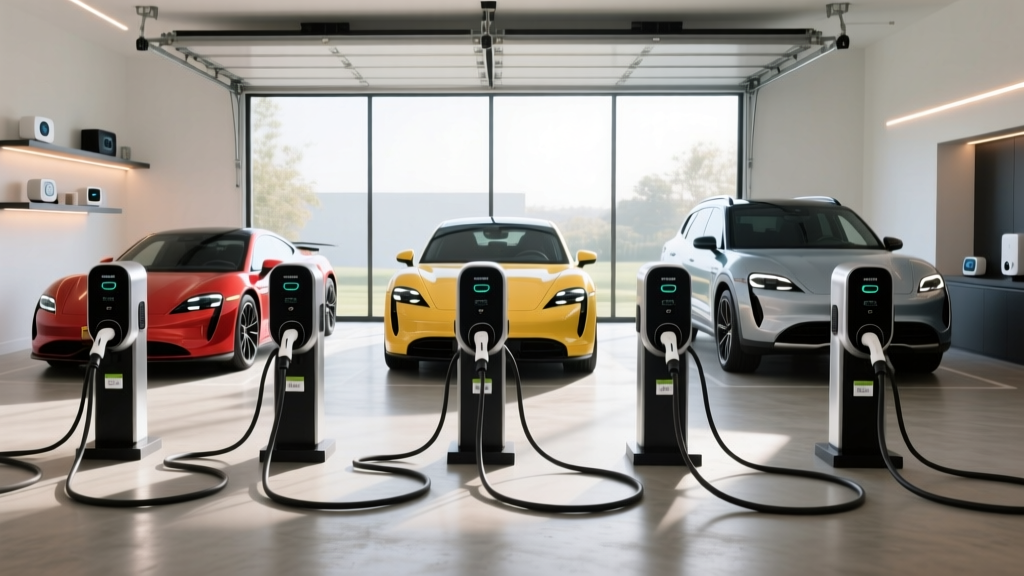
For 2008-era EVs, you don't need a 48A charger — most legacy onboard chargers max out at 3.3–16.8 kW. But investing in a capable unit future-proofs your installation if you add a newer EV later.
Emporia Vue Level 2 (48A)
- Power output: 11.5 kW (48A / 240V)
- Connector: J1772 (NACS adapter available)
- Cable length: 24 ft
- Smart features: Wi-Fi, app scheduling, solar integration, load management
- Price: ~$399
- Best for: Budget-conscious owners wanting smart features
ChargePoint Home Flex (50A)
- Power output: 12 kW (50A / 240V)
- Connector: J1772 (NACS version available)
- Cable length: 23 ft
- Smart features: Wi-Fi, Alexa, app scheduling, amperage dial adjustable 16–50A
- Price: ~$649
- Best for: Flexible amperage for older panels
Grizzl-E Smart (40A)
- Power output: 9.6 kW (40A / 240V)
- Connector: J1772
- Cable length: 24 ft
- Smart features: OCPP-compatible, app control, extreme cold rated (-40°C)
- Price: ~$499
- Best for: Cold climates, outdoor installs, no-frills reliability
All three units support J1772 natively, which covers Th!nk City, i-MiEV, and converted EVs. For the Tesla Roadster, pair any J1772 charger with a JDapter Stub ($199–$299) or the Tesla-provided Roadster adapter to connect the car's proprietary inlet.
Safety, Code, and Long-Term Ownership Considerations
Charging a 16–18-year-old EV introduces considerations beyond the charger itself:
- Battery degradation: 2008-era lithium-cobalt or Zebra (NaNiCl) batteries have likely lost 20–40% of original capacity. Expect real-world range of 120–160 miles on a Roadster (vs. 244 miles EPA original), and 40–60 miles on a Th!nk City.
- Onboard charger aging: Capacitor wear in early onboard chargers can reduce charge acceptance. If your Roadster charges slower than 16.8 kW on a known-good circuit, the onboard charger may need service.
- Dedicated circuit requirement: NEC Article 625 requires EVSE to be on a dedicated circuit — no sharing with dryers, welders, or other loads.
- Ventilation: Not required for modern EVSE, but ensure your garage has general ventilation if charging a Zebra-battery Th!nk City (which can off-gas during high-temperature operation).
- Insurance: Classic/collector EV insurance (Hagerty, Grundy) often covers 2008 Roadsters at agreed value — factor this into total ownership cost.
How much does it cost to install a home EV charger?
A standard Level 2 home installation (40A–50A, 240V) costs $800–$2,150 when your electrical panel has spare capacity. If a panel upgrade from 100A to 200A is required, total costs range from $2,300–$5,650. The federal §25C credit covers 30% of equipment and labor, up to $1,000.
How fast will each charging level add range?
Level 1 (120V) adds 4–5 miles per hour. Level 2 (240V, 32A–48A) adds 11–40 miles per hour depending on amperage and the car's onboard charger limit. DC fast charging adds 60–120 miles per hour but is generally not supported on 2008-era EVs.
Which connector/charger is compatible with my EV?
The 2008 Tesla Roadster uses a proprietary connector requiring a JDapter or Tesla adapter for J1772 Level 2 charging. The Th!nk City and later i-MiEV use J1772. No 2008 EV natively supports CCS1, CHAdeMO, or NACS — adapters are required for public network access.
How much does charging cost per mile vs gas?
Home off-peak charging costs roughly $0.03/mile. A 30 MPG gas car at $3.40/gallon costs $0.11/mile. Home EV charging is approximately 3–4x cheaper per mile, though public DC fast charging ($0.14–$0.16/mile) narrows that advantage significantly.
What electrical upgrades might I need?
Homes with 100A or 125A panels may require a service upgrade to 200A ($1,500–$3,500) to safely add a 40A–50A EV circuit. Alternatives include installing a smart load management system or choosing a lower-amperage (32A) charger to stay within existing panel capacity. A licensed electrician should perform an NEC Article 220 load calculation before installation.