Getting Your F-150 Lightning Supercharged: What Every Owner Needs to Know
If you've bought or are eyeing a Ford F-150 Lightning — whether the standard-range 98 kWh pack or the extended-range 131 kWh version — the single most important ownership decision you'll make is how you charge it. The Lightning's massive battery makes charging logistics more consequential than in smaller EVs: a Level 1 trickle cord won't cut it for daily use, and public DC fast-charging speeds vary wildly depending on connector, station power, and battery preconditioning.
This guide breaks down exactly what it takes to keep a supercharged F-150 Lightning ready for work, road trips, and daily driving — from home electrical upgrades to real-world cost-per-mile math versus a gas F-150.
Charging Levels Explained: How Fast Can You Add Range?
EV charging is measured in kW (kilowatts — the rate of power delivery), while battery capacity is measured in kWh (kilowatt-hours — total energy stored). Confusing these two is the most common mistake new EV owners make. Think of kW as how fast water flows from a hose, and kWh as the size of the bucket.
| Level | Voltage / Amperage | Power (kW) | Miles of Range per Hour | Best For |
|---|---|---|---|---|
| Level 1 (120V) | 120V / 12A | ~1.4 kW | ~3–4 mi/hr | Emergency/trickle only |
| Level 2 (240V Home) | 240V / 48A | 11.5 kW | ~30–33 mi/hr | Daily home charging |
| Level 2 (240V Home Max) | 240V / 80A (dual charger) | 19.2 kW | ~50–54 mi/hr | Fastest home option |
| DC Fast Charge | 400V architecture | Peak 155 kW | ~185–220 mi/hr (at peak) | Road trips, rapid top-ups |
Home Charger Installation: Electrical Requirements and Real Costs
The F-150 Lightning's battery is large enough that a proper Level 2 home charger isn't optional — it's essential. Here's what the electrical side actually looks like.
What Your Electrical Panel Needs
A standard 48A Level 2 charger requires a dedicated 60A circuit on a 240V line (the National Electrical Code requires circuits be rated 125% above continuous load). The extended-range Lightning with the optional 80A Pro Power onboard charger setup needs a 100A dedicated circuit — a significant ask for many homes.
- Minimum panel capacity: 200A service is strongly recommended; older homes with 100A panels will likely need a panel upgrade ($1,500–$3,500).
- Wire gauge: 6 AWG copper for 48A circuits; 3 AWG for 60A; 1/0 AWG for 80A runs.
- Circuit breaker: Dedicated, properly sized — not shared with other appliances.
- GFCI protection: Required by NEC 2020+ for EV receptacles in garages and all outdoor installations.
Permit and Inspection
Most jurisdictions require an electrical permit for EV charger installations ($50–$200 depending on locality). A licensed electrician pulls this and schedules a post-install inspection. Skipping the permit risks insurance claim denials and code violations.
Full Installation Cost Breakdown
| Component | Low End | High End | Notes |
|---|---|---|---|
| Level 2 charger (hardware) | $400 | $750 | 40A–48A smart charger |
| Electrician labor (install) | $300 | $1,200 | Depends on run length, conduit, wall type |
| Electrical permit | $50 | $200 | Varies by municipality |
| Panel upgrade (if needed) | $1,500 | $3,500 | 100A → 200A service upgrade |
| Total (no panel upgrade) | $750 | $2,150 | Most homes with 200A service |
| Total (with panel upgrade) | $2,250 | $5,650 | Older homes needing service upgrade |
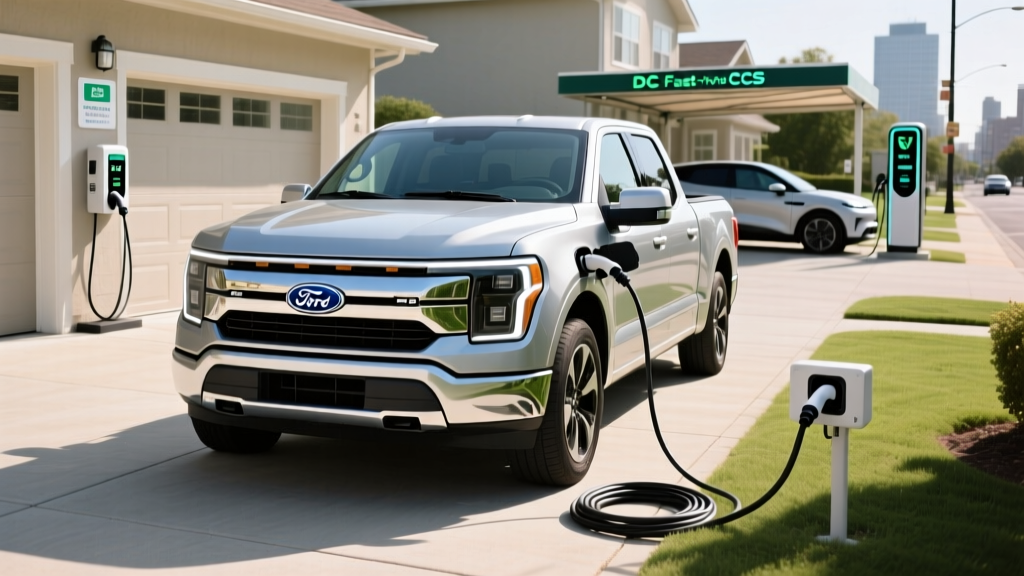
Ford includes a mobile charger cord with the Lightning that can handle 120V (Level 1) and 240V (Level 2 at up to 30A via a NEMA 14-50 outlet). For faster home charging, a hardwired wall unit is the better long-term investment. According to Ford's official Lightning specs, the dual onboard charger option (19.2 kW capable) is available on Lariat and Platinum trims.
Connector Compatibility: NACS, CCS1, and What You Need
The connector landscape shifted dramatically in 2024–2025. Ford was among the first automakers to adopt the North American Charging Standard (NACS) — Tesla's connector design — for new vehicles. Here's where the Lightning stands:
| Model Year | Built-in Connector | Tesla Supercharger Access | CCS Station Access |
|---|---|---|---|
| 2022–2024 F-150 Lightning | CCS1 | Via Ford-provided NACS adapter | Native |
| 2025–2026 F-150 Lightning | NACS | Native (no adapter needed) | Via NACS-to-CCS adapter |
What this means practically: If you own a 2022–2024 Lightning, you already have access to Tesla's Supercharger network using Ford's adapter, dramatically expanding your road-trip charging options. For 2025–2026 models, NACS is native, but you'll want a NACS-to-CCS adapter ($200–$300) for Electrify America and other CCS-only public stations, which still represent a meaningful portion of the public charging network.
CHAdeMO is effectively dead for new light-duty vehicles in the U.S. — no adapter is needed or recommended for Lightning owners.
Cost to Charge: Per-Mile Math vs. a Gas F-150
The economic case for the Lightning hinges on your electricity rate and driving patterns. Here's a realistic comparison using 2026 energy and fuel prices.
| Scenario | Rate ($/kWh) | Cost per Mile | Full 131 kWh Pack Cost |
|---|---|---|---|
| Home (off-peak utility rate) | $0.09 | $0.18 | $11.79 |
| Home (avg U.S. residential) | $0.17 | $0.34 | $22.27 |
| Public Level 2 (ChargePoint/EVgo) | $0.30–$0.45 | $0.60–$0.90 | $39–$59 |
| DC Fast (Electrify America/Supercharger) | $0.35–$0.55 | $0.70–$1.10 | $46–$72 |
| Gas F-150 (20 MPG, $3.40/gal) | — | $0.17/mi | — |
Recommended Home Chargers for the F-150 Lightning
Not all Level 2 chargers are equal. Here are three proven units matched to the Lightning's capabilities, with specs that matter.
Best Overall: ChargePoint Home Flex
- Power output: Up to 50A (12 kW at 240V), adjustable via DIP switch
- Connector: NACS (2025+ models) or J1772 with adapter
- Cable length: 23 feet
- Smart features: Wi-Fi, app scheduling, utility integration, Alexa
- Price: ~$550–$650
- Why for Lightning: Flexible amperage lets you match your circuit capacity exactly; NEMA 14-50 plug or hardwired.
Best High-Power: Ford Charge Station Pro (80A)
- Power output: 80A (19.2 kW at 240V) — requires dual onboard charger option
- Connector: NACS (2025+) / CCS1 (2022–2024)
- Cable length: 25 feet
- Smart features: FordPass integration, Intelligent Backup Power (V2H capable with Home Integration System)
- Price: ~$1,100–$1,300 (hardware only)
- Why for Lightning: Only way to unlock 19.2 kW home charging; enables vehicle-to-home backup power.
Best Budget: Emporia Vue Level 2
- Power output: Up to 48A (11.5 kW at 240V)
- Connector: J1772 (NACS adapter available)
- Cable length: 24 feet
- Smart features: Wi-Fi, app control, energy monitoring, solar integration
- Price: ~$380–$450
- Why for Lightning: Best value for 48A charging; energy monitoring helps track costs precisely.
Safety, Code, and Installation Gotchas
EV chargers draw sustained high current for hours — this is fundamentally different from a dryer or oven that cycles on and off. Key safety requirements:
- Dedicated circuit: Your charger must have its own breaker — never share with other loads.
- Hardwired vs. receptacle: Hardwired installations (no plug) are preferred for 48A+ chargers; NEMA 14-50 receptacles are acceptable up to 40A continuous but have been linked to overheating incidents with cheap receptacles. Use only an industrial-grade Hubbell or Bryant 14-50R if going the receptacle route.
- Outdoor rating: If mounting outside, ensure the unit carries a NEMA 4 or IP65 rating. All outdoor EV receptacles require a weatherproof in-use cover.
- GFCI breaker: NEC 2020 and later require GFCI protection for EV charging receptacles. Some chargers have built-in GFCI — check before double-protecting, which can cause nuisance trips.
- Load management: If your panel is near capacity, consider a smart load-management system (e.g., Emporia or Span panel integration) that dynamically reduces charger amperage when other loads spike, avoiding a panel upgrade entirely.
DC Fast Charging on Road Trips: What to Expect
The Lightning's 400V architecture caps its DC fast-charge peak at 155 kW — competitive with other trucks but below the 250–350 kW peaks of 800V vehicles like the Hyundai Ioniq 5 or Porsche Macan EV. Here's what real road-trip charging looks like:
- 15% to 80% at a 150+ kW CCS or NACS station: ~38–41 minutes (extended-range pack)
- 15% to 80% at a 50 kW station: ~95–105 minutes
- Preconditioning: Set a navigation waypoint to a DC fast charger in the FordPass or Sync system. The truck will warm or cool the battery to optimal temperature before you arrive, shaving 5–15 minutes off your session.
- Tesla Supercharger access: 2022–2024 Lightnings use Ford's provided adapter; 2025+ connect natively. Supercharger V3 stalls deliver up to 250 kW, but the Lightning caps at 155 kW regardless.
For federal tax credit purposes under IRS §30D, note that home charger hardware purchased in 2025–2026 may qualify for the Alternative Fuel Vehicle Refueling Property Credit (up to $1,000 for residential equipment), subject to census-tract eligibility and income requirements. Consult a tax professional for your specific situation.
Frequently Asked Questions
How much does it cost to install a home EV charger for the F-150 Lightning?
For a home with an existing 200A electrical panel, expect $750–$2,150 total (charger hardware + electrician labor + permit). If your home needs a panel upgrade from 100A to 200A service, add $1,500–$3,500, bringing the total to $2,250–$5,650. Always get two to three quotes from licensed electricians.
How fast will each charging level add range to my Lightning?
Level 1 (120V) adds roughly 3–4 miles per hour — essentially useless for a 131 kWh pack. Level 2 at 48A adds about 30–33 miles per hour, enough to fully replenish overnight. Level 2 at 80A (with dual onboard charger) adds 50–54 miles per hour. DC fast charging peaks around 185–220 miles per hour at the top of the charge curve but tapers substantially above 80% SoC.
Which connector and charger is compatible with my F-150 Lightning?
Model years 2022–2024 use CCS1 natively and can access Tesla Superchargers via a Ford-provided NACS adapter. Model years 2025–2026 use NACS natively and need a NACS-to-CCS adapter (sold separately, ~$200–$300) for Electrify America and other CCS-only networks. For home Level 2 charging, any J1772 or NACS wall unit rated for 48A or higher will work.
How much does charging cost per mile compared to a gas F-150?
At home on off-peak electricity ($0.09/kWh), the Lightning costs about $0.18 per mile. A gas F-150 at 20 MPG with $3.40/gallon fuel costs about $0.17 per mile. At average U.S. residential rates ($0.17/kWh), the Lightning rises to $0.34/mile. Public DC fast charging at $0.40–$0.55/kWh pushes cost to $0.70–$1.10/mile — more expensive than gas. The economics strongly favor home charging.
What electrical upgrades might I need for a Lightning home charger?
The most common upgrade is a panel service increase from 100A to 200A ($1,500–$3,500) if your home is older. You will definitely need a new dedicated 240V circuit with appropriately sized breaker and wire gauge. For the 80A Ford Charge Station Pro, you need a 100A dedicated circuit, which requires substantial panel headroom. Homes with 200A service and minimal existing 240V loads usually have enough capacity for a 48A charger without a panel upgrade. A licensed electrician can perform a load calculation to confirm.