Quick Specs: 2021 Tesla Model 3 Long Range Charging Profile
Before we unpack home installations and public networks, here is the baseline hardware you are working with. The 2021 Tesla Model 3 Long Range AWD uses an 82 kWh battery pack (approximately 75–79 kWh usable) in an NMC (nickel-manganese-cobalt) chemistry. Tesla rates this model at 353 miles of EPA range, though real-world highway driving at 70+ mph typically yields 280–310 miles, and cold-weather conditions can shave another 15–25% off that figure.
| Spec | Value |
|---|---|
| EPA Range | 353 miles |
| Battery Capacity | ~82 kWh total / ~75–79 kWh usable (NMC) |
| Max DC Fast Charge Rate | 250 kW peak (V3 Supercharger) |
| 10–80% DC Fast Charge Time | ~27–30 minutes |
| Max Level 2 AC Charge Rate | 11.5 kW (48A onboard charger) |
| Level 1 (120V) Charge Rate | ~1 kW |
| Connector | NACS (Tesla proprietary, now industry standard) |
| 0–60 mph | 4.2 seconds |
| Horsepower | 346 hp (dual motor AWD) |
| MPGe (combined) | 134 MPGe (EPA) |
| Battery Warranty | 8 years / 120,000 miles (≥70% retention) |
Understanding Charging Levels: How Fast Does Each Add Range?
The single most common confusion in EV ownership is the difference between kW (kilowatts, a measure of power — how fast energy flows) and kWh (kilowatt-hours, a measure of energy — how much the battery holds). Think of kW as the flow rate of a hose and kWh as the size of the bucket. Your 2021 Model 3 Long Range holds roughly 75–79 usable kWh in its bucket. The charging level determines how fast that bucket fills.
| Level | Voltage | Max Power (kW) | Miles of Range per Hour | Full Charge Time (0–100%) |
|---|---|---|---|---|
| Level 1 (Standard 120V outlet) | 120V | ~1 kW | 3–4 mi/hr | ~70–80 hours |
| Level 2 (240V home/public) | 240V | 11.5 kW (car's max) | 37–44 mi/hr | ~7–8 hours |
| DC Fast Charging (Supercharger) | 400V+ | 250 kW peak | ~170 mi in 15 min | 10–80% in ~27–30 min |
Why does DC fast charging slow above 80%? Lithium-ion batteries accept charge fastest at low state of charge (SoC). As cells approach full, the battery management system reduces current to prevent damage. On a V3 Supercharger, you might see 250 kW at 10% SoC, but by 60% you are likely at 80–100 kW, and above 80% it drops to 30–40 kW. This is the charge curve — and it is why we quote 10–80% times rather than 0–100%.
Home Charging Installation: Electrical Requirements, Costs & Panel Upgrades
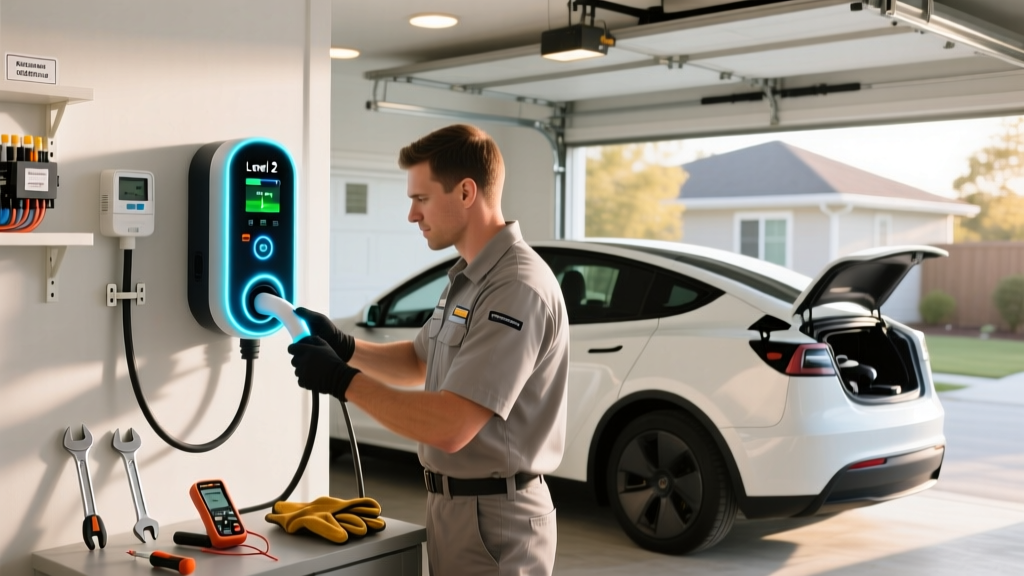
For a 2021 Model 3 Long Range owner, Level 2 home charging is the daily workhorse. The car's onboard charger accepts up to 11.5 kW (48 amps at 240V). To deliver that, you need a dedicated 60-amp circuit (the National Electrical Code requires circuits to be rated at 125% of the continuous load, so 48A continuous draw requires a 60A breaker).
Electrical Requirements
- Circuit: Dedicated 60A, 240V breaker
- Wire gauge: 6 AWG copper (or 4 AWG aluminum for longer runs)
- Connector: NACS (native Tesla) or NEMA 14-50 outlet for portable use
- GFCI protection: Required by NEC 2020+ for new EV outlet installations in garages
- Permit: Required in most jurisdictions — typically $50–$200
What If Your Panel Can't Handle It?
Most modern homes with 200-amp service panels can accommodate a 60A EV circuit without issue. However, older homes with 100A or 150A panels may be near capacity, especially if you already run electric ranges, dryers, and HVAC on the same panel. An electrician will perform a load calculation to determine available headroom. If an upgrade is needed:
- Panel upgrade (100A → 200A): $1,500–$3,500 including permit
- Service upgrade (to 320A/400A for future-proofing): $3,000–$5,000+
This is the hidden cost that catches many EV buyers off guard. Always get the load calculation done before purchasing equipment.
| Item | Low Estimate | High Estimate | Notes |
|---|---|---|---|
| Level 2 EVSE (charger hardware) | $350 | $750 | Tesla Wall Connector, ChargePoint, Emporia |
| Electrician labor (standard install) | $400 | $1,200 | Varies by run length, wall type, conduit |
| Electrical materials (wire, conduit, breaker) | $100 | $400 | Longer runs cost more |
| Permit & inspection | $50 | $250 | Required in most jurisdictions |
| Panel upgrade (if needed) | $1,500 | $3,500 | 100A → 200A service |
| Total (no panel upgrade) | $900 | $2,600 | Typical for most homes |
| Total (with panel upgrade) | $2,400 | $6,100 | Older homes with 100A service |
Note: Some utilities and states offer rebates of $250–$1,000 for home charger installation. Check your local utility and the IRS Residential Clean Energy Credit for potential 30% tax credit on equipment and installation (up to $1,000).
Connector Compatibility: NACS, CCS, and Adapter Needs
Your 2021 Tesla Model 3 Long Range comes with a NACS (North American Charging Standard) connector — Tesla's proprietary plug that has since been adopted by Ford, GM, Rivian, Hyundai, and most major automakers as the industry standard. This is a significant advantage in 2026: NACS provides native access to the Tesla Supercharger network (over 25,000 stalls in North America) without any adapter.
| Connector Type | Native Support? | Adapter Needed? | Network Examples |
|---|---|---|---|
| NACS (Tesla) | ✅ Yes — native | None | Tesla Superchargers, Tesla Destination, most new public chargers |
| CCS1 | ❌ No — adapter required | Tesla CCS Adapter (~$250) | Electrify America, EVgo, older ChargePoint DC stations |
| CHAdeMO | ❌ No — legacy | Setec CHAdeMO adapter (~$400) | Older Nissan-Leaf-era stations (being phased out) |
| J1772 (Level 2) | ❌ No — adapter required | Tesla J1772 Adapter (included with car) | Public Level 2 stations, workplace chargers |
Practical recommendation: The Tesla CCS adapter is worth buying ($250 from Tesla) to access Electrify America and other CCS-only DC fast chargers during road trips. The J1772 adapter comes with your car — keep it in the trunk for public Level 2 stations at hotels, workplaces, and shopping centers. CHAdeMO is effectively dead in 2026; skip it unless you frequent a specific legacy station.
Equipment Recommendations: Best Level 2 Home Chargers for Your Model 3
Because your Model 3 can accept up to 11.5 kW (48A), pairing it with an undersized charger wastes capability. Here are three proven options, all hardwired or NEMA 14-50 compatible, all NACS-native or easily adapted:
Tesla Wall Connector (Gen 3)
- Power Output: Up to 11.5 kW (48A)
- Connector: NACS (native)
- Cable Length: 24 ft
- Smart Features: Wi-Fi, OTA updates, power sharing (load share between two units on one circuit), Tesla app integration
- Price: ~$475
- Verdict: Best value for Tesla owners. Matches car's max AC rate exactly. No adapter needed.
Emporia Vue + Level 2 EV Charger
- Power Output: Up to 11.5 kW (48A)
- Connector: NACS (2025+ models) or J1772 with adapter
- Cable Length: 24 ft
- Smart Features: Whole-home energy monitoring integration, solar-aware charging, scheduling, load management
- Price: ~$400 (charger) + $100 (Emporia Vue monitor)
- Verdict: Best for solar homes or those who want granular energy data.
ChargePoint Home Flex
- Power Output: Up to 12 kW (50A) — adjustable via DIP switch
- Connector: NACS (2025+ models) or J1772 with adapter
- Cable Length: 23 ft
- Smart Features: Wi-Fi, app scheduling, Alexa/Google integration, flexible amperage (16A–50A to match your circuit)
- Price: ~$650
- Verdict: Best for multi-EV households or future-proofing. Adjustable amperage means it works on 20A–60A circuits.
What about the Tesla Mobile Connector? It ships with your Model 3 and can deliver up to 7 kW (32A) on a 240V NEMA 14-50 outlet. That is adequate for overnight charging (adding ~200 miles in 8 hours), but for the full 11.5 kW experience, a hardwired Wall Connector on a 60A circuit is the way to go.
Cost to Charge: Home vs. Public vs. Gas — Real $/Mile Comparison
Charging cost depends on electricity rates, which vary enormously. Here are realistic 2026 scenarios for a 2021 Model 3 Long Range (assume ~78 kWh usable battery, ~3.5 miles per kWh efficiency):
| Scenario | Rate | Full Charge Cost | Cost per Mile |
|---|---|---|---|
| Home (off-peak utility rate) | $0.10/kWh | $7.80 | $0.022/mi |
| Home (national avg residential) | $0.17/kWh | $13.26 | $0.038/mi |
| Home (high-cost state: CA, HI) | $0.30/kWh | $23.40 | $0.067/mi |
| Tesla Supercharger (avg 2026) | $0.32/kWh | $24.96 | $0.071/mi |
| Electrify America (avg) | $0.43/kWh | $33.54 | $0.096/mi |
| Gas car (30 MPG, $3.50/gal) | $3.50/gal | $41.42 (12-gal tank) | $0.117/mi |
The takeaway: Even at the national average residential rate, home charging costs roughly one-third what gasoline does per mile. Supercharging on road trips is still cheaper than gas, but exclusive reliance on DC fast charging (especially third-party networks) narrows the savings gap significantly. The economics strongly favor home charging as your primary routine.
For a driver covering 12,000 miles per year charging primarily at home (national avg rate), expect annual fuel costs of approximately $456 versus $1,404 for a 30 MPG gas car — a savings of ~$948/year.
Public Charging & Road Trip Strategy
Your 2021 Model 3 Long Range is one of the best road-trip EVs thanks to native Supercharger access. Here is what to expect on DC fast charging:
Charging Curve Reality on a V3 Supercharger (250 kW)
- 10–30% SoC: Peak rate near 250 kW — adds ~100 miles in ~10 minutes
- 30–60% SoC: Sustained 120–150 kW — adds ~80 miles in ~15 minutes
- 60–80% SoC: Tapering to 60–80 kW — adds ~40 miles in ~12 minutes
- 80–100% SoC: Below 30 kW — not recommended for road trips; charge to 80% and go
Preconditioning matters. When you navigate to a Supercharger in the Tesla navigation system, the car automatically warms the battery to optimal temperature (around 95°F/35°C). Arriving without preconditioning — especially in cold weather — can cut your peak charge rate in half. Always route through the car's nav to ensure preconditioning activates.
Supercharger Network Access
As of 2026, Tesla Superchargers are open to non-Tesla EVs via the Magic Dock (CCS adapter built into select stalls) or NACS-native vehicles. However, Tesla owners still benefit from seamless plug-and-charge billing (no app needed — it charges your Tesla account automatically) and typically the most reliable uptime in the industry.
Safety, Code & Best Practices
EV charging involves sustained high-current draw — this is not like plugging in a lamp. Key safety and code considerations for your installation:
- Dedicated circuit: Your Level 2 charger must be on its own dedicated breaker. Never share a circuit with other high-draw appliances.
- GFCI breaker: NEC 2020 and later require ground-fault circuit interrupter protection for EV outlets. This adds ~$50–$100 to the electrical cost but is non-negotiable for code compliance.
- Outdoor rating: If installing outside, ensure the EVSE is rated NEMA 4 (weatherproof). The Tesla Wall Connector and ChargePoint Home Flex both carry NEMA 4 ratings.
- Cable management: A 24-foot cable is long enough for most garages. If your charge port and outlet are on opposite sides, consider a cable organizer or retractable reel to prevent tripping hazards and cable wear.
- Surge protection: A whole-home surge protector ($200–$400 installed) protects your EVSE and car from voltage spikes, especially in areas with frequent lightning or unstable grid power.
- Always hire a licensed electrician: DIY 240V work is dangerous and will void insurance coverage if a fire results. Get a permit and final inspection — this protects your home's resale value and insurance standing.
Frequently Asked Questions
How much does it cost to install a home EV charger for a 2021 Tesla Model 3 Long Range?
For most homes with adequate 200A panel capacity, expect $900–$2,600 total (charger + electrician + materials + permit). If your home has an older 100A panel that needs upgrading, add $1,500–$3,500 for the panel work, bringing the total to $2,400–$6,100. Always get a load calculation from a licensed electrician before purchasing equipment.
How fast will each charging level add range to my Model 3 Long Range?
Level 1 (120V) adds 3–4 miles per hour — only practical for emergency top-ups or very low daily mileage. Level 2 (240V, 48A) adds 37–44 miles per hour, fully replenishing the battery overnight in 7–8 hours. DC fast charging at a V3 Supercharger adds up to 170 miles in 15 minutes, with a 10–80% session taking approximately 27–30 minutes.
Which connector and charger are compatible with my 2021 Model 3?
Your car uses the NACS connector natively, which gives you direct access to Tesla Superchargers and the growing number of NACS-equipped public chargers. For CCS stations (Electrify America, EVgo), you will need the Tesla CCS adapter (~$250). For J1772 Level 2 public chargers, the J1772-to-NACS adapter included with your car works fine. At home, the Tesla Wall Connector (NACS, 11.5 kW) is the best match.
How much does charging cost per mile compared to gas?
At the national average residential electricity rate ($0.17/kWh), home charging costs approximately $0.038 per mile — roughly one-third the cost of a 30 MPG gas car at $3.50/gallon ($0.117/mi). Even Tesla Supercharging at $0.32/kWh ($0.071/mi) remains cheaper than gasoline. The savings are most dramatic when charging at home on off-peak utility rates ($0.022/mi).
What electrical upgrades might I need for a home charger?
If your home has a modern 200A electrical panel with available capacity, you likely need only a new 60A, 240V dedicated circuit — standard work for any electrician. If your panel is 100A or already near capacity (common in homes built before 1990 with added electric appliances), you may need a panel upgrade to 200A ($1,500–$3,500). Some utilities offer load-management devices that let you add an EV circuit without a panel upgrade by temporarily reducing charger power when other appliances are running — ask your electrician about this option.
Does frequent DC fast charging degrade my Model 3 battery faster?
Research from NREL and real-world fleet data suggest that exclusive DC fast charging accelerates degradation modestly — perhaps 1–2% more capacity loss over 100,000 miles compared to Level 2 charging. Tesla's battery management system is among the best in the industry at managing thermal loads. For daily use, Level 2 home charging is ideal; use DC fast charging for road trips without significant concern. Your battery is warrantied for 8 years / 120,000 miles with at least 70% capacity retention.