Your EV's EPA range sticker tells only part of the story. In real-world driving, the miles you actually get per charge depend on a web of interconnected variables: how you charge, what the thermometer reads, how fast you cruise, and even the age of your battery pack. Understanding these EV range factors is the difference between confident road-tripping and white-knuckling it to the next charger.
This guide breaks down every major variable that expands or shrinks your real-world range — and pairs that knowledge with the charging hardware, electrical requirements, and cost data you need to optimize your setup at home and on the road.
The Physics Behind Your EV's Range
Range is a function of battery energy (measured in kWh — kilowatt-hours, the total fuel in your tank) divided by consumption (measured in kWh per mile). A vehicle with an 82 kWh usable battery consuming 0.28 kWh/mile delivers roughly 293 miles. Anything that increases consumption — speed, cold, elevation, cargo — reduces range proportionally.
Meanwhile, kW (kilowatts) measures the rate of energy transfer — how fast you can refill that battery. Confusing kW with kWh is the single most common EV mistake. Think of it this way: kWh is the size of your gas tank; kW is the diameter of the fuel hose.
How Charging Levels Shape Your Usable Range
The speed at which you can replenish range determines how practical your EV is for daily life and long trips. Here's how the three charging tiers compare, using a midsize crossover consuming roughly 3.0 miles per kWh as the baseline:
| Level | Voltage | Power (kW) | Miles Added Per Hour | Typical Use Case |
|---|---|---|---|---|
| Level 1 | 120V AC | 1.0–1.4 kW | 3–5 mi/hr | Overnight top-up, PHEVs, low-mileage commuters |
| Level 2 | 240V AC | 7.2–19.2 kW | 22–58 mi/hr | Home daily charging, workplace, destination charging |
| DC Fast Charge | 400–800V DC | 50–350 kW | 150–1,000+ mi/hr (peak) | Road trips, highway corridors, quick top-ups |
Charging time examples (10–80% SoC):
- 62 kWh battery (e.g., Nissan Ariya, base Standard Range): ~45 minutes on a 130 kW DCFC; ~8.5 hours on a 7.2 kW Level 2 home charger.
- 82 kWh battery (e.g., Tesla Model Y Long Range): ~25 minutes on a 250 kW Supercharger; ~11 hours on a 7.2 kW Level 2.
- 100 kWh battery (e.g., Rivian R1S Max Pack): ~35 minutes on a 350 kW Electrify America station; ~13 hours on a 7.7 kW Level 2.
The charge-curve reality check: No EV sustains its peak kW rating for the full session. A vehicle advertising "250 kW peak" typically holds that rate only between roughly 10–40% State of Charge, then tapers progressively. Above 80%, speeds often drop below 50 kW to protect battery longevity. This is why 10–80% times are the industry-standard metric — the final 20% can take as long as the first 70%.
Weather, Speed, and Terrain: The Range Killers
Not all miles are created equal. These are the variables that most dramatically alter your real-world range:
Cold Weather
Lithium-ion batteries operate less efficiently in cold temperatures, and cabin heating is a major energy draw. At 20°F, expect 20–30% range loss compared to 70°F conditions. Vehicles equipped with a heat pump (standard on most 2026 Hyundai, Kia, Tesla, and BMW EVs) recover 5–10% of that loss by scavenging waste heat from the powertrain rather than relying solely on resistive heating.
Pro tip: Preconditioning your battery while plugged in — warming it using grid power before you depart — preserves range and dramatically improves DC fast-charge speeds in cold weather. A cold battery at a 150 kW charger might accept only 40 kW until it warms up internally.
Highway Speed
Aerodynamic drag increases with the square of speed. Driving at 80 mph consumes roughly 25–30% more energy than driving at 65 mph. On a 300-mile EPA-rated vehicle, that can mean the difference between 260 real-world highway miles and 310.
Elevation and Payload
Climbing mountain passes consumes heavily, though regenerative braking recovers some energy on descents. Towing a trailer can cut range by 40–50%, and even a fully loaded cabin with roof cargo adds measurable consumption.
Home Charger Installation: Costs, Electrical Requirements, and Permits
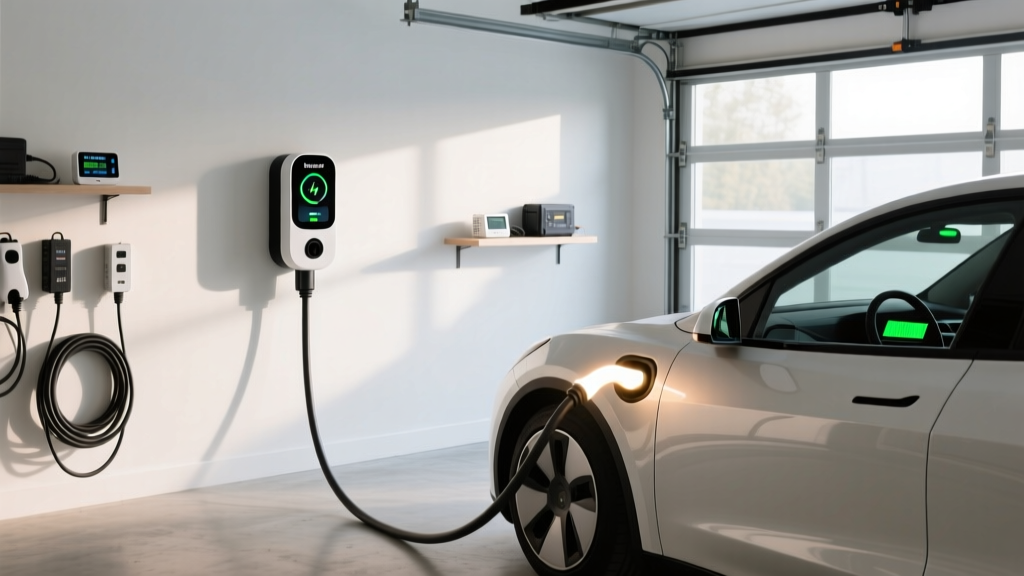
Installing a Level 2 home charger is the single highest-impact upgrade an EV owner can make. Here's what's involved:
Electrical Requirements
A typical Level 2 home charger requires a 240V dedicated circuit, similar to a dryer or oven outlet. Common configurations:
- 40-amp circuit → delivers up to 32 amps continuous (9.6 kW) — the most common residential setup
- 50-amp circuit → delivers up to 40 amps continuous (9.6–11.5 kW depending on charger)
- 60-amp circuit → delivers up to 48 amps continuous (11.5 kW) — needed for larger-battery EVs or faster overnight fills
Panel upgrade reality: Many older homes have 100-amp electrical panels that are already near capacity. Adding a 40–60 amp EV circuit may require a panel upgrade to 200 amps, which typically costs $1,500–$3,000. A licensed electrician will perform a load calculation to determine if your existing panel can handle the additional draw. Some utilities and state programs offer rebates for panel upgrades tied to EV adoption.
Installation Cost Breakdown
| Component | Low End | High End | Notes |
|---|---|---|---|
| Level 2 Charger (Equipment) | $350 | $750 | Smart Wi-Fi chargers with 25-ft cable, NACS or J1772 |
| Electrician Labor | $500 | $2,000 | Depends on run length from panel to garage/driveway |
| Electrical Permit | $50 | $250 | Varies by municipality; required for code compliance |
| Panel Upgrade (if needed) | $1,500 | $3,000 | 100A → 200A service upgrade |
| Conduit & Wiring Materials | $100 | $500 | Longer runs and outdoor conduit add cost |
| Total (no panel upgrade) | $1,000 | $3,500 | Most homes with 200A service fall in this range |
| Total (with panel upgrade) | $2,500 | $6,500 | Older homes with 100A panels |
Safety and Code Considerations
- Dedicated circuit: Your EV charger must be on its own breaker — never shared with other appliances.
- GFCI protection: The National Electrical Code (NEC) requires ground-fault circuit interrupter protection for outdoor outlets and many indoor garage installations. Most quality Level 2 chargers include built-in GFCI.
- Outdoor rating: If your charger will be mounted outside, ensure it carries a NEMA 4 (weatherproof) rating. Indoor-only units (NEMA 1) are less expensive but cannot be exposed to rain or snow.
- Hardwired vs. plug-in: Hardwired units (directly connected to your electrical panel) are required for circuits above 40 amps and offer a cleaner install. Plug-in units using a NEMA 14-50 outlet offer portability but are limited to 40 amps maximum.
Connector Compatibility: NACS, CCS, and CHAdeMO
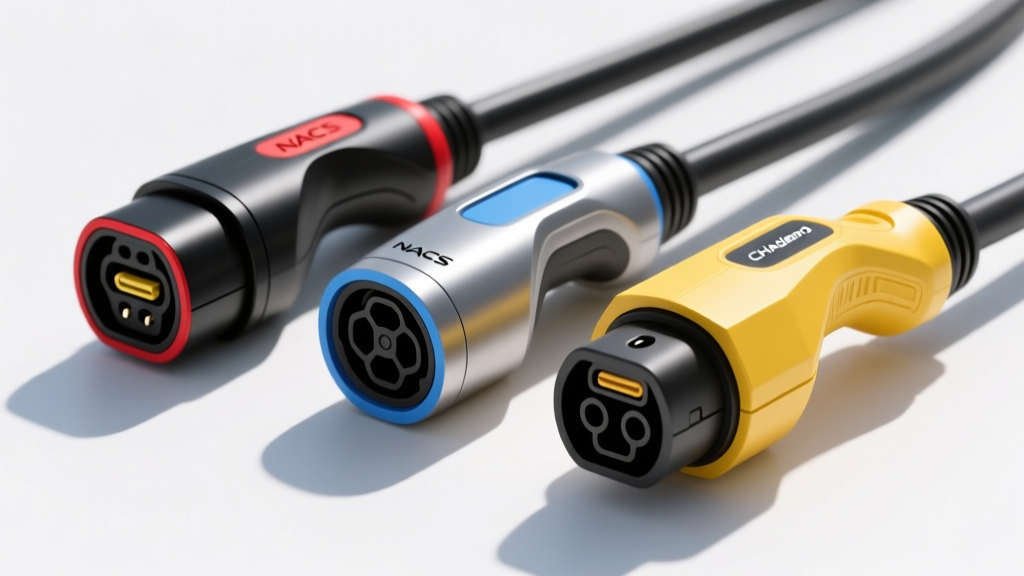
The charging connector landscape has consolidated significantly. As of 2026, the North American Charging Standard (NACS), originally developed by Tesla, has been adopted by Ford, GM, Rivian, Hyundai, Kia, BMW, and most other major automakers. CCS1 remains on many vehicles sold between 2019–2024, and CHAdeMO is effectively legacy (Nissan Leaf only).
| Connector | Brands Using It (2026 Models) | DC Fast Charge Availability | Adapter Needed? |
|---|---|---|---|
| NACS (Tesla) | Tesla, Ford, GM, Rivian, Hyundai, Kia, BMW, Volvo, Polestar | Tesla Supercharger network + growing third-party NACS stations | CCS-to-NACS adapters available (~$200) for older CCS vehicles |
| CCS1 | Legacy models (2019–2024 VW ID.4, older Ford Mach-E, etc.) | Electrify America, EVgo, ChargePoint DCFC | NACS-to-CCS adapter needed for Tesla Superchargers |
| CHAdeMO | Nissan Leaf (discontinued after 2025 model year) | Limited; declining network support | No reliable adapter to NACS/CCS for DCFC |
Adapter strategy: If you own a CCS1-equipped EV, a NACS-to-CCS adapter (sold by Tesla and third-party manufacturers) unlocks access to the Supercharger network — the most reliable DC fast-charging infrastructure in North America. Verify adapter compatibility with your specific model year before purchasing, as firmware updates occasionally affect handshake protocols.
Charging Cost Per Mile: Home vs. Public vs. Gas
One of the strongest EV ownership advantages is fuel cost — but the savings vary enormously depending on where and when you charge.
| Scenario | Rate ($/kWh) | Cost for 300 Miles* | Cost Per Mile |
|---|---|---|---|
| Home (off-peak utility rate) | $0.08–$0.12 | $7.20–$10.80 | $0.024–$0.036 |
| Home (standard residential rate) | $0.13–$0.18 | $11.70–$16.20 | $0.039–$0.054 |
| Public Level 2 (workplace/retail) | $0.20–$0.35 | $18.00–$31.50 | $0.060–$0.105 |
| DC Fast Charge (Electrify America, EVgo) | $0.35–$0.55 | $31.50–$49.50 | $0.105–$0.165 |
| Gas vehicle (28 MPG, $3.40/gal) | $3.40/gal | $36.43 | $0.121 |
*Based on a vehicle consuming 3.0 miles per kWh (roughly 33 kWh per 100 miles), representative of a midsize crossover like the Tesla Model Y or Hyundai Ioniq 5.
The bottom line: Home off-peak charging delivers fuel costs roughly one-quarter to one-third of a comparable gas vehicle. But relying exclusively on DC fast charging can push your per-mile cost above that of a fuel-efficient hybrid. The economics strongly favor installing a Level 2 home charger.
According to the U.S. Department of Energy's fueleconomy.gov, the national average electricity rate for EV charging is approximately $0.16/kWh, yielding an average cost per mile of about $0.048 — compared to $0.12–$0.15 for a 25–30 MPG gas vehicle at current fuel prices.
Recommended Home Charging Equipment (2026)
These Level 2 chargers represent the best balance of reliability, smart features, and value for residential installation:
ChargePoint Home Flex (NACS)
- Power Output: Up to 11.5 kW (48 amps on a 60A circuit)
- Connector: NACS (J1772 version also available)
- Cable Length: 23 feet
- Smart Features: Wi-Fi, app scheduling, utility demand-response integration, Alexa support
- Price: ~$550
- Best For: Flexible amperage settings allow installation on circuits from 20A to 60A without buying different hardware
Tesla Wall Connector (NACS)
- Power Output: Up to 11.5 kW (48 amps on a 60A circuit)
- Connector: NACS native
- Cable Length: 24 feet
- Smart Features: Wi-Fi, over-the-air updates, power-sharing between two units on one circuit, Tesla app integration
- Price: ~$475
- Best For: Tesla owners and NACS-adopted vehicles; cleanest integration with Tesla ecosystem
Emporia Level 2 EV Charger
- Power Output: Up to 11.5 kW (48 amps on a 60A circuit)
- Connector: J1772 (NACS adapter included)
- Cable Length: 24 feet
- Smart Features: Wi-Fi, detailed energy monitoring, solar-integration scheduling, load management with Emporia Vue panel monitor
- Price: ~$400
- Best For: Budget-conscious buyers wanting granular energy tracking and solar-aware charging
Battery Chemistry and Long-Term Range Retention
Your battery's chemistry determines not just its range today, but how much range it will retain in year five and year ten.
| Factor | NMC / NCA (Nickel-based) | LFP (Lithium Iron Phosphate) |
|---|---|---|
| Energy Density | Higher — more range per kg | Lower — heavier pack for same kWh |
| Typical Degradation (5 yr) | 10–15% capacity loss | 5–8% capacity loss |
| Recommended Daily SoC | 80% for daily; 100% for trips | 100% is fine daily (no upper-limit concern) |
| Cold-Weather Performance | Better low-temp conductivity | More range loss in freezing temps |
| Common In: | Tesla Model Y LR, Hyundai Ioniq 5 LR, Rivian | Tesla Model 3 RWD, base Volvo EX30, some Ford models |
| Warranty Standard | 8 yr / 100,000 mi, ≥70% capacity | 8 yr / 100,000 mi, ≥70% capacity |
Warranty context: Federal law requires EV battery warranties of at least 8 years / 100,000 miles (10 years / 150,000 miles in CARB states like California). The warranty typically guarantees the battery will retain at least 70% of its original capacity. A vehicle with a 300-mile EPA range new should still deliver 210+ miles at the warranty threshold. According to data compiled by Recurrent Auto, the average EV battery retains approximately 90% of its original capacity after five years — well above warranty minimums.
Maximizing Your Real-World Range: A Practical Framework
- Mostly city / suburban commuting (<60 miles/day): Level 2 home charging at off-peak rates covers you completely. Set charge limit to 80% (NMC) or 100% (LFP). Precondition while plugged in on cold mornings. You'll rarely visit a public charger.
- Mixed commuting + weekend road trips: Home Level 2 is essential. For trips, plan DCFC stops at 20–80% SoC to avoid the slow taper above 80%. Use apps like A Better Routeplanner to model stops with elevation and temperature.
- No home charging access (apartment/street parking): Rely on workplace Level 2 and public DCFC. Expect higher per-mile costs ($0.06–$0.16/mi). Prioritize residences near reliable charging infrastructure. Consider a PHEV if DCFC access is inconsistent.
- Cold-climate driver (sustained sub-30°F winters): Choose a vehicle with a heat pump. Garage your car when possible. Always precondition while plugged in. Budget for 25% winter range loss in trip planning.
Frequently Asked Questions
How much does it cost to install a home EV charger?
For a home with an adequate 200-amp electrical panel, expect $1,000–$3,500 total (charger + electrician + permit). If your home has an older 100-amp panel that needs upgrading, the total can reach $2,500–$6,500. Get at least two quotes from licensed electricians and confirm they include the permit in their estimate — unpermitted work can void your homeowner's insurance coverage for electrical fires.
How fast will each charging level add range?
Level 1 (120V standard outlet) adds 3–5 miles per hour — enough for PHEVs or very low-mileage drivers. Level 2 (240V) adds 22–58 miles per hour depending on amperage, fully replenishing most EVs overnight. DC fast charging adds 150–1,000+ miles per hour at peak, with a typical 10–80% session taking 18–45 minutes depending on battery size and charger power.
Which connector/charger is compatible with my EV?
If your 2025–2026 model-year EV is from Tesla, Ford, GM, Hyundai, Kia, Rivian, BMW, or Volvo, it almost certainly uses NACS. Older EVs (2019–2024) from Volkswagen, older Ford, and Stellantis may still have CCS1. The Nissan Leaf uses CHAdeMO. Check your owner's manual or the charge port itself — the connector shape is visually distinct. Adapters exist for most cross-standard scenarios, though CHAdeMO-to-NACS DCFC adapters remain unreliable.
How much does charging cost per mile vs gas?
Home charging at off-peak rates costs $0.02–$0.04 per mile — roughly one-quarter the cost of a 28 MPG gas vehicle at $3.40/gallon ($0.12/mi). Even standard residential rates ($0.13–$0.18/kWh) keep you at $0.04–$0.05 per mile. However, exclusive reliance on DC fast charging ($0.35–$0.55/kWh) can push costs to $0.11–$0.17 per mile, rivaling or exceeding gas. The home charger is the key to EV fuel savings.
What electrical upgrades might I need?
A licensed electrician will perform a load calculation on your panel. If you have a 200-amp panel with available capacity, you likely need only a new dedicated circuit breaker and wiring run. If you have a 100-amp panel, a panel upgrade to 200 amps ($1,500–$3,000) is often required. Some homeowners opt for a smart load-management device (like the Emporia Vue or Span panel) that dynamically shares capacity between the EV charger and other circuits, avoiding a full panel upgrade. Check with your utility — many offer rebates of $250–$1,000 for panel upgrades tied to EV adoption, and the IRS §30D tax credit may apply to certain home charging equipment installed in eligible census tracts (up to $1,000 under §30C, the alternative fuel infrastructure credit).
Does fast charging damage my battery?
Modern thermal management systems have made DC fast charging far safer for battery health than early-generation EVs. That said, frequent daily DCFC use (especially to 100% SoC) accelerates degradation modestly. Data from Recurrent Auto shows that EVs charged primarily on Level 2 with occasional DCFC retain approximately 2–3% more capacity at 100,000 miles compared to those DCFC-charged daily. For battery longevity, favor Level 2 home charging and reserve DCFC for road trips.