Dodge Charger: Still Alive, Now Electric
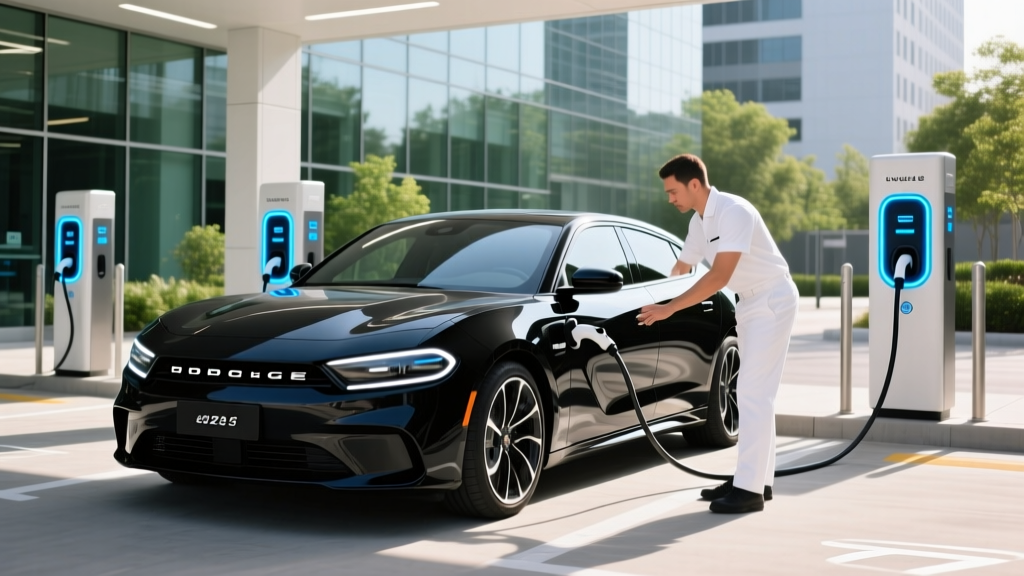
If you've been asking are Dodge Chargers still being made, the answer is yes — but the muscle car has undergone a radical transformation. After discontinuing the gas-powered Charger (and Challenger) after the 2023 model year, Stellantis resurrected the nameplate as the 2025 Dodge Charger Daytona EV, a fully electric muscle car built on the STLA Large platform. The first models began reaching dealers in early 2025, and the 2026 lineup continues with updated trims.
For buyers drawn to the Charger Daytona's blend of muscle-car heritage and electric powertrain, understanding how to charge this EV at home and on the road is essential. This guide covers the Charger Daytona's charging specifications alongside a complete home-charging setup walkthrough — from electrical panel requirements to connector compatibility and real-world cost per mile.
2026 Dodge Charger Daytona: Core EV Specs
| Spec | R/T Trim | Scat Pack Trim |
|---|---|---|
| Battery (usable) | ~93.9 kWh, NMC | ~93.9 kWh, NMC |
| EPA Range (est.) | ~317 miles | ~260 miles |
| Real-World Highway Range | ~260–280 mi | ~210–230 mi |
| Peak DC Fast Charge | ~200 kW (CCS1) | ~200 kW (CCS1) |
| 10–80% DC Fast Charge | ~32 minutes | ~32 minutes |
| Level 2 AC Charge Rate | ~11 kW | ~11 kW |
| Horsepower | 496 hp | 670 hp |
| 0–60 mph | 4.7 sec | 3.3 sec |
| Connector | CCS1 | CCS1 |
| Base MSRP | ~$51,990 | ~$59,990 |
| Battery Warranty | 8 yr / 100,000 mi | 8 yr / 100,000 mi |
Charging Levels Explained: Speeds and Times
Understanding the difference between kW (kilowatts — the rate of power delivery) and kWh (kilowatt-hours — the total energy stored in the battery) is the single most important concept for EV ownership. Think of kW as the flow rate of a hose and kWh as the size of the bucket you're filling.
| Level | Voltage | Power (kW) | Miles Added/Hour | Typical Use |
|---|---|---|---|---|
| Level 1 | 120V | 1.0–1.4 kW | 3–5 mi/hr | Overnight trickle, emergency |
| Level 2 | 240V | 3.3–19.2 kW | 12–75 mi/hr | Home, workplace, shopping |
| DC Fast Charge | 400–800V DC | 50–350 kW | 150–800+ mi/hr (peak) | Road trips, highway corridors |
Charging time examples for the Charger Daytona's ~93.9 kWh battery:
- Level 1 (120V, 1.4 kW): 10–80% (~65.7 kWh) takes approximately 47 hours — impractical as a primary strategy.
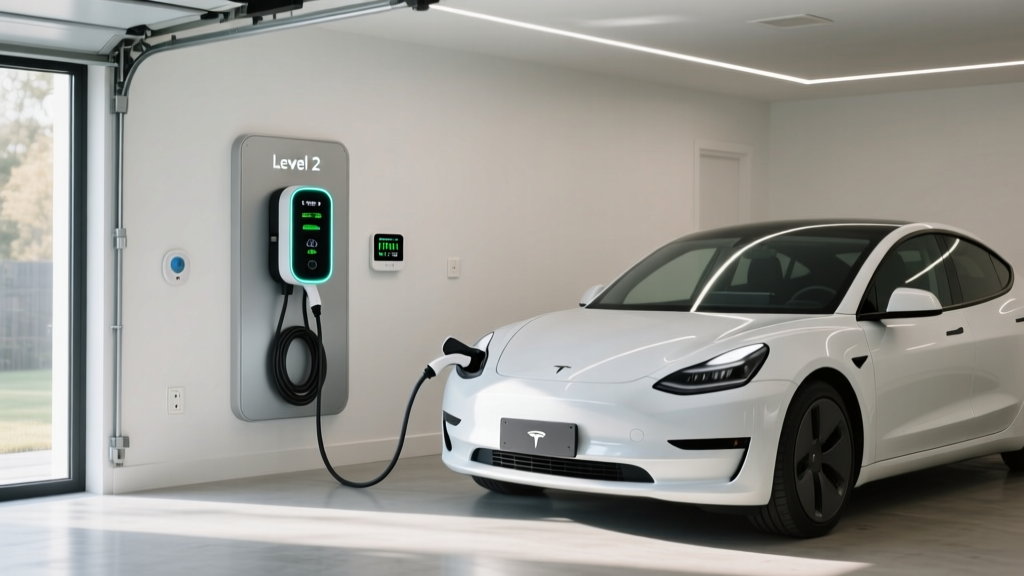
- Level 2 (240V, 11 kW onboard): 10–80% takes roughly 6 hours. A 48A home charger delivers the full 11 kW the car can accept.
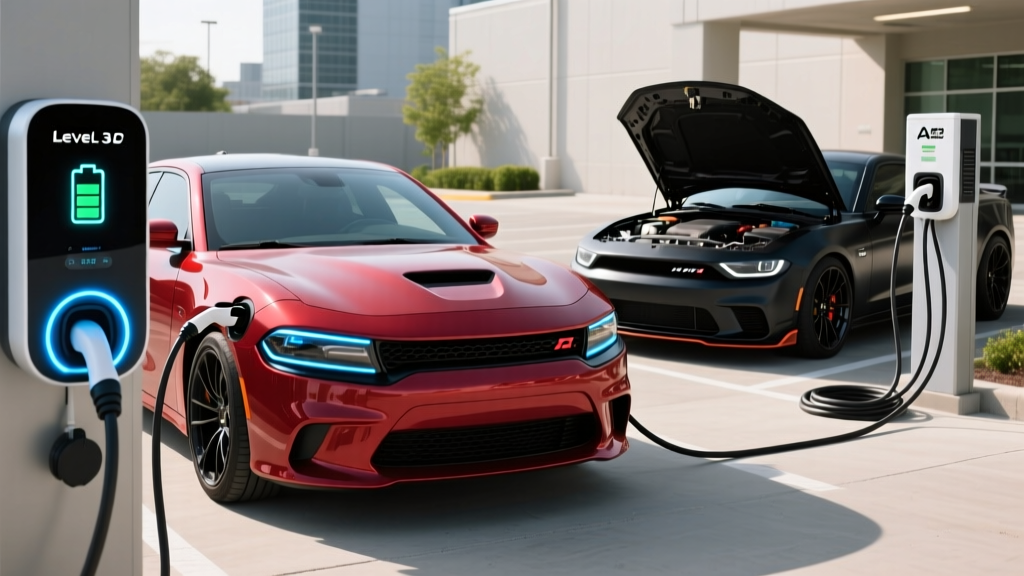
- DC Fast Charge (~200 kW peak): 10–80% in approximately 32 minutes. Note that the charge curve tapers significantly above 80% — going from 80–100% can add another 20–25 minutes. This is why road-trip strategy targets 80% stops.
Home Charger Installation: Electrical Requirements and Costs
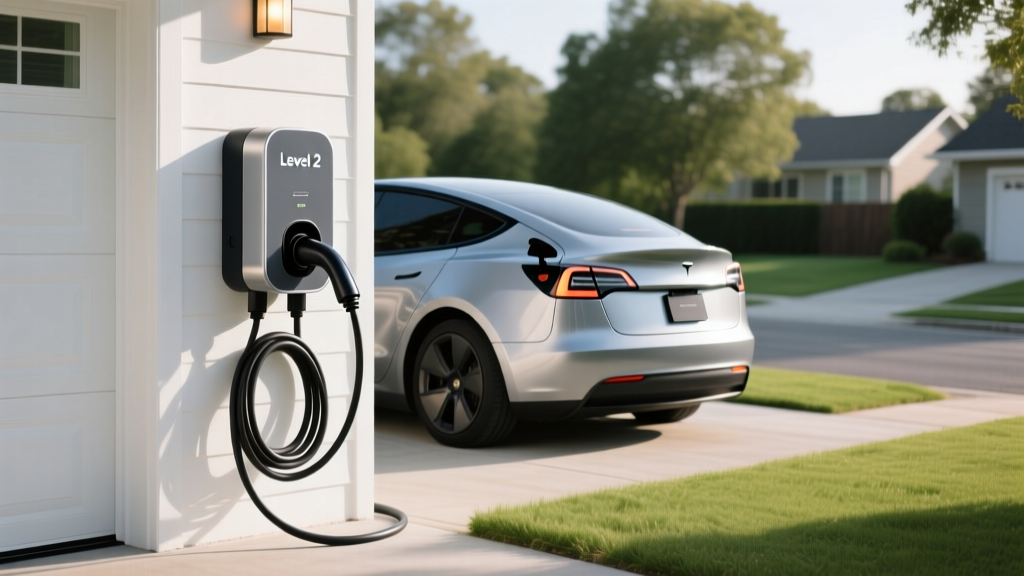
Installing a dedicated Level 2 home charger is the single best investment for daily EV convenience. For the Charger Daytona, you want a 240V circuit rated for at least 48 amps to maximize the car's 11 kW onboard charger. This typically requires a 60-amp breaker (EVSE continuous-load code requires the breaker to be rated 125% above the charger's max draw).
Electrical Panel Considerations
Most modern homes with a 200-amp service panel can accommodate a 60A EV circuit without an upgrade. However, older homes with 100A or 150A panels, or panels already near capacity from HVAC, electric ranges, and dryers, may need a panel upgrade to 200A — a significant added cost. A licensed electrician will perform a load calculation per NEC Article 220 to determine if your panel has headroom.
Permitting and Code
Virtually all jurisdictions require a permit for a new 240V circuit. The installation must include a dedicated circuit (no shared loads), proper wire gauge (typically 6 AWG copper for 60A), and in many areas a GFCI breaker if the outlet is outdoors or in a garage. Hardwired installations avoid the GFCI requirement and are generally preferred for reliability.
| Cost Component | Typical Range | Notes |
|---|---|---|
| Level 2 Charger (Equipment) | $300–$700 | Varies by brand, power, smart features |
| Electrician Labor (standard install) | $500–$1,500 | Short run from panel; longer runs cost more |
| Materials (wire, conduit, breaker) | $150–$400 | Depends on run length and local code |
| Permit Fee | $50–$200 | Varies by municipality |
| Panel Upgrade (if needed) | $1,500–$3,500 | 200A upgrade from 100A/150A service |
| Total (no panel upgrade) | $1,000–$2,800 | Most common scenario |
| Total (with panel upgrade) | $2,500–$6,300 | Older homes |
Connector Compatibility: CCS1, NACS, and Adapters
The 2025–2026 Dodge Charger Daytona ships with a CCS1 (Combined Charging System) port. This is the legacy standard used by most non-Tesla automakers, though the industry is rapidly migrating to Tesla's NACS (North American Charging Standard).
| Connector | Used By | Charger Daytona Compatible? |
|---|---|---|
| CCS1 | VW, Hyundai, BMW, older Ford/GM, Stellantis | Yes — native port |
| NACS (Tesla) | Tesla, 2025+ Ford, GM, Rivian, Volvo, others | Requires CCS1-to-NACS adapter (~$200–$250) |
| CHAdeMO | Legacy Nissan Leaf, Mitsubishi | No — obsolete for new vehicles |
Why an adapter matters: Stellantis has not announced a switch to NACS for the Charger Daytona as of the 2026 model year. However, Tesla's Supercharger network — the largest and most reliable DC fast-charging network in the U.S. — is increasingly NACS-only. A CCS1-to-NACS adapter (such as the Lectron or A2Z unit) unlocks access to Tesla Superchargers with V3 stalls delivering up to 250 kW. Note that the Charger Daytona's ~200 kW peak acceptance means you won't fully saturate a V3 stall, but you'll still charge near peak speed. Check Dodge's official site for any mid-cycle connector updates.
Cost to Charge: Home vs. Public vs. Gas Comparison
One of the strongest arguments for the Charger Daytona EV over its discontinued HEMI predecessors is fuel cost. Here's what charging actually costs across scenarios, based on the ~93.9 kWh battery and real-world efficiency of approximately 2.5–3.0 miles/kWh (varies by trim and driving style):
| Scenario | $/kWh | Cost for 10–80% (~65.7 kWh) | Cost Per Mile (est.) |
|---|---|---|---|
| Home Off-Peak (utility TOU rate) | $0.08–$0.12 | $5.26–$7.88 | $0.03–$0.04/mi |
| Home Standard Rate | $0.14–$0.18 | $9.20–$11.83 | $0.04–$0.05/mi |
| Public Level 2 (ChargePoint, etc.) | $0.25–$0.40 | $16.43–$26.28 | $0.07–$0.10/mi |
| DC Fast Charge (Electrify America) | $0.35–$0.55 | $22.99–$36.14 | $0.10–$0.14/mi |
| Tesla Supercharger (with adapter) | $0.28–$0.40 | $18.40–$26.28 | $0.08–$0.10/mi |
| Gas Equivalent (2023 Charger 5.7L HEMI, 19 MPG combined, $3.40/gal) | — | — | $0.18/mi |
Even at public DC fast-charging rates, the Charger Daytona costs less per mile than the old 5.7L HEMI Charger. At home off-peak rates, the savings are dramatic — roughly 75–80% less per mile compared to gasoline. Over 15,000 miles/year, home charging can save $1,800–$2,200 annually versus fueling a comparable gas muscle car. Reference current fuel economy data at fueleconomy.gov.
Recommended Home Chargers for the Charger Daytona
Since the Daytona's onboard charger maxes out at ~11 kW, a 48-amp Level 2 charger on a 60A circuit is the sweet spot. Going higher (e.g., 80A) won't charge this car faster but provides future-proofing if your next EV has a larger onboard charger.
ChargePoint Home Flex (240V, up to 50A / 12 kW)
- Power Output: Up to 50A (12 kW at 240V) — slightly above the Daytona's 11 kW ceiling, providing overhead
- Connector: CCS1 (J1772 + CCS combo)
- Cable Length: 23 feet
- Smart Features: Wi-Fi, app scheduling, utility TOU integration, Alexa
- Installation: Hardwired or NEMA 14-50 plug
- Price: ~$549 (charger only)
Grizzl-E Smart (240V, 40A / 9.6 kW)
- Power Output: 40A (9.6 kW) — will charge the Daytona slightly slower than its max, but a budget-friendly option
- Connector: CCS1
- Cable Length: 24 feet
- Smart Features: Bluetooth + Wi-Fi, app control, OCPP compatible
- Installation: NEMA 14-50 or hardwired; rated -40°F to +122°F (excellent for outdoor/cold-climate installs)
- Price: ~$399
Emporia Level 2 EV Charger (240V, 48A / 11.5 kW)
- Power Output: 48A (11.5 kW) — closely matches the Daytona's 11 kW onboard charger
- Connector: CCS1
- Cable Length: 24 feet
- Smart Features: Wi-Fi, energy monitoring via Emporia Vue integration, solar-aware scheduling
- Installation: Hardwired (recommended) or NEMA 14-50
- Price: ~$399
Our pick for Charger Daytona owners: The ChargePoint Home Flex at 50A provides the best balance of power, smart features, and reliability. If you have solar panels or want granular energy tracking, the Emporia is an outstanding alternative at a lower price. All three are ENERGY STAR certified and eligible for any applicable state/utility rebates.
Safety, Code, and Installation Best Practices
EV charging involves sustained high-current draw — unlike a dryer that cycles on and off, a Level 2 charger may run at full load for 6+ hours. This makes proper installation non-negotiable:
- Dedicated circuit: The EVSE must have its own breaker — never share with other appliances.
- Wire gauge: 6 AWG copper (THHN in conduit) for a 60A breaker; 4 AWG aluminum is an alternative for longer runs where cost matters.
- GFCI protection: Required by NEC 2020+ for outdoor receptacles and many jurisdictions require it for garages as well. Hardwired installations may exempt you from this requirement in some areas — confirm with your local AHJ (Authority Having Jurisdiction).
- Outdoor rating: If mounting outside, ensure the charger carries a NEMA 4 or IP65 rating for weather resistance. All three recommendations above are outdoor-rated.
- Cable management: Use a holster or retractable cable system to prevent trip hazards and protect the connector from ground contamination.
- Utility notification: Many utilities require notification before installing a Level 2 charger. Some offer TOU (time-of-use) rate plans that dramatically reduce charging costs — contact your utility before installation.
Federal Tax Credits and Incentives for Home Charging
The federal §30C Alternative Fuel Infrastructure Tax Credit was revived under the Inflation Reduction Act, offering up to $1,000 for residential EV charger installation. Key caveats:
- The credit covers 30% of equipment + installation costs, capped at $1,000
- Your home must be in a qualifying census tract (non-urban or low-income area) — check the IRS eligibility tool
- The credit applies to the tax year the installation is completed
- Many state utilities offer additional rebates of $200–$500 for Level 2 charger installation — check your local utility
- This is separate from the §30D vehicle purchase credit, which has its own MSRP caps, income limits, and battery-sourcing requirements
Frequently Asked Questions
Are Dodge Chargers still being made?
Yes. After ending production of the gas-powered Charger in December 2023, Dodge launched the all-electric Charger Daytona for the 2025 model year, continuing into 2026. It's available in R/T (496 hp) and Scat Pack (670 hp) trims. Dodge has also announced a six-cylinder Hurricane inline-six variant (non-electric) for buyers not yet ready for full EV adoption, though availability and timing remain limited.
How much does it cost to install a home EV charger for the Charger Daytona?
Expect $1,000–$2,800 for a standard installation (equipment + electrician + permit) if your electrical panel has capacity. Homes needing a 200A panel upgrade should budget $2,500–$6,300 total. Get at least three quotes from licensed electricians and confirm they have EVSE installation experience.
How fast will each charging level add range?
Level 1 (120V) adds 3–5 miles per hour — too slow for a 93.9 kWh battery as a daily solution. Level 2 (240V, 48A) adds roughly 28–35 miles per hour on the Charger Daytona, fully replenishing overnight. DC fast charging at ~200 kW can add up to 150+ miles in 10 minutes during the peak of the charge curve, tapering as the battery fills above 60–70%.
Which connector does the Charger Daytona use?
CCS1. To access Tesla Superchargers — the largest U.S. network — you'll need a CCS1-to-NACS adapter ($200–$250). At home, any J1772/CCS1 Level 2 charger will work natively.
How much does charging cost per mile vs. the old gas Charger?
At home off-peak rates ($0.10/kWh), the Charger Daytona costs roughly $0.03–$0.04 per mile. The old 5.7L HEMI Charger at 19 MPG combined and $3.40/gallon cost about $0.18 per mile. That's a 75–80% fuel cost reduction, saving roughly $1,800–$2,200 per year at 15,000 miles.
What electrical upgrades might I need?
A 60-amp dedicated circuit on a 240V line is required for optimal Level 2 charging. If your panel is 100A or 150A and near capacity, a panel upgrade to 200A ($1,500–$3,500) may be necessary. Your electrician will perform a NEC Article 220 load calculation to determine this. Homes built after 2000 with 200A service rarely need an upgrade.
Does the Charger Daytona qualify for the $7,500 federal EV tax credit?
Federal §30D credit eligibility depends on MSRP caps (sedans: $55,000), buyer income limits ($150K single / $300K joint), and battery critical-mineral sourcing requirements. The Charger Daytona R/T's ~$51,990 base MSRP falls under the cap, but the Scat Pack at ~$59,990 exceeds the sedan cap. Battery sourcing rules are evolving — verify current-year eligibility at IRS.gov and consult a tax professional before relying on the credit in your purchase decision.