Why Home Charging Changes Everything About EV Ownership
If you own or are considering an electric vehicle, the single most impactful upgrade you can make isn't a bigger battery or a faster motor — it's a dedicated Level 2 home charger. Over 80% of EV charging happens at home, according to the U.S. Department of Energy, and for good reason: it's cheaper, more convenient, and eliminates the "charging errand" entirely. You plug in when you get home and wake up to a full battery every morning.
But "charging an EV at home" isn't a one-size-fits-all proposition. The difference between plugging into a standard 120V outlet (Level 1) and installing a 240V hardwired charger (Level 2) is the difference between adding 4 miles of range per hour and adding 35+ miles per hour. This guide breaks down every number you need — speeds, costs, electrical requirements, and equipment picks — so you can make a confident decision.
Charging Levels Explained: Speeds in kW and Miles Per Hour
Before we talk about installation, let's establish the three charging levels and what they actually deliver. A critical distinction: kW (kilowatts) measures power — the rate at which energy flows into your battery. kWh (kilowatt-hours) measures energy — the total capacity of your battery. Think of kW as the width of a hose and kWh as the size of the bucket. A wider hose (more kW) fills the bucket (kWh) faster.
| Level | Voltage | Max Power (kW) | Miles of Range Added/Hour | Best For |
|---|---|---|---|---|
| Level 1 (120V) | 120V AC | 1.2–1.9 kW | 3–5 miles | PHEVs, overnight top-ups, emergencies |
| Level 2 (240V) | 240V AC | 3.3–19.2 kW | 12–70+ miles | Daily home charging for all BEVs |
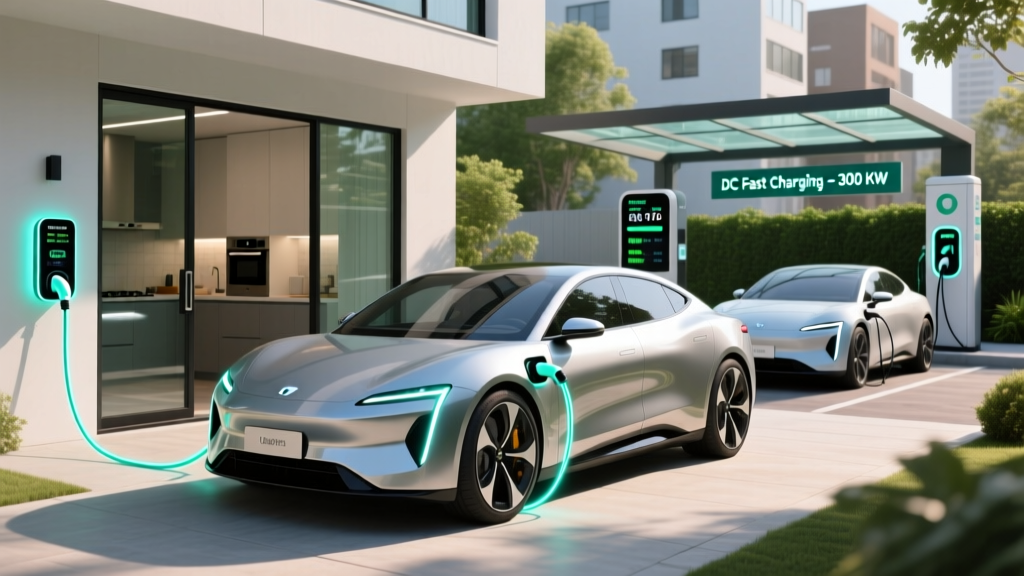
| DC Fast Charging | 400–800V DC | 50–350 kW | 150–1,000+ miles (peak) | Road trips, quick top-ups away from home |
The "miles per hour" figures vary based on your vehicle's efficiency. A highly efficient sedan like the Hyundai Ioniq 6 (4.0 mi/kWh) will gain more range per kW than a heavy truck like the Ford F-150 Lightning (2.0 mi/kWh). Always calculate based on your specific vehicle's efficiency rating from fueleconomy.gov.
Level 1 reality check: A 120V outlet delivering 1.4 kW will add roughly 45–55 miles of range over a 12-hour overnight session. That's adequate for a plug-in hybrid with 30–40 miles of electric range, or a BEV commuter driving under 40 miles round-trip. For a long-range BEV with an 80+ kWh battery, a full Level 1 charge from empty would take 3–4 days.
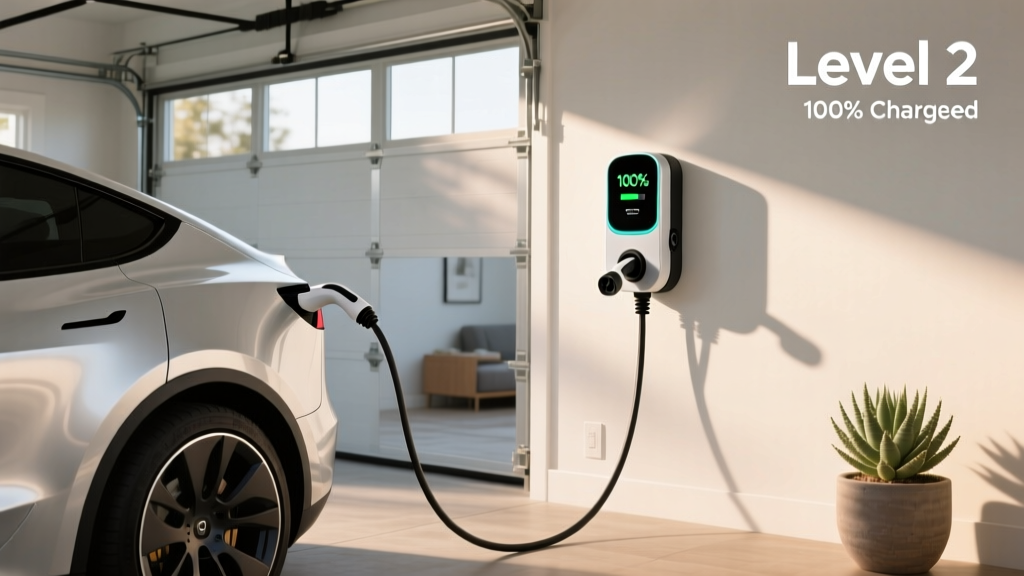
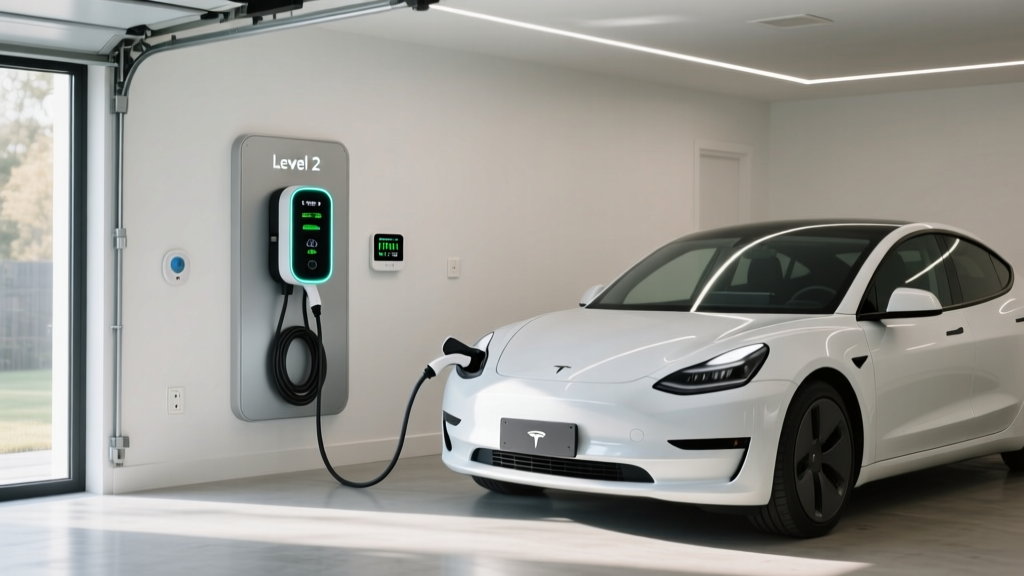
Level 2 is the home charging sweet spot. A 48-amp (11.5 kW) Level 2 charger can fully replenish a 75 kWh battery overnight in roughly 7–8 hours. That covers virtually any daily driving need.
How Much Does It Cost to Install a Home EV Charger?
This is the question every EV buyer asks, and the honest answer spans a wide range depending on your home's electrical infrastructure. Here's a realistic breakdown based on 2026 national averages for a typical Level 2 (240V, 48-amp) installation:
| Component | Typical Cost Range | Notes |
|---|---|---|
| Level 2 Charger (Equipment) | $300–$750 | Hardwired 48A units; smart WiFi-enabled models at higher end |
| Electrician Labor | $400–$1,500 | Depends on run length from panel to garage/carport |
| Electrical Permit | $50–$250 | Varies by municipality; required in most jurisdictions |
| Panel Upgrade (if needed) | $1,500–$3,500+ | Required if existing panel lacks capacity or open breaker slots |
| Total (No Panel Upgrade) | $750–$2,500 | Most homes with 200A service and open slots |
| Total (With Panel Upgrade) | $2,250–$6,000+ | Older homes with 100A service or full panels |
What Electrical Upgrades Might I Need?
Most homes built after 2000 have a 200-amp electrical panel with available breaker slots. If that's you, expect a straightforward install: the electrician runs 6 AWG copper wire (or 4 AWG aluminum) from your panel to the charger location, installs a NEMA 14-50 outlet or hardwires the unit, and pulls a permit. Total time on-site: typically 2–4 hours.
Here's where it gets more complex — and expensive:
- 100-amp service panels: Common in homes built before the 1980s. A 48-amp EV charger draws 60 amps of breaker capacity (NEC code requires circuits be rated at 125% of continuous load). Adding a 60A load to a 100A panel that's already serving a modern household often requires a panel upgrade to 200A, costing $1,500–$3,500.
- Full breaker panels: Even a 200A panel can be out of physical slots. A tandem breaker reconfiguration may solve this ($150–$300), or you may need a sub-panel ($400–$800).
- Long wire runs: If your panel is on the opposite side of the house from your garage, wire costs increase significantly. Expect $8–$15 per foot for 6 AWG copper, plus conduit. A 100-foot run can add $800–$1,500 in materials and labor alone.
- Utility service upgrades: In rare cases, the utility drop to your home is only rated for 100A total. Upgrading the service mast and meter base is a utility-coordinated project that can cost $2,000–$5,000+.
Pro tip: Before calling an electrician, check your panel for the main breaker rating (150A, 200A) and count your open slots. Take a photo and share it during estimates — it saves time and helps electricians give accurate quotes remotely.
Which Connector and Charger Is Compatible with My EV?
The connector landscape has shifted dramatically. As of 2026, the North American Charging Standard (NACS), originally developed by Tesla, has become the dominant connector for new EVs sold in North America. Most non-Tesla automakers — Ford, GM, Rivian, Hyundai, Kia, and others — have adopted NACS for their 2025+ model-year vehicles. However, millions of CCS1-equipped EVs from 2018–2024 remain on the road, and CHAdeMO persists on older Nissan Leafs.
| Connector | Vehicles Using It (2026) | Home Charger Availability | Adapter Options |
|---|---|---|---|
| NACS (Tesla-style) | Tesla (all years), Ford (2025+), GM (2025+), Rivian (2025+), Hyundai/Kia (2025+), others | Tesla Wall Connector, ChargePoint Home Flex (NACS), Emporia Vista (NACS) | CCS1-to-NACS adapters available from Tesla and third parties (~$150–$250) |
| CCS1 (Combo) | VW ID.4 (2021–2024), Hyundai Ioniq 5 (2022–2024), Kia EV6 (2022–2024), BMW i4, older non-Tesla EVs | ChargePoint Home Flex (CCS), Emporia Vue (CCS), JuiceBox (CCS) | NACS-to-CCS1 adapters from Tesla (~$200) and Lectron (~$150) |
| CHAdeMO | Nissan Leaf (all years), Mitsubishi Outlander PHEV (older) | Limited; mostly Level 2 J1772 chargers with CHAdeMO DC uncommon at home | No practical home adapter; CHAdeMO DC chargers are commercial-grade |
| J1772 (Level 2 only) | All non-Tesla EVs for AC Level 2 charging (universal standard) | Every Level 2 home charger includes J1772 or offers it as an option | Tesla Mobile Connector includes J1772 adapter; NACS-to-J1772 adapters available |
Key takeaway for home charging: For Level 2 (AC) charging at home, every non-Tesla EV in the U.S. uses the J1772 connector. Tesla vehicles use the NACS connector. If you're buying a home charger, match it to your vehicle's connector — or buy a universal charger and use an adapter. For 2025+ model-year vehicles from Ford, GM, Rivian, and others that have switched to NACS, you'll want a NACS-connector home charger.
How Much Does Charging Cost Per Mile vs. Gas?
This is where EV ownership economics shine — but the savings depend heavily on where and when you charge. Electricity prices vary enormously across the U.S., from roughly $0.10/kWh in parts of the Pacific Northwest and Louisiana to $0.35+/kWh in California and the Northeast during peak hours.
Let's run the math using a representative mid-size EV with an efficiency of 3.5 miles per kWh (comparable to a Tesla Model Y or Hyundai Ioniq 5):
| Charging Scenario | Cost per kWh | Cost per Mile | Equivalent Gas Price (at 30 MPG) |
|---|---|---|---|
| Home — Off-Peak / Time-of-Use Rate | $0.12 | $0.034 | $1.02/gallon |
| Home — Standard Residential Rate | $0.17 | $0.049 | $1.46/gallon |
| Home — High-Cost Region (CA, Northeast) | $0.30 | $0.086 | $2.57/gallon |
| Public Level 2 (ChargePoint, etc.) | $0.25–$0.49 | $0.071–$0.140 | $2.14–$4.20/gallon |
| DC Fast Charging (Electrify America, Tesla Supercharger) | $0.35–$0.55 | $0.100–$0.157 | $3.00–$4.71/gallon |
| Gas Vehicle (30 MPG, $3.50/gal) | — | $0.117 | $3.50/gallon |
The bottom line: Charging at home on an off-peak utility rate is 60–70% cheaper per mile than gasoline. Even at standard residential rates, you'll typically save 50%+ over gas. Public DC fast charging, however, can approach or exceed gas costs — it's a convenience premium for road trips, not a daily charging strategy.
Many utilities now offer time-of-use (TOU) plans specifically designed for EV owners, with rates as low as $0.07–$0.12/kWh between midnight and 6 AM. Check with your utility about EV-specific rate plans — this single step can cut your charging costs in half.
Best Home EV Chargers for 2026: Equipment Picks
We've tested and tracked reliability data on the major Level 2 home chargers available in 2026. Here are our top picks across categories, with exact specs:
Best Overall: Tesla Wall Connector (NACS)
- Power Output: Up to 11.5 kW (48 amps) on a 60A circuit
- Connector: NACS (native); J1772 adapter included in box
- Cable Length: 24 feet
- Smart Features: WiFi connectivity, over-the-air updates, load sharing (pair multiple units on one circuit), energy metering via Tesla app
- Price: $475 (as of early 2026)
- Best For: Tesla owners and 2025+ NACS-adopting EVs (Ford, GM, Rivian). The J1772 adapter makes it backward-compatible with older CCS1 vehicles for Level 2.
Best Universal: ChargePoint Home Flex
- Power Output: Up to 12 kW (50 amps) on a 60A circuit; configurable down to 16A for lower-capacity panels
- Connector: Available in NACS or J1772 configurations
- Cable Length: 23 feet
- Smart Features: WiFi, ChargePoint app with scheduling, Alexa/Google Home integration, flexible amperage settings via DIP switches
- Price: $549–$599
- Best For: Multi-EV households or buyers who want maximum flexibility. The adjustable amperage (16A–50A) is ideal if your panel can't support a full 60A circuit.
Best Value: Emporia Vue Level 2 Charger
- Power Output: Up to 11.5 kW (48 amps) on a 60A circuit
- Connector: J1772 (NACS version available)
- Cable Length: 24 feet
- Smart Features: WiFi, Emporia app with real-time energy monitoring, solar integration (pair with Emporia Vue energy monitor), TOU scheduling
- Price: $349–$399
- Best For: Budget-conscious buyers who still want smart features. The solar integration is a standout for homes with rooftop panels — you can set the charger to use only excess solar production.
What about NEMA 14-50 outlets vs. hardwired? A NEMA 14-50 outlet (the same as a large dryer or range outlet) gives you the flexibility to unplug the charger and take it with you, or plug in a different device. However, NEC 2023 code revisions in some jurisdictions now require GFCI breakers for 14-50 receptacles, which can add $50–$150 and occasionally cause nuisance tripping with certain chargers. Hardwired installations avoid the GFCI requirement and are generally more reliable — but they're permanent. Discuss both options with your electrician.
Charging Time Examples: What to Expect with Common Battery Sizes
How long a home charge actually takes depends on your battery's usable capacity (in kWh), the charger's power output (in kW), and your starting state of charge. Here are real-world examples for popular 2026 EVs charging on a 48-amp (11.5 kW) Level 2 home charger:
| Vehicle | Usable Battery (kWh) | Max AC Charge Rate (kW) | 10%–80% Time (Level 2, 11.5 kW) | 0%–100% Time |
|---|---|---|---|---|
| Tesla Model Y Long Range (2026) | 75 kWh | 11.5 kW | ~4.5 hours | ~6.5 hours |
| Hyundai Ioniq 5 (2025+ NACS) | 74 kWh | 10.9 kW | ~4.5 hours | ~6.8 hours |
| Ford F-150 Lightning Extended Range | 131 kWh | 19.2 kW | ~5.0 hours (at 19.2 kW) | ~6.8 hours (at 19.2 kW) |
| Chevrolet Equinox EV (2026) | 85 kWh | 11.5 kW | ~5.1 hours | ~7.4 hours |
| BMW i4 eDrive40 | 81 kWh | 11 kW | ~5.2 hours | ~7.4 hours |
Important nuance — the charge curve: Lithium-ion batteries accept charge fastest at low states of charge and taper significantly above 80%. On a Level 2 home charger, this taper is gentle — you might see 11.5 kW sustained from 10%–80%, then a drop to 3–5 kW from 80%–100%. This is why the 10%–80% figure is more practical than 0%–100%. For daily driving, most EV owners set their charge limit to 80% (which also extends long-term battery health) and only charge to 100% before road trips.
For DC fast charging on road trips, the same vehicles can hit 10%–80% in 18–35 minutes depending on peak DC charge rate (150–350 kW) and the vehicle's charge curve profile. See our EPA fuel economy database for official efficiency and range figures for every model.
Safety, Code, and Installation Best Practices
A Level 2 EV charger is a significant electrical appliance that draws sustained high current for hours at a time. Proper installation isn't optional — it's a safety and insurance requirement. Here's what to verify:
- Dedicated circuit: Your EV charger must be on its own dedicated breaker — not shared with other outlets or appliances. A 48-amp charger requires a 60-amp breaker per NEC continuous-load rules (80% derating).
- Wire gauge: 6 AWG copper (or 4 AWG aluminum) for a 60A circuit. Undersized wire is a fire hazard — never let a contractor cut corners here.
- GFCI protection: If you install a NEMA 14-50 receptacle (rather than hardwiring), NEC 2023 and many local codes require a GFCI breaker. Hardwired installations typically do not require GFCI. Confirm with your local building department — codes vary by jurisdiction.
- Outdoor rating: If your charger is installed outdoors (carport, driveway, exterior wall), it must carry a NEMA 4 or IP65 weather resistance rating. All three chargers recommended above are rated for outdoor installation.
- Permit and inspection: Most municipalities require an electrical permit for a new 240V circuit. The permit fee is typically $50–$250, and a city inspector will verify the installation meets code. Do not skip this step. Unpermitted electrical work can void your homeowner's insurance and create liability issues if a fire occurs.
- Utility notification: Some utilities require you to notify them before installing an EV charger, especially if you're requesting a TOU rate plan or a service upgrade. A few utilities offer rebates of $250–$1,000 for charger installation — check with your provider.
For detailed IRS guidance on the §30D clean vehicle credit and whether home charging equipment qualifies under the alternative fuel vehicle refueling property credit (Form 8911), consult a tax professional. The refueling property credit can cover up to 30% of home charger installation costs (max $1,000) for eligible taxpayers in qualifying census tracts.
Frequently Asked Questions
Can I charge my EV with a regular household outlet?
Yes — that's Level 1 charging (120V, 1.2–1.9 kW). It adds roughly 3–5 miles of range per hour. For a plug-in hybrid with 30–40 miles of electric range, overnight Level 1 charging is often sufficient. For a full BEV with 250+ miles of range, Level 1 works only if your daily driving is under 40–50 miles and you can leave the car plugged in for 12+ hours. Most BEV owners find Level 1 too slow for practical daily use and upgrade to Level 2.
Do I need a 200-amp electrical panel for a Level 2 charger?
Not necessarily. A 48-amp Level 2 charger draws a continuous 48 amps, which requires a 60-amp breaker (per NEC 125% rule). If you have a 200-amp panel with available capacity, this is usually fine. If you have a 100-amp panel, you may need an upgrade — but some electricians can perform a load calculation that shows your actual peak usage leaves enough headroom. Lower-amperage chargers (16A or 32A) are also an option for homes with limited panel capacity, adding 12–25 miles per hour instead of 35+.
How fast will each charging level add range to my EV?
Level 1 (120V): 3–5 miles per hour. Level 2 (240V, 48A): 30–45 miles per hour for a typical mid-size EV. DC Fast Charging (150–350 kW): 150–1,000+ miles per hour at peak, but sessions typically last 18–40 minutes for a 10%–80% charge because the rate tapers above 80%.
Is it cheaper to charge at home or at public stations?
Home charging is almost always cheaper. At a national average residential rate of ~$0.17/kWh, home charging costs roughly $0.049/mile for a 3.5 mi/kWh EV. Public Level 2 stations charge $0.25–$0.49/kWh, and DC fast chargers charge $0.35–$0.55/kWh — making public charging 2–3x more expensive. The economics strongly favor home charging as your primary strategy.
Will charging at home increase my electric bill significantly?
Yes, but less than you'd spend on gas. Driving 12,000 miles per year in an EV averaging 3.5 mi/kWh requires about 3,430 kWh annually. At $0.17/kWh (national average), that's ~$583/year in electricity — compared to ~$1,400/year in gasoline for a 30 MPG vehicle at $3.50/gallon. Your net annual fuel savings: roughly $800+, depending on your local electricity and gas prices.
Should I charge to 100% every night?
No — for daily use, most automakers recommend setting your charge limit to 80% to maximize long-term battery health. Lithium-ion batteries degrade faster when held at 100% state of charge for extended periods. Charge to 100% only when you need maximum range for a long trip. If your EV uses an LFP (lithium iron phosphate) battery — like the Tesla Model 3 RWD or certain Ford Mustang Mach-E trims — the manufacturer may recommend periodic 100% charges for battery calibration. Check your owner's manual for chemistry-specific guidance.