Understanding EV Charging Levels: Level 1, Level 2, and DC Fast Charging
Before evaluating any DC EV charger — whether a public station or the rare residential unit — you need a firm grasp of the three charging tiers and the critical distinction between kW (kilowatts, the rate of power delivery) and kWh (kilowatt-hours, the energy stored in your battery). Think of kW as how fast water flows from a hose, and kWh as the total gallons in the bucket. Confusing them is the single most common EV literacy gap, and it leads to bad purchase decisions.
| Level | Voltage | Power (kW) | Miles Added/Hour | Typical Use Case |
|---|---|---|---|---|
| Level 1 (120V) | 120V AC | 1.0–1.4 kW | 3–5 mi/hr | Overnight trickle; PHEVs, low-mileage drivers |
| Level 2 (240V) | 240V AC | 3.3–19.2 kW | 12–75 mi/hr | Home daily charging; workplace; retail destinations |
| DC Fast Charging | 200–900V DC | 50–350 kW | 150–1,200+ mi/hr (peak) | Road trips; highway corridors; commercial fleets |
Level 1 plugs into any standard 120V household outlet. It's adequate for plug-in hybrids with 20–40 miles of electric range, or BEV owners who drive under 30 miles daily and can leave the car plugged in for 10+ hours. For a 75 kWh battery (like the Ford Mustang Mach-E Extended Range), Level 1 adds roughly 4 miles per hour — a full recharge would take over 3 days.
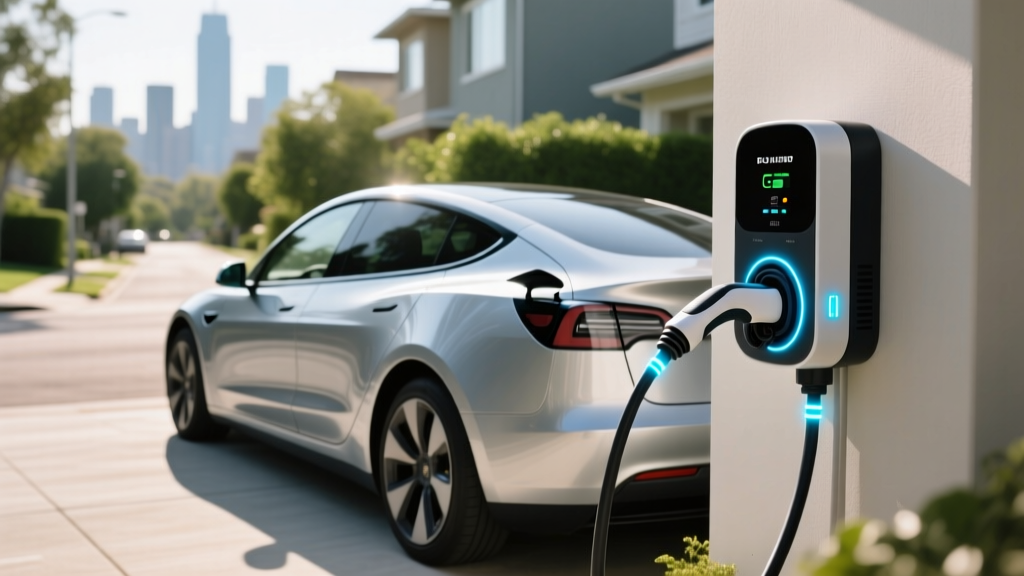
Level 2 is the backbone of practical EV ownership. A 48-amp (11.5 kW) home charger can fully replenish most EVs overnight in 6–9 hours. This is what 95% of BEV owners install at home.
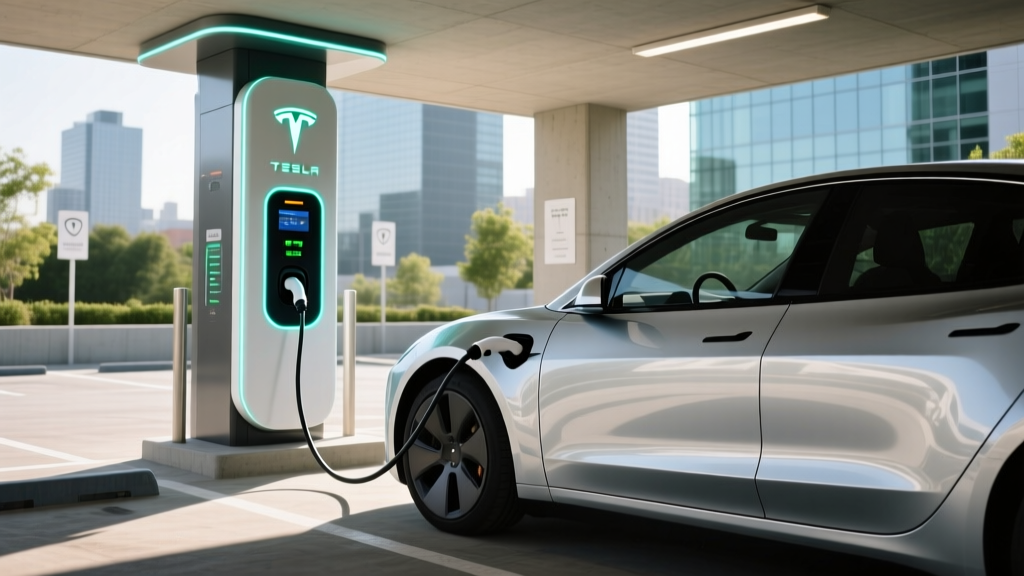
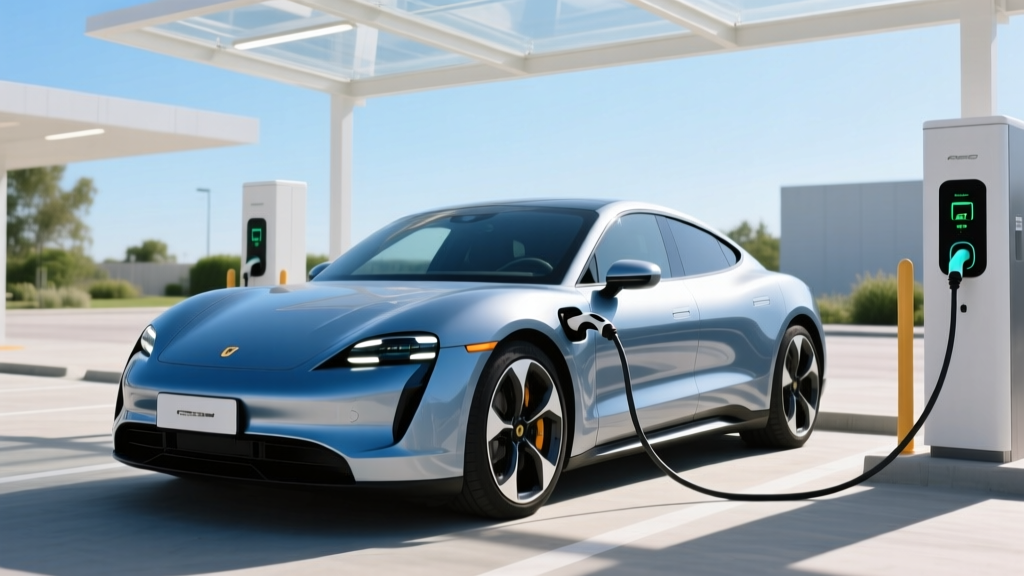
DC fast charging bypasses the vehicle's onboard charger entirely, sending direct current straight to the battery at much higher voltages and power levels. Public DC EV chargers from networks like Electrify America, EVgo, and Tesla Superchargers deliver 50 kW to 350 kW. A 350 kW charger can add 200+ miles in 15 minutes to a compatible vehicle like the Hyundai Ioniq 5 or Porsche Taycan. However, real-world charging speed depends on the vehicle's charge curve — most EVs peak at their maximum kW only between 10–30% state of charge, then taper significantly above 80% to protect battery health.
Can You Install a DC EV Charger at Home?
The short answer: almost never, and almost never sensibly. Here's why.
Residential DC fast chargers exist — companies like Wallbox offer the Quasar (up to 22 kW DC, bidirectional), and commercial-grade units from ABB or Tritium can be purchased by individuals. But a 50 kW DC unit requires 480V three-phase power, which virtually no US residence has. Even the 22 kW Wallbox Quasar needs a 240V/100A dedicated circuit, which demands a 200-amp (minimum) electrical panel with substantial spare capacity.
The economics also discourage home DC installation. A 50 kW DC unit costs $15,000–$40,000 for the hardware alone, plus $3,000–$10,000+ for electrical upgrades and installation. For context, a quality Level 2 home charger like the ChargePoint Home Flex ($599) or Tesla Wall Connector ($475) delivers 11.5 kW on a 60A/48A circuit — enough to fully charge any consumer EV overnight at 1/50th the equipment cost.
The practical approach: Install a Level 2 charger at home for daily needs (waking up to a full battery every morning), and use public DC fast chargers for road trips and occasional quick top-ups.
Home Level 2 Charger Installation: Electrical Requirements and Costs
Most EV owners installing a home charger need a 240V dedicated circuit, similar to what a clothes dryer or electric range uses. Here are the common configurations:
- 40A circuit (32A continuous): Delivers up to 7.7 kW. Adds ~25–30 miles/hour. Adequate for most daily needs. Requires a NEMA 14-50 outlet or hardwired connection.
- 60A circuit (48A continuous): Delivers up to 11.5 kW. Adds ~40–45 miles/hour. The sweet spot for most modern EVs with larger batteries (75–100 kWh).
- 80A circuit (64A continuous): Delivers up to 15.4–19.2 kW (vehicle-dependent). Requires hardwiring and an EV that supports AC charging above 11.5 kW (e.g., Ford F-150 Lightning with the optional 80A Charge Station Pro, or the Hummer EV).
Panel Capacity: The Hidden Cost
Your home's electrical panel has a maximum amperage rating — typically 100A, 150A, or 200A in US homes. An electrician will perform a load calculation (per NEC Article 220) to determine if your panel can support a new 40A–60A circuit. If your 200A panel is already near capacity (common in homes with electric heat, A/C, and an electric range), you may need a panel upgrade to 300A–400A, which adds $2,000–$5,000 to the project.
Some homeowners opt for a smart load-management device like the Emporia Vue with EVSE integration or the Span smart panel, which dynamically reduces charger amperage when other high-draw appliances are running. This can avoid a panel upgrade entirely.
| Cost Component | Typical Range | Notes |
|---|---|---|
| Level 2 Charger (equipment) | $350–$750 | ChargePoint, Tesla, Emporia, Wallbox |
| Electrician labor (standard install) | $500–$1,500 | Depends on run length from panel to garage |
| Permit & inspection | $50–$300 | Varies by municipality; required for code compliance |
| Electrical panel upgrade (if needed) | $2,000–$5,000 | 200A→300A/400A; older homes with 100A panels |
| Total (no panel upgrade) | $900–$2,550 | Most common scenario for post-2000 homes |
| Total (with panel upgrade) | $2,900–$7,550 | Common in pre-1990 homes or high-load households |
The IRS §30D tax credit does not cover home charger installation for most taxpayers — that was covered under §30C (Alternative Fuel Infrastructure Tax Credit), which was extended through 2032 with a 30% credit up to $1,000 for residential charging equipment and installation. Check current IRS §30C guidelines for eligibility, as census-tract restrictions apply.
Connector Compatibility: NACS, CCS1, CHAdeMO, and Adapters
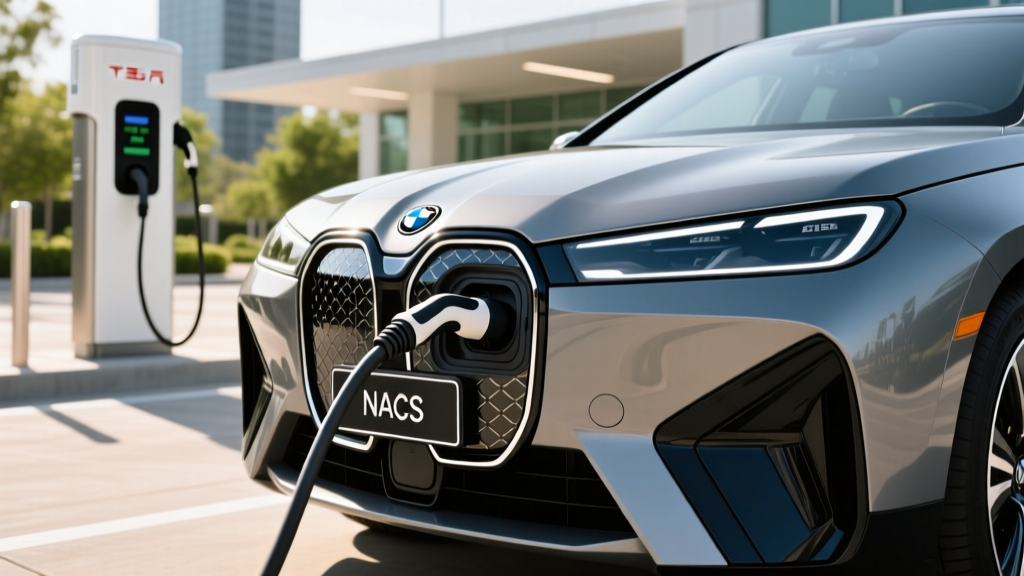
The North American charging landscape has largely converged on the NACS (North American Charging Standard) connector, originally developed by Tesla and now adopted by Ford, GM, Rivian, Hyundai/Kia, Volvo, BMW, and most other major automakers starting with 2025–2026 model-year vehicles. CCS1 (Combined Charging System) remains on many 2020–2024 models, while CHAdeMO is essentially legacy (Nissan Leaf, Mitsubishi Outlander PHEV).
| Connector | AC Level 2 | DC Fast Charging | Vehicles (2025–2026 Models) | Adapter Availability |
|---|---|---|---|---|
| NACS (J3400) | Yes | Yes (up to 350+ kW) | Tesla (all), Ford, GM, Rivian, Hyundai Ioniq 5/6 (2025+), Kia EV6/EV9 (2025+), Volvo, BMW | CCS→NACS adapters ($150–$300); widely available |
| CCS1 | Yes (via J1772) | Yes (up to 350 kW) | VW ID.4 (pre-2025), older Hyundai/Kia, BMW i4/iX (pre-2025), Porsche Taycan (pre-2025) | NACS→CCS adapters available for Tesla Supercharger access |
| CHAdeMO | No | Yes (up to 100 kW) | Nissan Leaf (discontinued), Mitsubishi Outlander PHEV | Limited; CHAdeMO→CCS adapters exist but are expensive ($400+) |
For 2026 buyers: If you're purchasing a new EV, NACS is the future-proof choice. If you own a CCS-equipped vehicle from 2022–2024, a NACS adapter (such as the Lectron or A2Z adapter, ~$180–$250) unlocks access to Tesla's Supercharger network — which, as of 2026, has opened over 20,000 stalls to non-Tesla vehicles via NACS adapters or built-in Magic Dock connectors.
Charging Time Examples: 10% to 80% for Common Battery Sizes
DC fast charging speed is not constant. Every EV has a charge curve: peak kW is typically sustained only between roughly 10–30% state of charge, then the battery management system progressively reduces power to protect cell health. A vehicle advertised as "350 kW capable" will only hold that rate for a few minutes under ideal thermal conditions.
Here are realistic 10–80% DC fast charging times based on manufacturer data and real-world testing:
| Vehicle | Battery (kWh) | Peak DC kW | 10–80% Time | Notes |
|---|---|---|---|---|
| Hyundai Ioniq 5 (2026) | 84 kWh (NMC) | 240 kW | ~18 min | 800V architecture; excellent curve sustainability |
| Tesla Model Y Long Range (2026) | 75 kWh (NMC/LFP) | 250 kW | ~22 min | V4 Supercharger compatible |
| Ford F-150 Lightning Ext. Range | 131 kWh (NMC) | 155 kW | ~41 min | Large battery limits peak C-rate |
| Chevrolet Equinox EV (2026) | 85 kWh (NMC) | 190 kW | ~24 min | Ultium platform |
| Porsche Taycan (2025+) | 105 kWh (NMC) | 320 kW | ~16 min | 800V; among fastest charging production EVs |
| Nissan Ariya | 91 kWh (NMC) | 130 kW | ~35 min | Conservative charge curve limits speed |
Preconditioning matters. Most EVs with active thermal management (Tesla, Hyundai/Kia 800V, Porsche, GM Ultium) will preheat or precool the battery when you navigate to a DC fast charger. Arriving with a cold battery can double your 10–80% time. Always use the vehicle's navigation to route through a fast charger, even if you know the way — this triggers preconditioning automatically.
Cost to Charge: Home vs Public DC Fast Charging vs Gas
The economics of EV charging depend heavily on where and when you plug in. Here's a data-driven breakdown using a representative 2026 EV averaging 3.0 miles/kWh (about 110 MPGe combined, similar to a Tesla Model Y or Hyundai Ioniq 5):
| Scenario | $/kWh | Cost per 300 miles | Cost per mile | vs Gas (30 MPG @ $3.40/gal) |
|---|---|---|---|---|
| Home Level 2 (national avg. residential, 2026) | $0.16 | $16.00 | $0.053 | 53% cheaper |
| Home Level 2 (off-peak TOU rate) | $0.09 | $9.00 | $0.030 | 73% cheaper |
| Home Level 2 (high-cost state, CA/HI avg.) | $0.30 | $30.00 | $0.100 | 12% cheaper |
| Public Level 2 (ChargePoint, EVgo L2) | $0.25–$0.35 | $25–$35 | $0.083–$0.117 | Comparable to gas |
| DC Fast Charging (Electrify America, EVgo) | $0.40–$0.55 | $40–$55 | $0.133–$0.183 | Comparable or more expensive |
| Tesla Supercharger (avg. 2026) | $0.30–$0.40 | $30–$40 | $0.100–$0.133 | 12–22% cheaper |
For comparison, a gas vehicle averaging 30 MPG at $3.40/gallon costs $0.113/mile, or $34 per 300 miles.
The takeaway: Home charging is where EVs deliver massive fuel savings. Relying exclusively on DC fast charging erases much of the cost advantage — and in some cases, exceeds gas costs. Plan your ownership around home Level 2 access, and treat DC fast charging as a road-trip tool, not a daily habit.
Equipment Recommendations: Best Home Level 2 Chargers (2026)
While a home DC EV charger isn't practical for most buyers, choosing the right Level 2 unit is critical. Here are top picks based on power output, connector type, smart features, and real-world reliability:
Tesla Wall Connector (Gen 4)
- Power: Up to 11.5 kW (48A) on a 60A circuit
- Connector: NACS (native); J1772 adapter included
- Cable length: 24 ft
- Smart features: Wi-Fi, OTA updates, Power Sharing (link up to 6 units on one circuit), access control
- Price: ~$475
- Best for: Tesla owners and NACS-equipped EVs; excellent value
ChargePoint Home Flex (2nd Gen)
- Power: Up to 12 kW (50A) on a 60A circuit; adjustable down to 16A
- Connector: J1772 (NACS adapter available separately)
- Cable length: 23 ft
- Smart features: Wi-Fi, app scheduling, Alexa integration, load sharing, detailed energy tracking
- Price: ~$599
- Best for: CCS/J1772 vehicles; most flexible amperage adjustment
Emporia Level 2 EV Charger
- Power: Up to 11.5 kW (48A) on a 60A circuit
- Connector: J1772 (NACS version available)
- Cable length: 24 ft
- Smart features: Wi-Fi, integration with Emporia Vue energy monitor, solar-aware charging, TOU scheduling
- Price: ~$399
- Best for: Budget-conscious buyers; solar-panel households
Wallbox Pulsar Plus
- Power: Up to 11.5 kW (48A)
- Connector: J1772 or NACS (select at purchase)
- Cable length: 25 ft
- Smart features: Wi-Fi + Bluetooth, Power Boost (dynamic load management with panel monitor), Eco-Smart solar mode
- Price: ~$649
- Best for: Homes with limited panel capacity (Power Boost avoids upgrade)
All of the above are NEMA 4 rated (suitable for indoor or outdoor installation) and UL-listed for safety. Hardwired installation is recommended over plug-in (NEMA 14-50) for circuits above 40A, as NEC code requires GFCI breakers for receptacles — and EVSE units have built-in ground-fault protection, making a GFCI breaker redundant and a source of nuisance trips.
Safety, Code, and Installation Best Practices
EV charging installation must comply with the National Electrical Code (NEC) Article 625 and local amendments. Key requirements:
- Dedicated circuit: Your EV charger must be on its own breaker — no sharing with other outlets or appliances.
- Continuous load derating: EVSE is classified as a continuous load, meaning the circuit must be rated at 125% of the charger's maximum draw. A 48A charger requires a 60A breaker. A 40A charger requires a 50A breaker.
- GFCI protection: NEC 2020 and later requires GFCI protection for receptacles used for EV charging. Hardwired EVSE units have internal GFCI, so hardwiring avoids the nuisance-trip issue common with GFCI breakers + EVSE GFCI doubling up.
- Outdoor rating: If your charger is installed outside (carport, driveway), it must be rated NEMA 4 (weatherproof). All recommended units above meet this standard.
- Permit and inspection: Most jurisdictions require an electrical permit and a post-installation inspection. Skipping this can void home insurance coverage and create a liability risk. Budget $50–$300 and 1–3 weeks for the process.
- Wire gauge: 6 AWG copper for 60A circuits; 8 AWG for 40A circuits (verify with your electrician based on run length and local code).
Always hire a licensed electrician experienced with EVSE installations. Ask for a load calculation before committing to a circuit size, and get at least two quotes — labor rates vary dramatically by region.
Frequently Asked Questions
How much does it cost to install a home EV charger?
A typical Level 2 home charger installation costs $900–$2,550 total (equipment + electrician + permit) if your electrical panel has sufficient capacity. If a panel upgrade is needed (common in pre-1990 homes or those with 100A service), expect $2,900–$7,550 total. The federal §30C tax credit covers 30% of equipment and installation costs, up to $1,000, subject to census-tract eligibility — consult IRS guidelines or a tax professional.
How fast will each charging level add range?
Level 1 (120V) adds 3–5 miles per hour. Level 2 (240V, 48A/11.5 kW) adds roughly 40–45 miles per hour for an efficient EV like the Tesla Model Y. DC fast charging at 150+ kW can add 150–200+ miles in 15–20 minutes, depending on the vehicle's charge curve and battery preconditioning.
Which connector/charger is compatible with my EV?
For 2025–2026 models, NACS is the dominant standard — Tesla, Ford, GM, Rivian, Hyundai, Kia, Volvo, and BMW now use it. Older CCS1-equipped vehicles (2020–2024) can access NACS/Supercharger stations with a $150–$250 adapter. CHAdeMO is legacy-only (Nissan Leaf). Check your vehicle's charge port or consult fueleconomy.gov for your specific model's connector type.
How much does charging cost per mile vs gas?
Home charging at the national average of $0.16/kWh costs about $0.05/mile for a typical EV — roughly 53% less than a 30 MPG gas car at $3.40/gallon ($0.113/mile). Off-peak home rates ($0.09/kWh) drop that to $0.03/mile. However, public DC fast charging at $0.40–$0.55/kWh costs $0.13–$0.18/mile, comparable to or exceeding gas. The cost advantage of EVs depends heavily on home charging access.
What electrical upgrades might I need?
The most common upgrade is a panel capacity increase from 100A or 150A to 200A–400A, costing $2,000–$5,000. You'll need this if your existing panel is near capacity with existing loads (electric heat, A/C, dryer, range). Alternatives include smart load-management devices (Span panel, Emporia load balancing) or reducing charger amperage to 32A–40A to fit within existing capacity. A licensed electrician's load calculation will determine the exact requirement.