The BMW iX is one of the most technologically refined electric SUVs on the market, but for 2026 owners and shoppers, one question dominates the charging conversation: Can the BMW iX use Tesla Superchargers? The short answer is yes — with the right adapter — but the details around speed, compatibility, and network access matter enormously for your road-trip planning and daily charging routine.
This guide breaks down everything you need to know about charging a BMW iX in 2026, from Tesla Supercharger access via the NACS standard, to home Level 2 installation costs, to the real cost-per-mile versus gasoline. We'll use exact numbers — kW charge rates, kWh battery capacity, EPA range, and dollar figures — because vague promises don't help you plan a 400-mile drive or budget for a panel upgrade.
BMW iX Charging Specs at a Glance (2026 Model Year)
Before we tackle network access, here are the hard numbers for the current BMW iX lineup. BMW equips the iX with an NMC (nickel manganese cobalt) lithium-ion battery pack and supports both CCS1 and, increasingly, native NACS charging depending on production date and market.
| Spec | iX xDrive50 | iX M60 |
|---|---|---|
| Battery (usable) | 105.2 kWh (NMC) | 105.2 kWh (NMC) |
| EPA Range | ~324 miles | ~296 miles |
| Real-World Highway Range | ~260–285 miles | ~240–260 miles |
| Peak DC Fast Charge Rate | 200 kW (CCS) / 200+ kW (NACS) | 200 kW (CCS) / 200+ kW (NACS) |
| 10–80% DC Fast Charge | ~31 minutes | ~31 minutes |
| Level 2 AC Charge Rate | 11 kW (onboard charger) | 11 kW (onboard charger) |
| Level 2 Full Charge (0–100%) | ~11 hours | ~11 hours |
| MPGe (combined) | 86 MPGe | 78 MPGe |
| Battery/Powertrain Warranty | 8 years / 100,000 miles | 8 years / 100,000 miles |
Real-world range caveat: The EPA sticker says 324 miles for the xDrive50, but expect 260–285 miles on sustained highway driving at 70+ mph, and 20–30% less in freezing temperatures. BMW's thermal management system is robust, but cold weather impacts all NMC chemistry batteries. Source: fueleconomy.gov.
Can the BMW iX Charge at Tesla Superchargers?
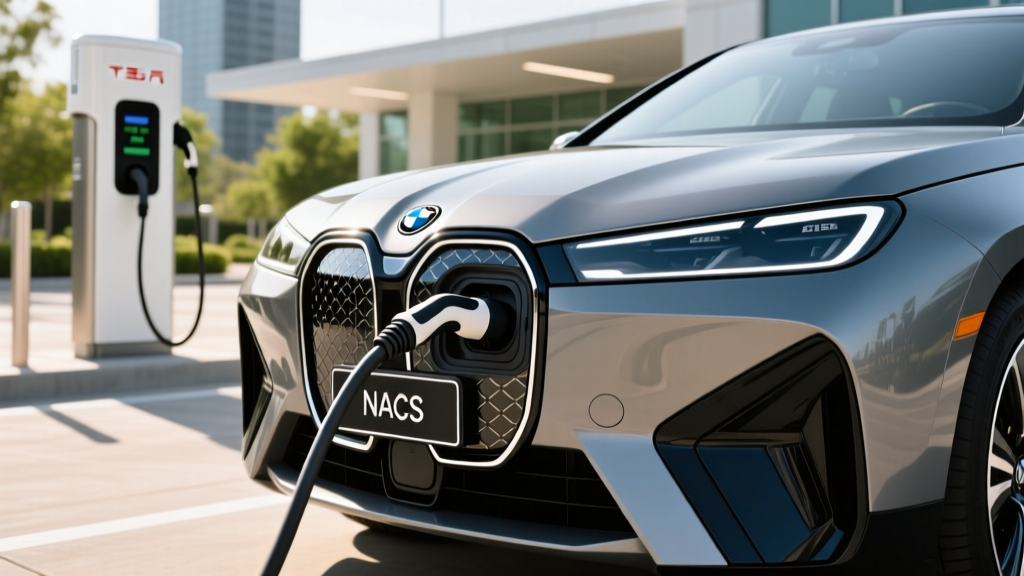
As of 2026, the North American Charging Standard (NACS) — originally Tesla's proprietary connector — has become the dominant fast-charging connector in the United States. BMW began equipping select iX models with native NACS ports for the 2025 model year, and by 2026, most new iX vehicles leaving the factory ship with a NACS charge port.
For earlier iX models (2022–2024) originally equipped with CCS1 ports, BMW and third-party manufacturers offer CCS-to-NACS adapters that enable Supercharger access. Here's what you need to know:
- 2025–2026 iX with native NACS: Plug directly into any Tesla Supercharger V3 or V4 stall. No adapter needed. Use the BMW or Tesla app to initiate a session.
- 2022–2024 iX with CCS1 port: Requires a CCS-to-NACS adapter (BMW OEM adapter or a certified third-party unit like the Lectron or A2Z adapter, typically $150–$300). You'll also need to register your vehicle's VIN in the Tesla app for billing.
Charging speed on Superchargers: Tesla V3 Superchargers deliver up to 250 kW, and V4 stalls can deliver up to 350 kW (cabinet-dependent). The BMW iX peaks at roughly 200 kW on DC fast charging, so you'll see maximum charge rates around 190–200 kW on a V3 or V4 stall — slightly below the stall's maximum but excellent for the iX's battery management system. Expect a 10–80% charge in approximately 31 minutes at a V3 stall, tapering significantly above 80% as the battery management system protects cell longevity.
The charge curve matters: the iX holds near peak rate from roughly 10–50% SoC, then steps down through 60%, 70%, and 80%. Charging from 80–100% on DC fast charging can add another 40+ minutes — plan your road-trip stops to leave at 80% unless you need the full battery for your next leg.
Charging Levels Explained: Speeds and Range Added Per Hour
Whether you're charging at home, at a destination, or on a road trip, understanding the three charging levels is essential for planning. Here's how each level performs with the BMW iX's 105.2 kWh battery:
| Level | Power (kW) | Voltage / Amperage | Miles of Range per Hour | iX 10–80% Time | Best For |
|---|---|---|---|---|---|
| Level 1 | 1.4–1.9 kW | 120V / 12–16A | 3–5 miles/hr | ~50+ hours | Overnight trickle, emergency top-up |
| Level 2 | 7.2–19.2 kW | 240V / 30–80A | 20–55 miles/hr | ~5–11 hours | Daily home & destination charging |
| DC Fast Charge | 50–350 kW | 400–800V DC | 150–600+ miles/hr | ~31 minutes (iX at 200 kW) | Road trips, rapid top-ups |
Key insight for BMW iX owners: The iX's onboard AC charger maxes out at 11 kW. Even if you install a 48-amp (11.5 kW) Level 2 home charger, the car will only accept 11 kW. That's still enough for roughly 30 miles of range per hour of Level 2 charging, and a full overnight charge from near-empty in about 11 hours. Installing a higher-amperage charger won't damage the car — the iX simply draws what it can accept — but it won't charge faster either.
Home Level 2 Charger Installation: Electrical Requirements, Costs, and Upgrades
Home charging is where 80% or more of all EV charging happens, and getting the setup right is critical. Here's what a Level 2 installation for a BMW iX actually involves — and what it costs.
Electrical Requirements
A Level 2 charger for the iX requires a 240-volt dedicated circuit. For optimal charging, we recommend a 50-amp circuit (which delivers up to 40 amps continuous / 9.6 kW to the vehicle) or a 60-amp circuit (48 amps continuous / 11.5 kW). Since the iX caps at 11 kW AC, a 60-amp circuit with a 48-amp charger is the sweet spot — it gives the car everything it can accept with a small buffer for future vehicles.
You'll need:
- A dedicated double-pole breaker in your electrical panel
- Appropriate gauge wiring (6 AWG copper for 50A; 4 AWG for 60A)
- A NEMA 14-50 outlet (for plug-in chargers) or hardwired connection (for higher-amperage units)
- GFCI protection if the outlet is outdoors (required by NEC 2020 and later)
Installation Cost Breakdown
| Component | Basic Install (Near Panel) | Complex Install (Long Run / Garage) | With Panel Upgrade |
|---|---|---|---|
| Level 2 Charger Equipment | $400–$700 | $400–$700 | $400–$700 |
| Electrician Labor | $300–$600 | $800–$2,000 | $1,500–$3,000 |
| Permit & Inspection | $50–$200 | $100–$300 | $150–$400 |
| Electrical Panel Upgrade (100A → 200A) | N/A | N/A | $1,500–$3,500 |
| Conduit, Wiring, Misc. | $50–$150 | $200–$600 | $200–$600 |
| TOTAL ESTIMATED COST | $800–$1,650 | $1,500–$3,600 | $3,750–$8,200 |
Federal Tax Credit for Home Charging Equipment
The IRS §30C Alternative Fuel Vehicle Refueling Property Credit covers up to 30% of home charger equipment and installation costs, capped at $1,000. This applies to both the charger hardware and electrician labor. Eligibility depends on your census tract meeting certain income or rural criteria. Check current-year rules at irs.gov and consult a tax professional — eligibility varies by address and tax year.
Connector Compatibility: NACS, CCS1, and Adapter Options
The connector landscape has shifted dramatically. Here's where the BMW iX stands in 2026 and what you need for every charging scenario:
| Connector Type | Native on 2025–2026 iX? | Native on 2022–2024 iX? | Networks Available | Adapter Needed? |
|---|---|---|---|---|
| NACS (Tesla) | Yes (most 2025+ builds) | No (CCS1 native) | Tesla Supercharger, Electrify America (select), Rivian Adventure Network | CCS-to-NACS adapter for 2022–2024 models |
| CCS1 | Adapter may be included | Yes | Electrify America, EVgo, ChargePoint, Ionity (EU) | NACS-to-CCS adapter for 2025+ NACS-native models |
| CHAdeMO | No | No | Legacy stations (declining) | Not available — CHAdeMO is being phased out |
| J1772 (Level 2 AC) | Via NACS-to-J1772 adapter | Via CCS-to-J1772 adapter or built-in | All public Level 2 stations, home chargers | Adapter included with most new iX deliveries |
Practical advice: If you're buying a 2022–2024 iX used, budget $150–$300 for a quality CCS-to-NACS adapter to unlock the Tesla Supercharger network — the largest and most reliable DC fast-charging network in North America with over 25,000 stalls. For 2025–2026 models with native NACS, BMW typically includes a NACS-to-J1772 adapter in the box for public Level 2 charging compatibility.
Cost to Charge: Home vs. Public vs. Gas Comparison
One of the strongest ownership arguments for the BMW iX is fuel cost savings. Here's what charging actually costs across different scenarios, compared to a gasoline equivalent (BMW X5 xDrive40i at 23 MPG combined, $3.50/gallon):
| Scenario | Rate | Cost for Full Charge (105.2 kWh) | Cost per Mile | Annual Cost (12,000 mi) |
|---|---|---|---|---|
| Home (off-peak utility rate) | $0.08–$0.14/kWh | $8.42–$14.73 | $0.03–$0.05 | $360–$600 |
| Home (average US rate) | $0.16/kWh | $16.83 | $0.05–$0.06 | $600–$720 |
| Public Level 2 (ChargePoint, etc.) | $0.20–$0.35/kWh | $21.04–$36.82 | $0.07–$0.12 | $840–$1,440 |
| DC Fast Charge (Tesla Supercharger) | $0.25–$0.40/kWh | $26.30–$42.08 | $0.08–$0.14 | $960–$1,680 |
| DC Fast Charge (Electrify America) | $0.31–$0.48/kWh | $32.61–$50.50 | $0.10–$0.16 | $1,200–$1,920 |
| Gas Equivalent (BMW X5, 23 MPG) | $3.50/gallon | — | $0.15 | $1,826 |
The takeaway: Charging at home on off-peak rates saves roughly $1,200–$1,450 per year versus gasoline. Even exclusive DC fast charging at Supercharger rates saves $150–$860 annually. The savings are largest for home-charging-heavy owners. If you can install Level 2 at home and use time-of-use utility rates, the iX's "fuel" cost drops to roughly one-quarter of a comparable gas SUV.
Recommended Home Level 2 Chargers for the BMW iX
Given the iX's 11 kW AC charge cap, you want a reliable, smart Level 2 unit that delivers 40–48 amps on a 240V circuit. Here are our top picks based on reliability, features, and value:
ChargePoint Home Flex (NACS)
- Power Output: Up to 11.5 kW (48A / 240V)
- Connector: NACS (native); J1772 adapter available
- Cable Length: 23 feet
- Smart Features: Wi-Fi, app scheduling, Alexa integration, energy tracking
- Price: ~$599–$699
- Verdict: Best all-around smart charger; adjustable amperage from 16A–48A via DIP switches
Tesla Wall Connector (NACS)
- Power Output: Up to 11.5 kW (48A / 240V)
- Connector: NACS native
- Cable Length: 24 feet
- Smart Features: Wi-Fi, OTA firmware updates, power sharing (up to 6 units on one circuit), load management
- Price: ~$475
- Verdict: Excellent value and build quality; ideal if your iX has native NACS. No J1772 output without adapter.
Emporia Vue Level 2 Smart Charger
- Power Output: Up to 11.5 kW (48A / 240V)
- Connector: J1772 (NACS adapter included)
- Cable Length: 24 feet
- Smart Features: Wi-Fi, app control, solar integration, energy monitoring, scheduling
- Price: ~$399–$449
- Verdict: Budget-friendly smart option; great for solar-panel homes. Slightly less polished app than ChargePoint.
For 2022–2024 CCS1-equipped iX owners: If you haven't purchased a CCS-to-NACS adapter and primarily charge at home, a J1772-output charger (like the Emporia or ChargePoint with J1772 connector) works natively with your car's CCS port (CCS is a superset of J1772 for AC charging). No adapter needed for home Level 2.
Safety, Electrical Code, and Best Practices
A Level 2 charger draws significant continuous current — often for 8+ hours overnight. Proper installation isn't optional; it's a fire-safety requirement. Here are the critical code and safety considerations:
- Dedicated circuit: Your EV charger must be on its own dedicated breaker — never shared with other appliances. A 50A or 60A double-pole breaker is standard.
- Continuous load derating: The NEC requires that continuous loads (3+ hours) use only 80% of a circuit's rated capacity. A 50A breaker supports 40A continuous; a 60A breaker supports 48A continuous. Chargers are designed to respect this.
- GFCI protection: NEC 2020+ requires GFCI (Ground Fault Circuit Interrupter) protection for all outdoor EV charging outlets. Many modern chargers have built-in GFCI; if yours doesn't, your electrician must install a GFCI breaker.
- Outdoor rating: If mounting outdoors, the charger must carry a NEMA 4 or IP65 weatherproof rating. All three units recommended above meet outdoor installation standards.
- Permit and inspection: Most jurisdictions require an electrical permit ($50–$200) and a post-installation inspection. Skipping this can void your homeowner's insurance coverage in the event of an electrical fire.
- Wire gauge: 6 AWG copper for 50A circuits; 4 AWG copper for 60A. Aluminum wire requires larger gauge. Your electrician will specify based on run length and local code.
Frequently Asked Questions
How much does it cost to install a home EV charger for a BMW iX?
A basic Level 2 installation with the electrical panel nearby costs $800–$1,650 including equipment, labor, and permits. A complex run through walls or to a detached garage costs $1,500–$3,600. If your home needs a 100A-to-200A panel upgrade, total costs can reach $3,750–$8,200. Always get a load calculation from a licensed electrician first.
How fast will each charging level add range to my BMW iX?
Level 1 (120V) adds about 3–5 miles of range per hour — essentially unusable for a 105.2 kWh battery. Level 2 (240V, 48A) adds roughly 30 miles per hour, fully charging overnight. DC fast charging at 200 kW adds roughly 200+ miles in 15 minutes (10–50% SoC), tapering as the battery fills.
Which connector and charger is compatible with my BMW iX?
2025–2026 iX models with native NACS ports plug directly into Tesla Superchargers and NACS-equipped public stations. 2022–2024 iX models with CCS1 ports need a CCS-to-NACS adapter ($150–$300) for Supercharger access. For home Level 2 charging, all iX models accept J1772 AC charging natively (CCS1 models directly, NACS models via included adapter).
How much does charging the BMW iX cost per mile versus gas?
Home charging at average US electricity rates ($0.16/kWh) costs about $0.05–$0.06 per mile. DC fast charging at Supercharger rates ($0.28–$0.40/kWh) costs $0.08–$0.14 per mile. A comparable gas BMW X5 at 23 MPG and $3.50/gallon costs $0.15 per mile. Home charging saves roughly 60–65% on "fuel" costs.
What electrical upgrades might I need for a home charger?
The most common upgrade is a panel capacity increase from 100A to 200A ($1,500–$3,500), needed in older homes where the existing panel is near capacity. You may also need a new breaker slot (some older panels are full), conduit runs through walls or underground, or a sub-panel in a detached garage. A licensed electrician's load calculation will determine exactly what's required.
Can I use a Tesla Supercharger with a 2022 or 2023 BMW iX?
Yes, with a CCS-to-NACS adapter. Purchase a BMW-approved or certified third-party adapter ($150–$300), register your iX's VIN in the Tesla app for billing, and you'll have access to all V3 and V4 Supercharger stalls. Charge speeds will peak around 190–200 kW, matching the iX's DC fast-charge capability.
Does the BMW iX battery warranty cover degradation?
BMW covers the iX high-voltage battery for 8 years or 100,000 miles, whichever comes first. The warranty guarantees the battery will retain at least 70% of its original capacity. Real-world data from 2022–2023 iX owners suggests degradation of roughly 3–5% over the first two years, with the curve flattening significantly afterward — consistent with modern NMC chemistry and BMW's conservative buffer management.