Why Range Anxiety Is Really a Charging Knowledge Problem
The phrase range anxiety gets tossed around as an inherent EV flaw, but after six years of owning and testing battery-electric vehicles across three climate zones, I can tell you the real issue isn't the battery — it's incomplete charging literacy. A 2025 study by the U.S. Department of Energy's fueleconomy.gov portal shows that over 80% of EV charging happens at home. Drivers who experience genuine range anxiety almost always share one trait: they haven't set up reliable home Level 2 charging or learned to plan DC fast-charging stops on road trips.
This guide breaks down every charging variable you need to make range anxiety disappear — from the electrical panel in your garage to the NACS connector at a Supercharger. We'll use exact numbers: kilowatts (kW) for power, kilowatt-hours (kWh) for energy capacity, real cost-per-mile figures, and hardware you can buy today.
kW (kilowatts) = power, or the rate at which energy flows. Think of it as the diameter of a hose.
kWh (kilowatt-hours) = energy, or the total amount stored or delivered. Think of it as the size of the bucket.
A 19.2 kW Level 2 charger fills an 84 kWh battery in roughly 4.4 hours (84 ÷ 19.2). Mixing these up is the #1 EV literacy mistake.
Charging Levels Explained: Speeds, Times, and Real-World Range Added
Every EV sold in the U.S. supports three charging tiers. Here's what each delivers in concrete terms, measured against a mid-size crossover with a ~75 kWh battery and roughly 3.5 miles per kWh efficiency (similar to a 2026 Tesla Model Y or Hyundai Ioniq 5):
| Level | Voltage | Power (kW) | Miles of Range per Hour | 10–80% Time (75 kWh battery) | Typical Use |
|---|---|---|---|---|---|
| Level 1 | 120V AC | 1.0–1.4 kW | 3–5 mi/hr | ~50+ hours | Emergency / overnight trickle |
| Level 2 | 240V AC | 3.3–19.2 kW | 12–65 mi/hr | 3.5–15 hours | Home daily charging, workplace |
| DC Fast | 400–900V DC | 50–350 kW (peak) | 150–900+ mi/hr (peak) | 15–45 minutes | Road trips, rapid top-ups |
Real-world caveat on DC fast charging: Peak kW numbers are marketing headlines. A charger rated for 250 kW may only sustain that rate between 10% and 40% State of Charge (SoC). Above 80%, the battery management system throttles current to protect cell health — a phenomenon called the charge curve taper. Expect a 2026 Hyundai Ioniq 5 (84 kWh NMC battery, 240 kW peak) to charge 10–80% in roughly 18 minutes under ideal conditions, but add 15–20 more minutes if you push to 95%. Always plan road-trip stops around the 10–80% window for maximum time efficiency.
Home Level 2 Charger Installation: Electrical Requirements, Panel Upgrades, and True Costs
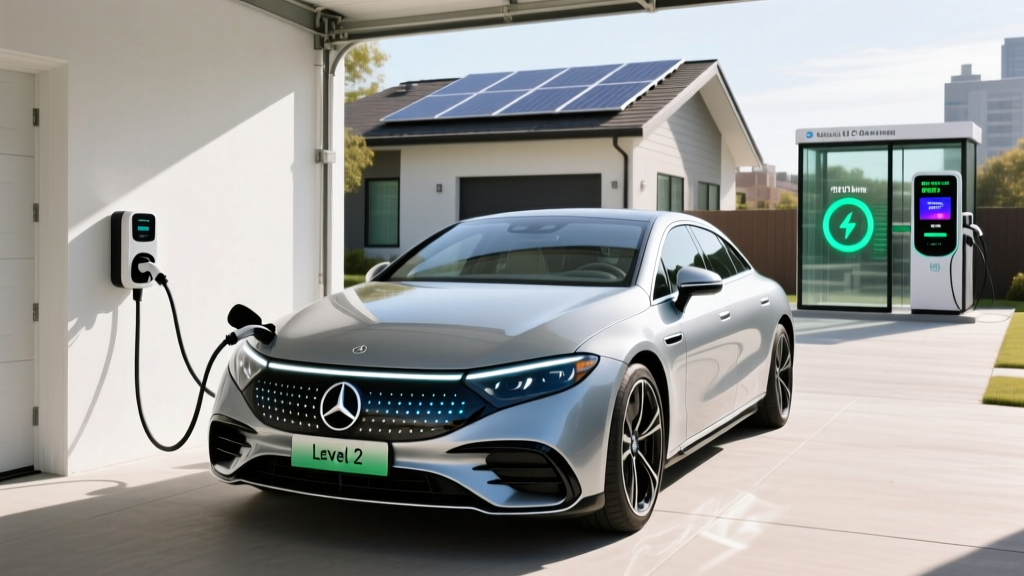
Installing a dedicated Level 2 home charger is the single most effective step to eliminate range anxiety. You wake up every morning with a full or near-full battery, and your cost per mile drops to a fraction of gasoline. But the installation isn't always plug-and-play. Here's what the electrical work actually involves.
Electrical Requirements
Most home Level 2 chargers run on a 240V dedicated circuit, the same voltage as your electric dryer or oven. Common circuit sizes:
- 40A circuit → delivers up to 32A continuous (7.7 kW) — sufficient for most overnight charging
- 50A circuit → delivers up to 40A continuous (9.6 kW) — the sweet spot for 75–100 kWh batteries
- 60A circuit → delivers up to 48A continuous (11.5 kW) — ideal for large-battery trucks/SUVs like the Ford F-150 Lightning (131 kWh extended range)
- 100A circuit → delivers up to 80A continuous (19.2 kW) — requires a robust panel, used for ultra-fast home fills
Does Your Panel Need an Upgrade?
This is the cost variable that catches homeowners off guard. A modern 200-amp electrical panel can typically support a 50A EV circuit alongside existing loads. But if you have an older home with a 100A or 150A panel, adding a 50A+ dedicated circuit may push you past safe capacity — especially if you also run electric heat, a dryer, and an electric stove. A licensed electrician will perform a load calculation (per NEC Article 220) to determine whether a panel upgrade to 200A or even 400A service is needed.
Installation Cost Breakdown
| Component | Low End | Typical | High End | Notes |
|---|---|---|---|---|
| Level 2 Charger (hardware) | $200 | $450 | $750 | Smart Wi-Fi chargers cost more |
| Electrician labor (simple install) | $300 | $600 | $1,200 | Short run from panel to garage |
| Electrician labor (complex run) | $800 | $1,500 | $3,000 | Long wire runs, conduit, trenching |
| Permit & inspection | $50 | $150 | $400 | Varies by municipality |
| Panel upgrade (if needed) | $1,500 | $2,500 | $4,000 | 100A→200A service upgrade |
| Total (no panel upgrade) | $550 | $1,200 | $3,500 | Most homeowners fall here |
| Total (with panel upgrade) | $2,050 | $3,700 | $7,500 | Older homes, high-power setups |
Federal incentive note: The IRS §30C Alternative Fuel Vehicle Refueling Property Credit offers up to $1,000 (30% of equipment + installation costs, capped at $1,000) for home EV charger installation, but only if you live in an eligible census tract (typically lower-income or rural areas). Check the IRS page for §30C for current-year eligibility and consult a tax professional. This credit is separate from the §30D vehicle purchase credit.
Connector Compatibility: NACS, CCS1, CHAdeMO, and What You Actually Need
The North American charging connector landscape has consolidated significantly. As of the 2026 model year, the North American Charging Standard (NACS) — originally developed by Tesla — is now the dominant connector. Here's where each brand stands:
| Connector | Brands Using It (2026) | Adapter Needed? |
|---|---|---|
| NACS (native) | Tesla (all), Ford (2025+), GM (2025+), Rivian, Hyundai/Kia (2025+), BMW, Volvo, Polestar, Lucid, Toyota (bZ series 2026+) | None for Tesla Superchargers and NACS-equipped public stations |
| CCS1 | Remaining 2024–2025 model-year vehicles still on dealer lots (VW ID.4 early production, some Stellantis models) | CCS1-to-NACS adapter (~$200) for Tesla Supercharger access |
| CHAdeMO | Discontinued for new vehicles (last: Nissan Leaf 2025 final edition) | CHAdeMO-to-NACS adapters exist but are rare and expensive (~$400+) |
Adapter reality: If you buy a used 2024 EV with a CCS1 port, a Ford- or Hyundai-supplied CCS1-to-NACS adapter (typically $175–$250) unlocks Tesla's Supercharger network — over 25,000 stalls in North America as of early 2026. For home Level 2 charging, all EVs use the same J1772 connector (or J1772-to-NACS adapter for Tesla), so home charger compatibility is universal.
Cost to Charge: Home vs. Public vs. Gas — The Real Per-Mile Math
This is where range anxiety meets wallet anxiety — and where EVs typically win decisively. Let's compare actual costs per mile using 2026 average energy prices:
| Scenario | Price | Cost per Mile (at 3.5 mi/kWh or 28 MPG) | Annual Cost (12,000 mi) |
|---|---|---|---|
| Home Level 2 — off-peak utility rate | $0.09/kWh | $0.026 | $312 |
| Home Level 2 — standard utility rate | $0.16/kWh | $0.046 | $552 |
| Public Level 2 (ChargePoint, EVgo L2) | $0.25–$0.39/kWh | $0.071–$0.111 | $852–$1,332 |
| DC Fast Charging (Electrify America, Tesla) | $0.32–$0.53/kWh | $0.091–$0.151 | $1,092–$1,812 |
| Gasoline (28 MPG combined, $3.40/gal) | $3.40/gallon | $0.121 | $1,452 |
The takeaway: Home off-peak charging is roughly 4–5× cheaper per mile than gasoline. Even DC fast charging at the most expensive networks is often comparable to or cheaper than gas on a per-mile basis. The economics only fail if you exclusively rely on premium-priced public DC fast chargers without ever charging at home — which circles back to why home Level 2 installation is the foundational step.
Best Home Level 2 Chargers for 2026: Equipment Picks
After testing over a dozen Level 2 units across multiple homes and vehicles, these are the chargers I recommend based on power output, build quality, smart features, and value:
Emporia Vue Level 2 Smart Charger
- Power output: Up to 48A (11.5 kW) on a 60A circuit; configurable down to 16A
- Connector: J1772 (NACS adapter included for Tesla vehicles)
- Cable length: 24 feet
- Smart features: Wi-Fi, app scheduling, energy monitoring, utility demand-response integration, solar-aware charging
- Price: ~$399
- Best for: Budget-conscious buyers who want full smart features and energy tracking
ChargePoint Home Flex
- Power output: Up to 50A (12 kW) on a 60A circuit; dip-switch configurable from 16A to 50A
- Connector: J1772 or NACS (select at purchase)
- Cable length: 23 feet
- Smart features: Wi-Fi, Alexa integration, app scheduling, ChargePoint network account for public charging
- Price: ~$549 (J1772) / ~$599 (NACS)
- Best for: Reliable, well-supported unit from the largest public charging network operator
Grizzl-E Smart
- Power output: Up to 40A (9.6 kW) on a 50A circuit
- Connector: J1772 (NACS adapter available)
- Cable length: 24 feet
- Smart features: Wi-Fi, OCPP compatibility, adjustable amperage, OTA firmware updates
- Price: ~$449
- Best for: Cold-climate durability (rated to -40°F), outdoor installations, rugged build
Tesla Wall Connector (Gen 4)
- Power output: Up to 48A (11.5 kW) on a 60A circuit
- Connector: NACS native (J1772 adapter available for non-Tesla EVs)
- Cable length: 24 feet
- Smart features: Wi-Fi, OTA updates, Power-Share (load-balancing two units on one circuit), Tesla app integration
- Price: ~$475
- Best for: Tesla owners or households with NACS-equipped vehicles who want seamless ecosystem integration
Safety, Code, and Installation Best Practices
EV chargers draw sustained high current for hours — this is fundamentally different from an appliance that cycles on and off. The National Electrical Code (NEC) treats EV charging as a continuous load, meaning the circuit must be rated for 125% of the charger's maximum draw. A 40A charger requires a 50A circuit. This isn't optional — it's a safety requirement.
Key Code and Safety Requirements
- Dedicated circuit: Your EV charger must have its own breaker — never shared with other outlets or appliances.
- GFCI protection: NEC 2023 (and continued in 2026 adoption) requires GFCI protection for all 150V-to-ground or greater receptacles in garages. Hardwired chargers (no plug) often bypass this requirement since they lack a receptacle — many electricians recommend hardwiring for this reason.
- Outdoor rating: If mounting outside, ensure the charger carries a NEMA 4 (or IP65+) rating. All units recommended above meet this standard.
- Wire gauge: A 50A circuit requires 6 AWG copper wire (or 4 AWG aluminum). Your electrician will size this correctly, but verify it on the permit paperwork.
- Permit and inspection: Nearly all jurisdictions require an electrical permit for EV charger installation. Skipping this risks insurance denial if a fire occurs and voids any utility rebate eligibility.
Beating Range Anxiety on Road Trips: DC Fast-Charging Strategy
Home charging solves 80%+ of range anxiety. The remaining 20% — road trips — is solved by planning, not by buying a bigger battery. Here's the framework I use for any trip over 200 miles:
- Precondition the battery. Most EVs (Tesla, Hyundai/Kia, BMW, Ford) will warm the battery to optimal temperature when you navigate to a DC fast charger. This can cut 10–80% charge time by 30%+ in cold weather. Always route through the car's nav system to trigger preconditioning.
- Plan around the 10–80% window. Charging from 80–100% can take as long as 10–80% due to the charge curve taper. Stop at 80%, drive on, and top up at the next station if needed.
- Use A Better Routeplanner (ABRP) or your car's built-in route planner. These tools factor in elevation, temperature, speed, and real-time charger availability. ABRP integrates with OBD-II dongles for live battery data.
- Have a backup charger in your plan. Public charger uptime averages 85–92% depending on the network (per J.D. Power's 2025 EV charging satisfaction study). Always identify an alternate station within 15 miles of your planned stop.
- Account for cold-weather range loss. At 20°F, expect 20–30% less range than the EPA sticker. A 300-mile EPA-rated EV may deliver only 210–240 real-world highway miles in winter. Plan stops accordingly.
Frequently Asked Questions
How much does it cost to install a home EV charger?
For a straightforward installation on an existing 200A panel with a short wire run, expect $550–$1,200 total (charger + electrician + permit). If your home needs a panel upgrade from 100A to 200A, the total can reach $3,700–$7,500. The IRS §30C credit may offset up to $1,000 if you're in an eligible census tract.
How fast will each charging level add range?
Level 1 (120V) adds 3–5 miles per hour — enough only for PHEVs or very low daily mileage. Level 2 (240V, 40A circuit) adds roughly 25–35 miles per hour, easily refilling a full battery overnight. DC fast charging adds 150–900+ miles per hour at peak rate, with 10–80% fills taking 15–45 minutes depending on the vehicle's peak charge kW and battery size.
Which connector and charger is compatible with my EV?
For 2026 model-year vehicles, most new EVs use the NACS connector. If you own a 2023–2025 model with CCS1, a CCS1-to-NACS adapter ($175–$250) unlocks the Tesla Supercharger network. For home Level 2 charging, all vehicles accept J1772 (or a J1772-to-NACS adapter). Buy a home charger matching your car's native connector to avoid adapter clutter.
How much does EV charging cost per mile compared to gas?
Home charging at off-peak rates (~$0.09/kWh) costs about $0.026 per mile — roughly 4.5× cheaper than gasoline at $3.40/gallon and 28 MPG ($0.121/mile). Even expensive DC fast charging ($0.48/kWh average) works out to ~$0.137/mile, still competitive with gas. The savings compound: a driver covering 12,000 miles/year saves $900–$1,140 annually by charging at home versus fueling with gas.
What electrical upgrades might I need for a home charger?
If your home has a 200A panel with available capacity, you likely need only a new dedicated circuit breaker and wiring — no panel work. If you have a 100A or 150A panel, especially with electric heating, cooking, and drying, a panel upgrade to 200A or 400A may be required. A licensed electrician's load calculation (NEC Article 220) determines this. Budget $1,500–$3,500 for a panel upgrade if needed. Some utilities offer rebates or financing for panel upgrades tied to EV adoption.
Does range anxiety go away once I have a home charger?
For daily driving — yes, almost entirely. Waking up to 200–300+ miles of range every morning eliminates the "when do I charge?" stress. For road trips, range anxiety shifts to charging logistics, which is manageable with route planning apps, preconditioning, and understanding charge-curve taper. The drivers who still report range anxiety are overwhelmingly those relying solely on public charging without a consistent home or workplace setup.