The Tesla Cybertruck's 123 kWh (usable) battery pack is one of the largest in any consumer EV. That massive energy reservoir delivers an EPA-estimated 340 miles of range in the AWD trim, but it also means charging logistics demand more planning than a smaller-battery EV. Whether you're evaluating a home Level 2 setup, mapping DC fast-charging stops on a road trip, or relying on Tesla's Mobile Connector for opportunistic top-ups, understanding the Cybertruck's charging profile is essential before you plug in.
This guide breaks down every Cybertruck mobile charging opportunity available in 2026 — from a standard 120V household outlet to a 250 kW Supercharger — with exact kW figures, real-world charge times, equipment picks, and the true cost per mile compared to a gas truck.
Cybertruck Charging Specs at a Glance
| Spec | Value |
|---|---|
| Battery capacity (usable) | ~123 kWh |
| Battery chemistry | NMC (nickel manganese cobalt) |
| EPA range (AWD) | 340 miles |
| Real-world highway range | ~270–300 mi (70+ mph, moderate temps) |
| Real-world cold-weather range | ~230–260 mi (below 32°F) |
| Max DC fast-charge rate | 250 kW (peak) |
| 10–80% DC fast charge | ~30–35 minutes |
| Max Level 2 (AC) rate | 11.5 kW (48A onboard charger) |
| Level 1 (120V) rate | ~1.4 kW (12A) |
| Connector | NACS (native Tesla) |
| Battery warranty | 8 years / 120,000 miles |
| Base MSRP (AWD, 2025/2026) | $79,990 |
Charging Levels Explained: Speeds, kW, and Miles Per Hour
Understanding the three charging levels is foundational. Remember: kW (kilowatts) measures the rate of power delivery — like water flow from a hose. kWh (kilowatt-hours) measures total energy stored — like the size of the tank. A higher kW rate fills the battery faster, but the total capacity in kWh determines how much energy you can store.
| Level | Voltage | Power (kW) | Miles of Range/Hour | Best For |
|---|---|---|---|---|
| Level 1 (120V) | 120V AC | ~1.4 kW | ~3–4 mi/hr | Overnight trickle, emergencies, low-mileage days |
| Level 2 (240V) | 240V AC | 3.8–11.5 kW | ~12–38 mi/hr | Daily home charging, destination charging |
| DC Fast Charging | 400V+ DC | 50–250 kW | ~150–750 mi/hr (peak) | Road trips, rapid top-ups |
For the Cybertruck's 123 kWh pack, Level 1 charging is painfully slow — roughly 80+ hours from empty to full. It's a viable mobile charging opportunity only for topping up a few dozen miles overnight at a rental cabin or relative's house. Level 2 is where daily charging happens. At the Cybertruck's maximum 11.5 kW AC acceptance rate, a full charge takes roughly 11–12 hours — ideal for overnight replenishment. DC fast charging at 250 kW peak can add roughly 200 miles in 15 minutes, though the charge curve tapers significantly above 80% State of Charge (SoC).
Home Level 2 Installation: Electrical Requirements and Cost Breakdown
To unlock the Cybertruck's full 11.5 kW Level 2 capability at home, you need a 240V circuit rated for at least 60 amps (to support continuous 48A draw — electrical code requires circuits rated at 125% of continuous load). Here's what that involves:
- Circuit: Dedicated 60A breaker on a 240V line
- Wire gauge: 6 AWG copper (or 4 AWG aluminum) for runs up to ~100 feet
- Panel capacity: Your home's main panel must have enough spare capacity. A 200A panel is typically sufficient; older 100A panels may require an upgrade ($1,500–$3,500)
- Permit: Most jurisdictions require an electrical permit ($50–$250)
- GFCI protection: 2023 NEC (and subsequent editions) require GFCI protection for EV receptacles — your electrician will ensure compliance
- Outdoor rating: If installing outdoors, the charger and any receptacle must carry a NEMA 4 or NEMA 4X weather rating
| Item | Cost Range |
|---|---|
| Level 2 charger equipment (smart, 48A) | $400–$750 |
| Electrician labor (standard install, <50 ft run) | $500–$1,500 |
| Electrical permit | $50–$250 |
| Panel upgrade (if needed, 100A → 200A) | $1,500–$3,500 |
| Total (no panel upgrade) | $950–$2,500 |
| Total (with panel upgrade) | $2,450–$6,000 |
Always hire a licensed electrician familiar with EV charging installs. Ask for a load calculation on your panel before committing — this determines whether an upgrade is necessary. The U.S. Department of Energy's home charging guide provides a solid overview of what to expect.
Connector Compatibility: NACS, CCS, and Adapter Needs
The Cybertruck ships with a native NACS (North American Charging Standard) connector — Tesla's proprietary plug, now adopted industry-wide. This means:
- Tesla Superchargers: Plug directly in — no adapter needed. The Cybertruck accesses Tesla's full Supercharger network at up to 250 kW.
- CCS1 public chargers (Electrify America, EVgo, etc.): You'll need Tesla's CCS adapter (sold separately, ~$175–$250) to connect to non-Tesla DC fast chargers.
- CHAdeMO: Largely legacy in the U.S. — an adapter exists (~$400+), but CHAdeMO stations are increasingly rare and typically capped at 50 kW, making them impractical for the Cybertruck's large battery.
| Connector | Cybertruck Compatible? | Adapter Needed? | Notes |
|---|---|---|---|
| NACS (Tesla) | Yes (native) | No | Full Supercharger access at 250 kW |
| CCS1 | Yes (with adapter) | Tesla CCS adapter (~$175–$250) | Access to Electrify America, EVgo, ChargePoint DC |
| CHAdeMO | Yes (with adapter) | Third-party adapter (~$400+) | Rare in U.S.; max 50 kW — not recommended |
| J1772 (Level 2) | Yes (with adapter) | Tesla J1772 adapter (included) | Destination chargers, public Level 2 stations |
For Cybertruck owners, the Supercharger network remains the most reliable DC fast-charging option. Tesla's Supercharger map shows over 6,000 U.S. stations as of early 2026. However, carrying the CCS adapter unlocks thousands of additional chargers for road trips through areas with limited Supercharger coverage.
Cost to Charge: Per-Mile Economics vs. a Gas Truck
With a 123 kWh battery, a full Cybertruck charge represents a significant energy purchase. Here's what it costs across common scenarios:
| Scenario | Rate ($/kWh) | Cost for Full Charge | Cost Per Mile (340 mi) |
|---|---|---|---|
| Home — off-peak utility rate | $0.08–$0.12 | $9.84–$14.76 | $0.029–$0.043 |
| Home — standard residential rate | $0.13–$0.18 | $15.99–$22.14 | $0.047–$0.065 |
| Public Level 2 (workplace, mall) | $0.20–$0.35 | $24.60–$43.05 | $0.072–$0.127 |
| DC Fast Charge (Supercharger avg.) | $0.28–$0.40 | $34.44–$49.20 | $0.101–$0.145 |
| DC Fast Charge (Electrify America peak) | $0.40–$0.55 | $49.20–$67.65 | $0.145–$0.199 |
Compare this to a comparable gas truck — say a Ford F-150 4WD averaging 19 MPG combined (fueleconomy.gov) — at $3.40/gallon:
| Vehicle | Energy Cost | Efficiency | Cost Per Mile |
|---|---|---|---|
| Cybertruck AWD (home, $0.14/kWh avg) | $0.14/kWh | ~2.77 mi/kWh (340 mi / 123 kWh) | ~$0.051 |
| Ford F-150 4WD gas | $3.40/gallon | 19 MPG | ~$0.179 |
| Savings per mile | ~$0.128/mile | ||
Over 15,000 miles per year, that's roughly $1,920 in annual fuel savings when charging primarily at home. Over five years: nearly $9,600. However, if you rely heavily on DC fast charging at $0.35–$0.50/kWh, the per-mile cost rises to $0.10–$0.18 — narrowing the gap with gas substantially.
Equipment Recommendations: Best Chargers for the Cybertruck
The Cybertruck's 48A onboard charger means you'll want a Level 2 unit capable of at least 48A (on a 60A circuit) to maximize charging speed. Here are three proven options:
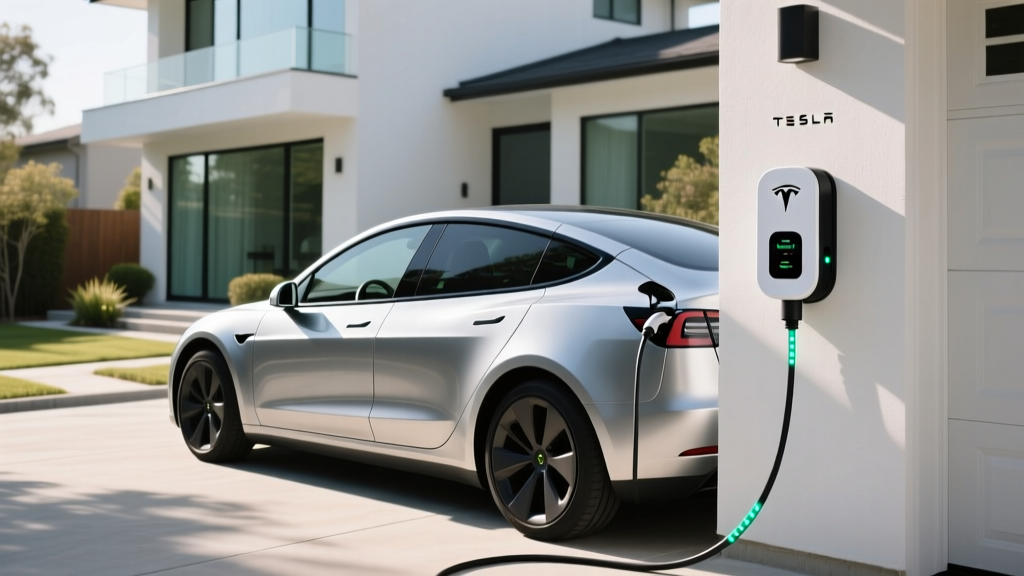
Tesla Wall Connector (Gen 3)
- Power output: Up to 11.5 kW (48A)
- Connector: NACS native — no adapter needed
- Cable length: 24 ft
- Smart features: Wi-Fi, OTA updates, load sharing with second unit, power-sharing across multiple Wall Connectors
- Price: ~$475
- Verdict: The obvious default for any Tesla. Seamless integration, reliable, and supports the Cybertruck's max AC rate.
ChargePoint Home Flex
- Power output: Up to 12 kW (50A) — configurable from 16A to 50A
- Connector: J1772 (Cybertruck needs Tesla's included J1772 adapter)
- Cable length: 23 ft
- Smart features: Wi-Fi, Alexa integration, detailed energy tracking via app, scheduled charging
- Price: ~$550–$650
- Verdict: Best for mixed-EV households (non-Tesla + Tesla). Amperage is adjustable to match your circuit.
Emporia Level 2 EV Charger
- Power output: Up to 11.5 kW (48A)
- Connector: J1772 (adapter needed for Cybertruck)
- Cable length: 24 ft
- Smart features: Wi-Fi, energy monitoring, integrates with Emporia Vue home energy panel, solar-aware charging
- Price: ~$399
- Verdict: Budget-friendly smart charger with excellent energy monitoring — ideal for solar-equipped homes.
Mobile Charging Opportunities: The Tesla Mobile Connector
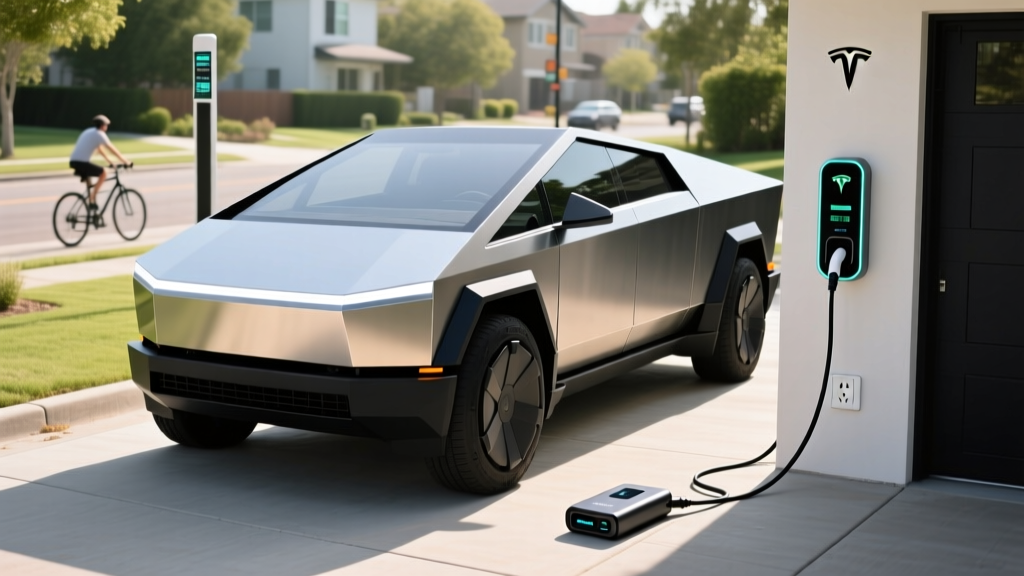
The Cybertruck ships with Tesla's Mobile Connector, which is essentially a portable charging cable with swappable plug adapters. This is where the concept of a mobile charging opportunity becomes practical:
- NEMA 5-15 (standard 120V outlet): ~1.4 kW, adds ~3–4 miles per hour. Slow, but available virtually everywhere — hotels, garages, campsites. A 10-hour overnight session adds ~35 miles.
- NEMA 14-50 (240V, 50A outlet): ~7.2 kW (limited by Mobile Connector's 32A max), adds ~22 miles per hour. Common at RV parks, campgrounds, and some homes with dryer or range outlets. A 10-hour session adds ~220 miles — enough to nearly refill the Cybertruck.
- NEMA 6-50 (240V, 50A): Similar to 14-50, found in some workshops and garages.
The Mobile Connector's 32A ceiling means it can't reach the Cybertruck's full 48A Level 2 rate. For maximum home charging speed, a hardwired Wall Connector is superior. But as a travel companion, the Mobile Connector turns any 240V outlet into a viable overnight charging stop — a genuine mobile charging opportunity on road trips through areas with sparse Supercharger coverage.
Charging Time Examples: 10–80% at Various Speeds
The 10–80% SoC window is the practical fast-charging sweet spot. Above 80%, the charge curve tapers dramatically to protect battery longevity — charging from 80–100% can take as long as 10–80%.
| Charging Method | Power (kW) | Energy Added (~86 kWh) | Approximate Time |
|---|---|---|---|
| DC Fast (Supercharger V3) | 250 kW peak (~150 avg) | ~86 kWh | ~30–35 minutes |
| DC Fast (CCS station, 150 kW) | 150 kW peak (~100 avg) | ~86 kWh | ~45–55 minutes |
| DC Fast (50 kW CHAdeMO/CCS) | 50 kW sustained | ~86 kWh | ~1 hr 45 min |
| Level 2 (Wall Connector, 48A) | 11.5 kW | ~86 kWh | ~7.5 hours |
| Level 2 (Mobile Connector, 14-50) | 7.2 kW | ~86 kWh | ~12 hours |
| Level 1 (120V, Mobile Connector) | 1.4 kW | ~86 kWh | ~61 hours |
The peak 250 kW rate on a Supercharger V3 stall is not sustained across the full session. Expect the Cybertruck to hold 200–250 kW between roughly 10–35% SoC, then taper to 150 kW through 50%, 100 kW by 65%, and below 50 kW past 80%. This taper curve is managed by the battery management system (BMS) to minimize degradation of the NMC cells.
Safety and Code Considerations
EV charging draws sustained high current for hours — this is fundamentally different from intermittent appliance use. Key safety requirements:
- Dedicated circuit: Your Level 2 charger must be on its own dedicated breaker — never shared with other appliances.
- GFCI protection: Required by NEC Article 625 for all EV charging equipment. Hardwired chargers typically include internal GFCI; receptacle-based installs need a GFCI breaker.
- Outdoor installations: Must use NEMA 4-rated enclosures and outdoor-rated cable. The Tesla Wall Connector carries a NEMA 3R rating — adequate for covered outdoor mounting but not fully sealed against driven rain.
- Cable management: Avoid running charging cables across walkways or driveways where they pose a trip hazard or risk being driven over.
- Ventilation: Indoor charging of the Cybertruck does not require special ventilation (unlike lead-acid battery charging), but ensure the installation area stays within the charger's rated temperature range.
Frequently Asked Questions
How much does it cost to install a home EV charger for the Cybertruck?
A standard 60A/240V circuit with a Tesla Wall Connector typically costs $950–$2,500 if your panel has sufficient capacity. If your home needs a panel upgrade (common in pre-1990 homes with 100A service), expect $2,450–$6,000 total. Always get a load calculation from a licensed electrician first.
How fast will each charging level add range to the Cybertruck?
Level 1 (120V) adds roughly 3–4 miles per hour. Level 2 (240V at 48A) adds roughly 38 miles per hour. DC fast charging at a 250 kW Supercharger can add up to 200 miles in approximately 15 minutes, though the rate tapers as the battery fills.
Which connector and charger is compatible with the Cybertruck?
The Cybertruck uses NACS natively. It plugs directly into Tesla Superchargers and Tesla Wall Connectors. For CCS1 public chargers, you need Tesla's CCS adapter (~$175–$250). For J1772 Level 2 public chargers, Tesla includes a J1772 adapter with the vehicle.
How much does charging the Cybertruck cost per mile vs. gas?
At a national average residential rate of ~$0.14/kWh, the Cybertruck costs roughly $0.051/mile to fuel. A comparable gas F-150 at 19 MPG and $3.40/gallon costs ~$0.179/mile. That's a savings of approximately $0.13/mile, or ~$1,920/year at 15,000 miles. DC fast charging at $0.35–$0.50/kWh raises the Cybertruck's cost to $0.10–$0.18/mile.
What electrical upgrades might I need for a Cybertruck home charger?
The most common upgrade is a panel replacement from 100A to 200A service ($1,500–$3,500). You may also need a new 60A breaker slot, upgraded wiring (6 AWG copper), and a GFCI breaker per NEC code. Homes built after 2000 with 200A panels usually need only the dedicated circuit and charger installation.
Does the Cybertruck qualify for the federal EV tax credit?
Under IRS §30D rules, the Cybertruck's eligibility depends on current-year battery sourcing, critical minerals requirements, the $80,000 MSRP cap for trucks, and buyer income limits ($150K single / $300K joint). As of 2026, verify eligibility on the IRS clean vehicle credit page and consider consulting a tax professional — rules and sourcing compliance change frequently. The point-of-sale transfer option allows dealers to apply the credit as a purchase-price reduction if eligible.