Why EV Owners Are Searching for a Red Charger
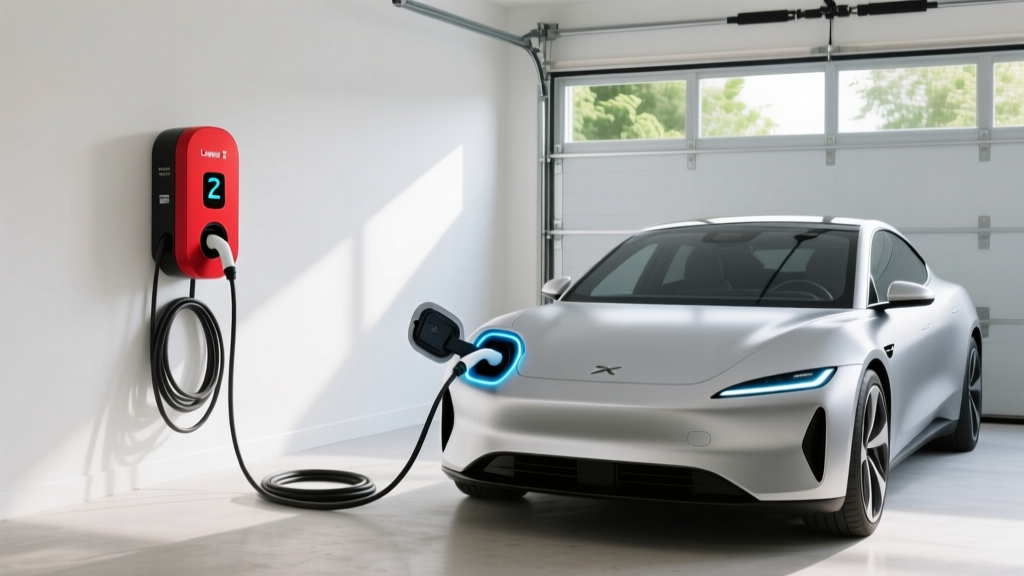
Aesthetics matter in the garage. While most Level 2 home charging stations ship in safe, forgettable black or white, a growing number of EV owners want hardware that matches their car, their workshop, or simply stands out. The "red charger" search has become shorthand for buyers hunting for a high-quality, visually distinctive home EVSE (Electric Vehicle Supply Equipment) that doesn't look like an industrial afterthought bolted to the drywall.
This guide breaks down every practical factor behind choosing and installing a red-accented or red-bodied Level 2 charger at home — electrical requirements, real install costs, connector compatibility, charging speeds, and the ongoing cost per mile versus gasoline. We'll also recommend specific red charger models available in 2026 with exact power outputs, cable lengths, and pricing.
Charging Levels Explained: Speeds in kW and Miles Per Hour
Before picking hardware, you need to understand the three charging tiers and the critical distinction between kW (kilowatts) — the rate of power delivery — and kWh (kilowatt-hours) — the total energy stored in your battery. Think of kW as the width of the hose and kWh as the size of the bucket. A 48-amp Level 2 charger delivering 11.5 kW fills a 75 kWh battery faster than a 1.4 kW Level 1 cord, because the hose is wider.
| Level | Voltage | Power (kW) | Miles of Range Added Per Hour | Typical Use |
|---|---|---|---|---|
| Level 1 | 120V AC | 1.2 – 1.9 kW | 3 – 5 mi/hr | Overnight trickle; PHEV topping off |
| Level 2 | 240V AC | 3.3 – 19.2 kW | 12 – 70 mi/hr | Home daily charging; destination charging |
| DC Fast | 400–800V DC | 50 – 350 kW | 150 – 1,000+ mi/hr (peak) | Road trips; quick top-ups on public networks |
Most BEV owners find a 40-amp or 48-amp Level 2 home charger (9.6–11.5 kW) is the sweet spot: it replenishes 30–40 miles of range per hour of charging, easily covering a daily commute overnight. DC fast chargers are for road trips — they're not practical or cost-effective for daily home use.
Home Installation: Electrical Requirements, Panel Upgrades, and Real Costs
The single biggest variable in your EV charging setup isn't the charger itself — it's your home's electrical panel. Here's what a licensed electrician will evaluate:
Core Electrical Requirements
- Circuit: A dedicated 240V circuit. For a 48-amp charger, NEC Article 625 requires a 60-amp breaker (continuous loads must be derated to 80% of breaker capacity).
- Wire gauge: Typically 6 AWG copper for a 60-amp run; 4 AWG for longer runs over 100 feet to minimize voltage drop.
- Outlet vs. hardwired: A NEMA 14-50 receptacle offers portability; hardwired units allow higher amperage (some 80-amp chargers exceed what a NEMA 14-50 can safely deliver) and may not require GFCI protection at the breaker, saving $100–$200.
- GFCI: NEC 2020+ requires GFCI protection for 240V receptacles used for EV charging in garages. Hardwired installations may bypass this requirement in some jurisdictions — confirm with your local inspector.
Do You Need a Panel Upgrade?
If your home has a 100-amp main panel and you're already running central A/C, an electric dryer, and an electric range, adding a 60-amp EV circuit may exceed your panel's capacity. An electrician will perform a load calculation per NEC Article 220. If you're over capacity, expect one of these solutions:
- Panel upgrade to 200A: $1,500–$3,500. Common in homes built before 1990.
- Smart load-management device: $300–$600 hardware + install. Devices like the Emporia Smart Load Center or Span panel dynamically throttle the charger when other large loads kick on, avoiding a full panel upgrade.
- Lower-amperage charger: Dropping from 48A to 32A (requiring only a 40-amp breaker) may fit within your existing panel.
Installation Cost Breakdown
| Component | Low-End | High-End | Notes |
|---|---|---|---|
| Level 2 charger unit (40–48A) | $350 | $700 | Varies by brand, smart features, cable length |
| Electrician labor | $300 | $1,200 | Depends on run length from panel to garage |
| Materials (wire, conduit, breaker) | $100 | $400 | Longer runs = more copper = higher cost |
| Permit and inspection | $50 | $250 | Required in most jurisdictions |
| Panel upgrade (if needed) | $1,500 | $3,500 | Only if load calculation demands it |
| Total (no panel upgrade) | $800 | $2,550 | Most homes fall in $1,000–$1,800 |
| Total (with panel upgrade) | $2,300 | $6,050 | Older homes, high-load panels |
The federal Residential Clean Energy Credit does not cover EV chargers after 2022. However, the Alternative Fuel Vehicle Refueling Property Credit (Form 8911) may offer up to $1,000 for home charger hardware and installation in eligible census tracts. Check IRS guidance for current-year eligibility, as income and location restrictions apply.
Connector Compatibility: NACS, CCS1, CHAdeMO, and Adapter Needs
As of 2026, the North American EV connector landscape has consolidated heavily around NACS (North American Charging Standard), the connector Tesla pioneered and opened to the industry in late 2022. Nearly every major automaker — Ford, GM, Rivian, Volvo, Hyundai, Kia, BMW, Mercedes — has adopted NACS on new vehicles starting with 2025–2026 model years.
| Connector | Brands Using It (New Vehicles) | Adapter Needed For |
|---|---|---|
| NACS (Tesla-style) | Tesla, Ford, GM, Rivian, Volvo, Polestar, Hyundai, Kia, BMW, Mercedes, Lucid (2025+) | Older CCS public chargers — use CCS-to-NACS adapter |
| CCS1 | Remaining 2024–2025 models from VW (ID.4 early builds), some Stellantis PHEVs | Tesla Superchargers — use NACS-to-CCS adapter (e.g., Tesla CCS adapter, Lectron) |
| CHAdeMO | Nissan Leaf (legacy only, discontinued for 2026) | Most new public DC stations — increasingly rare |
What this means for your red charger purchase: If you're buying a new 2026 EV, it almost certainly has a NACS port. Choose a NACS-connector home charger. If you own a 2023–2025 model with CCS1, buy a CCS1 charger or use a NACS charger with a NACS-to-CCS adapter (approximately $150–$250). Always verify your vehicle's port before ordering.
Red Charger Equipment Picks: Top Models Compared
Few Level 2 chargers ship in true red. Here are the best red or red-accented options available in 2026, along with a premium charger that offers red customization:
Emporia Vue Smart EV Charger (Red Edition)
- Power output: 48 amps / 11.5 kW (hardwired) or 40 amps / 9.6 kW (NEMA 14-50)
- Connector: NACS (2026 models); CCS1 available for older vehicles
- Cable length: 24 feet
- Smart features: Wi-Fi, Emporia app scheduling, solar-integration mode, energy monitoring, load management with Emporia panel
- Price: ~$399 (frequently on sale for $349)
- Outdoor rating: NEMA 4 (suitable for outdoor install)
- Verdict: Best value red charger with robust smart features and solar-aware charging.
ChargePoint Home Flex (with Custom Color Faceplate — Red)
- Power output: Up to 50 amps / 12 kW (adjustable in 8-amp increments down to 16A)
- Connector: NACS (standard on 2025+ units); CCS1 available
- Cable length: 23 feet
- Smart features: Wi-Fi, ChargePoint app, Alexa integration, amperage flexibility for panel-limited homes, scheduled charging
- Price: ~$649 base + $29 red faceplate accessory
- Outdoor rating: NEMA 4
- Verdict: Best for homes with marginal electrical capacity — the adjustable amperage lets you dial down to fit a 40-amp or even a 20-amp circuit.
Wallbox Pulsar Plus (Red Finish)
- Power output: 40 amps / 9.6 kW (NEMA 14-50) or 48 amps / 11.5 kW (hardwired)
- Connector: NACS or CCS1 (select at purchase)
- Cable length: 25 feet (longest in class)
- Smart features: Wi-Fi + Bluetooth, myWallbox app, Power Sharing for two chargers on one circuit, Eco-Smart solar mode
- Price: ~$549
- Outdoor rating: NEMA 4X (superior corrosion resistance for coastal or humid climates)
- Verdict: Best red charger for two-EV households — Power Sharing lets two Pulsar Plus units share a single 60-amp circuit, splitting amperage dynamically.
Cost Per Mile: Home Charging vs. Public Charging vs. Gasoline
The economics of EV ownership hinge on where you charge. Electricity rates vary dramatically between your home meter (especially on a time-of-use plan) and a public DC fast charger.
| Scenario | Rate | Cost to Add 200 Miles* | Cost Per Mile |
|---|---|---|---|
| Home Level 2 — off-peak TOU | $0.09/kWh | $5.40 | $0.027 |
| Home Level 2 — standard rate | $0.16/kWh | $9.60 | $0.048 |
| Public Level 2 (ChargePoint, EVgo L2) | $0.28/kWh | $16.80 | $0.084 |
| DC Fast Charging (Electrify America, Tesla Supercharger) | $0.38/kWh | $22.80 | $0.114 |
| Gasoline vehicle (30 MPG, $3.40/gal) | $3.40/gallon | $22.67 | $0.113 |
*Based on a vehicle efficiency of 3.0 miles/kWh (≈ 112 MPGe), typical of a mid-size crossover like the Hyundai Ioniq 5 or Tesla Model Y.
The takeaway: Home off-peak charging costs roughly one-quarter what gasoline does per mile. Even standard-rate home charging is about half the cost of gas. DC fast charging, however, approaches gas-equivalent pricing — use it for road trips, not daily fueling. According to fueleconomy.gov, the average EV achieves 97–132 MPGe combined, making home electricity the cheapest "fuel" by a wide margin.
Charging Time Examples: How Long to Fill Common Battery Sizes
Charge times depend on your battery's usable capacity (in kWh) and your charger's sustained power output (in kW). Note that batteries charge fastest between 10–80% State of Charge (SoC); above 80%, the battery management system tapers the charge rate to protect cell longevity.
| Battery Size (usable kWh) | Example Vehicle | Level 1 (1.4 kW) | Level 2 — 32A / 7.7 kW | Level 2 — 48A / 11.5 kW | DC Fast (peak kW) |
|---|---|---|---|---|---|
| 15 kWh | Toyota RAV4 Prime (PHEV) | ~7.5 hrs | ~1.5 hrs | ~1 hr | N/A (no DC port) |
| 58 kWh | VW ID.4 Standard | ~29 hrs | ~5.5 hrs | ~3.5 hrs | ~28 min (170 kW peak) |
| 75 kWh | Tesla Model Y Long Range | ~37 hrs | ~7 hrs | ~4.5 hrs | ~25 min (250 kW peak) |
| 84 kWh | Hyundai Ioniq 5 Long Range AWD | ~42 hrs | ~8 hrs | ~5 hrs | ~18 min (350 kW peak, 800V) |
| 123 kWh | GMC Sierra EV Denali | ~61 hrs | ~12 hrs | ~7.5 hrs | ~40 min (350 kW peak) |
Real-world caveat: These times assume preconditioned batteries at moderate ambient temperatures (60–80°F). In sub-freezing weather, expect Level 2 charge times to increase 15–30% and DC fast charging to slow significantly unless the vehicle has active battery preconditioning (Tesla, Hyundai E-GMP, and GM Ultium platforms handle this well; older models may not).
Safety, Code Compliance, and Outdoor Installation
A properly installed home charger should be invisible from a safety standpoint — it simply works, every time, without tripping breakers or overheating. Here's what to verify:
- Dedicated circuit: Your EV charger must be on its own breaker — never shared with other outlets or appliances.
- UL listing: Only buy chargers with UL (Underwriters Laboratories) or ETL certification. Avoid uncertified units from marketplace sellers, regardless of price or color.
- NEMA rating: For garage installs, NEMA 3R is sufficient. For outdoor or carport installations, require NEMA 4 or 4X (dust-tight and water-jet resistant).
- Permit and inspection: Most jurisdictions require an electrical permit for a new 240V circuit. The inspection ensures proper wire gauge, breaker sizing, grounding, and GFCI compliance. Skipping the permit risks insurance denial in the event of an electrical fire.
- Cable management: A 24–25 foot cable is heavy. Use a wall-mounted cable organizer or retractor to prevent tripping hazards and connector damage.
- Wi-Fi security: Smart chargers connect to your home network. Use a strong, unique password and keep firmware updated — these devices can be an entry point for network attacks if left on default credentials.
Frequently Asked Questions
How much does it cost to install a home EV charger?
For a typical 48-amp Level 2 charger on a new 60-amp 240V circuit, expect to pay $1,000–$1,800 total (charger unit + electrician labor + materials + permit) if your electrical panel has sufficient capacity. If a panel upgrade to 200 amps is needed, add $1,500–$3,500. Homes with short runs from panel to garage (under 30 feet) fall at the low end; long runs through finished walls push costs higher.
How fast will each charging level add range?
Level 1 (120V) adds roughly 3–5 miles per hour — adequate for PHEVs with small batteries but impractical for a full BEV. Level 2 at 48 amps (11.5 kW) adds approximately 35–40 miles per hour, fully replenishing most BEVs overnight. DC fast chargers can add 100–200+ miles in 15–20 minutes, depending on the vehicle's peak charge rate and battery state of charge.
Which connector or charger is compatible with my EV?
Check your vehicle's charge port. For 2025–2026 model-year EVs from Tesla, Ford, GM, Hyundai, Kia, Rivian, Volvo, and most others, the connector is NACS. For 2023–2024 models from VW, some Stellantis brands, and older BMW/Mercedes EVs, it's CCS1. The Nissan Leaf uses CHAdeMO but has been discontinued. Buy a charger matching your port, or use a certified adapter ($150–$250).
How much does charging cost per mile vs gas?
At home on an off-peak rate of $0.09/kWh, an average EV (3 mi/kWh) costs about $0.03 per mile. A 30 MPG gas car at $3.40/gallon costs roughly $0.11 per mile — nearly 4× more. Even on a standard $0.16/kWh home rate, EV fueling is about half the cost of gasoline. Public DC fast charging at $0.38/kWh approaches gas parity, which is why home charging is the economic foundation of EV ownership.
What electrical upgrades might I need?
The most common upgrade is a panel replacement from 100A to 200A ($1,500–$3,500) if your existing panel lacks headroom for a 60-amp circuit. Alternatives include installing a smart load-management device ($300–$600) that dynamically throttles the charger, or choosing a lower-amperage charger (32A on a 40-amp breaker) to fit within your current panel. Your electrician will perform a NEC Article 220 load calculation to determine the best path.
Is a red charger just cosmetic, or does color affect performance?
Color is purely cosmetic and has no effect on charging speed, efficiency, or safety. However, a bright red charger is more visible in a dim garage, which can help prevent accidentally backing into the cable or unit. The performance factors that matter are amperage, voltage, cable gauge, connector type, and UL certification — all independent of color.
Can I use a smart charger to charge only when electricity is cheapest?
Yes. Chargers like the Emporia Vue, ChargePoint Home Flex, and Wallbox Pulsar Plus support scheduled charging via their companion apps. Set a charging window (e.g., 11 PM – 6 AM) to align with your utility's off-peak time-of-use (TOU) rate. Some utilities — like PG&E's EV2-A plan or Xcel Energy's EV rate — offer dedicated TOU plans with rates as low as $0.06–$0.09/kWh overnight, cutting your fueling cost by 40–60% compared to standard rates.