Introduction to Commercial DCFC Deployment
Deploying Level 3 Direct Current Fast Chargers (DCFC) is a monumental leap from residential or standard commercial Level 2 setups. While a home charger might require a simple 240V circuit upgrade, a commercial DCFC site demands high-voltage utility coordination, heavy civil engineering, and rigorous adherence to local building codes. For commercial real estate developers, fleet operators, and retail destinations, installing 150 kW to 350 kW+ charging architecture is a major capital expenditure that requires meticulous planning. This guide outlines expert best practices for navigating the complex lifecycle of commercial DCFC installation, from initial utility feasibility studies to final commissioning and long-term maintenance.
Phase 1: Site Assessment and Utility Coordination
The single largest point of failure in commercial DCFC projects is underestimating utility lead times and infrastructure requirements. DCFCs typically require 480V, 3-phase electrical service capable of delivering massive continuous amperage. If your site currently operates on standard 120V/208V commercial power, a utility-side transformer upgrade and new switchgear installation are mandatory.
Expert Tip: Engage your local utility provider during the site selection phase, not after purchasing the hardware. Utility 'make-ready' work—which includes trenching, laying new underground distribution lines, and installing pad-mounted transformers—can take anywhere from 6 to 18 months depending on regional supply chain constraints and labor availability.
According to the Alternative Fuels Data Center, early coordination with utilities can help identify existing grid capacity and potential demand charge structures that will impact your operational costs. Request a 'service capacity letter' from the utility to determine exactly how many megawatts can be delivered to your specific parcel without requiring off-site substation upgrades.
Phase 2: Hardware Selection and Power Architecture
Selecting the right DCFC hardware depends heavily on your target demographic, expected dwell times, and site electrical capacity. A highway corridor requires ultra-fast 350 kW chargers to minimize stops, while a retail shopping center might optimize for 150 kW units to encourage longer shopping visits.
- ABB Terra 360: Capable of delivering up to 360 kW, this modular unit is ideal for high-turnover fleet and highway applications.
- Tritium RT175: A liquid-cooled, IP65-rated workhorse known for its compact footprint, sealed enclosure, and reliability in extreme weather conditions.
- ChargePoint Express 250: Offers scalable power blocks, allowing site hosts to add power modules as EV battery architectures evolve to accept higher voltages.
Commercial DCFC Hardware & Power Requirements Comparison
| Hardware Model | Max Power Output | Voltage Input | Max Amperage | Estimated Footprint |
|---|---|---|---|---|
| ABB Terra 360 | 360 kW | 480V 3-Phase | ~500A | Compact (Single Pedestal) |
| Tritium RT175 | 175 kW | 480V 3-Phase | ~250A | Ultra-Compact |
| ChargePoint Express 250 | 250 kW | 480V 3-Phase | ~350A | Modular (Dispenser + Power Block) |
Phase 3: Civil Engineering, Trenching, and Thermal Management
Once the power architecture is defined, civil engineering takes center stage. Routing heavy-gauge copper or aluminum conductors from the utility switchgear to the charger pedestals requires meticulous trenching and concrete work.
Trenching Standards: Conductors for 480V 3-phase DCFCs are incredibly thick, heavy, and rigid. Expert installers recommend trenching a minimum of 36 inches deep and utilizing 4-inch to 6-inch PVC or rigid galvanized steel (RGS) conduit. Avoid sharp 90-degree bends; use sweeping bends to allow for future cable pulls and to prevent damage to the thick insulation during installation.
Thermal Management: DCFCs generate immense heat during the AC-to-DC power conversion process. While liquid-cooled cables manage heat at the vehicle connector, the power cabinets themselves require adequate airflow. Never install DCFC power cabinets in direct, unshaded southern exposure in hot climates without considering active thermal derating, which will slow down charging speeds to protect internal components. Elevating the cabinets on 6-inch concrete housekeeping pads prevents water ingress, protects against snow accumulation, and aids in under-chassis ventilation.
Phase 4: Permitting, ADA Compliance, and Safety Codes
Navigating the permitting process for commercial DCFCs involves multiple jurisdictions: the local Authority Having Jurisdiction (AHJ) for electrical and building permits, the fire marshal, and environmental or zoning agencies.
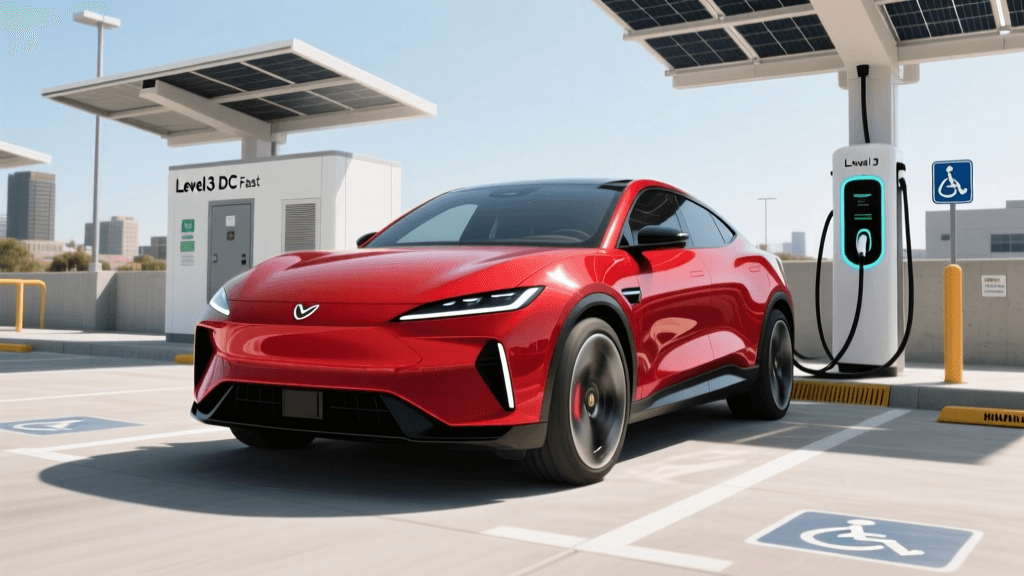
ADA Compliance: The Americans with Disabilities Act (ADA) mandates that public charging sites provide accessible routes and operable controls. The Federal Highway Administration's NEVI guidelines strongly emphasize that charging hardware must meet ADA reach ranges (typically between 15 and 48 inches above the finished floor) and provide clear floor space for wheelchair users. Ensure your site plan includes at least one fully ADA-compliant parking space with an adjacent access aisle routed safely to the charger interface screen and cable management system.
Fire and Safety: High-voltage switchgear and massive lithium-ion battery storage systems (if integrating microgrids) may require specialized fire suppression systems. Furthermore, you must install heavy-duty steel bollards filled with concrete directly in front of all power cabinets and dispensers to protect the multi-million-dollar equipment from accidental vehicle collisions.
Cost Breakdown and ROI Timelines
The financial commitment for commercial DCFCs extends far beyond the sticker price of the charger. According to infrastructure analyses by the National Renewable Energy Laboratory (NREL), site preparation and utility upgrades often eclipse the cost of the hardware itself.
- Hardware Costs: $40,000 to $90,000 per dual-port pedestal.
- Utility Make-Ready & Switchgear: $30,000 to $150,000+ (highly dependent on distance to the nearest 3-phase distribution line).
- Civil Work & Trenching: $15,000 to $40,000.
- Permitting & Engineering: $5,000 to $15,000.
Total installed costs frequently range from $100,000 to over $250,000 per site. To offset these costs, site hosts should aggressively explore state-level EV infrastructure rebates and the federal 30C Alternative Fuel Vehicle Refueling Property Tax Credit, which can cover up to 30% of hardware and installation costs in eligible low-income or rural census tracts.
Software Integration, OCPP, and Load Management
Modern DCFC networks require sophisticated backend software. Ensure your chosen hardware is OCPP (Open Charge Point Protocol) 1.6J or 2.0.1 compliant. This prevents vendor lock-in and allows you to switch network management software providers if service levels drop.
If your site has limited electrical capacity but high charging demand, implement Dynamic Load Management (DLM) software. DLM monitors the building's total energy consumption in real-time and automatically throttles the DCFC power output if the building's HVAC or manufacturing equipment spikes, preventing catastrophic demand charges or blown main fuses.
Expert Best Practices for Long-Term Reliability
- Implement Cellular Redundancy: DCFCs rely on constant network connectivity for payment processing, RFID authentication, and remote diagnostics. Install dual-SIM cellular routers with automatic failover, or run hardwired fiber ethernet connections to prevent offline downtime.
- Future-Proof Conduit Runs: Always lay empty 'pull string' conduits alongside your active power lines. Upgrading from 150 kW to 350 kW in five years will require new, thicker cabling; having empty conduit already in the ground will save tens of thousands of dollars in future concrete cutting and repaving.
- Establish a Maintenance SLA: Unlike Level 2 chargers, DCFCs have complex moving parts (cooling pumps, radiator fans, high-voltage contactors). Secure a Service Level Agreement (SLA) with your hardware provider or a certified third-party O&M contractor that guarantees a 24-hour on-site response time for critical faults to maximize your network uptime.