The Chevrolet Bolt is one of the most popular entry-level EVs on American roads, but its battery capacity, range, and charging speed have shifted significantly across model years. Whether you own a first-generation Bolt EV, the refreshed EUV, or the upcoming next-generation Bolt, understanding exactly how much range your model delivers — and how to charge it efficiently at home — is essential for daily driving satisfaction and long-term battery health.
This guide pairs a complete Chevy Bolt range by year breakdown with a practical home charging setup walkthrough. You'll find exact EPA figures, real-world range expectations, charging speeds at every level, installation cost breakdowns, and equipment recommendations that match the Bolt's electrical architecture.
Chevy Bolt Range by Year: Every Model from 2017 to 2026
General Motors has revised the Bolt's battery pack and efficiency several times since its 2017 debut. The most significant jump came in 2020 when GM increased usable battery capacity from 60 kWh to 65 kWh, and again for the 2022 refresh when the larger Bolt EUV joined the lineup. Below is the definitive EPA-rated range for every Bolt model year, along with the real-world range you should plan for.
| Model Year | Model | Battery (Usable kWh) | EPA Range (mi) | EPA Combined MPGe | Real-World Expectation* |
|---|---|---|---|---|---|
| 2017–2019 | Bolt EV | 60 kWh (NMC) | 238 | 119 MPGe | 195–215 mi |
| 2020–2021 | Bolt EV | 65 kWh (NMC) | 259 | 118 MPGe | 210–235 mi |
| 2022–2023 | Bolt EV | 65 kWh (NMC) | 259 | 120 MPGe | 210–235 mi |
| 2022–2023 | Bolt EUV | 65 kWh (NMC) | 247 | 115 MPGe | 200–225 mi |
| 2024–2025 | Bolt EV (final 1st gen) | 65 kWh (NMC) | 259 | 120 MPGe | 210–235 mi |
| 2024–2025 | Bolt EUV (final 1st gen) | 65 kWh (NMC) | 247 | 115 MPGe | 200–225 mi |
| 2026 (announced) | Next-Gen Bolt | ~65–70 kWh (LFP est.) | TBD (est. 260–280) | TBD | TBD |
For the most current official data, the U.S. Department of Energy's fueleconomy.gov maintains a searchable database of every Bolt model year with official range, efficiency, and energy-consumption figures.
Charging the Chevy Bolt: Understanding Levels and Speeds
Before wiring up a home charger, you need to understand the three charging levels and how each interacts with the Bolt's onboard hardware. The Bolt EV and EUV accept a maximum of 11.5 kW on Level 2 AC (with the upgraded onboard charger) and up to 55 kW on DC fast charging via CCS1. These are hard limits set by the vehicle — no charger can push power faster than the car can accept it.
kW vs. kWh — the essential distinction: kW (kilowatts) measures power — how fast energy flows into the battery. kWh (kilowatt-hours) measures energy capacity — how much the battery holds. Think of kW as the flow rate of a hose and kWh as the size of the bucket. A 65 kWh battery charged at 11.5 kW would theoretically fill from empty in about 5.6 hours, minus taper losses.
| Level | Voltage | Max Power (kW) | Approx. Miles of Range per Hour | Typical Use Case |
|---|---|---|---|---|
| Level 1 | 120V AC | 1.4 kW | 3–5 mi/hr | Overnight top-up, emergency |
| Level 2 | 240V AC | 7.2–19.2 kW | 20–60 mi/hr | Home daily charging, workplace |
| DC Fast (Level 3) | 400–800V DC | 50–350+ kW | 150–1,000+ mi/hr | Road trips, highway corridors |
• Level 1 (120V, 1.4 kW): 0–100% in approximately 46–47 hours (65 kWh pack). Useful only for overnight recovery of ~30–40 miles.
• Level 2 (240V, 11.5 kW max): 0–100% in roughly 6.5 hours. A typical 10–80% session takes about 4 hours at full rate.
• DC Fast Charge (55 kW peak via CCS1): 10–80% in approximately 55–65 minutes. The Bolt's DC charge curve tapers significantly above 80% SoC, so plan to unplug at 80% for the best time-to-energy ratio.
Note: 2017–2019 Bolt EVs with the standard 7.2 kW onboard charger will take ~9 hours for a full Level 2 charge. The 11.5 kW upgrade became available as a dealer-installed option and was later included on higher trims.
Home Charger Installation: Electrical Requirements, Costs, and Panel Upgrades
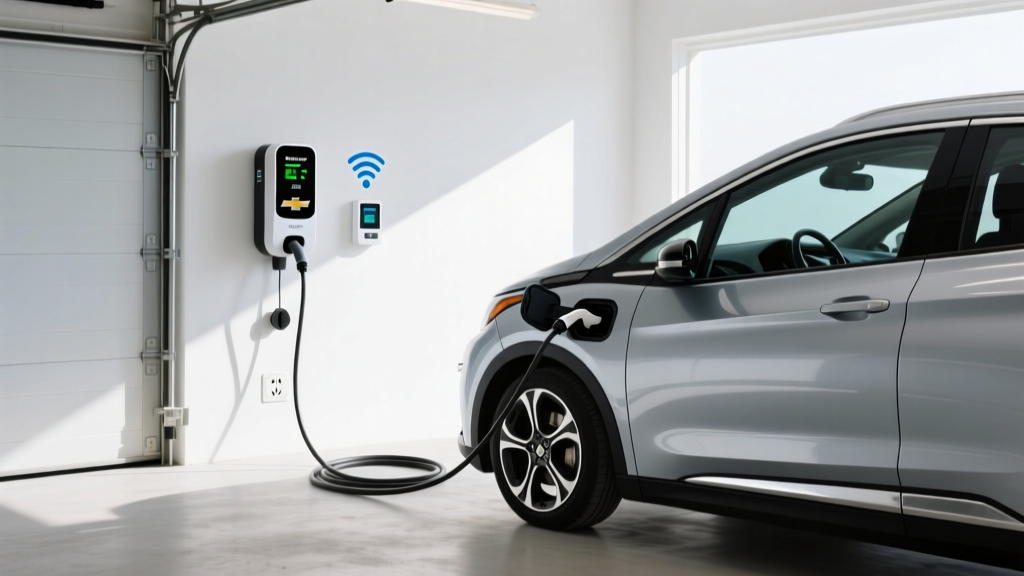
Installing a dedicated Level 2 home charger is the single best upgrade a Bolt owner can make. It transforms daily ownership — plug in when you get home, wake up to a full battery every morning. But the installation cost depends heavily on your home's existing electrical infrastructure.
Electrical Requirements for a Bolt-Compatible Level 2 Charger
To deliver the Bolt's maximum 11.5 kW AC charge rate, you need a 240V circuit rated at 48 amps or higher (EVSEs are considered continuous loads under NEC Article 625, so the circuit must be rated at 125% of the charger's max draw — a 48A charger requires a 60A breaker). Many homeowners opt for a 40A charger on a 50A circuit, which delivers 9.6 kW and still fills a Bolt overnight in about 7.5 hours.
- Minimum viable setup: 240V / 30A circuit → 24A continuous → 5.8 kW (adds ~22 mi/hr to a Bolt)
- Recommended setup: 240V / 50A circuit → 40A continuous → 9.6 kW (adds ~36 mi/hr)
- Maximum Bolt utilization: 240V / 60A circuit → 48A continuous → 11.5 kW (adds ~43 mi/hr)
What Does It Cost to Install a Home EV Charger?
Installation costs vary widely based on panel capacity, wiring distance, and local permitting. Below is a realistic breakdown based on national averages and electrician quotes in 2025–2026.
| Component | Typical Range | Notes |
|---|---|---|
| Level 2 EVSE (charger unit) | $300–$700 | Smart Wi-Fi models cost more; hardwired units are cheaper than plug-in (NEMA 14-50) |
| Electrician labor (standard install) | $500–$1,500 | Depends on wire run length (panel to garage/driveway); 10–30 ft is typical |
| Electrical permit | $50–$200 | Required in most jurisdictions; inspected after install |
| Panel upgrade (if needed) | $1,500–$4,000 | Older homes with 100A service often need upgrade to 200A to add a 50–60A EV circuit |
| Conduit and wiring materials | $100–$400 | Longer runs or outdoor conduit increase cost |
| Total (no panel upgrade) | $850–$2,800 | Most homes with 200A service fall in this range |
| Total (with panel upgrade) | $2,350–$6,800 | Common for pre-2000 homes with 100A or 150A panels |
Safety and Code Considerations
The National Electrical Code (NEC) Article 625 governs EV charging installations. Key requirements to verify with your electrician:
- Dedicated circuit: The EVSE must have its own dedicated breaker — no sharing with other outlets or appliances.
- GFCI protection: NEC 2020 and later require GFCI protection for outdoor receptacles used for EV charging. Hardwired EVSEs often have built-in ground-fault protection, which can simplify compliance.
- Outdoor rating: If your charger is mounted outside or in an unenclosed carport, the unit must carry a NEMA 4 or NEMA 4X weatherproof rating.
- Wire gauge: A 50A circuit typically requires 6 AWG copper wire; a 60A circuit requires 4 AWG. Your electrician will size wire based on run length and local code.
- Permit and inspection: Most municipalities require a permit for EVSE installation. The inspection ensures safe wiring, proper grounding, and code compliance. Skipping this step can void home insurance coverage in the event of an electrical fire.
Connector Compatibility: CCS1, NACS, and What the Bolt Uses
The Chevy Bolt EV and EUV (all model years through 2025) use the CCS1 (Combined Charging System) connector for both Level 2 AC and DC fast charging. This is the standard J1772 plug with two additional DC pins below it.
However, the North American charging landscape is rapidly shifting toward NACS (North American Charging Standard), the connector developed by Tesla and now adopted by Ford, GM, Rivian, Volvo, and most major automakers. GM has confirmed that future models — including the anticipated next-generation Bolt — will use NACS natively. For current Bolt owners, this means:
| Connector Type | Used By | Bolt Compatibility | Adapter Needed? |
|---|---|---|---|
| CCS1 | Chevy Bolt, VW ID.4, Hyundai Ioniq 5, most non-Tesla EVs | Native (built-in) | No |
| NACS (Tesla) | Tesla Model 3/Y/S/X, Ford F-150 Lightning, future GM models | Not native (1st-gen Bolt) | Yes — CCS1-to-NACS adapter for Supercharger access |
| CHAdeMO | Nissan LEAF (legacy) | Not compatible | No adapter available; network is largely retired |
| J1772 (AC only) | All EVs for Level 1/2 AC | Native (top portion of CCS1) | No |
GM Supercharger access: GM began enabling Bolt owners to access Tesla Supercharger stations (now rebranded as part of GM's expanded charging network) via a GM-approved CCS1-to-NACS adapter. As of 2025, this adapter costs approximately $200–$400 depending on the supplier and unlocks thousands of additional DC fast-charging locations. Verify compatibility with your specific model year through the MyChevrolet app before purchasing.
Cost to Charge a Chevy Bolt: Home vs. Public vs. Gas Comparison
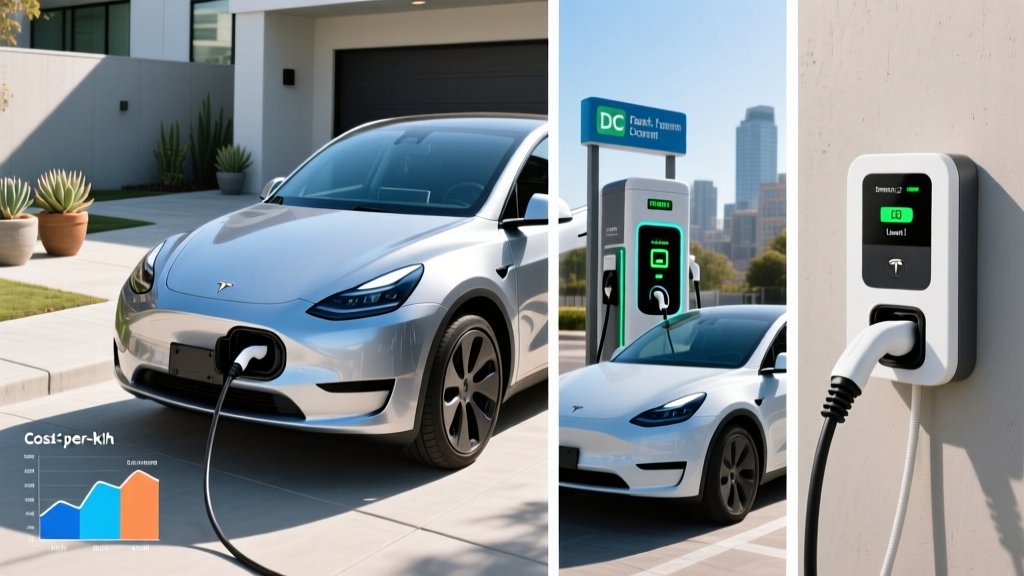
One of the strongest arguments for Bolt ownership is fuel cost savings. Here's how charging costs break down across different scenarios, using a 65 kWh battery (2020–2025 Bolt EV) and national average electricity rates.
| Scenario | Rate ($/kWh) | Full Charge Cost (0–100%) | Cost per Mile (259 mi range) |
|---|---|---|---|
| Home — off-peak utility rate | $0.09–$0.13 | $5.85–$8.45 | $0.023–$0.033 |
| Home — standard residential rate | $0.14–$0.18 | $9.10–$11.70 | $0.035–$0.045 |
| Public Level 2 (ChargePoint, EVgo) | $0.25–$0.40 | $16.25–$26.00 | $0.063–$0.100 |
| DC Fast Charge (Electrify America, EVgo) | $0.35–$0.55 | $22.75–$35.75 | $0.088–$0.138 |
| Gasoline equivalent (25 MPG car at $3.50/gal) | $0.14/mile | $36.26 (equiv.) | $0.140 |
The bottom line: Charging at home on off-peak rates costs roughly 75–83% less per mile than fueling a comparable 25 MPG gasoline car. Even at public DC fast-charging rates, the Bolt is typically cheaper to "fuel" than a gas compact. However, relying exclusively on public DC fast charging erodes savings significantly and accelerates battery degradation due to sustained high-temperature charging. Home Level 2 charging is the economic sweet spot.
Many utilities offer time-of-use (TOU) plans that drop rates to $0.06–$0.09/kWh overnight. If your utility offers this, scheduling your Bolt to charge between midnight and 5 AM can reduce your annual charging cost to under $200 for 12,000 miles of driving.
Best Home Chargers for the Chevy Bolt: Equipment Recommendations
Because the Bolt's onboard charger maxes out at 11.5 kW (48A), buying a 19.2 kW charger won't charge it any faster. Here are three chargers matched to the Bolt's capabilities, each with different features and price points.
Emporia Level 2 EV Charger
- Power: 48A / 11.5 kW (240V)
- Connector: J1772 (CCS1 compatible)
- Cable length: 24 ft
- Smart features: Wi-Fi, energy monitoring via app, solar integration, TOU scheduling
- Installation: Hardwired (requires 60A breaker)
- Price: ~$400
- Best for: Bolt owners who want max charge speed and energy tracking on a budget
ChargePoint Home Flex
- Power: Configurable 16A–50A / up to 12 kW (240V)
- Connector: J1772 (CCS1 compatible)
- Cable length: 23 ft
- Smart features: Wi-Fi, Alexa integration, ChargePoint app scheduling, Alexa/Google Home
- Installation: NEMA 14-50 plug or hardwired
- Price: ~$550–$700
- Best for: Flexibility — adjustable amperage lets you match your circuit without a panel upgrade
Grizzl-E Smart
- Power: 40A / 9.6 kW (240V)
- Connector: J1772 (CCS1 compatible)
- Cable length: 24 ft
- Smart features: Wi-Fi, OCPP support, adjustable amperage (16A–40A), outdoor-rated (NEMA 4X)
- Installation: NEMA 14-50 plug or hardwired
- Price: ~$450–$550
- Best for: Outdoor installs and cold-climate durability; Canadian-built with -40°F rating
Why not a Tesla Wall Connector? The Tesla Wall Connector (Gen 3) is an excellent charger, but it ships with a NACS connector. To use it with a Bolt's CCS1 inlet, you'd need a NACS-to-J1772 adapter, adding cost and an extra point of failure. The chargers above plug directly into the Bolt's native port.
Frequently Asked Questions
How much does it cost to install a home EV charger for a Chevy Bolt?
A standard Level 2 installation on an existing 200A panel typically costs $850–$2,800 total (charger + electrician + permit). If your home needs a panel upgrade from 100A to 200A, total costs can reach $2,350–$6,800. Always get a load calculation from a licensed electrician before purchasing equipment.
How fast will each charging level add range to my Bolt?
Level 1 (120V) adds about 3–5 miles per hour — enough for overnight top-ups but not daily full charges. Level 2 (240V at 48A) adds roughly 43 miles per hour, fully replenishing a 65 kWh Bolt battery in about 6.5 hours. DC fast charging at 55 kW can add ~100 miles in 30 minutes, though the charge curve tapers significantly above 80% SoC.
Which connector and charger is compatible with my Chevy Bolt?
All Bolt EV and EUV models (2017–2025) use CCS1 natively. Any J1772 Level 2 charger or CCS1 DC fast charger will work. For Tesla Supercharger access, you'll need a GM-approved CCS1-to-NACS adapter. The upcoming next-generation Bolt (announced for 2026) is expected to ship with NACS natively.
How much does charging a Bolt cost per mile compared to gas?
At home off-peak rates ($0.10/kWh), charging a Bolt costs approximately $0.025–$0.033 per mile. A comparable 25 MPG gas car at $3.50/gallon costs $0.14 per mile — roughly 4–5× more. Even at public DC fast-charging rates ($0.45/kWh), the Bolt costs about $0.11/mile, still cheaper than gasoline.
What electrical upgrades might I need for a home charger?
The most common upgrade is a panel capacity increase from 100A to 200A service, needed in older homes that lack spare capacity for a 50–60A dedicated EV circuit. You may also need a new conduit run from the panel to your garage or driveway, and potentially a sub-panel if the distance is long. Some utilities offer rebates that offset these costs — check with your provider before starting work.
Does the Chevy Bolt qualify for the federal EV tax credit?
The first-generation Bolt EV and EUV (final production in 2023–2025) lost eligibility for the §30D federal tax credit due to battery component and critical mineral sourcing requirements under the Inflation Reduction Act. However, used Bolt EVs may qualify for the up-to-$4,000 used-EV credit (IRC §25E) if the sale price is under $25,000, the buyer meets income caps ($75,000 single / $150,000 joint), and the vehicle is purchased from a licensed dealer. Always verify current eligibility on IRS.gov or consult a tax professional, as sourcing rules are updated periodically.
Will DC fast charging degrade my Bolt's battery faster?
Occasional DC fast charging has minimal impact on battery health. However, daily DC fast charging — especially in hot climates — accelerates degradation due to sustained high temperatures during high-rate charging. GM's battery management system includes active thermal management to mitigate this, but best practice is to rely on Level 2 home charging for daily use and reserve DC fast charging for road trips. The Bolt's battery warranty covers 8 years / 100,000 miles with a capacity retention threshold of 60% (though most Bolts retain 85–92% capacity at 100,000 miles based on owner-reported data).
For the latest Bolt specifications and charging compatibility updates, consult the official Chevrolet Bolt EV page and the DOE's side-by-side comparison tool on fueleconomy.gov.