Charging the 2024 Tesla Model Y Long Range AWD: What You Need to Know
The 2024 Tesla Model Y Long Range AWD remains one of the most popular electric vehicles on the road, and for good reason. With an EPA-estimated 310 miles of range, a 75 kWh (usable) NMC battery pack, and peak DC fast charging at 250 kW, it's a capable daily driver and road-tripper alike. But owning one means understanding how to charge it efficiently — at home, on the road, and at a cost that makes sense versus gasoline.
This guide breaks down every charging scenario for the Model Y Long Range AWD: what equipment you need, what installation actually costs, how fast each method adds range, and what you'll pay per mile. Whether you're a current owner optimizing your setup or a buyer evaluating whether home charging is feasible, the numbers below will give you a precise picture.
Charging Levels Explained: Speeds, Power, and Range Added
EV charging is measured in kW (kilowatts), which represents the rate of power delivery — think of it as the speed of the water flowing into your battery. The battery's capacity is measured in kWh (kilowatt-hours), the total volume of energy it can hold. The 2024 Model Y Long Range AWD has roughly 75 kWh of usable battery capacity. Confusing these two units is the most common mistake new EV owners make.
Here's how each charging level translates into real speed for the Model Y:
| Level | Voltage / Amperage | Max Power (kW) | Miles of Range per Hour | Full Charge Time (0–100%) |
|---|---|---|---|---|
| Level 1 (120V outlet) | 120V / 12A | ~1.4 kW | 3–5 mi/hr | ~50–70 hours |
| Level 2 (240V home/public) | 240V / 48A | ~11.5 kW | 30–44 mi/hr | ~7–8 hours |
| DC Fast Charging | 400V architecture | Peak 250 kW | ~1,000+ mi/hr (peak) | 10–80% in ~25 min |
Key takeaway: Level 1 is only practical as emergency trickle charging or for PHEVs with small batteries. For a 75 kWh battery like the Model Y's, Level 2 at home is the minimum viable daily charging solution. DC fast charging is for road trips — it's not designed for daily use and frequent 100% DC sessions can accelerate battery degradation over time.
Home Level 2 Installation: Electrical Requirements and Costs
Installing a Level 2 home charger for your Model Y Long Range AWD is the single most impactful ownership upgrade you can make. It means waking up every morning with a full battery, eliminating gas station visits, and charging at the lowest per-kWh rates available.
Electrical Requirements
The Tesla Wall Connector (Gen 3) or any quality Level 2 charger for the Model Y requires a 240V dedicated circuit. For maximum charging speed, you'll want a 60-amp breaker feeding a 48-amp continuous charge rate (EV chargers can only use 80% of a circuit's rated capacity per NEC code). This delivers the Model Y's maximum AC charge rate of ~11.5 kW.
If your electrical panel doesn't have capacity for a new 60A double-pole breaker — common in older homes with 100A or 150A main service — you may need a panel upgrade to 200A, which is a significant additional cost. Some homeowners opt for a lower-amperage circuit (e.g., 40A breaker / 32A continuous, delivering ~7.7 kW) to avoid a panel upgrade, which still adds roughly 25–30 miles per hour of charging — more than enough for overnight replenishment.
Installation Cost Breakdown
Here's what you should budget for a professional Level 2 installation. Costs vary widely based on your home's electrical infrastructure, distance from panel to garage, and local labor rates:
| Item | Simple Install (panel nearby, 200A service) | Complex Install (long run, panel upgrade needed) |
|---|---|---|
| Level 2 Charger (equipment) | $350–$600 | $350–$600 |
| Electrician labor (2–4 hrs typical) | $300–$800 | $800–$2,000 |
| Electrical permit | $50–$200 | $50–$200 |
| Panel upgrade (if needed) | N/A | $1,500–$3,500 |
| Conduit/wiring materials | $50–$150 | $200–$600 |
| TOTAL ESTIMATE | $750–$1,750 | $2,900–$6,900 |
The wide range surprises many buyers. The critical variable is whether your electrical panel has spare capacity and how far the wiring must run from the panel to your charging location. Always get at least two quotes from licensed electricians and ask specifically about load calculation — a reputable electrician will perform this before recommending a circuit size.
Connector Compatibility: NACS, CCS, and Adapters
The 2024 Tesla Model Y Long Range AWD comes equipped with the North American Charging Standard (NACS) connector — Tesla's proprietary plug, which has now been adopted as the industry standard by Ford, GM, Rivian, Volvo, and most major automakers starting in 2025.
This gives Model Y owners a significant and growing charging advantage: native access to the Tesla Supercharger network (over 25,000 stalls in North America) plus compatibility with an expanding number of third-party chargers adopting NACS.
| Connector Type | Model Y Compatibility | Adapter Needed? | Network Examples |
|---|---|---|---|
| NACS (Tesla) | Native — built in | None | Tesla Supercharger, Tesla Destination |
| CCS1 | Via adapter | Tesla CCS Adapter (~$175–$250) | Electrify America, EVgo, ChargePoint |
| CHAdeMO | Via adapter | Setec CHAdeMO adapter (~$300) | Legacy networks (declining) |
| J1772 (Level 2 public) | Via adapter (included with car) | Tesla J1772 adapter (included) | Public Level 2 stations, workplaces |
Practical recommendation: The CCS adapter is worth purchasing if you regularly travel routes where Superchargers are sparse but Electrify America or EVgo stations are available. CHAdeMO is a declining standard and only worth an adapter if you have no other option in your area.
DC Fast Charging on the Road: Charge Curve and 10–80% Times
The 2024 Model Y Long Range AWD supports peak DC fast charging at 250 kW on V3 Tesla Superchargers. However, that peak rate is only sustained for a narrow portion of the charging session — typically between 10% and 30% state of charge. Understanding the charge curve is essential for planning road trips efficiently.
Here's what the real charging session looks like at a V3 Supercharger (250 kW capable):
- 10–30% SoC: Peak ~250 kW, adding roughly 5–6 miles of range per minute
- 30–50% SoC: Tapers to ~170–200 kW
- 50–80% SoC: Further tapers to ~100–130 kW
- 80–100% SoC: Drops sharply to ~30–50 kW (this is why charging past 80% is rarely worth the wait on road trips)
Real-world 10–80% time: approximately 25–28 minutes at a V3 Supercharger. At older V2 Superchargers (150 kW peak), expect 35–40 minutes for the same session. At Electrify America or EVgo 350 kW stations (using the CCS adapter), the Model Y will still peak around 250 kW due to its onboard charging hardware limit — so you won't gain a meaningful speed advantage on those ultra-high-power chargers.
Cost to Charge: Home vs. Public vs. Gasoline Comparison
One of the strongest ownership arguments for the Model Y Long Range AWD is fuel cost savings. Let's break down the actual numbers based on the vehicle's efficiency of approximately 28 kWh per 100 miles (roughly 120 MPGe combined, per fueleconomy.gov).
| Charging Scenario | Rate ($/kWh) | Cost per 100 Miles | Cost per Mile |
|---|---|---|---|
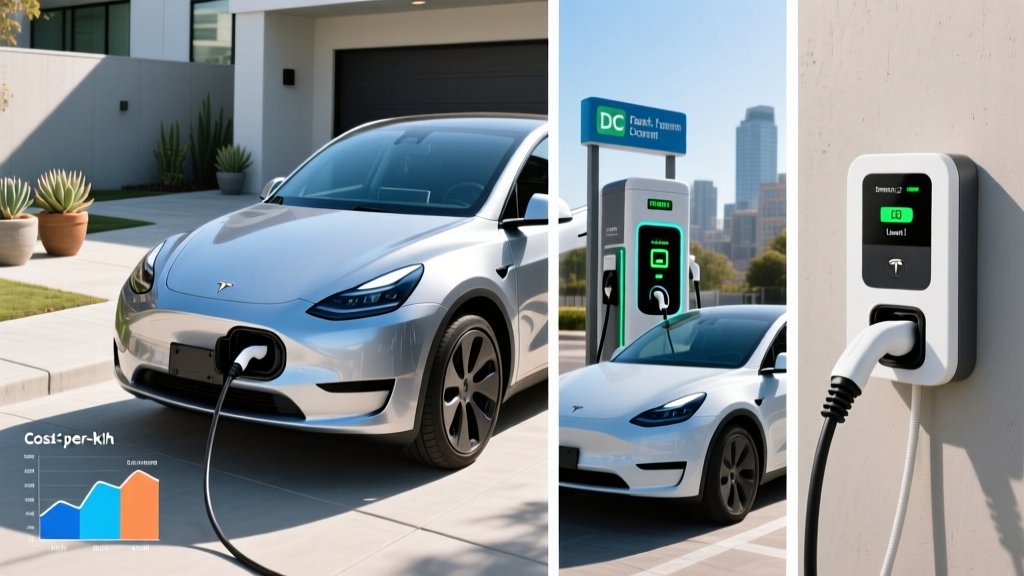
| Home (off-peak utility rate) | $0.10–$0.14 | $2.80–$3.92 | $0.03–$0.04 |
| Home (avg. national rate) | $0.16–$0.18 | $4.48–$5.04 | $0.04–$0.05 |
| Public Level 2 (ChargePoint, etc.) | $0.25–$0.49 | $7.00–$13.72 | $0.07–$0.14 |
| DC Fast (Supercharger avg.) | $0.28–$0.36 | $7.84–$10.08 | $0.08–$0.10 |
| DC Fast (Electrify America) | $0.43–$0.56 | $12.04–$15.68 | $0.12–$0.16 |
| Gasoline equivalent (25 MPG avg. @ $3.50/gal) | — | $14.00 | $0.14 |
The bottom line: Charging at home on an off-peak rate saves roughly 70–75% versus gasoline per mile. Even DC fast charging on the Supercharger network is 25–40% cheaper per mile than a comparable gas SUV getting 25 MPG. However, premium-priced public DC chargers (Electrify America at peak rates) can approach gasoline parity — which is why home charging is the economic foundation of EV ownership.
Recommended Home Charging Equipment for the Model Y
Not all Level 2 chargers are equal. Below are three proven options that pair well with the Model Y Long Range AWD, each with different strengths:
Tesla Wall Connector (Gen 3) — Best Overall for Tesla Owners
- Power output: Up to 11.5 kW (48A continuous on a 60A circuit)
- Connector: NACS native — no adapter needed
- Cable length: 24 feet
- Smart features: Wi-Fi connected, OTA updates, power sharing (link two units on one circuit), access control
- Price: ~$475
- Why it's our pick: Native NACS plug means you simply plug in with no adapter. The power-sharing feature lets you install two Wall Connectors on a single 60A circuit — ideal for two-EV households. The 24-foot cable reaches most garage configurations.
ChargePoint Home Flex — Best Universal / Multi-EV Household
- Power output: Up to 12 kW (50A continuous on a 60A circuit); adjustable down to 16A for lower-capacity panels
- Connector: J1772 (use included Tesla J1772 adapter) or NACS version now available
- Cable length: 23 feet
- Smart features: Wi-Fi, app-based scheduling for off-peak rates, Alexa integration, amperage adjustment via app
- Price: ~$550–$650
- Why consider it: The adjustable amperage is a standout — you can set it to 32A or 40A via the app to match your circuit without an electrician reconfiguring anything. Ideal if your household has a non-Tesla EV alongside the Model Y.
Emporia Vue Level 2 Charger — Best Budget Smart Charger
- Power output: Up to 11.5 kW (48A on 60A circuit)
- Connector: J1772 (use Tesla adapter) or NACS version available
- Cable length: 24 feet
- Smart features: Wi-Fi, app scheduling, energy monitoring, solar integration with Emporia Vue panel monitor
- Price: ~$350–$400
- Why consider it: Significantly cheaper than the Tesla Wall Connector with comparable power output. The solar-integration feature is excellent for homes with rooftop solar — you can configure it to charge only on excess solar production.
Safety, Code, and Installation Best Practices
EV charging draws sustained high current for hours — more like a welder than a typical household appliance. Proper installation isn't optional; it's a safety requirement.
- Dedicated circuit: Your Level 2 charger must be on its own dedicated breaker. Sharing a circuit with other loads risks tripping the breaker or overheating wiring.
- GFCI protection: The 2020 NEC and later require GFCI protection for EV charging outlets (if using a receptacle rather than hardwired). Hardwired installations (recommended) avoid nuisance GFCI trips that are common with high-amperage EV loads on receptacles.
- Hardwired vs. plug-in: Hardwired chargers (no plug, directly connected to wiring) are preferred for 48A+ installations. NEMA 14-50 receptacles are limited to 40A continuous by code and are prone to overheating if not installed with industrial-grade receptacles (Hubbell or Bryant, not cheap big-box store versions).
- Outdoor rating: If your charger is mounted outside, ensure it carries a NEMA 4 rating (weatherproof). The Tesla Wall Connector and ChargePoint Home Flex are both rated for outdoor use.
- Permit and inspection: Most jurisdictions require an electrical permit for EV charger installation. The inspection ensures the work meets NEC and local code — this protects you and is often required to qualify for utility rebates or the federal Alternative Fuel Vehicle Refueling Property Credit (up to $1,000 for home charging equipment through 2032, subject to census-tract eligibility).
Frequently Asked Questions
How much does it cost to install a home EV charger for the Model Y?
A straightforward Level 2 installation on an existing 200A panel with a short wiring run typically costs $750–$1,750 including equipment, electrician labor, and permit. If your home needs a panel upgrade from 100A or 150A to 200A, total costs can range from $2,900–$6,900. Always get multiple quotes and ask about load calculation before committing.
How fast will each charging level add range to my Model Y Long Range AWD?
Level 1 (120V) adds roughly 3–5 miles per hour — essentially useless for a 75 kWh battery unless you drive fewer than 30 miles daily. Level 2 (240V, 48A) adds 30–44 miles per hour, replenishing a full overnight charge in 7–8 hours. DC fast charging at 250 kW adds over 1,000 miles per hour at peak, but taper means a realistic 10–80% session takes about 25–28 minutes.
Which charger and connector is compatible with my 2024 Model Y?
The 2024 Model Y uses the NACS connector natively. This plugs directly into Tesla Superchargers, Tesla Wall Connectors, and Tesla Destination chargers. For CCS-based public DC chargers (Electrify America, EVgo), you need the Tesla CCS adapter (~$175–$250). For J1772 public Level 2 chargers, Tesla includes a J1772-to-NACS adapter in the vehicle's charge kit.
How much does charging a Model Y cost per mile compared to gas?
At home on an average utility rate of $0.16/kWh, charging the Model Y Long Range AWD costs roughly $0.04–$0.05 per mile. A comparable gas SUV getting 25 MPG at $3.50/gallon costs about $0.14 per mile. That's a 65–70% savings per mile when charging at home. Even Supercharger DC fast charging at ~$0.32/kWh averages $0.09/mile — still about 35% cheaper than gas.
What electrical upgrades might I need for a home charger?
The most common upgrade is a panel capacity increase — homes with 100A or 150A main service may not have room for a new 60A double-pole breaker. Upgrading to 200A service costs $1,500–$3,500. Alternatively, you can install a lower-amperage circuit (e.g., 40A breaker / 32A continuous) that still delivers ~7.7 kW — adequate for overnight charging without a panel upgrade. A licensed electrician will perform a load calculation to determine your options. Some utilities offer rebates that offset panel upgrade costs — check with your local provider.
Should I charge to 100% every night?
No. The Model Y Long Range AWD uses an NMC battery, which degrades faster when regularly held at 100% or dropped below 10%. Tesla recommends setting the daily charge limit to 80% and only charging to 100% before long road trips. The vehicle's battery management system includes a buffer (roughly 2–3 kWh below the stated 75 kWh usable capacity) to protect against deep discharge, but following the 20–80% daily window will maximize long-term battery health.
Sources: EPA efficiency data via fueleconomy.gov; Tesla Model Y official specifications; IRS Alternative Fuel Vehicle Refueling Property Credit. Prices and rates reflect 2026 estimates and may vary by region.