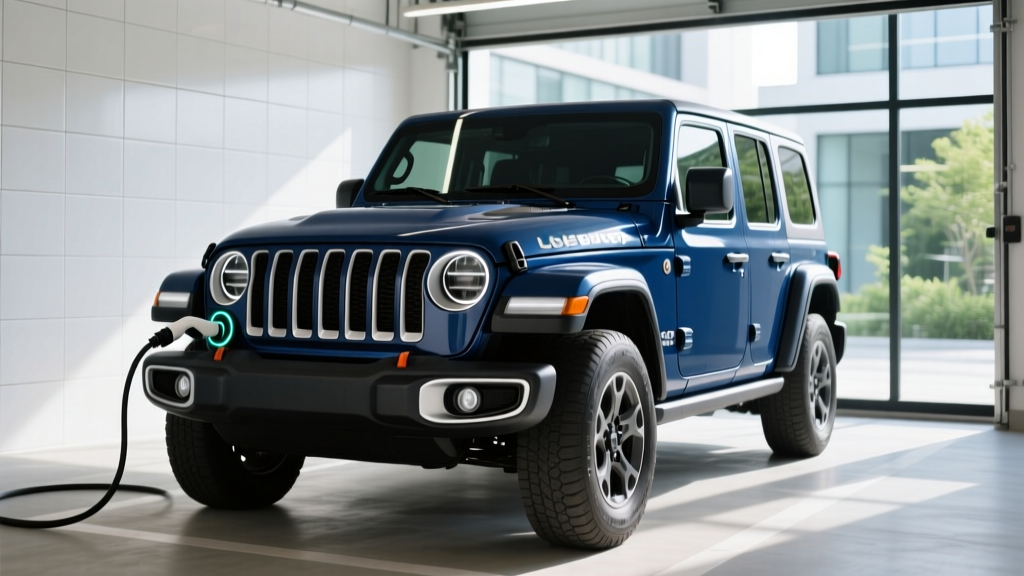
The 2021 Jeep Wrangler 4xe pairs serious off-road capability with a 17.3 kWh lithium-ion battery that delivers an EPA-rated 22 miles of electric-only range. For many owners, the biggest day-to-day question isn't about trail ratings — it's about how quickly they can recharge at home. The answer depends entirely on which charging level you use, and the difference between a standard 120V wall outlet and a dedicated 240V circuit is measured in hours, not minutes.
This guide breaks down exactly how long the Wrangler 4xe takes to charge at every level, what a home Level 2 installation actually costs in 2026, which connectors and chargers are compatible, and how the per-mile cost stacks up against the gas-only Wrangler. Whether you're plugging into a garage outlet tonight or planning a full electrical upgrade, the numbers below will tell you what to expect.
2021 Jeep Wrangler 4xe Battery and Charging Specs at a Glance
Before we get into charging times, here are the hard numbers that govern everything. The Wrangler 4xe uses a 17.3 kWh total-capacity battery pack (approximately 14–15 kWh usable, with the remainder reserved as a buffer to protect long-term health). The onboard charger — the component inside the vehicle that converts AC power from your home into DC power for the battery — is rated at 3.3 kW. That ceiling is the single most important spec for home charging, because it means even the most powerful Level 2 station can only push energy into this PHEV at 3.3 kW.
| Spec | Value |
|---|---|
| Battery capacity (total) | 17.3 kWh |
| Usable battery capacity | ~15 kWh |
| Battery chemistry | NMC (nickel manganese cobalt) |
| EPA electric-only range | 22 miles |
| EPA combined MPGe | 49 MPGe |
| Gas-only combined MPG | 20 MPG |
| Onboard charger (AC) | 3.3 kW max |
| Charge port | J1772 (AC) — front fender |
| DC fast charging | Not supported |
| Powertrain warranty | 5 yr / 60,000 mi |
| Hybrid battery warranty | 8 yr / 100,000 mi |
Source: EPA fueleconomy.gov
Level 1, Level 2, and DC Fast Charging: Speeds Explained
EV and PHEV charging is organized into three levels, defined by voltage and power delivery. Power is measured in kilowatts (kW) — the rate at which energy flows. Energy stored in the battery is measured in kilowatt-hours (kWh) — the total capacity. Confusing the two is the most common mistake new PHEV owners make. Think of kW as the speed of water flowing through a hose, and kWh as the size of the bucket you're filling.
| Level | Voltage | Typical Power (kW) | Miles of Range per Hour | Wrangler 4xe Compatible? |
|---|---|---|---|---|
| Level 1 | 120V AC | 1.0–1.4 kW | 3–5 mi/hr | Yes (included cordset) |
| Level 2 | 240V AC | 3.3–19.2 kW | 12–75 mi/hr* | Yes (capped at 3.3 kW) |
| DC Fast | 400–800V DC | 50–350 kW | 150–1,000+ mi/hr | No — no DC port |
*Miles-per-hour figures vary by vehicle efficiency. The Wrangler 4xe at 3.3 kW gains roughly 12–14 miles of electric range per hour on Level 2.
2021 Jeep Wrangler 4xe Level 1 Charging Time: The Full Breakdown
Level 1 charging uses a standard 120V household outlet and the portable cordset that came with your Wrangler 4xe. This is the simplest, zero-installation option, and for PHEV owners with short commutes, it may be all you need. Here's what the clock looks like:
- Power delivered: Approximately 1.2 kW continuous (120V × 12A, accounting for the 80% continuous-load rule on a 15A circuit)
- 0–100% full charge: Approximately 12–14 hours from a fully depleted battery
- Overnight top-up (8 hours): Adds roughly 9–10 kWh, or about 12–15 miles of electric range
- Real-world scenario: If you drive 20 miles round-trip and plug in at 9 PM, you'll recover most or all of your electric range by 7 AM — barely enough time, but it works
The limitation is clear: if your daily driving exceeds the 4xe's electric range, Level 1 alone won't fully replenish the battery overnight with much margin. Cold weather slows charging further, as the battery management system may divert some incoming power to warming the cells before accepting a full charge rate.
Level 2 Charging Time: The Practical Upgrade
Because the Wrangler 4xe's onboard charger maxes out at 3.3 kW, installing a 48A Level 2 station won't charge it any faster than a 16A station. The vehicle is the bottleneck, not the charger. At 3.3 kW on a 240V circuit:
- 0–100% full charge: Approximately 4.5–5 hours
- Overnight top-up (8 hours): Easily refills the full battery with time to spare
- Practical benefit: Plug in after a 30-mile commute at 6 PM, and the battery is full by 11 PM — well before you wake up
This is why Level 2 is the recommended setup for any Wrangler 4xe owner who wants to maximize electric driving and minimize gasoline consumption.
Home Level 2 Charger Installation: Electrical Requirements and Costs
Installing a Level 2 charger at home involves three cost components: the charging equipment itself, the electrician's labor and materials, and any necessary electrical panel upgrade. Skipping the panel assessment is the most common budgeting mistake — older homes with 100A service may need a panel upgrade before adding a 240V circuit.
| Component | Typical Cost Range | Notes |
|---|---|---|
| Level 2 charger (16A–32A, 240V) | $250–$550 | Hardwired or NEMA 14-50 plug |
| Electrician labor + materials | $400–$1,200 | Varies by run length, conduit, local rates |
| Permit and inspection | $50–$200 | Required in most jurisdictions |
| Panel upgrade (if needed) | $1,500–$3,500 | Only if existing panel lacks capacity |
| Total (no panel upgrade) | $700–$1,950 | Most homes with 200A service |
| Total (with panel upgrade) | $2,200–$5,450 | Older homes with 100A service |
For the Wrangler 4xe specifically, you can save money by choosing a 16A/240V charger (3.8 kW output — more than the 4xe can use) rather than a 48A unit designed for full-electric vehicles. A shorter cable run from the panel to the garage also reduces cost significantly.
Federal Tax Credit for Home Charging Equipment
The IRS §30D credit applies to the vehicle, but a separate provision — the Alternative Fuel Vehicle Refueling Property Credit (IRC §30C) — covers up to 30% of home charger equipment and installation costs, capped at $1,000. Eligibility depends on whether your census tract qualifies as a low-income or non-urban area. Check the IRS §30C guidelines and consult a tax professional for your specific situation.
Which Connectors and Chargers Work with the Wrangler 4xe?
The 2021 Wrangler 4xe uses the J1772 connector for all AC charging. This is the universal standard for non-Tesla plug-in vehicles in North America. You will never need a CCS or CHAdeMO connector — those are for DC fast charging, which the 4xe does not support.
| Connector Type | Used For | Wrangler 4xe Compatible? |
|---|---|---|
| J1772 | Level 1 and Level 2 AC charging | Yes — native port |
| NACS (Tesla) | Tesla Superchargers and destination charging | No — and no adapter needed (no DC capability) |
| CCS1 | DC fast charging (non-Tesla networks) | No — not applicable |
| CHAdeMO | DC fast charging (legacy Nissan/Mitsubishi) | No — not applicable |
If you also own a Tesla or plan to buy one, you can purchase a J1772-to-Tesla adapter for destination charging, but for the 4xe alone, any J1772 Level 2 station works natively.
Recommended Level 2 Chargers for the Wrangler 4xe
Since the 4xe caps at 3.3 kW, a 16A or 32A charger is ideal. Overspending on a 48A unit provides no charging-speed benefit for this vehicle.
ChargePoint Home Flex
- Power: Up to 12 kW (50A) — adjustable down to 16A
- Connector: J1772
- Cable length: 23 ft
- Smart features: Wi-Fi, app scheduling, energy tracking
- Price: ~$550
- Why for 4xe: Adjustable amperage lets you match your circuit; future-proof if you add a BEV later
Emporia Level 2 EV Charger
- Power: Up to 11.5 kW (48A) — configurable
- Connector: J1772
- Cable length: 24 ft
- Smart features: Wi-Fi, app, solar integration
- Price: ~$350
- Why for 4xe: Best value; energy monitoring pairs well with solar panels
Grizzl-E Smart
- Power: Up to 10 kW (40A)
- Connector: J1772
- Cable length: 24 ft
- Smart features: OCPP, app control
- Price: ~$450
- Why for 4xe: Rugged, outdoor-rated (NEMA 4), excellent for driveway installs in harsh climates
Charging Cost Per Mile: Wrangler 4xe vs. Gas-Only Wrangler
The financial case for the 4xe depends on how much of your driving you can cover on electricity. Here's a cost comparison using 2026 average energy prices:
| Scenario | Energy Cost | Cost Per Mile | Annual Cost (12,000 mi) |
|---|---|---|---|
| 4xe — home charging (off-peak, $0.13/kWh) | $0.13/kWh | $0.05/mi | $600 (if all electric) |
| 4xe — home charging (standard, $0.18/kWh) | $0.18/kWh | $0.07/mi | $840 (if all electric) |
| 4xe — public Level 2 ($0.30/kWh) | $0.30/kWh | $0.11/mi | $1,320 (if all electric) |
| Gas Wrangler (20 MPG, $3.40/gal) | $3.40/gal | $0.17/mi | $2,040 |
At the Wrangler 4xe's efficiency of roughly 2.5–2.8 kWh per mile of electric driving, home charging on an off-peak rate saves $1,200–$1,400 per year over the gas model — assuming you can do most of your daily miles on battery. Once the battery depletes, the 4xe reverts to its 20 MPG combined gas rating, which is essentially identical to the conventional Wrangler.
The key insight: the 4xe's savings only materialize if you charge regularly. Owners who never plug in are carrying 800+ pounds of battery and electric drivetrain weight for zero benefit, achieving slightly worse fuel economy than the gas model.
Safety, Electrical Code, and Installation Best Practices
Level 2 charger installations must comply with the National Electrical Code (NEC) and local amendments. Key requirements include:
- Dedicated circuit: Your Level 2 charger must be on its own dedicated breaker — not shared with other appliances
- GFCI protection: NEC 2020 and later requires GFCI protection for all EV charging outlets; hardwired units may have GFCI built into the charger
- Continuous load derating: EV charging is classified as a continuous load, meaning the circuit must be rated at 125% of the charger's amperage (a 16A charger needs a 20A breaker; a 32A charger needs a 40A breaker)
- Outdoor rating: If installing outside, the charger must carry a NEMA 4 (or better) weatherproof rating, and all conduit and junction boxes must be rated for wet locations
- Permit and inspection: Most jurisdictions require an electrical permit and a final inspection — skip this and you risk voiding homeowner's insurance coverage for electrical fires
Always hire a licensed electrician. The National Fire Protection Association maintains the NEC standards that govern EV charging installations.
Frequently Asked Questions
How long does it take to charge the 2021 Jeep Wrangler 4xe on a regular wall outlet?
On a standard 120V Level 1 outlet, a full 0–100% charge takes approximately 12–14 hours. For most owners who drive 15–20 miles daily and plug in overnight, Level 1 will recover enough range to cover the next day's commute, but with minimal margin.
Can I use a Tesla Supercharger with the Wrangler 4xe?
No. The Wrangler 4xe does not support DC fast charging of any kind. It has no CCS, CHAdeMO, or NACS port. The vehicle can only accept AC power through its J1772 port at a maximum of 3.3 kW.
Is a Level 2 charger worth it for a PHEV with only 22 miles of range?
Yes, if you want to reliably recharge the full battery in 4–5 hours rather than 12–14. Level 2 gives you the flexibility to recharge mid-day if needed and ensures a full battery every morning regardless of how depleted you came home. The modest installation cost ($700–$1,950 for most homes) pays for itself through consistent electric-only commuting.
Does the Wrangler 4xe qualify for a federal tax credit?
The §30D New Clean Vehicle Credit rules have evolved significantly since the 4xe's 2021 launch. Current-year eligibility depends on MSRP caps, buyer income limits, and battery component/critical mineral sourcing requirements. The 2021 Wrangler 4xe originally qualified for up to $7,500, but purchasing one new today (if remaining inventory exists) requires checking current IRS §30D rules. Used 4xe models may qualify for the up-to-$4,000 used EV credit under separate eligibility criteria.
What happens if I never charge the Wrangler 4xe?
The vehicle will operate as a conventional hybrid, using the 2.0L turbocharged engine and regenerative braking to manage the small battery. You'll get roughly 20 MPG combined — similar to a gas Wrangler — but you'll carry the weight penalty of the battery pack and forfeit the entire economic advantage of the PHEV powertrain. Regular charging is what makes the 4xe worthwhile.
How long will the Wrangler 4xe battery last?
Stellantis warranties the hybrid battery for 8 years or 100,000 miles against defects and excessive capacity loss (typically below 60–70% of original capacity). Real-world PHEV battery degradation for NMC chemistry is approximately 1–2% per year under normal use, meaning you can expect roughly 85–90% capacity retention after 5 years. Avoiding frequent full 100% charges and deep discharges to 0% will extend longevity.