If you've ever pulled into a 7-Eleven for coffee and noticed an EV plugged in outside, you're not alone. Convenience stores and gas stations are rapidly adding electric vehicle chargers, and 7-Eleven is part of that wave. But whether you can rely on a 7-Eleven for a meaningful charge — and what it will cost you — depends heavily on the specific location, the charger type installed, and your vehicle's connector.
This guide answers the core question, then goes further: we break down every charging level available to EV owners, compare public convenience-store charging with home Level 2 setups, and walk through the real costs of installing your own charger in 2026.
Does 7-Eleven Have Charging Stations?
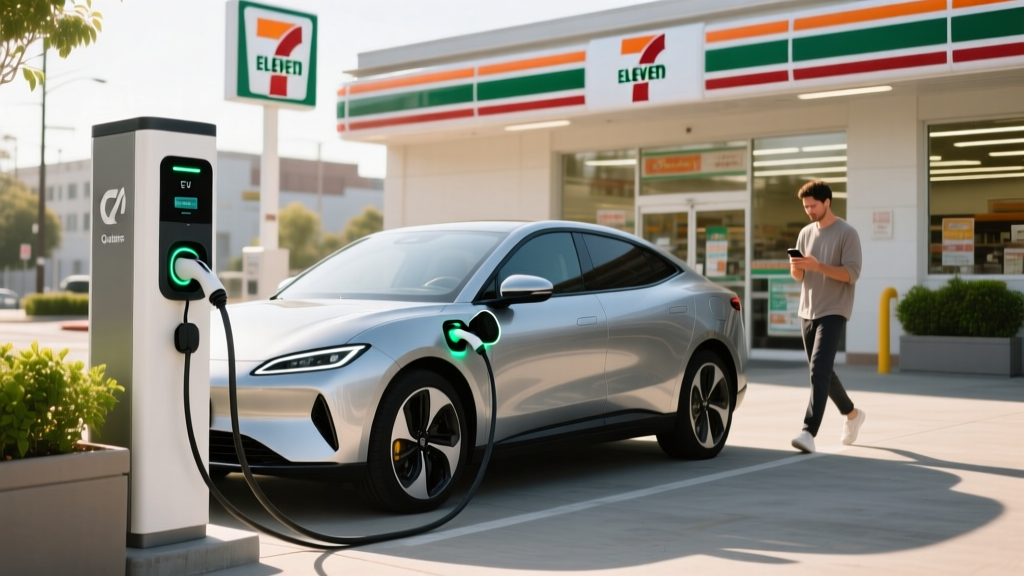
Yes — 7-Eleven has been rolling out EV charging stations at select locations across the United States, though availability is far from universal. The company partnered with charging networks including EVgo and ChargePoint to install DC fast chargers at high-traffic stores, primarily in states with strong EV adoption such as California, Texas, Florida, and parts of the Northeast corridor.
As of early 2026, roughly 150–200 7-Eleven locations nationwide offer DC fast charging, typically ranging from 50 kW to 150 kW per stall. A handful of flagship locations in California feature 350 kW units. However, this represents a small fraction of 7-Eleven's approximately 13,000 U.S. stores, so you cannot assume any given location will have a charger.
To find a 7-Eleven with charging, use the Alternative Fuels Data Center station locator or network-specific apps (EVgo, ChargePoint, PlugShare). Filter by address and connector type before you drive.
Understanding EV Charging Levels: Speeds in kW and Miles Per Hour
Before comparing public chargers to home setups, you need clarity on charging levels. The critical distinction: kW (kilowatts) measures the rate of power delivery — think of it as how fast water flows through a hose. kWh (kilowatt-hours) measures total energy stored in your battery — the size of the tank. Never use them interchangeably.
| Level | Voltage | Power (kW) | Miles of Range Added Per Hour | Typical Use Case |
|---|---|---|---|---|
| Level 1 | 120V AC | 1.0–1.4 kW | 3–5 mi/hr | Overnight trickle; PHEVs |
| Level 2 | 240V AC | 3.3–19.2 kW | 12–75 mi/hr | Home daily charging; workplaces |
| DC Fast (Level 3) | 400–800V DC | 50–350 kW | 150–1,200+ mi/hr (peak) | Road trips; quick top-ups |
At a typical 7-Eleven with a 50 kW DC fast charger, a vehicle like the Hyundai Ioniq 5 (which can accept up to 240 kW peak) will be bottlenecked by the station's output. You'll add roughly 25–30 miles of range in 15 minutes at 50 kW — functional, but far from the 10–80% charge in 18 minutes the Ioniq 5 achieves at a 240 kW station.
How Much Does Charging Cost Per Mile vs. Gas?
The economics of EV charging vary dramatically depending on where and when you plug in. Here's how common scenarios compare for a midsize EV averaging 3.5 miles per kWh (roughly the efficiency of a Tesla Model Y or Ford Mustang Mach-E):
| Charging Scenario | Cost per kWh | Cost per Mile | Equivalent MPG Gas Cost at $3.50/gal |
|---|---|---|---|
| Home Level 2 (off-peak utility rate) | $0.08–$0.12 | $0.023–$0.034 | 103–152 MPG |
| Home Level 2 (standard rate) | $0.14–$0.18 | $0.040–$0.051 | 69–88 MPG |
| Public Level 2 (network pricing) | $0.20–$0.35 | $0.057–$0.100 | 35–61 MPG |
| DC Fast (EVgo/Electrify America) | $0.35–$0.55 | $0.100–$0.157 | 22–35 MPG |
| Gasoline (30 MPG combined) | — | $0.117 | 30 MPG (baseline) |
The takeaway: home charging is the economic sweet spot, delivering fuel costs equivalent to 100+ MPG. Public DC fast charging at convenience stores or highway stations can approach or even exceed gasoline costs per mile. The 7-Eleven charger is convenient for emergencies and top-ups, but relying on it as your primary charging strategy erases much of the EV cost advantage.
For a detailed breakdown of utility rate plans and time-of-use pricing, check the EPA's EV fuel economy resource page.
Home Level 2 Charger Installation: Costs, Electrical Requirements, and Panel Upgrades
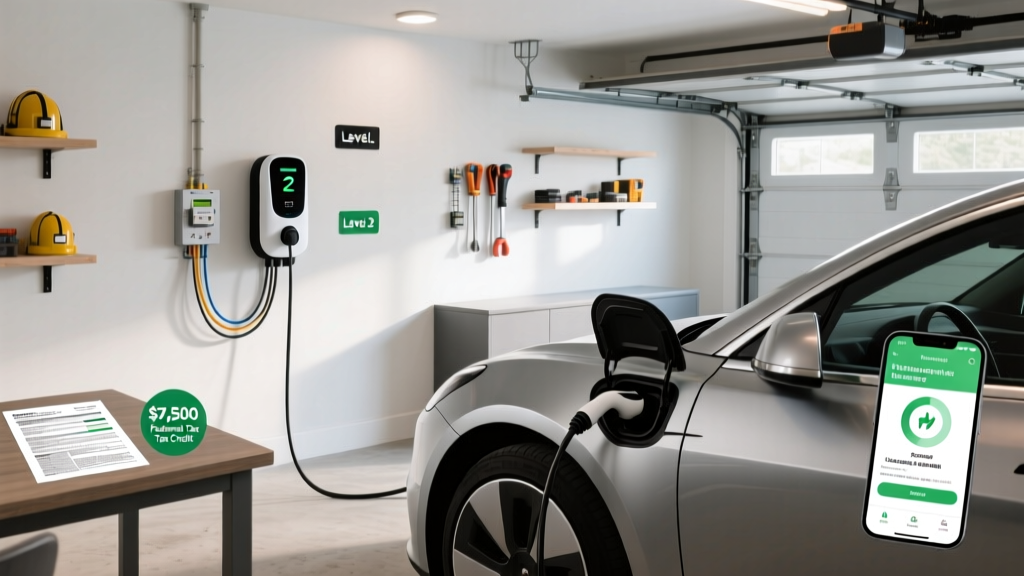
Installing a Level 2 home charger is the single highest-impact upgrade an EV owner can make. Here's what the project actually involves in 2026:
Electrical Requirements
A typical home Level 2 charger requires a 240-volt dedicated circuit, similar to what powers an electric dryer or oven. Common configurations:
- 40-amp circuit → delivers up to 32 amps continuous (7.7 kW) — the most popular residential setup
- 50-amp circuit → delivers up to 40 amps continuous (9.6 kW) — recommended for larger batteries (100+ kWh)
- 60-amp circuit → delivers up to 48 amps continuous (11.5 kW) — for high-power onboard chargers (e.g., Ford F-150 Lightning extended range)
Installation Cost Breakdown
| Component | Simple Install (Near Panel) | Complex Install (Far Run / Upgrade) |
|---|---|---|
| Level 2 charger equipment | $350–$700 | $500–$750 |
| Electrician labor (2–6 hours) | $300–$600 | $800–$2,000 |
| Wiring, conduit, materials | $100–$300 | $400–$1,200 |
| Electrical permit | $50–$150 | $50–$200 |
| Panel upgrade (if needed) | $0 | $1,500–$3,500 |
| Total estimated cost | $800–$1,750 | $3,250–$7,650 |
Safety and Code Considerations
- Dedicated circuit required: EV chargers must be on their own breaker — never shared with other appliances.
- GFCI protection: The 2023 NEC (adopted by most jurisdictions by 2026) requires GFCI protection for all EV charging outlets. Hardwired units may have GFCI built into the charger itself.
- Outdoor rating: If installing outside, ensure the charger carries a NEMA 4 or NEMA 4X rating for weather resistance.
- Permit and inspection: Nearly all jurisdictions require a permit for new 240V circuits. Skipping this risks insurance denial in the event of an electrical fire.
Which Connector Is Compatible With My EV?
The connector landscape shifted significantly in 2024–2025 when most major automakers adopted the North American Charging Standard (NACS), originally developed by Tesla. Here's where things stand for 2026 model-year vehicles:
| Connector Type | Brands Using It (2026) | Notes |
|---|---|---|
| NACS (Tesla/J3400) | Tesla, Ford, GM, Rivian, Volvo, Polestar, Mercedes, Nissan (new models), Honda, BMW, Hyundai/Kia (new models) | Now the dominant standard; direct Supercharger access for most |
| CCS1 (Combined Charging System) | VW ID.4 (remaining stock), Stellantis, some Hyundai/Kia (carryover models) | Legacy standard; adapters to NACS widely available |
| CHAdeMO | Nissan Leaf (discontinued 2025), Mitsubishi Outlander PHEV (older) | Effectively deprecated in the US; avoid for new purchases |
Adapter needs: If you own a CCS1-equipped vehicle (e.g., a 2024 VW ID.4), you'll likely need a CCS-to-NACS adapter ($150–$250) to access Tesla Superchargers, which now open to non-Tesla vehicles via the NACS standard. Most 7-Eleven locations with EVgo chargers offer CCS1 connectors; newer installs increasingly include NACS cables as well.
Always confirm connector availability on the charging network app before driving to a station — arriving at a charger with the wrong plug is the most common public-charging frustration.
Equipment Recommendations: Best Home Level 2 Chargers for 2026
Here are four well-regarded Level 2 home chargers spanning different budgets and feature sets. All are UL-listed and compatible with NACS-equipped vehicles (or available in CCS variants):
Tesla Wall Connector (J3400/NACS)
- Power output: Up to 11.5 kW (48A on 60A circuit)
- Cable length: 24 ft
- Smart features: Wi-Fi, OTA updates, load sharing between units, Powerwall integration
- Connector: NACS native
- Price: ~$475
- Best for: Tesla and NACS-native owners wanting maximum power
ChargePoint Home Flex
- Power output: Up to 12 kW (50A on 60A circuit); configurable from 16A–50A
- Cable length: 23 ft
- Smart features: Wi-Fi, app scheduling, Alexa integration, energy tracking
- Connector: NACS or J1772 (with adapter)
- Price: ~$650
- Best for: Flexibility across connector types; adjustable amperage
Emporia Level 2 EV Charger
- Power output: Up to 11.5 kW (48A)
- Cable length: 24 ft
- Smart features: Wi-Fi, solar integration, energy monitoring, scheduling
- Connector: J1772 (NACS adapter included)
- Price: ~$400
- Best for: Budget-conscious buyers with solar panels
Grizzl-E Smart
- Power output: Up to 10 kW (40A on 50A circuit)
- Cable length: 24 ft
- Smart features: OCPP-compatible, app control, adjustable amperage
- Connector: J1772 or NACS
- Price: ~$499
- Best for: Cold-climate durability; built in Canada
Charging Time Examples: 10–80% for Common EV Battery Sizes
Charging speed isn't just about the station's kW rating. Your vehicle's onboard charger (for Level 2) and its maximum DC fast-charge acceptance rate both matter. Additionally, charging slows significantly above 80% State of Charge (SoC) due to battery-management-system protections — this is called the charge curve taper.
| Vehicle (Usable Battery kWh) | Home Level 2 (7.7 kW / 32A) | 50 kW DC Fast | 150 kW DC Fast | 250–350 kW DC Fast |
|---|---|---|---|---|
| Tesla Model Y (75 kWh) | ~7 hrs | ~65 min | ~30 min | ~18 min |
| Hyundai Ioniq 5 (77.4 kWh) | ~7 hrs | ~68 min | ~28 min | ~18 min |
| Ford F-150 Lightning (131 kWh ext.) | ~12 hrs | ~110 min | ~48 min | ~35 min |
| Chevrolet Equinox EV (85 kWh) | ~8 hrs | ~75 min | ~33 min | N/A (150 kW max) |
A 7-Eleven with a 50 kW charger will get you back on the road with a useful top-up in 15–20 minutes, but a full 10–80% charge at that speed takes over an hour for most vehicles. That's fine when paired with a coffee stop, but it underscores why home Level 2 remains the practical backbone of daily EV ownership.
Frequently Asked Questions
Does every 7-Eleven have an EV charger?
No. Only a small fraction of 7-Eleven's ~13,000 U.S. locations currently have EV charging stations. Availability is concentrated in California, Texas, and other high-EV-adoption states. Always check PlugShare, EVgo, or ChargePoint apps before assuming a specific store has a charger.
How much does it cost to install a home EV charger?
A straightforward Level 2 installation near your electrical panel typically costs $800–$1,750 including equipment, electrician labor, materials, and permit. If your home requires a panel upgrade or a long wiring run, costs can reach $3,250–$7,650. Always get a load calculation from a licensed electrician first.
How fast will each charging level add range?
Level 1 (120V standard outlet) adds 3–5 miles per hour. Level 2 (240V home charger) adds 12–75 miles per hour depending on amperage. DC fast charging at 50 kW adds roughly 150+ miles per hour at peak, while 250–350 kW stations can theoretically add 1,000+ miles per hour — though real-world speeds taper as the battery fills.
Which connector does my EV need?
Most 2026 model-year EVs now use the NACS (J3400) connector, including Tesla, Ford, GM, Rivian, Hyundai, and Kia new models. Older or carryover models may still have CCS1. CHAdeMO is effectively discontinued in the U.S. Check your vehicle's charge port or owner's manual, and carry an adapter if your vehicle is CCS-equipped and you plan to use NACS stations.
What electrical upgrades might I need for a home charger?
Homes with 100-amp electrical panels — common in homes built before 1990 — may need an upgrade to 200 amps, costing $1,500–$3,500. Even homes with 200-amp panels may need a load calculation to confirm capacity. Your electrician will assess existing loads (HVAC, dryer, oven, water heater) against available headroom per NEC Article 220.
Is charging at 7-Eleven cheaper than at home?
Almost never. Public DC fast chargers at convenience stores typically cost $0.35–$0.55 per kWh, translating to $0.10–$0.16 per mile for a typical EV. Home off-peak charging at $0.08–$0.12 per kWh delivers the same miles for $0.02–$0.03 each. Use 7-Eleven chargers for convenience and top-ups, not as your primary fueling strategy.
Can I use a Tesla Supercharger at a 7-Eleven?
7-Eleven chargers are typically operated by EVgo or ChargePoint, not Tesla's Supercharger network. However, some 7-Eleven locations may host Tesla destination chargers or Superchargers in adjacent parking areas. Check the Tesla app's "Charge Your Non-Tesla" feature and PlugShare for specifics at any given location.