The federal Alternative Fuel Vehicle Refueling Property Credit (IRS §30C) can cover up to 30% of the cost to install a home EV charger — maxing out at $1,000 for residential property. But stacking that credit against the real expenses of a Level 2 home charging setup (equipment, electrician labor, permits, and possible panel upgrades) reveals a more nuanced math than most guides admit. This guide walks through every cost layer, the charging speeds you'll actually see, connector compatibility across the 2026 EV market, and the per-mile economics that determine whether home charging pays off versus gas.
Understanding the EV Charging Tax Credit (IRS §30C)
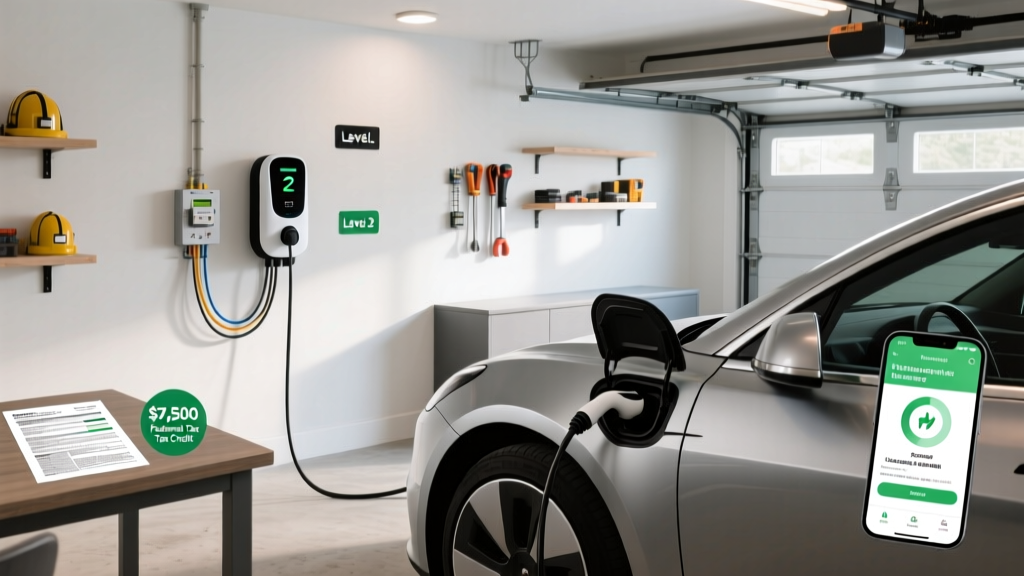
Unlike the better-known §30D new-vehicle credit, the §30C credit applies to the charging equipment and its installation, not the car itself. As of 2026, the credit covers 30% of qualified expenditures for residential charging infrastructure, capped at $1,000 per tax year per property. Eligible costs include the charger hardware, wiring, conduit, labor, and permits — essentially everything on your electrician's invoice tied directly to the charger circuit.
A few rules matter before you assume eligibility:
- The equipment must be installed at your primary residence (rentals and vacation homes generally do not qualify).
- The property must be located in a qualifying census tract — typically rural or low-income communities, per the Inflation Reduction Act's place-based targeting.
- There is no income cap on §30C, unlike §30D's AGI limits.
- The credit is non-refundable: it can reduce your federal tax liability to zero but won't generate a refund beyond that.
For a typical Level 2 installation costing $1,800 all-in, the credit would offset $540. For a complex install with a panel upgrade totaling $4,500, the credit caps at $1,000. Always verify current-year rules at IRS.gov §30C and consult a tax professional, as census-tract eligibility and credit parameters can shift.
Charging Levels: Speeds, Power, and Range Added Per Hour
EV charging falls into three tiers, each defined by its power delivery in kilowatts (kW). Remember: kW measures power (the rate of energy flow), while kWh measures energy (what your battery actually stores). Confusing them is the most common EV literacy mistake.
| Level | Voltage | Max Power (kW) | Miles of Range Added Per Hour | Typical Use Case |
|---|---|---|---|---|
| Level 1 | 120V AC | 1.4–1.9 kW | 3–5 mi/hr | Overnight top-ups, PHEVs, low-mileage drivers |
| Level 2 | 240V AC | 7.2–19.2 kW | 20–70 mi/hr | Home daily charging, workplace, destination |
| DC Fast | 400–800V DC | 50–350 kW | 150–1,200 mi/hr (peak) | Road trips, highway corridors |
For a 75 kWh battery (roughly a Tesla Model Y or Hyundai Ioniq 5), expect these real-world charging times:
- Level 1 (1.4 kW): 0–100% in ~54 hours. Impractical for BEVs; fine for PHEVs with 15 kWh batteries.
- Level 2 (11.5 kW / 48A): 0–100% in ~7 hours. The residential sweet spot.
- DC Fast (peak 250 kW): 10–80% in ~18–25 minutes depending on vehicle architecture and battery temperature. Note that charge rate tapers significantly above 80% State of Charge (SoC) to protect battery health — the last 20% can take as long as the first 80%.
Home Installation Costs: Equipment, Electrician, and Panel Upgrades
The sticker price of a Level 2 charger ($400–$700) is only part of the equation. The total installed cost depends heavily on your home's electrical infrastructure.
| Cost Component | Low End | High End | Notes |
|---|---|---|---|
| Level 2 Charger (Equipment) | $400 | $700 | 40A–48A hardwired or NEMA 14-50 plug |
| Electrician Labor | $500 | $2,000 | Depends on run length from panel to garage |
| Permit & Inspection | $50 | $300 | Varies by municipality |
| Electrical Panel Upgrade | $0 | $3,000 | Required if panel is 100A or maxed out; 200A service recommended |
| Total (No Panel Upgrade) | $950 | $3,000 | Typical for newer homes with 200A service |
| Total (With Panel Upgrade) | $2,500 | $6,000 | Older homes (pre-1990) often need this |
Electrical Requirements for Level 2
A 48-amp Level 2 charger requires a dedicated 60-amp circuit (National Electrical Code requires circuits be loaded to no more than 80% of breaker capacity: 48A ÷ 0.8 = 60A). The charger operates at 240V, drawing 11.5 kW continuously. Your electrical panel must have spare capacity — typically two adjacent breaker slots and sufficient amperage headroom.
Homes built after 2000 usually have 200-amp service with room to spare. Homes from the 1960s–1980s often have 100A or 150A panels already near capacity with HVAC, electric range, and dryer loads. A licensed electrician will perform a load calculation to determine if an upgrade is necessary.
Safety and Code Considerations
- Dedicated circuit: EV chargers must have their own breaker — no sharing with other appliances.
- GFCI protection: Required for outdoor installations and increasingly mandated for garages under updated NEC codes.
- Outdoor rating: If your charger mounts outside, verify NEMA 4 (weatherproof) rating. Indoor-only units (NEMA 2) will fail inspection on exterior walls.
- Hardwired vs. plug: Hardwired units (no plug) are generally safer, permit more flexible placement, and avoid the code requirement for GFCI breakers on 240V receptacles — which can cost $150+ extra and are prone to nuisance tripping with some chargers.
- Cable management: Ensure the charging cable won't be a trip hazard or subject to vehicle traffic. Most codes require the connector holster to be 18–48 inches above the floor.
Connector Compatibility: NACS, CCS1, CHAdeMO, and Adapters
The connector landscape consolidated significantly by 2026. The North American Charging Standard (NACS), developed by Tesla and now adopted by nearly every major automaker, is the dominant plug. CCS1 remains on some legacy models, and CHAdeMO is effectively discontinued on new vehicles.
| Connector | Brands Using It (2026 Models) | Home Charging | Public DC Fast |
|---|---|---|---|
| NACS (Tesla) | Tesla, Ford, GM, Rivian, Hyundai, Kia, Volvo, Polestar, BMW, Mercedes | NACS wall connectors widely available | Tesla Superchargers + most new EA/BP Pulse stalls |
| CCS1 | VW ID.4 (pre-2025), some legacy BMW/Hyundai models | CCS1 home chargers still sold | Electrify America, EVgo (most stalls) |
| CHAdeMO | Nissan Leaf (discontinued after 2025), Mitsubishi Outlander PHEV (older) | Rare for home | Phased out at most networks |
Adapter needs: If you own a CCS1-equipped EV, a CCS1-to-NACS adapter ($150–$250) unlocks the Supercharger network. Tesla owners driving to CCS1-only Electrify America stalls need a NACS-to-CCS1 adapter. For home Level 2 charging, most universal chargers ship with a NACS or J1772 connector; verify your vehicle's inlet before ordering.
Cost to Charge: $/kWh Scenarios and Cost Per Mile vs Gas
The economics of EV charging depend on where and when you plug in. Electricity rates vary enormously by region and time-of-use.
| Scenario | Rate ($/kWh) | Efficiency (kWh/100mi) | Cost Per Mile | Gas Equivalent (at $3.50/gal) |
|---|---|---|---|---|
| Home off-peak (utility TOU rate) | $0.08–$0.12 | 28 | $0.022–$0.034 | 45 MPG vehicle |
| Home standard rate | $0.14–$0.18 | 28 | $0.039–$0.050 | 30–35 MPG vehicle |
| Public Level 2 (ChargePoint, etc.) | $0.25–$0.40 | 28 | $0.070–$0.112 | 18–25 MPG vehicle |
| DC Fast (Electrify America, Tesla) | $0.35–$0.55 | 28 | $0.098–$0.154 | 15–22 MPG vehicle |
A driver covering 12,000 miles/year charging primarily at home on off-peak rates ($0.10/kWh) spends roughly $336 annually on electricity. The same driver in a 25 MPG gas vehicle at $3.50/gallon spends $1,680. That's a $1,344/year fuel savings — enough to recoup a $2,000 home charger installation in about 18 months.
However, drivers who rely exclusively on DC fast charging ($0.45/kWh average) pay $0.126/mile — comparable to a 28 MPG gas vehicle. Home charging access is the single biggest determinant of EV operating-cost advantage.
Recommended Home Level 2 Chargers for 2026
ChargePoint Home Flex
- Power: Up to 12 kW (50A) on a 60A circuit; adjustable down to 16A for smaller circuits
- Connector: NACS or J1772 (configurable at purchase)
- Cable length: 23 feet
- Smart features: Wi-Fi, scheduling, Alexa/Google integration, energy tracking
- Price: ~$550
- Best for: Most homes; flexible amperage accommodates 30A–60A circuits
Tesla Wall Connector
- Power: Up to 11.5 kW (48A) on a 60A circuit
- Connector: NACS native; includes J1772 adapter in box
- Cable length: 24 feet
- Smart features: Wi-Fi, over-the-air updates, load sharing (pair two units on one circuit), power sharing with Tesla Powerwall
- Price: ~$475
- Best for: Tesla owners or mixed-EV households; cleanest NACS integration
Emporia Level 2 EV Charger
- Power: Up to 11.5 kW (48A)
- Connector: J1772 or NACS
- Cable length: 24 feet
- Smart features: Energy monitoring, solar integration, time-of-use scheduling, works with Emporia home energy monitor
- Price: ~$400
- Best for: Budget-conscious buyers with solar panels; best energy-monitoring app
Grizzl-E Smart
- Power: Up to 10 kW (40A)
- Connector: J1772 (NACS adapter available)
- Cable length: 24 feet
- Smart features: OCPP-compatible, adjustable amperage, extreme cold rating (-40°F)
- Price: ~$550
- Best for: Cold-climate garages and outdoor mounts; rugged build quality
Electrical Upgrades You Might Need Before Installing
Before committing to a charger purchase, assess your home's readiness:
- Panel amperage: Check your main breaker — 200A is standard for modern homes. If yours is 100A or 150A and already serving electric HVAC, range, dryer, and water heater, a panel upgrade ($1,500–$3,000) is likely required.
- Available breaker slots: A Level 2 charger needs a double-pole 60A breaker (two adjacent slots). If your panel is full, a sub-panel or tandem breakers may be options — but only if an electrician confirms capacity.
- Wire run distance: If your panel is on the opposite side of the house from the garage, the copper wire cost alone can add $500–$1,000. Longer runs require thicker gauge wire to prevent voltage drop.
- Utility service entrance: In rare cases, the service drop from the utility pole or transformer to your meter may need upgrading — this is the utility's responsibility but can add weeks of lead time.
Get at least two quotes from licensed electricians who specialize in EV charger installs. Ask specifically about the load calculation, whether a permit is required (it almost always is), and whether they'll coordinate the utility inspection.
Frequently Asked Questions
How much does it cost to install a home EV charger?
Most homeowners pay between $950 and $3,000 for a Level 2 installation in a home with adequate 200A electrical service. If a panel upgrade is needed, total costs range from $2,500 to $6,000. The §30C EV charging tax credit can offset up to $1,000 (30% of costs) if your property is in an eligible census tract.
How fast will each charging level add range?
Level 1 (120V) adds 3–5 miles per hour. Level 2 (240V, 48A) adds roughly 35–45 miles per hour for most EVs. DC fast charging at 250 kW can add 150–200 miles in 15–20 minutes, though the charge rate tapers significantly above 80% SoC.
Which connector or charger is compatible with my EV?
For 2026 models, most new EVs (Tesla, Ford, GM, Hyundai, Kia, Rivian, BMW) use NACS. Older CCS1 vehicles can use adapters to access NACS chargers and vice versa. Check your vehicle's charge port before buying a home charger — most charger manufacturers offer NACS or J1772 connector options at purchase.
How much does charging cost per mile vs gas?
Home charging at off-peak rates ($0.10/kWh) costs roughly $0.03/mile — equivalent to a 45 MPG gas vehicle. Public DC fast charging at $0.45/kWh costs ~$0.13/mile, similar to a 22 MPG gas vehicle. Home access is critical to realizing EV cost savings. Reference efficiency data at fueleconomy.gov.
What electrical upgrades might I need?
Homes with 100A or 150A panels, or panels that are already near capacity, typically need a service upgrade to 200A ($1,500–$3,000). You also need two adjacent breaker slots for a 60A double-pole breaker. Long wire runs from the panel to the garage add material costs. A licensed electrician's load calculation will determine your exact needs.
Can I claim the EV charging tax credit if I rent?
No. The §30C credit applies only to equipment installed at your primary residence that you own. Rental properties and second homes do not qualify. Check current eligibility requirements at IRS.gov.
Do I need a smart charger or is a basic unit fine?
Smart chargers (Wi-Fi-enabled) let you schedule charging during off-peak utility rates, monitor energy use, and receive firmware updates. If your utility offers time-of-use rates, a smart charger pays for its $100–$150 premium within months by shifting charging to cheaper overnight hours. Basic "dumb" chargers work fine but forfeit these savings.