If you own or are shopping for a 2023 Tesla Model Y Long Range, your charging strategy will define the ownership experience. The Long Range AWD variant pairs a ~75 kWh usable NMC battery pack with an EPA-rated 330 miles of range and an 11.5 kW onboard AC charger — specs that make home Level 2 charging both practical and essential. This guide walks through every electrical, financial, and equipment decision you need to make, with real numbers instead of marketing claims.
What the 2023 Tesla Model Y Long Range Needs from Your Electrical System
Before picking a charger, understand what the car can actually accept. The 2023 Model Y Long Range AWD has an 11.5 kW onboard AC charger (48 amps). That means even if you plug into a 60-amp circuit capable of delivering 14.4 kW, the car will only draw 11.5 kW. Oversizing the circuit isn't wasted money — it future-proofs for your next EV — but undersizing it leaves range on the table every night.
| Spec | Value |
|---|---|
| Usable battery capacity | ~75 kWh (NMC chemistry) |
| EPA range | 330 miles (expect ~275–295 mi highway; ~230–250 mi in freezing weather) |
| Onboard AC charger | 11.5 kW / 48 amps max |
| Peak DC fast charge | 250 kW (Supercharger V3) |
| 10–80% DC fast charge | ~27 minutes (warm battery, V3 stall) |
| Connector (AC & DC) | NACS (native Tesla) |
| EPA efficiency | 122 MPGe combined (28 kWh/100 mi) |
The critical distinction: kW (kilowatts) measures the rate of power flow — think of it as how wide the pipe is. kWh (kilowatt-hours) measures total energy stored — the size of the tank. Your Model Y has a ~75 kWh tank and can fill it through a 11.5 kW pipe at home or a 250 kW pipe at a Supercharger.
Charging Levels Explained: Speeds in kW and Miles Per Hour
Every EV owner needs to internalize three charging tiers. Here's how they apply to the 2023 Model Y Long Range specifically, based on its 28 kWh/100mi efficiency:
| Level | Voltage / Amps | Power (kW) | Miles of Range / Hour | Best Use Case |
|---|---|---|---|---|
| Level 1 | 120V / 12A | ~1.4 kW | ~3–4 mi/hr | Emergency / trickle top-off |
| Level 2 | 240V / 48A | 11.5 kW | ~37–41 mi/hr | Daily home charging (ideal) |
| Level 2 (lower) | 240V / 32A | 7.7 kW | ~25–28 mi/hr | Adequate for most daily driving |
| DC Fast | 400V+ / variable | Up to 250 kW | ~800+ mi/hr (peak) | Road trips, rapid top-ups |
Real-world charging time examples for the Model Y's 75 kWh battery:
- Level 1 (120V, 1.4 kW): 10–80% (~52.5 kWh) takes roughly 37 hours. Impractical for daily use.
- Level 2 at 48A (11.5 kW): 10–80% in approximately 4.5 hours. An overnight session easily refills the pack.
- Level 2 at 32A (7.7 kW): 10–80% in about 6.8 hours. Still sufficient for most overnight needs.
- DC Fast at 250 kW (V3 Supercharger): 10–80% in ~27 minutes with a preconditioned battery. Charging tapers sharply above 80% — expect 80–100% to take an additional 15–20 minutes due to the charge curve.
Home Charger Installation: Electrical Requirements and Real Costs
This is where most new EV owners get surprised. The charger unit itself is often the cheapest part of the equation. The real cost variables are your home's electrical panel capacity, the wire run distance, and local permit fees.
Electrical Requirements for a 48-Amp Level 2 Charger
To get the full 11.5 kW your Model Y can accept, you need:
- A 60-amp dedicated circuit (NEC code requires continuous loads to be derated to 80% of breaker capacity: 48A × 1.25 = 60A breaker)
- 240V service — standard in US homes for dryers and ovens
- 6 AWG copper wire (or 4 AWG aluminum) for runs up to ~100 feet; thicker gauge for longer runs to reduce voltage drop
- A NACS connector (native on the Tesla Wall Connector and all Tesla vehicles)
If you opt for a 32-amp charger (7.7 kW), a 40-amp circuit with 8 AWG wire suffices — potentially saving on wire and breaker costs.
Do You Need a Panel Upgrade?
Homes with a 100-amp main service panel often lack the headroom for a 60-amp EV circuit, especially if you already run electric heat, a dryer, and an oven. A licensed electrician will perform a load calculation (NEC Article 220) to determine available capacity. If your panel is at or near capacity, you'll need either:
- A panel upgrade to 200 amps: $1,800–$4,000 depending on your utility and local rates
- A smart load-management device (e.g., Emporia Smart Load Center or Span panel integration): $400–$1,200 installed, which dynamically limits charger draw when other circuits are in use
| Component | Cost Range | Notes |
|---|---|---|
| Level 2 charger unit (48A, NACS) | $400–$650 | Tesla Wall Connector, ChargePoint, Emporia |
| Electrician labor (standard install) | $500–$1,500 | Short wire run, panel has capacity |
| Electrical permit | $50–$250 | Varies by municipality |
| Wire & conduit materials | $100–$400 | Depends on run length |
| Panel upgrade (if needed) | $1,800–$4,000 | 100A → 200A service |
| Total (no panel upgrade) | $1,050–$2,800 | Most homes with 200A service |
| Total (with panel upgrade) | $2,850–$6,800 | Older homes with 100A service |
The federal Residential Clean Energy Credit (IRS §25D) covers 30% of charger equipment and installation costs up to $1,000 for the 2023–2025 tax years (subject to income and location requirements). Check with a tax professional for eligibility. Some utilities also offer rebates of $250–$500 — check your local provider.
Connector Compatibility: NACS, CCS, and Adapters
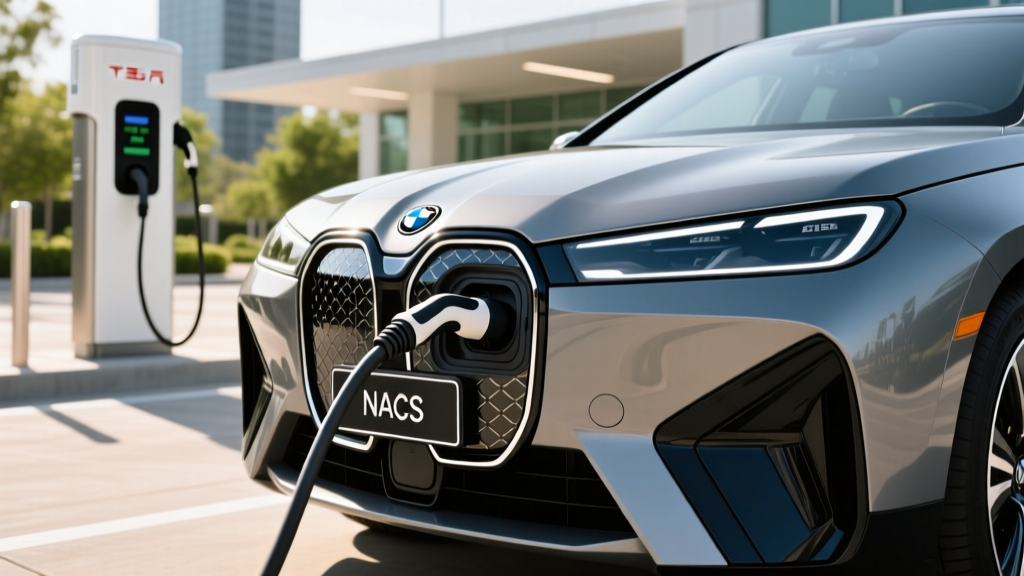
The 2023 Tesla Model Y Long Range uses the NACS (North American Charging Standard) connector natively — both for AC Level 2 and DC fast charging. This is a significant advantage in 2026, as NACS has become the dominant standard with Ford, GM, Rivian, Hyundai, and most other automakers adopting it.
| Connector | Native Support? | Adapter Needed? | Availability |
|---|---|---|---|
| NACS (Tesla) | Yes — native | None | Tesla Wall Connector, Superchargers, growing third-party networks |
| J1772 (Level 2 public) | No | Tesla J1772 adapter (included with vehicle) | Public Level 2 stations, workplaces |
| CCS1 (DC fast) | No | Tesla CCS Adapter (~$250) | Electrify America, EVgo, non-Tesla DC stations |
| CHAdeMO | No | Not available | Legacy standard — avoid relying on this |
For home charging, you'll use NACS exclusively. For road trips, the Supercharger network is your primary DC fast-charging option — and the Tesla Supercharger map shows over 50,000 stalls globally, with the vast majority in North America offering V3 (250 kW) or V4 speeds.
Charging Cost Per Mile: Home vs. Public vs. Gas
One of the strongest ownership arguments for the 2023 Model Y Long Range is fuel cost savings — but the math depends heavily on where and when you charge.
| Scenario | Rate | Cost per kWh | Cost per Mile* |
|---|---|---|---|
| Home (off-peak utility rate) | Time-of-use plan | $0.08–$0.14 | $0.022–$0.039 |
| Home (standard rate, no TOU) | Flat rate | $0.14–$0.20 | $0.039–$0.056 |
| Public Level 2 (ChargePoint, etc.) | Per kWh | $0.25–$0.49 | $0.070–$0.137 |
| Tesla Supercharger (V3) | Per kWh | $0.25–$0.40 | $0.070–$0.112 |
| Non-Tesla DC fast (Electrify America) | Per kWh | $0.35–$0.55 | $0.098–$0.154 |
| Gas equivalent (28 MPG, $3.50/gal) | Per gallon | — | $0.125 |
*Based on the Model Y Long Range's 28 kWh/100mi EPA efficiency.
At home on an off-peak rate of $0.11/kWh, you'll spend roughly $0.03 per mile — about one-quarter the cost of a 28 MPG gas vehicle at $3.50/gallon. Over 15,000 miles per year, that's approximately $450 in electricity vs. $1,875 in gas — a $1,425 annual savings.
However, if you rely primarily on public DC fast charging at $0.40/kWh, your cost per mile jumps to $0.112 — nearly matching gasoline. This is why home charging access is the single most important economic factor in EV ownership.
Recommended Level 2 Chargers for the Model Y Long Range
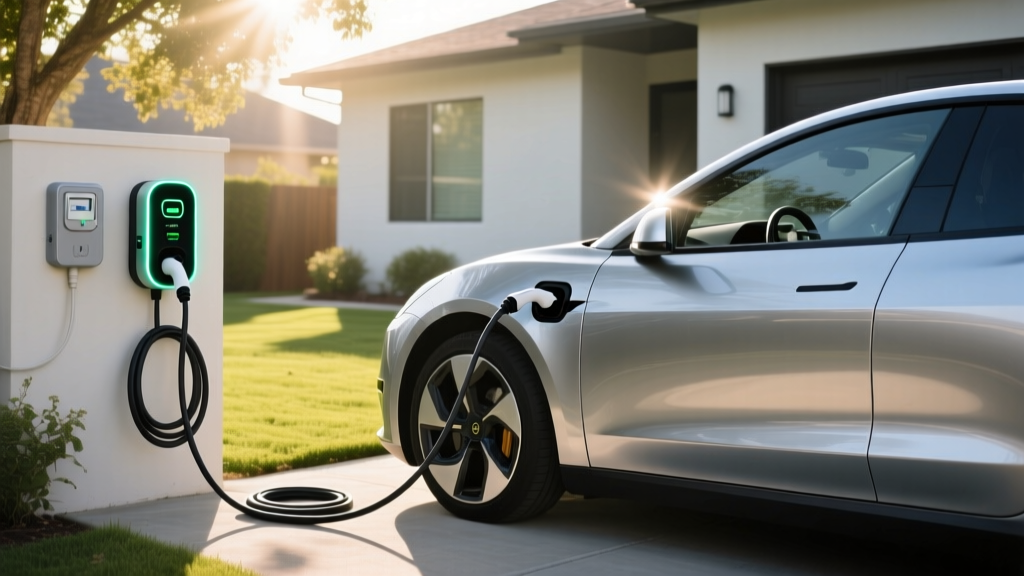
Since the Model Y accepts up to 11.5 kW / 48 amps, a 48-amp charger maximizes your overnight refill speed. Here are top picks, all with native NACS connectors:
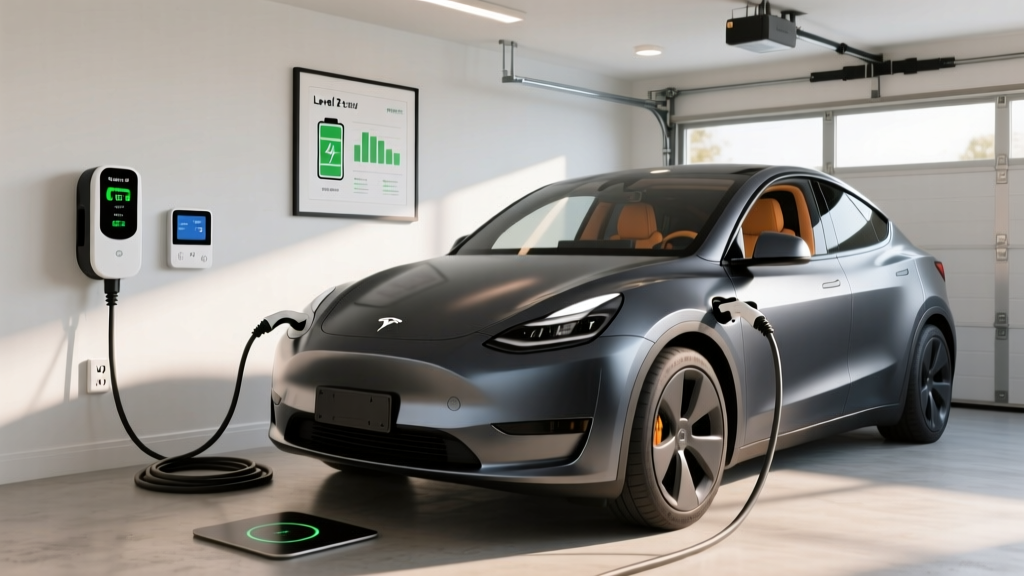
Tesla Wall Connector (Gen 3)
- Power output: 11.5 kW / 48A max
- Connector: NACS (native)
- Cable length: 24 feet
- Smart features: Wi-Fi, OTA firmware updates, power sharing (pair two units on one circuit), load management
- Price: ~$475
- Why it works: Purpose-built for Tesla vehicles, seamless integration with the Tesla app, and the 24-foot cable covers most garage layouts. Power sharing lets you install two connectors on a single 60A circuit — ideal for two-EV households.
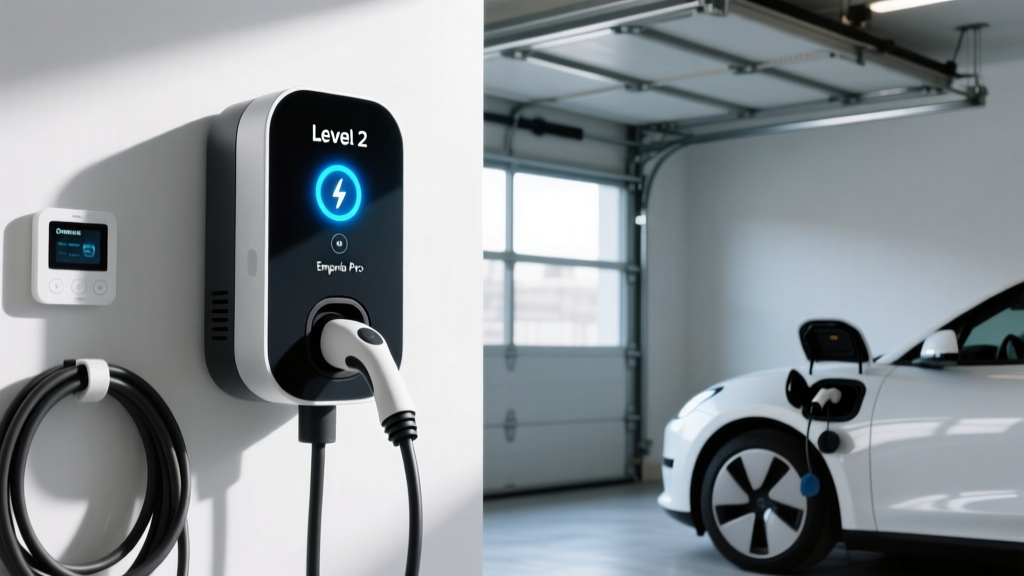
Emporia Vue Level 2 Charger
- Power output: 11.5 kW / 48A max
- Connector: NACS (2025+ models) or J1772 with adapter
- Cable length: 24 feet
- Smart features: Energy monitoring, solar integration, scheduling, works with Emporia Vue home energy panel
- Price: ~$399
- Why it works: Best-in-class energy monitoring. If you have solar panels, it can charge only with excess solar production — effectively free fuel.
ChargePoint Home Flex (NACS version)
- Power output: Up to 12 kW / 50A (configurable down to 16A)
- Connector: NACS (available 2025+)
- Cable length: 23 feet
- Smart features: App scheduling, Alexa integration, flexible amperage settings to match your circuit
- Price: ~$599
- Why it works: The adjustable amperage is a standout — set it to 32A for a 40A circuit today, then reconfigure to 48A if you upgrade your panel later. No need to buy a new charger.
Safety, Code, and Installation Best Practices
EV charging is a continuous high-power load — your charger could run at full draw for 6+ hours straight. This demands proper installation:
- Dedicated circuit: Your Level 2 charger must have its own breaker — never share a circuit with other appliances.
- GFCI protection: NEC 2020 and later require GFCI protection for outdoor receptacles. Hardwired installations (recommended) may not require a GFCI breaker depending on jurisdiction, but many electricians include one for safety. Note: some EV owners report nuisance GFCI trips with certain chargers — a hardwired connection avoids this.
- Hardwired vs. plug: Hardwiring is strongly recommended for 48A chargers. A NEMA 14-50 receptacle is rated for 50A but is only safe for continuous loads up to 40A. Running 48A through a 14-50 outlet risks overheating. If you must use a plug, limit to 40A (9.6 kW) or install a 60A-rated receptacle (rare and expensive).
- Outdoor rating: If mounting outside, ensure the charger carries a NEMA 4 or IP55+ rating for weather resistance. The Tesla Wall Connector is rated for indoor and outdoor use.
- Permit and inspection: Most jurisdictions require an electrical permit and post-installation inspection. Skipping this risks insurance claim denials and code violations. Budget $50–$250 for the permit.
Always hire a licensed electrician — specifically one experienced with EV charger installations. The National Electrical Code (NEC) governs these installations, and local amendments may add requirements.
Frequently Asked Questions
How much does it cost to install a home EV charger for a 2023 Tesla Model Y Long Range?
For a standard installation with a 200-amp panel and short wire run, expect $1,050–$2,800 total (charger, electrician, permit, materials). If your home has a 100-amp panel and needs a service upgrade, total costs can reach $2,850–$6,800. The federal §25D credit covers 30% up to $1,000.
How fast will each charging level add range to my Model Y?
Level 1 (120V) adds ~3–4 miles per hour. Level 2 at 48A (240V) adds ~37–41 miles per hour. DC fast charging at a V3 Supercharger (250 kW) can add up to 200 miles in roughly 15 minutes, though the charge curve tapers significantly above 80% SoC.
Which connector and charger is compatible with the 2023 Model Y Long Range?
The 2023 Model Y uses NACS natively for both AC and DC charging. At home, use a NACS-equipped Level 2 charger (Tesla Wall Connector, Emporia, or ChargePoint NACS models). For non-Tesla public Level 2 stations, use the included J1772-to-NACS adapter. For non-Tesla DC fast chargers, you'll need the optional Tesla CCS adapter (~$250).
How much does charging cost per mile compared to gas?
Charging at home on an off-peak rate (~$0.11/kWh) costs about $0.03/mile. A comparable 28 MPG gas vehicle at $3.50/gallon costs ~$0.125/mile. That's roughly a 76% fuel cost reduction. However, exclusive reliance on public DC fast charging ($0.35–$0.55/kWh) can bring costs close to or above gasoline.
What electrical upgrades might I need for a 48-amp home charger?
You need a 60-amp dedicated 240V circuit. If your home's main panel is 100 amps and already heavily loaded, you may need a panel upgrade to 200 amps ($1,800–$4,000). Alternatively, a smart load-management device ($400–$1,200) can dynamically limit charger draw to avoid overloading your existing panel. Always get a load calculation from a licensed electrician before committing to a charger amperage.
Can I use a NEMA 14-50 outlet instead of hardwiring?
You can, but with a critical caveat: a NEMA 14-50 outlet is rated for 50 amps, and NEC continuous-load rules limit that to 40 amps (9.6 kW). To use the Model Y's full 48A (11.5 kW), you must hardwire to a 60-amp breaker. Hardwiring also eliminates the risk of outlet overheating during long charging sessions.
Bottom line: the 2023 Tesla Model Y Long Range is one of the most home-charging-friendly EVs on the market, thanks to its 11.5 kW onboard charger and native NACS connector. Budget $1,500–$3,000 for a quality Level 2 installation, take the 30% federal credit where eligible, and you'll unlock $0.03/mile fueling with 37+ miles of range added every hour you're plugged in.