Why Your 2023 Hyundai Ioniq 5 SEL Range Depends on Your Charging Setup
The 2023 Hyundai Ioniq 5 SEL with the Long Range AWD powertrain carries an EPA-estimated 303 miles of range from its 77.4 kWh usable battery pack (NMC chemistry). The RWD Long Range variant pushes that to 303 miles as well, while the Standard Range RWD (smaller 58 kWh battery) is rated at 220 miles. But sticker numbers only tell part of the story — your real-world range and daily usability hinge almost entirely on how you charge.
Highway driving at 75 mph, cold-weather operation below freezing, and repeated DC fast charging without preconditioning can each shave 15-30% off the EPA figure. In our experience, a realistic highway range expectation sits around 250-270 miles in moderate temperatures, dropping to 210-230 miles in sub-30°F conditions. The good news: with a proper Level 2 home charger and strategic DC fast charging, the Ioniq 5's 800V architecture makes it one of the fastest-charging EVs in its class.
EPA: 303 mi (Long Range AWD) | Real highway (65-75 mph): ~250-270 mi | Cold weather (<30°F): ~210-230 mi | City/regen-heavy: ~290-310 mi
Charging Levels Explained: How Fast Each Adds Range
Understanding the three charging tiers is essential for Ioniq 5 owners. The critical distinction: kW (kilowatts) measures power — the rate of energy delivery — while kWh (kilowatt-hours) measures energy capacity, like gallons in a tank. A 10 kW charger delivering power for one hour adds 10 kWh of energy to your battery.
| Level | Voltage / Amperage | Power (kW) | Miles Added/Hour (Ioniq 5) | Best For |
|---|---|---|---|---|
| Level 1 (120V) | 120V / 12A | ~1.4 kW | ~4-5 mi/hr | Overnight top-ups, emergencies |
| Level 2 (240V) | 240V / 32-48A | 7.7-11.5 kW | ~25-38 mi/hr | Daily home charging |
| DC Fast Charge | 400-800V DC | Up to 240 kW peak | ~200+ mi in 18 min (10-80%) | Road trips, rapid top-ups |
The Ioniq 5's onboard AC charger accepts up to 10.9 kW on Level 2, meaning a 48-amp circuit delivers a full charge from empty in roughly 8.5 hours for the Long Range battery. On DC fast charging, the 800V architecture allows peak rates of 240 kW on a 350 kW-capable charger, achieving a 10-80% charge in approximately 18 minutes under ideal thermal conditions. Note: charge speed tapers significantly above 80% SoC — that last 20% can take as long as the first 80%.
Home Charger Installation: Electrical Requirements and Costs
Installing a Level 2 home charger is the single highest-impact upgrade for daily EV ownership. For the Ioniq 5, you'll want a 240V circuit with a minimum of 40 amps (ideally 48 amps to maximize the 10.9 kW onboard charger).
Electrical Panel and Circuit Requirements
Your home's electrical panel must have sufficient capacity for a dedicated 40-60 amp circuit. Most modern homes with 200-amp service can accommodate this without a panel upgrade. Older homes with 100-amp service often require a panel upgrade — a significant added cost. A licensed electrician will perform a load calculation per NEC Article 220 to determine if your panel has headroom.
Key requirements:
- Dedicated circuit: The charger must be on its own breaker — no sharing with other appliances
- NEMA 14-50 outlet or hardwired: A 14-50 receptacle offers portability; hardwired connections allow up to 48A continuous (vs. 40A on a 50A outlet per NEC 80% rule)
- GFCI protection: NEC 2020 and later require GFCI breakers for EV receptacles — this adds ~$50-100 to breaker cost
- Wire gauge: 6 AWG copper for 50A circuits; 4 AWG for 60A circuits
- Outdoor rating: If mounting outside, the charger must carry a NEMA 4 rating for weather resistance
Installation Cost Breakdown
| Component | Simple Install (panel nearby) | Complex Install (long run / panel upgrade) |
|---|---|---|
| Level 2 Charger (hardware) | $400 - $700 | $400 - $700 |
| Electrician labor | $300 - $600 | $800 - $2,000 |
| Permit & inspection | $50 - $150 | $100 - $300 |
| Panel upgrade (if needed) | $0 | $1,500 - $3,500 |
| Total | $750 - $1,450 | $2,800 - $6,500 |
Many utilities offer rebates of $200-$500 for Level 2 charger installation — check with your local provider. The IRS Residential Clean Energy Credit (Form 5695) may cover 30% of installation costs up to $1,000 through 2032, though this applies to the charging equipment and labor, not panel upgrades.
Connector Compatibility: What Plugs Into the Ioniq 5
The 2023 Hyundai Ioniq 5 uses the CCS1 (Combined Charging System) connector for both Level 2 AC and DC fast charging in North America. Hyundai has announced a transition to the NACS (Tesla-style) connector for future models, and as of 2025, Hyundai began offering NACS adapters for existing CCS1-equipped vehicles to access Tesla Superchargers.
| Connector Type | Used By | Ioniq 5 Compatible? | Adapter Needed? |
|---|---|---|---|
| CCS1 | Hyundai, Kia, Ford, VW, BMW, most non-Tesla | Yes — native | No |
| NACS (Tesla) | Tesla; Ford, GM, Rivian (2025+ models) | Yes — with adapter | CCS-to-NACS adapter (~$200-300) |
| CHAdeMO | Nissan Leaf (legacy) | No | N/A — network is shrinking |
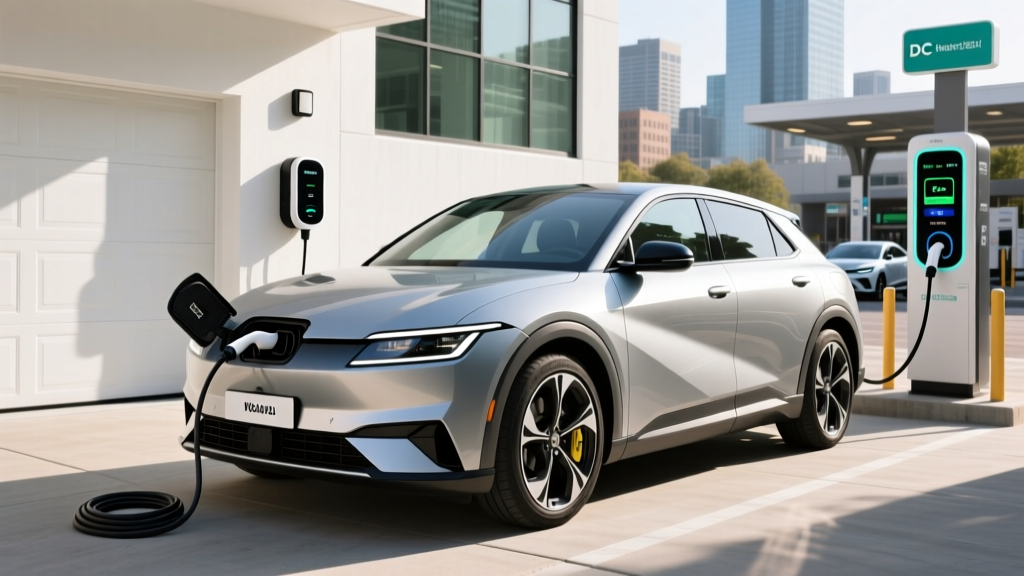
For home Level 2 charging, all non-Tesla chargers use a J1772 connector, which plugs directly into the Ioniq 5's AC port. For Tesla Supercharger access, you'll need Hyundai's official CCS-to-NACS adapter or a third-party equivalent rated for DC fast charging.
Charging Cost Per Mile: Home vs. Public vs. Gas
The Ioniq 5 Long Range AWD achieves an EPA-rated 110 MPGe combined, consuming roughly 30 kWh per 100 miles (source: fueleconomy.gov). Your actual cost per mile depends heavily on where and when you charge.
| Scenario | Rate ($/kWh) | Cost per 100 mi | Cost per Mile |
|---|---|---|---|
| Home (off-peak utility rate) | $0.09 | $2.70 | $0.027 |
| Home (national avg. residential) | $0.16 | $4.80 | $0.048 |
| Public Level 2 (ChargePoint, etc.) | $0.25-$0.49 | $7.50-$14.70 | $0.075-$0.147 |
| DC Fast (Electrify America / EVgo) | $0.35-$0.56 | $10.50-$16.80 | $0.105-$0.168 |
| Gas car (27 MPG, $3.50/gal) | — | $12.96 | $0.130 |
At home off-peak rates, the Ioniq 5 costs roughly 80% less per mile to "fuel" than a comparable gas crossover. Even at public DC fast charging rates, it's roughly cost-neutral with gasoline. The economics strongly favor home charging — this is where the real savings materialize.
Recommended Home Chargers for the Ioniq 5
Based on the Ioniq 5's 10.9 kW onboard charger, here are three chargers that maximize its AC charging capability:
ChargePoint Home Flex
- Power: Up to 11.5 kW (48A) — adjustable down to 16A
- Connector: J1772 (25-ft cable)
- Smart features: Wi-Fi, app scheduling, utility integration, Alexa
- Price: ~$550-$650
- Why: Amperage flexibility lets you match your circuit; NEMA 4 rated for outdoor use
Emporia Level 2 EV Charger
- Power: Up to 11.5 kW (48A)
- Connector: J1772 (24-ft cable)
- Smart features: Real-time energy monitoring, solar integration, app control
- Price: ~$400-$500
- Why: Best value with energy monitoring; pairs well with solar panels
Grizzl-E Smart
- Power: Up to 11.5 kW (48A)
- Connector: J1772 (24-ft cable)
- Smart features: OCPP-compatible, app control, adjustable amperage
- Price: ~$500-$600
- Why: Built in Canada for extreme cold (-40°C rated); rugged aluminum case
For the Ioniq 5, any 48A charger will max out its onboard charger. If your panel can only support a 40A circuit, choose a charger with adjustable amperage (like the ChargePoint Home Flex or Grizzl-E) and set it to 32A to comply with the NEC 80% continuous-load rule.
DC Fast Charging Strategy for Road Trips
The Ioniq 5's 800V battery architecture is its standout feature for road-trip charging. On a 350 kW-capable DC fast charger (Electrify America, EVgo, or Ionity stations), the Ioniq 5 can peak at 240 kW, adding roughly 200 miles of range in 18 minutes from 10-80% SoC.
Key strategy tips:
- Precondition the battery: Use the Ioniq 5's navigation to route to a charger — this triggers battery preconditioning, warming the pack for optimal charge speed. Without preconditioning in cold weather, peak charge rate can drop by 40-50%.
- Don't charge past 80% on DC: The charge curve tapers sharply above 80%. The 80-100% top-up can take 25-35 minutes — faster to drive on and stop again if you need more range.
- Seek 350 kW stations: On a 150 kW charger, the Ioniq 5 is capped at 150 kW and 10-80% stretches to ~25 minutes. The 800V advantage only fully materializes on 350 kW hardware.
- Monitor battery temperature: Repeated back-to-back DC fast charges in hot weather can trigger thermal throttling. Allow cooling time if you notice charge speeds declining.
Frequently Asked Questions
How much does it cost to install a home EV charger for the Ioniq 5?
A straightforward Level 2 installation with a nearby 200A panel typically costs $750-$1,450 total (charger + electrician + permit). If your home needs a panel upgrade from 100A to 200A, expect $2,800-$6,500 all-in. Always get 2-3 quotes from licensed electricians and verify they pull a permit — unpermitted work can void home insurance.
How fast will each charging level add range to the Ioniq 5?
Level 1 (120V) adds roughly 4-5 miles per hour. Level 2 (240V, 48A) adds approximately 32-38 miles per hour. DC fast charging at a 350 kW station can add ~200 miles in 18 minutes (10-80% SoC). These figures assume the Long Range 77.4 kWh battery.
Which connector is compatible with the 2023 Ioniq 5?
The 2023 Ioniq 5 uses CCS1 natively for all AC and DC charging. For Tesla Supercharger access, you'll need a CCS-to-NACS adapter (available from Hyundai or third-party suppliers, ~$200-300). For home Level 2, any J1772 charger works without an adapter.
How much does charging the Ioniq 5 cost per mile vs. gas?
Charging at home at the national average residential rate (~$0.16/kWh), the Ioniq 5 costs about $0.048 per mile — roughly 63% less than a 27 MPG gas car at $3.50/gallon ($0.130/mile). Off-peak home rates can push that to $0.027/mile. Public DC fast charging is roughly cost-comparable to gasoline.
What electrical upgrades might I need for a Level 2 charger?
Homes with 100-amp electrical service often need a panel upgrade to 200 amps ($1,500-$3,500). Even with adequate service, you may need a new dedicated 50A or 60A breaker, 6 or 4 AWG wiring run from panel to garage, and a GFCI breaker (required by NEC 2020+). An electrician's load calculation determines exactly what's needed.
Does the 2023 Ioniq 5 qualify for the federal tax credit?
The 2023 Ioniq 5 was eligible for up to $7,500 under IRS §30D when purchased new, subject to buyer income caps ($150K single / $300K joint), MSRP limits ($55K for SUVs), and battery sourcing requirements. For 2026 purchases, credit eligibility has tightened under updated critical-mineral and battery-component rules. Check current status at IRS qualified vehicle list. The used-EV credit (§25E) of up to $4,000 may apply for pre-owned Ioniq 5 purchases.