The 100A Bottleneck: Why EV Chargers Break Older Panels
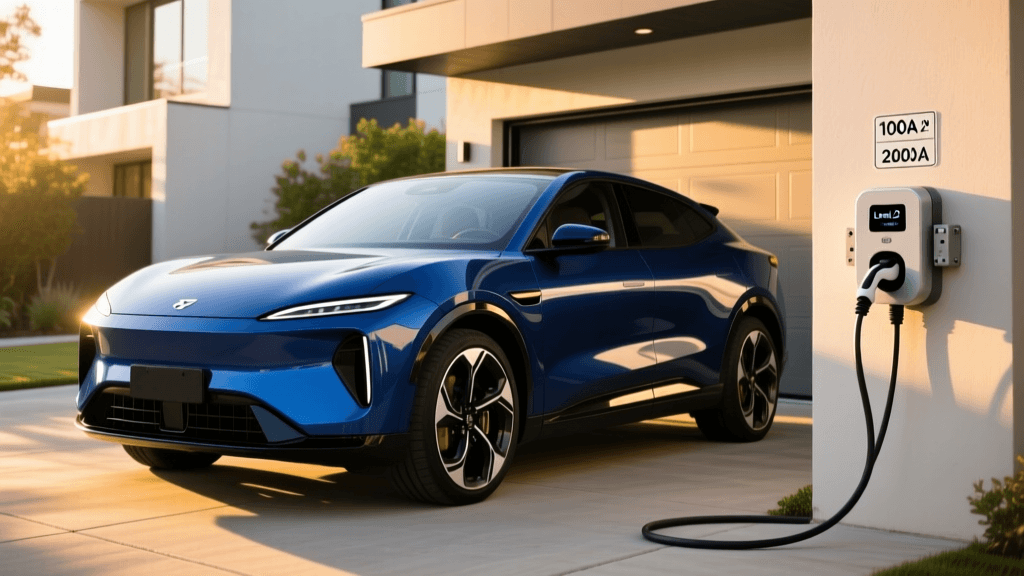
For homeowners living in properties built between the 1960s and 1990s, a 100-amp electrical service was the standard. While sufficient for legacy appliances, the introduction of a Level 2 Electric Vehicle (EV) charger fundamentally alters a home's electrical profile. According to the U.S. Department of Energy's Home Charging Guide, Level 2 chargers typically draw between 32 and 48 amps of continuous current. When applied to a 100A panel, this massive new load frequently exceeds safe operational limits, necessitating a service upgrade to 200 amps.
This data-driven analysis breaks down the exact mathematics of National Electrical Code (NEC) load calculations, the itemized costs of a 100A to 200A panel upgrade, and the financial viability of alternative load-management technologies.
The Mathematics of NEC Article 220: Continuous vs. Peak Load
To understand why a 100A panel fails under EV charging conditions, we must look at the National Fire Protection Association (NFPA) NEC Article 220, which governs branch, feeder, and service load calculations. The NEC defines a 'continuous load' as any load expected to run for three hours or more. EV charging easily meets this criteria.
Under NEC guidelines, continuous loads cannot exceed 80% of a breaker's rated capacity. Therefore, a 100A main breaker only provides 80A of continuous capacity. If your home's baseline continuous draw (HVAC, refrigerator, lighting, water heater) is 45A, adding a 48A EV charger pushes your total continuous load to 93A—well over the 80A safe limit, risking nuisance tripping or catastrophic thermal failure.
Data Table: 100A vs. 200A Capacity Under EV Load
| Metric | 100A Service Panel | 200A Service Panel |
|---|---|---|
| Total Peak Capacity | 100 Amps | 200 Amps |
| Continuous Capacity (80% Rule) | 80 Amps | 160 Amps |
| Average Home Baseline Load | 40 - 50 Amps | 40 - 50 Amps |
| Level 2 EV Charger (48A / 60A Breaker) | 48 Amps | 48 Amps |
| Total Continuous Demand | 88 - 98 Amps (OVERLOAD) | 88 - 98 Amps (SAFE) |
| Remaining Headroom | -8 to -18 Amps | 62 to 72 Amps |
Cost Analysis: Upgrading from 100A to 200A
Upgrading a residential electrical service is not a simple breaker swap; it involves replacing the meter base, service entrance conductors, main breaker panel, and grounding systems. Based on national electrical contractor averages, a standard 200A upgrade costs between $2,500 and $4,500, though complex runs can exceed $6,000.
Itemized Cost Breakdown (National Averages)
- Permits and Utility Fees: $250 - $600 (Includes city AHJ permits and utility reconnection fees).
- Materials (200A Meter Main, 4/0 AWG Aluminum Wire, Grounding): $800 - $1,400.
- Labor (Electrician @ $100-$150/hr for 8-12 hours): $1,200 - $1,800.
- Utility Service Drop Upgrade: $0 - $2,500 (If the utility's overhead wires or underground transformer must be upgraded to support 200A).
A critical hidden cost is the utility service drop. If your home has an overhead mast, the utility may need to replace the 100A service drop wires with thicker 200A-rated cables. While some utilities do this for free, others pass the trenching or mast-replacement costs to the homeowner.
Alternatives to a Full 200A Panel Upgrade
Recent advancements in smart grid technology offer data-driven alternatives to the traditional, capital-intensive 200A copper-and-aluminum upgrade. According to research on EV Grid Integration by the National Renewable Energy Laboratory (NREL), dynamic load management can safely integrate EVs into constrained panels without physical infrastructure overhauls.
Comparison Chart: Traditional Upgrade vs. Smart Alternatives
| Solution | Upfront Cost | Installation Time | Pros | Cons |
|---|---|---|---|---|
| Traditional 200A Upgrade | $2,500 - $4,500+ | 1 - 3 Days | Permanent, adds home value, unlimited headroom. | High cost, utility coordination required, invasive. |
| Automated Load Management (ALMS) | $400 - $800 | 2 - 4 Hours | Very cheap, avoids utility drop upgrades, fast install. | EV charging speed throttles when house load spikes. |
| Smart Panel (e.g., SPAN) | $3,500 - $5,500 | 1 - 2 Days | Circuit-level control, solar/battery ready, app monitoring. | High hardware cost, requires specialized installer. |
Deep Dive: Automated Load Management Systems (ALMS)
Devices like the Emporia VUE or Wallbox Power Management use Current Transformer (CT) clamps installed on your main 100A service lugs. These clamps monitor your home's real-time electrical consumption. If you turn on the electric oven and the HVAC kicks in, the ALMS detects the spike and dynamically throttles the EV charger's amperage down to prevent the main 100A breaker from tripping. Once the house load drops, the EV charger ramps back up to maximum speed. For homeowners facing $3,000+ utility drop fees, ALMS offers a mathematically superior ROI.
Installation Timeline and Disruption Data
Time is a crucial metric for homeowners. A standard 100A to 200A upgrade follows a strict sequence:
- Day 1: Preparation and Rough-in. The electrician mounts the new meter base and runs the new 4/0 AWG service entrance conductors. Power remains on.
- Day 2: Utility Disconnect and Swap. The utility company cuts the power at the street or transformer. The electrician swaps the main panel. This results in a 4 to 8-hour total home blackout.
- Day 3: Inspection and Reconnection. The local Authority Having Jurisdiction (AHJ) inspects the work for NEC compliance (checking torque marks on lugs, grounding electrode conductor sizing, and bonding). Once passed, the utility reconnects the meter.
Pro Tip: Never schedule an EV delivery or rely on home medical equipment during the 48-hour window of a panel upgrade. Utility reconnection delays are the most common cause of extended blackouts, often adding 1 to 3 days to the timeline due to utility crew scheduling.
ROI and Home Value Impact
Does a 200A panel increase your home's resale value? Real estate data indicates that while a panel upgrade rarely yields a 100% dollar-for-dollar ROI at closing, it removes a major friction point during home inspections. Homes with 100A service are increasingly flagged by modern buyers who anticipate EV ownership, heat pump installations, or solar integration. Upgrading to 200A future-proofs the property, effectively preserving the home's marketability in an electrified economy. Furthermore, many local jurisdictions and utilities offer rebates ranging from $200 to $500 for 'EV-Ready' panel upgrades, slightly offsetting the initial capital expenditure.
Final Verdict: What the Data Dictates
If your home's baseline load calculation (per NEC Article 220) leaves less than 60 amps of continuous headroom, a physical upgrade to 200A is the safest, most robust path forward, provided your utility's service drop upgrade costs are reasonable. However, if your utility demands $3,000+ to trench new lines or replace an overhead transformer, the data strongly favors implementing an Automated Load Management System (ALMS). By leveraging real-time software throttling, you can safely charge your EV on your existing 100A panel for a fraction of the cost, proving that in modern EV infrastructure, software can often solve hardware limitations.