The Fast-Charging Dilemma: Does DCFC Ruin Your EV Battery?
For prospective and current electric vehicle owners, the convenience of DC fast charging (DCFC) is often shadowed by a persistent fear: will frequent fast charging permanently degrade my battery? Pushing high currents into a lithium-ion battery generates significant heat and stress, which can accelerate capacity loss over time. However, not all EV batteries are created equal. The impact of fast charging depends heavily on the underlying cell chemistry, the voltage architecture, and the sophistication of the Battery Management System (BMS).
To answer the degradation question definitively, we are putting two of the most popular, yet fundamentally different, EVs on the market head-to-head: the Tesla Model 3 Rear-Wheel Drive (RWD) equipped with a Lithium Iron Phosphate (LFP) battery, and the Hyundai Ioniq 5 Long Range equipped with a Nickel Manganese Cobalt (NMC) battery and an 800-volt architecture. By analyzing how each vehicle handles the thermal and chemical stress of repeated 150kW+ fast charging sessions, we can determine which setup offers better long-term longevity and lower lifecycle costs.
Meet the Contenders: Chemistry and Architecture
Tesla Model 3 RWD: The LFP Workhorse
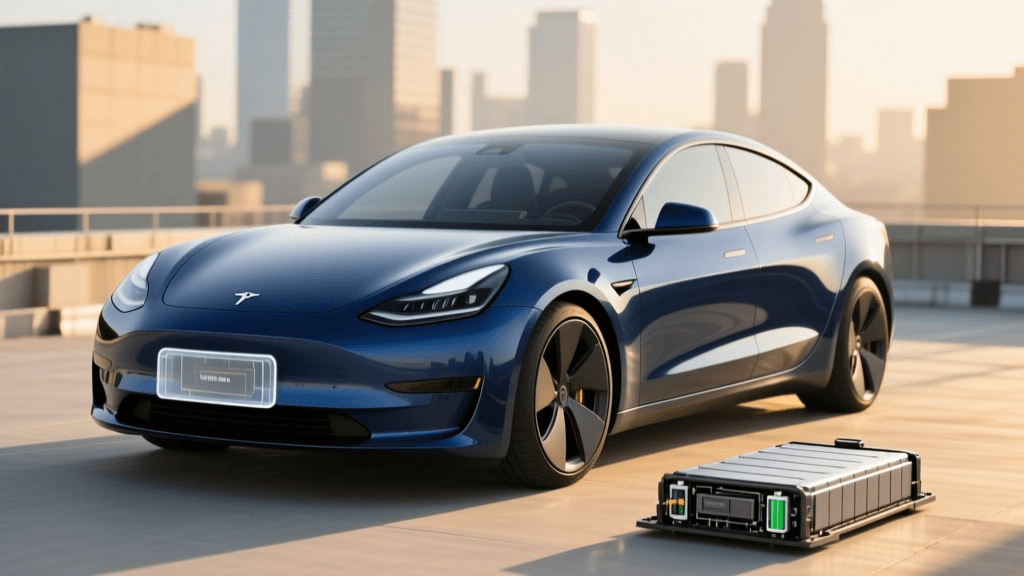
The base Tesla Model 3 RWD utilizes a 60 kWh battery pack supplied by CATL, featuring Lithium Iron Phosphate (LFP) chemistry. LFP cells are renowned for their exceptional thermal stability and structural resilience. Unlike NMC cells, LFP batteries do not contain cobalt or nickel, making them cheaper to produce and far less prone to thermal runaway. However, LFP chemistry has a lower energy density and a very flat voltage curve, which makes state-of-charge (SoC) estimation difficult for the BMS without regular 100% top-offs.
Hyundai Ioniq 5 Long Range: The 800V NMC Speedster
The Hyundai Ioniq 5 Long Range AWD packs a 77.4 kWh battery utilizing SK Innovation's NMC 811 chemistry (8 parts nickel, 1 part manganese, 1 part cobalt). NMC offers superior energy density and a more predictable voltage curve compared to LFP. More importantly, the Ioniq 5 is built on Hyundai's Electric-Global Modular Platform (E-GMP), which features a native 800-volt architecture. This high-voltage setup allows the car to accept ultra-fast charging speeds while keeping electrical currents—and therefore resistive heat—remarkably low.
The Showdown: How Fast Charging Affects Each Battery
When you plug into a 150 kW or 350 kW DC fast charger, the battery's internal resistance generates heat. Heat is the primary enemy of lithium-ion longevity. According to Geotab's comprehensive EV battery degradation study, vehicles that rely heavily on DC fast charging without adequate thermal management can see degradation rates exceed 3% to 4% annually, compared to the fleet average of 2.3%. So, how do our contenders manage this heat?
Tesla Model 3 LFP: Brute Force Cooling and Chemical Resilience
Tesla employs an industry-leading active liquid cooling system. When the navigation system routes you to a Supercharger, the car preemptively conditions the battery, bringing it to the optimal temperature window (usually around 40°C to 50°C) to accept maximum current safely. Because LFP chemistry is inherently more resistant to high-temperature degradation and structural micro-cracking than NMC, the Tesla Model 3 RWD can endure frequent fast charging with minimal chemical penalty. The trade-off is charging speed: the 400V architecture and LFP chemistry mean charging speeds taper aggressively after 60% SoC to protect the cells.
Hyundai Ioniq 5 NMC: The 800-Volt Advantage
Hyundai takes a different approach to mitigating fast-charging degradation. By utilizing an 800V architecture, the Ioniq 5 can charge at up to 235 kW, but it does so by pushing higher voltage rather than higher amperage. Since heat generation is proportional to the square of the current (I²R), keeping the amps lower drastically reduces the thermal load on the battery cells. Combined with a highly efficient liquid cooling system and a heat pump that scavenges waste heat from the motors, the Ioniq 5 protects its sensitive NMC chemistry from the thermal shock of ultra-fast charging. Data from Recurrent Auto's long-term battery research indicates that modern EVs with active thermal management, like those from Hyundai and Tesla, retain over 90% of their original capacity even after 100,000 miles, proving that fast charging is no longer the death sentence it was for early EVs like the Nissan Leaf.
Head-to-Head Data: Degradation, Speed, and Architecture
Below is a structured comparison of how the Tesla Model 3 RWD and Hyundai Ioniq 5 handle the physical and chemical demands of DC fast charging.
| Feature | Tesla Model 3 RWD (LFP) | Hyundai Ioniq 5 LR (NMC) |
|---|---|---|
| Battery Chemistry | Lithium Iron Phosphate (LFP) | Nickel Manganese Cobalt (NMC) |
| Voltage Architecture | 400-Volt | 800-Volt |
| Max DCFC Speed | ~170 kW | ~235 kW |
| 10-80% Charge Time | ~25 minutes | ~18 minutes |
| Thermal Management | Active Liquid Cooling | Active Liquid Cooling + Heat Pump |
| Optimal Daily SoC Limit | 100% | 80% |
| Fast Charge Degradation Risk | Very Low (Chemistry resilient) | Low (Mitigated by 800V & BMS) |
Long-Term Cost Analysis and Warranty Coverage
Battery degradation directly impacts total cost of ownership. If a battery degrades below 70% of its original capacity within the warranty period, the manufacturer will replace it. Both Tesla and Hyundai offer 8-year/100,000-mile battery warranties. However, out-of-warranty replacement costs vary wildly. A replacement for the 60 kWh CATL LFP pack in the Tesla Model 3 is generally more affordable due to the lack of expensive cobalt and nickel. Conversely, the 77.4 kWh NMC pack in the Ioniq 5 carries a higher replacement premium. According to Cadex Battery University's chemistry breakdown, LFP batteries also boast a significantly higher cycle life (often exceeding 3,000 full charge cycles) compared to NMC batteries (typically 1,000 to 2,000 cycles), meaning the Tesla LFP pack is mathematically likely to outlast the vehicle's chassis, even with frequent DCFC usage.
Actionable Fast-Charging Rules for Maximum Longevity
While both vehicles are engineered to handle fast charging, owners must adopt model-specific habits to minimize long-term degradation.
Rules for the Tesla Model 3 RWD (LFP)
- Always use the Navigation System: Never pull up to a Supercharger cold. Let the car's navigation precondition the battery for at least 30 minutes prior to arrival.
- Charge to 100% Weekly: LFP batteries suffer from voltage curve amnesia. Tesla explicitly recommends charging to 100% at least once a week to keep the BMS calibrated. Storing the car at 100% is perfectly safe for LFP chemistry.
- Avoid Deep Discharges: LFP cells are more vulnerable to degradation when dropped below 10%. Try to plug in when you hit 15% remaining.
Rules for the Hyundai Ioniq 5 (NMC)
- Leverage the 800V Preconditioning: Use the infotainment system to route to your charger. The Ioniq 5 will actively heat or cool the battery to ensure the 800V system can accept maximum voltage without overheating the NMC cells.
- Set the 80% Charging Limit: NMC chemistry experiences accelerated stress at high states of charge. Set your daily and fast-charging limit to 80%. Only charge to 100% immediately before a long road trip.
- Don't Store at 100%: Never leave the Ioniq 5 sitting in your driveway at 100% SoC for multiple days, especially in hot weather. High voltage combined with high ambient heat will permanently degrade the NMC cathode structure.
The Verdict: Which Handles Fast Charging Better?
If your lifestyle requires daily DC fast charging and you want absolute peace of mind regarding chemical degradation, the Tesla Model 3 RWD with its LFP battery is the undisputed champion. The LFP chemistry is virtually immune to the high-SoC and high-heat stresses that plague other lithium-ion variants, making it the ultimate workhorse for frequent fast-charging. However, if time is your most valuable asset and you prioritize ultra-fast charging speeds on road trips, the Hyundai Ioniq 5 is superior. Its 800-volt architecture brilliantly bypasses the thermal limitations of NMC chemistry, allowing you to spend just 18 minutes at a charger while the sophisticated BMS protects the battery's long-term health. Both vehicles prove that with modern thermal management, fast charging is a highly viable, safe, and sustainable way to power your daily commute.