For prospective and current Tesla owners, the high-voltage traction battery represents the single most expensive component in the vehicle. Understanding the Tesla battery degradation chart—which tracks State of Health (SoH) over time and mileage—is essential for evaluating long-term ownership costs and vehicle longevity.
Contrary to early EV skepticism, modern Tesla battery packs are engineered to outlast the vehicle's chassis. Data aggregated from fleet telemetry and third-party testing shows that most Tesla batteries retain between 85% and 92% of their original capacity after 150,000 miles. However, the rate and shape of that degradation depend heavily on chemistry (LFP vs. NCA/NMC), charging habits, and thermal management.
Understanding Tesla Battery Chemistry: LFP vs. NCA/NMC
Tesla currently utilizes two primary battery chemistries in its 2026 lineup. The choice of chemistry dictates not only the vehicle's range and performance but also its long-term degradation curve and daily charging recommendations.
| Feature | LFP (Lithium Iron Phosphate) | NCA/NMC (Nickel-based) |
|---|---|---|
| Typical Models | Model 3/Y Standard Range (RWD) | Model 3/Y Long Range, Model S/X |
| Energy Density | Lower (heavier pack for same kWh) | Higher (lighter, more range) |
| Cycle Life | Superior (3,000+ cycles) | Moderate (1,500–2,000 cycles) |
| Recommended SoC | 100% daily | 80% daily, 100% for trips |
| Cold Performance | Poor (significant range loss) | Better (heat pump mitigates) |
| Cost | Lower | Higher |
Which is better? If you prioritize maximum longevity and can charge to 100% daily without anxiety, LFP is the superior choice for durability. If you need maximum range and better cold-weather efficiency, the NCA/NMC packs in Long Range models are the better fit, provided you follow the 80% daily charge limit to minimize degradation.
The Tesla Battery Degradation Chart: Real-World Data Points
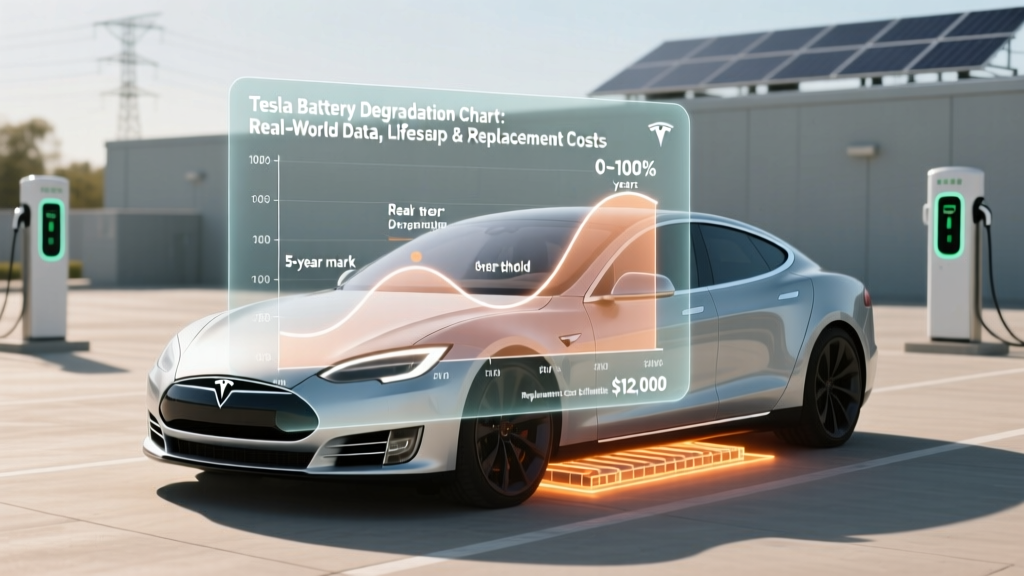
Battery degradation is non-linear. The Tesla battery degradation chart typically shows a steeper initial drop (the "knee") followed by a long, slow plateau. Based on fleet data and independent analysis from sources like Teslanomics and Recurrent Auto, the following trajectory is common for NCA/NMC packs:
- Year 1 / 15k miles: ~3–5% loss (initial stabilization)
- Year 3 / 50k miles: ~6–8% loss (plateau begins)
- Year 5 / 100k miles: ~9–11% loss
- Year 8 / 150k miles: ~12–15% loss
LFP batteries often show a flatter curve, with many packs retaining over 95% capacity at 100,000 miles when regularly charged to 100%, which helps the Battery Management System (BMS) balance cells more effectively.
What Does the Tesla Battery Warranty Cover?
Tesla's warranty is designed to protect against premature failure and excessive capacity loss. The warranty terms for 2026 models remain consistent with the federal mandate for high-voltage components.
| Model | Warranty Period | Mileage Limit | Capacity Retention Threshold |
|---|---|---|---|
| Model 3 / Y (RWD) | 8 Years | 100,000 miles | 70% |
| Model 3 / Y (LR/Perf) | 8 Years | 120,000 miles | 70% |
| Model S / X | 8 Years | 150,000 miles | 70% |
What is covered: If your battery falls below the 70% retention threshold within the term, Tesla will replace or refurbish the pack to bring it back to at least that threshold. It also covers manufacturing defects and internal electrical failures.
EV Battery Replacement Costs: When and How Much?
Out-of-warranty replacement is rare for Tesla owners who keep their vehicles under 200,000 miles, but it is a necessary consideration for high-mileage drivers or used-car buyers.
| Battery Type | Approximate Cost (Parts + Labor) | Typical Need Timeline |
|---|---|---|
| Model 3/Y LFP (60 kWh) | $5,000 – $8,000 | 250,000+ miles |
| Model 3/Y NCA (75-82 kWh) | $10,000 – $14,000 | 200,000+ miles |
| Model S/X (100 kWh) | $14,000 – $18,000 | 200,000+ miles |
Note that many "replacements" are actually module-level repairs, which can cost between $1,500 and $3,500, as Tesla service centers can now replace individual failed modules rather than the entire pack in many cases.
Factors Affecting Battery Life and How to Maximize Health
While Tesla's thermal management system is industry-leading, owner habits significantly impact the Tesla battery degradation chart over a decade of ownership.
- Avoid 0% and 100% (for NMC/NCA): Keep daily SoC between 20% and 80%.
- Minimize DC Fast Charging: Use Level 2 (11.5 kW) for daily needs; Supercharging (250 kW) should be reserved for road trips.
- Preconditioning: Always use the app to precondition while plugged in before fast charging or driving in extreme cold.
- Storage: If storing for weeks, leave plugged in with a 50% SoC limit.
- Temperature: Park in a garage when possible to avoid extreme heat/cold soak.
Monitoring Your Tesla Battery State of Health (SoH)
Owners can monitor battery health through several methods:
- In-Car Energy App: Track "Average Energy Consumption" over 5,000 miles to see if efficiency is dropping.
- Tesla Service Mode: (If accessible) Look for the "High Voltage Battery" health test.
- Third-Party Apps: Tools like Tessie or TeslaFi can estimate SoH by comparing the "nominal full range" to the original EPA sticker.
- Supercharger Logs: Frequent "charge speed limited" warnings may indicate cell imbalance or thermal issues.
Emerging Tech Context: Solid-State and Beyond
While solid-state batteries and silicon-anode technology promise higher density and faster charging, they remain in the pilot phase for 2026. Industry experts suggest mass-market availability in the 2028–2030 timeframe. For current buyers, the LFP and NCA/NMC chemistries remain the most reliable and cost-effective options.
Frequently Asked Questions
How long do Tesla batteries last?
Most Tesla batteries are designed to last 300,000 to 500,000 miles before requiring replacement. In terms of years, most owners will see 15+ years of usable service with 80%+ capacity remaining.
Does frequent Supercharging hurt the battery?
Yes, but the impact is smaller than often claimed. Tesla's BMS and cooling systems mitigate much of the heat damage. However, exclusive Supercharging can accelerate degradation by 1–2% over the life of the pack compared to Level 2 charging.
Will I need a new battery if I keep the car for 10 years?
Statistically, no. Most batteries will still have 85% of their capacity at the 10-year mark, which is still more range than most gas vehicles get on a full tank.
What voids the Tesla battery warranty?
Warranties are voided by improper use (like using the car as a stationary grid-storage device), flood/fire damage, or unauthorized modifications to the high-voltage system.