When an electric vehicle battery finally reaches the end of its automotive life, it doesn't head to a landfill. A growing network of recyclers, second-life programs, and manufacturer take-back initiatives ensures that the lithium, cobalt, nickel, and iron inside those packs get recovered and reused. But before recycling enters the picture, most EV owners have more immediate questions: How long will the battery actually last? What does degradation look like in real data? And if the pack does need replacing, what does that cost?
This guide walks through the full lifecycle of an EV traction battery — from chemistry choice and daily care to warranty coverage, replacement economics, and what happens when the pack leaves the car. Every figure below reflects current model-year data and published degradation studies.
How Long Do EV Batteries Last in Real-World Use?
The short answer: far longer than most buyers assume. Modern liquid-cooled lithium-ion packs are engineered to outlast the vehicle they're installed in. The industry standard warranty floor — mandated in part by California Air Resources Board (CARB) requirements adopted by many states — is 8 years or 100,000 miles, with a capacity retention threshold of 70%. In practice, degradation data from high-mileage fleets and owner-reported studies show most packs retain 85–92% of original capacity at the 100,000-mile mark.
Typical Degradation Curve (NMC and LFP Packs, Liquid-Cooled)
- Year 1 / 15,000 mi: ~2–4% loss (initial formation drop, then plateau)
- Year 3 / 45,000 mi: ~5–8% total loss
- Year 5 / 75,000 mi: ~8–12% total loss
- Year 8 / 120,000 mi: ~12–18% total loss
- Year 10 / 150,000 mi: ~15–22% total loss (varies heavily by climate and charging habits)
Sources: Geotab fleet study, Recurrent Auto battery data, manufacturer warranty disclosures.
These numbers assume moderate climates and a mix of Level 2 home charging with occasional DC fast charging. Owners in extreme heat (Arizona, Texas) or those who rely exclusively on 150+ kW DC fast charging may see degradation 3–5 percentage points higher over the same period. Cold-climate owners (Minnesota, Maine) generally see slower chemical degradation but may experience temporary range loss of 20–30% in sub-freezing temperatures due to increased internal resistance — that's not permanent degradation, just reduced available capacity until the pack warms.
LFP vs NMC Battery Chemistry: Which Lasts Longer and Why?
The two dominant cathode chemistries in 2026 EVs are LFP (lithium iron phosphate) and NMC/NCA (nickel manganese cobalt / nickel cobalt aluminum). The choice between them affects energy density, cycle life, cold-weather performance, cost, and — critically for recycling — the recoverable material value.
| Attribute | LFP (Lithium Iron Phosphate) | NMC / NCA (Nickel-Based) |
|---|---|---|
| Energy Density | Lower (~140–170 Wh/kg cell-level) | Higher (~220–300 Wh/kg cell-level) |
| Cycle Life | 3,000–6,000+ cycles to 80% SoH | 1,000–2,500 cycles to 80% SoH |
| Cold Performance | Weaker below 32°F; more range loss | Better low-temp discharge capability |
| Cost (cell-level) | ~$60–80/kWh (2026) | ~$90–120/kWh (2026) |
| Thermal Stability | Excellent; higher runaway threshold | Good; requires more active cooling |
| Recycling Value | Lower (no cobalt/nickel to recover) | Higher (cobalt, nickel recovery economics) |
| Common In (2026) | Tesla Model 3/Y RWD, Ford Mustang Mach-E Select, BYD models | Hyundai Ioniq 5/6, BMW iX, Rivian R1S/R1T, most long-range trims |
The practical takeaway: LFP packs last significantly longer in terms of charge cycles and degrade more slowly, making them ideal for daily drivers who charge to 100% regularly (LFP tolerates full SoC better than NMC). NMC packs offer more range per pound, making them the choice for long-range and performance trims where pack weight and space are constrained. For recycling purposes, NMC packs have higher material recovery value due to cobalt and nickel content, but LFP packs are increasingly recycled via hydrometallurgical processes to recover lithium and iron.
What Does the EV Battery Warranty Actually Cover?
Federal law mandates a minimum battery warranty of 8 years / 100,000 miles for emissions-related components, which the EPA classifies EV batteries under. California and states adopting CARB standards extend this to 10 years / 150,000 miles. Most manufacturers meet or exceed these floors. The warranty covers capacity loss below a specified threshold — typically 70% of original capacity — as well as defects in materials and workmanship.
| Manufacturer | Warranty Term | Capacity Threshold | Notes |
|---|---|---|---|
| Tesla (Model 3/Y LWD) | 8 yr / 100,000 mi | 70% | LFP pack; unlimited Supercharging permitted |
| Tesla (Model 3/Y LR & Performance) | 8 yr / 120,000 mi | 70% | NMC pack; higher mileage threshold |
| Hyundai / Kia | 10 yr / 100,000 mi | 70% | Among the longest terms in the industry |
| Ford (Mach-E, F-150 Lightning) | 8 yr / 100,000 mi | 70% | Covers battery and high-voltage components |
| Rivian | 8 yr / 175,000 mi | 70% | Highest mileage cap among major OEMs |
| BMW (iX, i4, i7) | 8 yr / 100,000 mi | 70% | Includes high-voltage system components |
Important nuance: the warranty covers defects and excessive degradation, not normal wear. If your 90 kWh pack drops to 62 kWh (below 70%) at 80,000 miles, that's a warranty claim. If it drops to 68 kWh (76%) at 120,000 miles, it's performing within expected parameters. The U.S. Department of Energy's EV technology page provides further context on battery longevity standards.
How Much Does an EV Battery Replacement Cost?
Out-of-warranty battery replacement remains the single largest potential repair cost for an EV, but context matters: the vast majority of packs never need replacement during the vehicle's usable life. When replacement is necessary — typically due to physical damage, manufacturing defect discovered after warranty, or extreme degradation in a high-mileage commercial vehicle — costs vary significantly by pack size and chemistry.
| Vehicle / Pack Size | Chemistry | Replacement Cost (Parts + Labor) | Typical Scenario |
|---|---|---|---|
| Tesla Model 3 RWD (~60 kWh) | LFP | $7,000–$10,000 | Post-warranty, high-mileage fleet |
| Hyundai Ioniq 5 (77.4 kWh) | NMC | $11,000–$15,000 | Rare; usually covered under 10-yr warranty |
| Ford F-150 Lightning Ext. Range (131 kWh) | NMC | $18,000–$24,000 | Largest consumer pack on market |
| Chevrolet Bolt EV (65 kWh) | NMC | $9,000–$13,000 | Post-recall replacement pricing baseline |
| BMW iX xDrive50 (111.5 kWh) | NMC | $16,000–$22,000 | Premium segment; module-level repair possible |
Two cost-reducing trends are worth noting. First, many shops now perform module-level repairs — replacing individual cell modules within the pack rather than the entire assembly — cutting costs by 40–60%. Second, remanufactured packs from OEM-authorized suppliers are becoming available at 25–35% below new-pack pricing. These trends will accelerate as the first large wave of EVs exits their warranty periods between 2026 and 2030.
Factors That Accelerate (or Slow) Battery Degradation
Battery chemistry sets the ceiling for longevity, but owner behavior determines where on that spectrum a given pack lands. The five most impactful factors, ranked by effect size:
Battery Care Checklist — Maximize Pack Life
- State of Charge habits (high impact): For NMC packs, keep daily SoC between 20–80%. Reserve 100% charges for road trips. LFP packs can (and should) be charged to 100% regularly — Tesla and Ford recommend this for LFP calibration.
- DC fast-charging frequency (moderate impact): Occasional DC fast charging (2–3 times per month) has negligible effect. Daily 150+ kW charging accelerates degradation by ~1–3% over 5 years vs. Level 2 only. Always precondition the battery before fast charging.
- Extreme heat exposure (moderate impact): Sustained ambient temps above 95°F with a high SoC is the worst combination. Park in shade or a garage when possible. Liquid-cooled packs manage this far better than older passive-cooled designs.
- Extreme cold (low long-term impact): Cold reduces available range temporarily but doesn't cause permanent degradation. Preconditioning before driving and charging protects the pack.
- Storage at extreme SoC (moderate impact): Don't leave an EV sitting at 100% or below 10% for weeks. For long storage, target 50% SoC and plug into Level 1 to let the BMS maintain the pack.
How to Check Your Battery's State of Health (SoH)
State of Health (SoH) is the percentage of original capacity your battery can still hold. A new pack is 100% SoH; a pack that held 75 kWh when new and now holds 64 kWh is at ~85% SoH. Monitoring this number lets you track degradation trends, plan for warranty claims, and assess resale value.
Methods available to owners in 2026:
- In-vehicle battery health display: Tesla (under Service > Battery Health), Hyundai/Kia (in the EV settings menu), and BMW (iDrive battery management screen) now show SoH or estimated remaining capacity directly.
- OBD-II dongle + app: Devices like the OBDLink SX paired with apps such as EV Health or Car Scanner can read the BMS-reported SoH value on most EVs.
- Recurrent Auto / Geotab data services: These platforms compare your vehicle's observed range and efficiency against fleet averages for your model, providing a degradation estimate without hardware.
- Dealer diagnostic check: A service center can pull a full BMS log showing cell-level voltage variance, internal resistance, and SoH — useful for pre-purchase inspections on used EVs.
If your SoH drops below 75% within the warranty period, document it and file a warranty claim. Manufacturers are obligated to replace or repair packs that fall below the stated threshold.
Recycling EV Batteries: What Happens at End of Life?
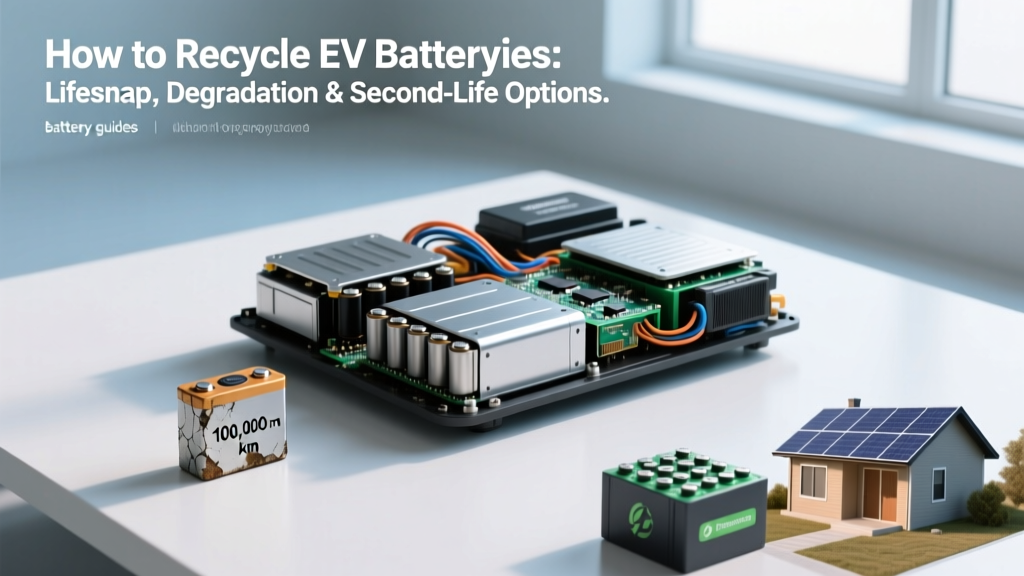
When a battery pack drops below ~70% SoH, it may no longer meet the driver's range needs — but it still holds 70% of its original energy capacity. That's where the recycling and second-life pipeline begins, and it's the direct answer to anyone wondering how to recycle EV batteries responsibly.
Stage 1 — Second-Life Applications: Before material recycling, many packs are repurposed for stationary energy storage. A 75 kWh pack at 70% SoH still stores ~52 kWh — enough to power a home for a day or serve as grid-scale buffer storage. Companies like Redwood Materials, B2U Storage Solutions, and Tesla's own energy division acquire used packs for these applications, extending total useful life by 5–10 additional years.
Stage 2 — Material Recovery (Recycling): When a pack can no longer serve any energy storage purpose, it enters the recycling stream. The two dominant processes in 2026:
- Hydrometallurgical recycling: Cells are shredded, dissolved in acid solutions, and individual metals (lithium, cobalt, nickel, manganese, copper, aluminum) are precipitated out. Recovery rates exceed 95% for cobalt and nickel, and 80–90% for lithium. This is the method used by Redwood Materials and Li-Cycle.
- Pyrometallurgical recycling (smelting): Older method; packs are smelted at high temperatures. Recovers cobalt and nickel well but loses most lithium and aluminum to slag. Being phased out in favor of hydro methods.
Stage 3 — Reintegration: Recovered materials are refined to battery-grade purity and sold back to cell manufacturers. Redwood Materials currently supplies recycled cathode material to Panasonic and Ford, closing the loop. The U.S. Department of Energy's battery recycling initiatives are funding domestic processing capacity to reduce reliance on foreign mineral supply chains.
How individual owners can recycle: You don't handle EV battery recycling directly. When a pack is replaced, the service center or dealer is required to route the old pack to an authorized recycler or the OEM's take-back program. If you're scrapping an EV, contact the manufacturer or a certified EV dismantler. Never attempt to disassemble a high-voltage pack — voltages of 400V (and 800V in Hyundai/Porsche/Kia architectures) are lethal.
What's Next: Solid-State and Silicon-Anode Batteries
Two emerging technologies will reshape battery longevity and recycling economics in the coming years — but neither is available in production consumer EVs as of 2026.
Solid-state batteries replace the liquid electrolyte with a solid ceramic or polymer, promising 30–50% higher energy density, faster charging (potentially 10–80% in under 10 minutes), and dramatically reduced fire risk. Toyota has announced a solid-state EV for 2027–2028, and Samsung SDI is targeting 2027 for mass production. These timelines have slipped repeatedly, so treat them as preliminary. When solid-state packs reach scale, recycling processes will need to adapt to new electrolyte materials.
Silicon-anode batteries (from companies like Sila Nanotechnologies and Group 14) replace the graphite anode with silicon, increasing energy density by 15–25%. Mercedes-Benz's upcoming EQG and a next-generation Panasonic cell for Tesla are expected to incorporate silicon-dominant anodes. These packs will use existing NMC cathodes, so recycling infrastructure won't need major changes.
Both technologies will eventually produce packs that last 300,000+ miles with minimal degradation, further reducing the volume of batteries entering the recycling stream.
Frequently Asked Questions
Can I recycle my EV battery myself?
No. High-voltage EV batteries (400V–800V) are extremely dangerous to disassemble without training and equipment. Recycling is handled by the service center, OEM take-back program, or certified dismantler when the pack is replaced or the vehicle is scrapped.
Do EV batteries end up in landfills?
Effectively none do. Federal and state regulations, combined with the high material recovery value (especially for NMC packs containing cobalt and nickel), mean that over 95% of EV batteries entering the waste stream are captured by recyclers or repurposed for second-life storage.
Is LFP or NMC better for longevity?
LFP wins on cycle life — 3,000–6,000 cycles vs. 1,000–2,500 for NMC — and degrades more slowly under normal use. If you plan to keep a vehicle for 10+ years or 150,000+ miles and don't need maximum range, LFP is the more durable choice. NMC is better if you need long range in a lighter, more compact pack.
How much range will I lose after 5 years?
Based on fleet data, expect 8–12% total capacity loss after 5 years and ~75,000 miles under normal conditions. For a vehicle with a 300-mile EPA range when new, that translates to roughly 264–276 miles of range at the five-year mark. Cold-weather and frequent DC fast-charging can push this to 15%.
Is it worth replacing an out-of-warranty battery?
It depends on the vehicle's value and your attachment to it. A $12,000 battery replacement on a 7-year-old EV worth $18,000 is a tough economic call. However, module-level repairs ($3,000–$6,000) and remanufactured packs (25–35% cheaper) are making replacements more viable. If the rest of the vehicle is in good shape, a replacement pack essentially resets the clock on the car's most expensive component.
Does the federal EV tax credit have anything to do with battery sourcing?
Yes. Under the current IRS §30D clean vehicle credit rules, up to $7,500 is available, but eligibility depends on battery component manufacturing location, critical mineral sourcing, buyer income caps, and vehicle MSRP limits ($55,000 for sedans, $80,000 for SUVs/trucks). Battery sourcing requirements are designed in part to build a domestic supply chain that includes recycling. Always consult a tax professional for your specific eligibility.