Today's EV Batteries vs the Solid-State Promise
Every EV buyer eventually asks the same question: how long will this battery last, and what happens when it doesn't? The answer depends on chemistry, habits, and a bit of physics. Current lithium-ion EV batteries — whether lithium iron phosphate (LFP) or nickel-manganese-cobalt (NMC/NCA) — have proven remarkably durable in real-world use, with most data showing less than 10% capacity loss over 150,000 miles. Meanwhile, solid-state lithium battery technology is generating enormous excitement as a potential generational leap in energy density, safety, and charging speed. But excitement needs calibration.
This guide cuts through the noise with real degradation data, warranty specifics, replacement costs, and a grounded look at what solid-state batteries will — and won't — deliver for buyers in the near term. Whether you're shopping a 2026 Tesla Model 3 with its LFP pack or a Rivian with NMC, the fundamentals of battery ownership start here.
LFP vs NMC/NCA: The Chemistry Decision You're Already Making
Most EVs sold in the U.S. today use one of two lithium-ion cathode chemistries, and the choice affects your daily ownership experience more than most buyers realize. You may not pick the chemistry directly — it's tied to the trim or model — but understanding the trade-offs helps you choose the right vehicle.
| Attribute | LFP (Lithium Iron Phosphate) | NMC/NCA (Nickel-based) |
|---|---|---|
| Energy Density | Lower (~160 Wh/kg cell-level) | Higher (~250–300 Wh/kg cell-level) |
| Typical Cycle Life | 3,000–6,000+ cycles | 1,000–2,500 cycles |
| Cold-Weather Performance | More range loss in freezing temps (15–30% reduction) | Better low-temp performance (10–20% reduction) |
| Cost per kWh | Lower (~$80–100/kWh at pack level) | Higher (~$120–150/kWh at pack level) |
| Recommended Daily SoC | 100% daily charging is fine | 80% daily recommended; 100% for trips only |
| Thermal Stability / Safety | Excellent — very resistant to thermal runaway | Good — requires robust BMS and cooling |
| Common in 2026 Models | Tesla Model 3/Y RWD, Ford Mustang Mach-E Select, many Chinese-market EVs | Hyundai Ioniq 5/6, Kia EV6/9, Rivian, Lucid, most long-range/AWD trims |
Which is better? Neither — they serve different needs. If you commute daily, charge at home, and prioritize longevity and low cost, LFP is the pragmatic pick. Its cycle life is extraordinary: even at one full cycle per day, an LFP pack rated for 4,000 cycles would last nearly 11 years of daily full charges. If you need maximum range per charge, tow frequently, or live in a cold climate where winter range loss stings, NMC/NCA's higher energy density and better cold performance justify the trade-off in cycle life.
How Long Do EV Batteries Actually Last?
The short answer: almost certainly longer than you'll own the car. The high-voltage traction battery (not the 12V auxiliary battery that powers accessories) in a modern EV is engineered for a 15–20 year service life under normal use. Real-world fleet data backs this up.
Real-World Degradation Data Points
- Tesla fleet data (2025 Impact Report): Model S/X batteries retained an average of ~88% capacity at 150,000 miles — a loss of roughly 12% over the vehicle's typical lifespan so far.
- Geotab fleet study (2024, 10,000+ EVs): Average annual degradation across all brands was ~1.8% per year, meaning a typical EV retains ~82% capacity after 10 years.
- Taxi fleet Nissan LEAFs (high-stress): Early LEAFs without active thermal management showed 20–25% degradation after 100,000 miles — a cautionary tale about thermal management, not chemistry limits.
- Hyundai/Kia E-GMP platform (Ioniq 5, EV6): Owner-reported data on forums and EV databases shows ~5–7% loss at 60,000 miles with regular DC fast charging.
The pattern is clear: modern batteries with active liquid cooling and sophisticated battery management systems (BMS) degrade slowly and predictably. The steepest loss — typically 2–4% — occurs in the first year or 20,000 miles, after which the curve flattens significantly. Most EVs will reach 200,000 miles with 75–85% of original capacity intact.
What the Battery Warranty Actually Covers
Federal law mandates that EV batteries carry a minimum warranty of 8 years / 100,000 miles (10 years / 150,000 miles in California Air Resources Board states). But the details matter — specifically the capacity retention threshold that triggers a claim.
| Manufacturer | Warranty Period | Capacity Threshold | Notes |
|---|---|---|---|
| Tesla | 8 yr / 120,000 mi (Model 3/Y); 8 yr / 150,000 mi (Model S/X) | 70% | Covers defects + capacity below threshold |
| Hyundai / Kia | 10 yr / 100,000 mi | 70% | Among the longest coverage periods |
| Ford | 8 yr / 100,000 mi | 70% | Applies to Mustang Mach-E, F-150 Lightning |
| GM (Chevrolet, Cadillac) | 8 yr / 100,000 mi | 70% | Ultium platform vehicles |
| Rivian | 8 yr / 175,000 mi | 70% | Higher mileage limit reflects adventure-use positioning |
| BMW | 8 yr / 100,000 mi | 70% | i4, iX, i7 covered |
Source: Manufacturer warranty documentation. Verify current terms at point of purchase, as policies can change by model year.
The 70% threshold is the industry standard. In practice, very few modern EVs hit this threshold within the warranty period. The warranty protects against manufacturing defects and abnormal degradation — it is not a guarantee that your battery will be replaced at 8 years. Think of it as insurance, not a maintenance schedule.
EV Battery Replacement Cost: The Number Everyone Fears
Out-of-warranty battery replacement is the single biggest anxiety for prospective EV buyers. Let's put real numbers to it — and add the context that most EVs never need a full pack replacement during their usable life.
| Vehicle / Platform | Battery Size | Estimated Replacement Cost (2026) | Typical Need Timeline |
|---|---|---|---|
| Tesla Model 3 RWD (LFP) | ~60 kWh | $8,000–$12,000 | Rarely needed; 300,000+ mi projected lifespan |
| Hyundai Ioniq 5 (NMC) | 77.4 kWh | $12,000–$16,000 | Rarely needed before 200,000 mi |
| Ford F-150 Lightning Ext. Range | 131 kWh | $18,000–$28,000 | Large pack = high cost; rarely needed in truck lifespan |
| Chevrolet Bolt EV/EUV | 65 kWh | $9,000–$14,000 | Recall replacements covered; post-recall packs improved |
| Rivian R1T / R1S (Large Pack) | ~128 kWh | $20,000–$30,000 | Module-level repair may reduce cost |
| Lucid Air Grand Touring | 112 kWh | $16,000–$24,000 | Premium vehicle; limited independent repair network |
Costs include parts and labor and vary by region and service provider. Module-level repair (replacing individual degraded modules rather than the full pack) is increasingly available and can reduce costs by 50–70%.
For context: a $14,000 battery replacement at 200,000 miles on a vehicle you've driven 15 years represents less than $0.07/mile in battery cost over the vehicle's life — well below what you'd have spent on gas during the same period. And pack prices continue to fall. According to BloombergNEF's annual battery price survey, average pack prices have dropped below $120/kWh in 2025, with further declines expected.
What Kills an EV Battery (and What Doesn't)
Not all miles are created equal. How you charge, where you park, and how you drive have measurable effects on long-term battery health. Here's what the data shows.
Factors That Accelerate Degradation
- Exclusive DC fast charging: Vehicles that rely almost entirely on DC fast charging (150+ kW) show roughly 1–2% more annual degradation than those that primarily use Level 2 home charging. The heat generated during high-power charging stresses cells.
- Sustained high state of charge: Storing an NMC battery at 100% SoC for days or weeks — especially in heat — accelerates calendar aging. LFP is more tolerant of 100% storage.
- Extreme heat exposure: Parking outdoors in 100°F+ climates year-round without thermal management active contributes to faster calendar degradation. Garage parking helps.
- Deep discharge cycles: Regularly running the battery below 10% SoC stresses cells. The BMS maintains a buffer, but habitually arriving at 0% isn't ideal.
Factors That Are Less Harmful Than You Think
- Occasional DC fast charging: Road-trip fast charging a few times a month has negligible impact on modern, liquid-cooled packs.
- Regenerative braking: The energy recaptured during regen flows back into the battery at moderate power levels. This does not meaningfully accelerate wear.
- Cold weather use: Cold temps reduce range temporarily but don't cause permanent damage. The BMS limits charge rate when the pack is cold — preconditioning helps.
Practical Habits for Maximum Battery Life
- Default to Level 2 home charging (7–11 kW / 240V). This is the gentlest charging method and covers 90%+ of most owners' needs.
- Set charge limits appropriately: 80% for daily NMC use; 100% is fine for LFP. Charge to 100% only when you need the full range for a trip.
- Precondition the battery before DC fast charging (most EVs do this automatically when you navigate to a charger). This warms the pack for optimal charge acceptance and reduces stress.
- Avoid leaving the car at 100% or below 10% for extended periods (days+). The 20–80% SoC window is the battery's comfort zone.
How to Check Your EV Battery's State of Health (SoH)
State of Health (SoH) is the percentage of your battery's original capacity that remains usable. A new EV has 100% SoH; a car with 88% SoH has lost 12% of its original capacity. Monitoring SoH helps you track degradation, plan for trips, and verify warranty eligibility.
In-Vehicle and App-Based Monitoring
- Tesla: The mobile app shows battery health percentage under the "Service" menu on newer software versions. Third-party tools like TeslaFi or Scan My Tesla (via OBD-II) provide more granular cell-level data.
- Hyundai/Kia: The infotainment system's EV menu shows a battery health indicator. The Car Scanner ELM OBD2 app can pull detailed SoH data via a Bluetooth OBD-II dongle.
- GM (Ultium): OnStar diagnostics can report battery health. The myChevrolet/myCadillac app includes an EV battery status section.
- Universal OBD-II tools: Devices like the OBDeleven or Carista adapters, paired with compatible apps, can read battery SoH, cell voltage variance, and coolant temps on many EVs.
What the Numbers Mean
If your SoH reads 92% at 50,000 miles, you're tracking well within normal expectations. If it drops below 80% before 100,000 miles on a liquid-cooled pack, that warrants a dealer diagnostic — you may have a defective module covered under warranty. Keep records of your SoH readings; they're useful for resale value and warranty claims.
Solid-State Lithium Batteries: The Next Generation (Not Yet on Sale)
Forward-looking section: Solid-state lithium battery technology is the most anticipated advancement in EV energy storage. Here's what it promises, where it stands, and when — realistically — you might drive one.
What Makes Solid-State Different
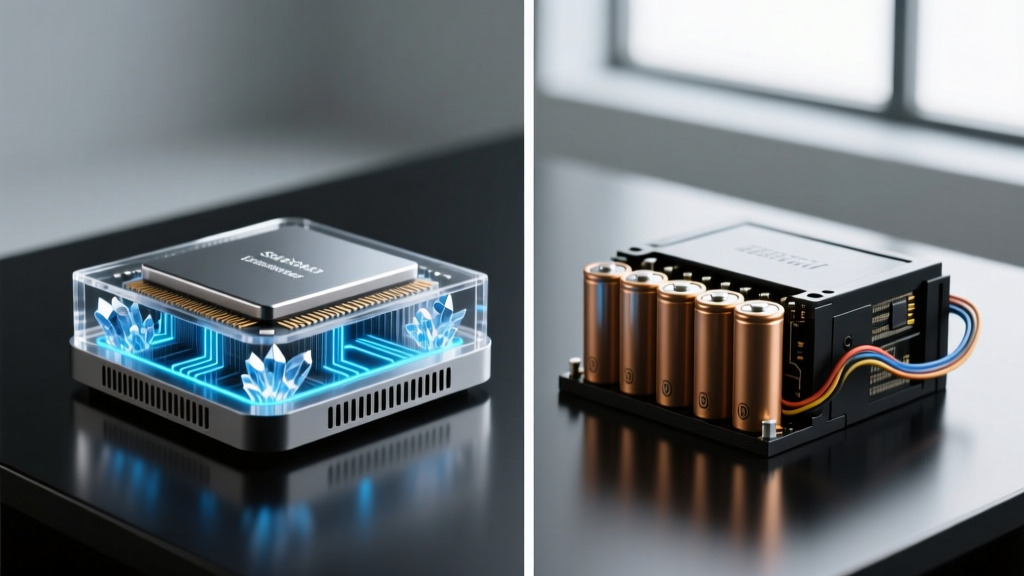
Today's lithium-ion batteries use a liquid electrolyte to shuttle ions between the cathode and anode. Solid-state batteries replace that liquid with a solid material — a ceramic, sulfide glass, or polymer. This change has cascading benefits:
- Higher energy density: Solid electrolytes enable lithium-metal anodes, potentially boosting cell-level energy density to 400–500 Wh/kg — roughly double today's NMC. That translates to either much more range in the same pack size, or a smaller, lighter pack for the same range.
- Faster charging: Solid-state cells can theoretically accept much higher charge rates without the lithium-plating risk that limits today's batteries. Charge times of 10 minutes (10–80%) have been demonstrated in lab settings.
- Improved safety: No flammable liquid electrolyte means dramatically lower thermal runaway risk. This could simplify pack cooling systems and reduce weight.
- Better cold performance: Some solid-state chemistries show less resistance increase at low temperatures.
Realistic Timeline and Announced Programs
| Company | Status (as of 2026) | Expected Consumer Availability |
|---|---|---|
| Toyota | Announced solid-state battery EVs; limited pilot production | 2027–2028 (announced, limited models) |
| Samsung SDI | Prototype production line operational; supplying samples to automakers | 2027+ (estimated) |
| QuantumScape (VW partnership) | Multi-layer prototype cells demonstrated; pre-commercial production | 2028+ (estimated, low volume) |
| Nissan | Pilot plant under construction in Yokohama | 2028–2029 (announced) |
| Solid Power (BMW/Ford partnership) | Sulfide-based cells in testing; A-sample delivery to partners | 2028+ (estimated) |
The Honest Caveats
Solid-state lithium battery technology faces real engineering challenges before mass adoption:
- Manufacturing scale-up: Producing solid-state cells at automotive volume (millions per year) with consistent quality is unsolved. Current production rates are lab/pilot-scale.
- Cost: Early solid-state packs will be significantly more expensive than today's lithium-ion. Initial deployment will likely be in premium or performance vehicles, not affordable commuters.
- Durability validation: Long-term cycle life data (thousands of cycles over years) in real-world conditions is still being gathered. Lab results are promising but not yet equivalent to decades of fleet data behind current chemistries.
- Interface stability: The contact point between solid electrolyte and electrodes can degrade over charge cycles — a materials-science challenge that multiple approaches are competing to solve.
For buyers shopping today or in the next 2–3 years: today's LFP and NMC batteries are mature, well-understood, and backed by strong warranties. Solid-state is a reason for long-term optimism, not a reason to delay a purchase.
Silicon Anode: The Stepping Stone
Before full solid-state arrives, expect to see silicon-dominant anodes in more EVs. Companies like Sila Nanotechnologies and Group14 are already supplying silicon-composite anode materials to battery makers. Silicon anodes can boost energy density 20–40% over graphite anodes used today, and they're compatible with existing liquid-electrolyte manufacturing. Several 2026–2027 model-year EVs are expected to incorporate partial silicon anodes — an incremental but meaningful improvement that bridges the gap to solid-state.
Frequently Asked Questions
How long do EV batteries last in years and miles?
Modern liquid-cooled EV batteries typically last 15–20 years or 200,000–300,000 miles before reaching 70–80% of original capacity. Fleet data from Tesla, Geotab, and owner communities consistently shows ~1.5–2% average annual degradation for well-managed packs. Most EV batteries will outlast the vehicle's body, suspension, and interior.
How much does it cost to replace an EV battery?
Full pack replacement costs range from roughly $8,000 for a smaller LFP pack (Tesla Model 3 RWD) to $28,000+ for a large NMC pack (F-150 Lightning Extended Range). However, most replacements are never needed — modern packs rarely fail catastrophically, and module-level repair can address localized degradation at 30–50% of full-pack cost. Battery prices per kWh continue to decline year over year.
What does the EV battery warranty cover?
The federal minimum is 8 years / 100,000 miles (10 years / 150,000 miles in CARB states). Coverage includes manufacturing defects and capacity loss below a threshold — typically 70% of original capacity. If your battery degrades to 69% within the warranty period, the manufacturer must repair or replace it at no cost. Some brands like Hyundai/Kia offer 10-year coverage. Check your specific vehicle's warranty booklet for exact terms.
How do I check and maximize my EV battery health?
Check SoH through your vehicle's app, infotainment system, or an OBD-II diagnostic tool. Maximize longevity by defaulting to Level 2 home charging, setting charge limits to 80% for NMC (100% is fine for LFP), preconditioning before fast charging, and avoiding prolonged storage at very high or very low SoC. Occasional DC fast charging on road trips is not harmful to modern packs.
LFP vs NMC — which battery chemistry is better for me?
Choose LFP if you prioritize longevity, lower cost, and daily home charging — and don't need maximum range per charge. LFP tolerates 100% daily charging and offers 3,000–6,000+ cycle life. Choose NMC/NCA if you need longer range, better cold-weather performance, or tow frequently. NMC has higher energy density but prefers 80% daily charge limits. Neither is universally better; the right choice depends on your driving patterns and climate.
Should I wait for solid-state batteries before buying an EV?
For most buyers, no. Solid-state lithium battery technology is still in the pilot/prototype stage as of 2026, with limited consumer availability not expected before 2027–2028 at the earliest — and likely in premium-priced vehicles initially. Today's LFP and NMC batteries are proven, well-warrantied, and declining in cost. If you need a vehicle now or within the next two years, current technology serves the vast majority of use cases well. For buyers planning a purchase in 2029+, solid-state may offer meaningful advantages worth monitoring.
Sources: U.S. Department of Energy / fueleconomy.gov, IRS §30D Clean Vehicle Credit, manufacturer warranty documentation (Tesla, Hyundai, Ford, GM, Rivian, BMW). Tax credit eligibility, warranty terms, and battery pricing are subject to change — verify current details at point of purchase.