If you've been reading EV headlines lately, you've likely seen the promise: solid-state batteries are coming, and they'll change everything — more range, faster charging, no fire risk. But as we move through 2026, the reality on dealer lots tells a different story. Every mass-market EV sold today still uses a liquid-electrolyte lithium-ion battery, whether that's an NMC (nickel manganese cobalt), NCA (nickel cobalt aluminum), or LFP (lithium iron phosphate) cell.
That doesn't mean battery tech is standing still. But understanding what you're actually buying today — and what's genuinely on the horizon — requires separating laboratory breakthroughs from production-ready reality. This guide covers the chemistry in today's EVs, real degradation data, replacement economics, and an honest look at the solid-state battery commercialization timeline.
The Chemistry in Your EV Today: LFP vs. NMC vs. NCA
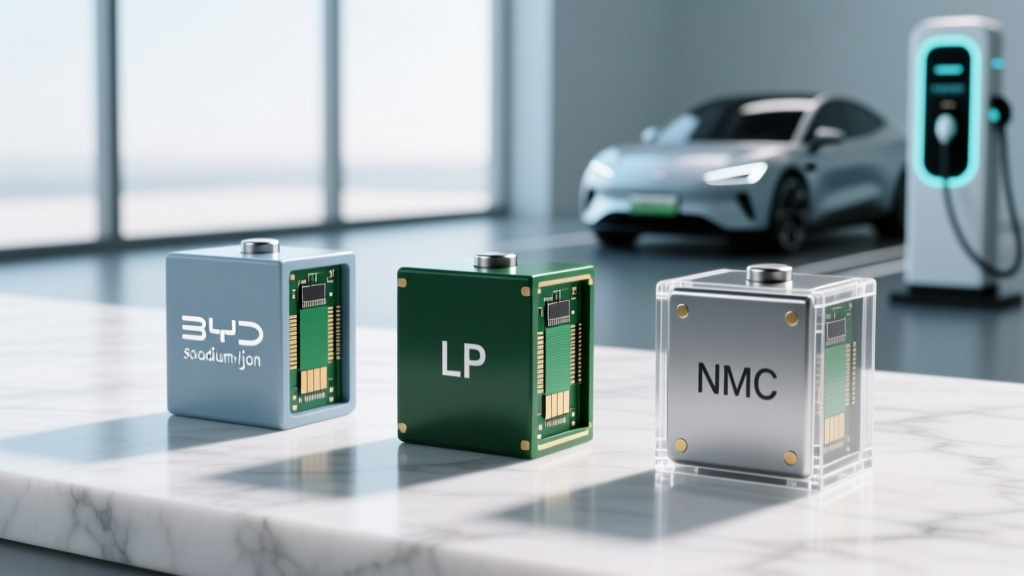
Every EV battery pack is built from individual cells, and the cathode chemistry of those cells determines nearly everything about your ownership experience: how far you can drive, how fast you can charge, how the battery handles winter, and how long it lasts. In 2026, three chemistries dominate the market.
NMC (Nickel Manganese Cobalt) and NCA (Nickel Cobalt Aluminum) remain the go-to for long-range and performance vehicles. Tesla's Model 3 Long Range, the Hyundai Ioniq 5, and the Ford Mustang Mach-E Extended Range all use NMC variants. These cells offer the highest energy density — meaning more kWh packed into a lighter, smaller pack — which translates directly to EPA range figures above 300 miles.
LFP (Lithium Iron Phosphate) has surged in popularity for standard-range and cost-focused trims. Tesla offers LFP in the Model 3 Rear-Wheel Drive and Model Y Standard Range. BYD's Blade Battery, used across their lineup and increasingly supplied to other automakers, is LFP. The chemistry trades some energy density for dramatically longer cycle life, lower cost, better thermal stability, and zero cobalt.
| Attribute | LFP (Lithium Iron Phosphate) | NMC (Nickel Manganese Cobalt) | NCA (Nickel Cobalt Aluminum) |
|---|---|---|---|
| Energy Density | ~160–180 Wh/kg (cell level) | ~220–260 Wh/kg (cell level) | ~250–270 Wh/kg (cell level) |
| Cycle Life | 3,000–5,000+ cycles to 80% SoH | 1,000–2,000 cycles to 80% SoH | 800–1,500 cycles to 80% SoH |
| Cold-Weather Performance | More range loss (~30–40% below freezing); slower charge acceptance when cold | Better low-temp performance (~20–30% range loss below freezing) | Similar to NMC; preconditioning critical |
| Charging to 100% | Recommended regularly (helps BMS calibration; no degradation penalty) | Best kept 20–80% daily; 100% only for trips | Same as NMC — 80% daily limit recommended |
| Cost per kWh (Pack Level) | ~$90–$110/kWh (2026 estimates) | ~$120–$145/kWh (2026 estimates) | ~$125–$150/kWh (2026 estimates) |
| Thermal Stability | Excellent — much higher thermal runaway threshold | Good — requires robust BMS and cooling | Good — similar management needs as NMC |
| Typical Use Case | Standard-range trims, fleet vehicles, budget EVs | Long-range, AWD, most mainstream EVs | Performance models (Tesla, some Porsche/Audi) |
| Example 2026 Vehicles | Tesla Model 3 RWD, BYD Atto 3, Ford F-150 Lightning Standard Range | Hyundai Ioniq 5, VW ID.4 Pro S, Chevy Equinox EV | Tesla Model S Plaid, Porsche Taycan, Lucid Air |
The practical takeaway: If you drive fewer than 250 miles a day, can charge at home, and want the longest-lasting battery with the lowest cost, LFP is a strong choice. If you need maximum range, frequently road-trip in cold weather, or want the fastest DC charging speeds, NMC/NCA remains the better fit.
Real Degradation Data: How Much Capacity Do EV Batteries Actually Lose?
Battery degradation — the gradual loss of usable capacity over time — is the single biggest long-term ownership concern for EV buyers. The good news, backed by millions of real-world data points, is that modern EV batteries degrade far less than early-generation packs and far less than most buyers fear.
What the data shows: According to aggregated fleet data published by Geotab across over 10,000 EVs, the average electric vehicle loses approximately 1.8% of its battery capacity per year under typical use. That translates to roughly 90% State of Health (SoH) after 5 years and approximately 82% SoH after 10 years.
But averages hide important variation. Here's what real-world data points tell us:
- Tesla Model 3/Y (NMC, 2019–2023): Fleet data from Recurrent Auto shows median degradation of ~5% over the first 50,000 miles, then a flattening curve — approximately 88–92% SoH at 100,000 miles.
- Tesla Model 3 RWD (LFP, 2022–2025): Early data suggests minimal degradation — 2–3% over 50,000 miles — though long-term LFP data in US fleets is still accumulating.
- Chevrolet Bolt EV/EUV (NMC, 2017–2023): Post-recall replacement batteries show excellent retention; pre-recall packs averaged ~8% loss at 75,000 miles before the recall addressed defective cells.
- Nissan LEAF (passive air cooling, 2011–2017): The cautionary tale — early LEAFs with passive thermal management showed 15–25% degradation in hot climates by year 5. Modern liquid-cooled packs (2018+) perform far better.
- Hyundai Ioniq 5 / Kia EV6 (NMC, 2022–2025): Limited long-term data so far, but early indicators from European fleet use show 3–4% loss at 40,000 miles with liquid-cooled 800V architecture managing heat well.
Key insight: Degradation is not linear. Most EV batteries experience a steeper drop in the first 10,000–20,000 miles (sometimes 2–4%), then the curve flattens considerably. A battery at 93% SoH at 30,000 miles is likely still at 88%+ at 100,000 miles — not headed for a cliff.
Battery Warranties: What's Actually Covered and for How Long
Federal law mandates that EV battery warranties cover a minimum of 8 years or 100,000 miles (whichever comes first) in most states, and 10 years or 150,000 miles in California Air Resources Board (CARB) states including California, New York, Massachusetts, and others that have adopted CARB standards.
But the details matter enormously. The warranty doesn't guarantee your battery stays at 100% — it guarantees it won't fall below a specific capacity retention threshold.
| Manufacturer | Warranty Period | Capacity Retention Threshold | Notes |
|---|---|---|---|
| Tesla (Model 3/Y Long Range, NMC) | 8 years / 120,000 miles | 70% of original capacity | Transferable to second owner |
| Tesla (Model 3 RWD, LFP) | 8 years / 100,000 miles | 70% of original capacity | Lower mileage cap on standard range |
| Hyundai / Kia (Ioniq 5, EV6, EV9) | 10 years / 100,000 miles | 70% of original capacity | Among the longest coverage in the industry |
| Ford (Mustang Mach-E, F-150 Lightning) | 8 years / 100,000 miles | 70% of original capacity | Standard across Ford EV lineup |
| General Motors (Equinox EV, Blazer EV, Silverado EV) | 8 years / 100,000 miles | 70% of original capacity (60% on some commercial) | Check specific model terms |
| Volkswagen (ID.4) | 8 years / 100,000 miles | 70% of original capacity | Transferable |
| BMW (i4, iX) | 8 years / 100,000 miles | 70% of original capacity | Includes battery management system |
Critical detail: The 70% threshold means a vehicle with an EPA range of 300 miles would need to drop below 210 miles of range for the warranty to trigger. Given that real-world data shows most batteries retaining 82–92% at 100,000 miles, warranty claims remain rare. According to data from Recurrent Auto, fewer than 1.5% of EVs in their study cohort have required a battery replacement under warranty.
EV Battery Replacement Cost: The Real Numbers
This is the question that generates the most anxiety — and the most misleading headlines. Yes, an out-of-warranty EV battery replacement is expensive. But context is essential: the vast majority of EV batteries never need replacement during the vehicle's useful life.
| Vehicle | Battery Capacity | Chemistry | Replacement Cost (Parts + Labor) | Typical Replacement Trigger |
|---|---|---|---|---|
| Tesla Model 3 RWD | ~60 kWh | LFP | $8,000–$12,000 | Rare before 200,000+ miles |
| Tesla Model Y Long Range | ~75 kWh | NMC | $12,000–$16,000 | Cell failure or extreme degradation |
| Hyundai Ioniq 5 | 77.4 kWh | NMC | $14,000–$18,000 | Module-level repair may reduce cost |
| Ford Mustang Mach-E Extended Range | 91 kWh | NMC | $15,000–$20,000 | Likely module-level service available |
| Ford F-150 Lightning Extended Range | 131 kWh | NMC | $20,000–$28,000 | Largest consumer pack; highest cost |
| Chevrolet Bolt EV (post-recall pack) | 65 kWh | NMC | $9,000–$14,000 | GM has offered subsidized replacements |
| Porsche Taycan | 93.4 kWh | NMC | $22,000–$30,000 | Porsche offers battery repair at module level |
Important nuance: These figures represent full pack replacements. Many modern EV battery packs are designed for module-level repair — meaning a technician can replace a single faulty module (one of 8–16 in the pack) for $2,000–$5,000 rather than replacing the entire pack. Porsche, BMW, and Hyundai/Kia have all emphasized module-serviceability in their current architectures.
When is replacement typically needed? In practice, full pack replacements are overwhelmingly triggered by manufacturing defects (covered under warranty), physical damage from collisions or road debris (covered by insurance), or coolant intrusion — not by gradual capacity fade. A pack that degrades to 75% SoH at 150,000 miles still provides functional daily transportation; it just has less range.
What Kills an EV Battery? Five Factors That Accelerate Degradation
Not all miles are equal when it comes to battery wear. Research from the National Renewable Energy Laboratory (NREL) and real-world fleet data identify five primary factors that accelerate lithium-ion battery degradation:
- 1. Repeated DC Fast Charging at High Power: Frequent use of 150+ kW DC fast charging generates significant heat within the cells. Occasional road-trip fast charging is fine — the battery management system (BMS) throttles charge speed to protect the cells. But daily fast-charging, especially without preconditioning, measurably accelerates degradation. Geotab's data shows EVs that fast-charge more than 3 times per week degrade roughly 1–2% faster over 3 years than those primarily using Level 2.
- 2. Sustained High State of Charge (NMC/NCA only): Storing an NMC or NCA battery at 100% SoC for days or weeks stresses the cathode. This is why manufacturers recommend a daily charge limit of 80% for NMC/NCA vehicles. LFP batteries are an exception — they actually benefit from periodic 100% charges for BMS calibration.
- 3. Deep Discharge Below 10%: Letting any lithium-ion battery sit at very low SoC for extended periods can cause copper dissolution in the anode current collector. Try not to leave your EV unplugged below 10% for more than a day or two.
- 4. Extreme Heat Exposure: Battery chemistry degrades fastest at sustained temperatures above 95°F (35°C). This is why early Nissan LEAFs in Arizona degraded much faster than identical cars in Oregon. Modern liquid-cooled packs manage this far better, but parking in shade and using scheduled departure preconditioning still helps in hot climates.
- 5. Extreme Cold Charging Without Preconditioning: Attempting to charge — especially at high power — when the battery is below freezing causes lithium plating on the anode, a form of permanent damage. Always use your vehicle's preconditioning feature (or let the BMS warm the battery via navigation-routed preconditioning to a charger) before charging in cold weather.
Monitoring Your Battery's Health: How to Check State of Health (SoH)
State of Health (SoH) is the percentage of your battery's original usable capacity that remains available. A new EV battery starts at 100% SoH; if your 80 kWh pack can now only hold 72 kWh, its SoH is 90%.
Built-in vehicle tools: Many 2026 EVs now display a battery health metric directly in the infotainment system or companion app. Tesla shows battery health percentage in the service menu on recent software versions. Hyundai's Bluelink app includes a battery condition indicator. BMW's iDrive displays a battery health report accessible through the ConnectedDrive portal.
Third-party monitoring: Services like Recurrent (free for owners) connect to your vehicle's telematics and provide detailed degradation tracking, range estimates based on your actual SoH, and comparison data against similar vehicles in your climate zone. Some used-EV buyers request a Recurrent battery report before purchase — it's becoming the Carfax of EV batteries.
OBD-II diagnostics: For a more technical read, OBD-II dongles paired with apps like Leaf Spy (Nissan), Tessie (Tesla), or Car Scanner can read the BMS-reported SoH, cell voltage variance, and total energy throughput. Cell variance above 0.1V between the highest and lowest cells can indicate a developing module imbalance worth monitoring.
The Solid-State Battery Commercialization Timeline: Where Things Actually Stand
Now to the question that brought many readers here: when will solid-state batteries — which replace the liquid electrolyte with a solid material (ceramic, sulfide, or polymer) — actually reach production EVs you can buy?
What solid-state promises: In theory, solid-state cells offer 30–50% higher energy density (potentially 350–400+ Wh/kg at the cell level), faster charging without lithium plating risk, dramatically improved thermal stability (near-zero fire risk), and longer cycle life. A solid-state pack could enable a 500+ mile EPA range in a midsize sedan without increasing pack weight or size.
The 2025–2026 reality check: As of early 2026, no mass-market consumer EV uses a full solid-state battery. Here's what is actually happening:
- Toyota: Has announced a solid-state battery EV for 2027–2028 with a claimed 750 km (~465 mile) range and 10-minute 10–80% charging. However, Toyota has revised this timeline multiple times since 2021. Initial production will be extremely limited — likely a low-volume flagship, not a Camry-priced sedan. Toyota is also pursuing a "bipolar NiMh" and enhanced lithium-ion path for nearer-term vehicles.
- Nissan: Announced a pilot production line for solid-state cells at its Yokohama plant, targeting 2028–2029 for a production vehicle. Prototype cells have been demonstrated but manufacturing yield and cost remain unsolved at scale.
- Samsung SDI: Has shown prototype all-solid-state cells to automaker partners with claimed specs of 900 Wh/L volumetric energy density. Mass production target is 2027, but this is for cell production — integration into a vehicle program adds 2–3 years of validation.
- QuantumScape: The Volkswagen-backed startup has delivered prototype cells to automotive partners and reported strong cycle-life test results. However, QuantumScape has not yet demonstrated gigawatt-hour-scale manufacturing. Realistic vehicle integration is 2028 at the earliest.
- Solid Power (BMW/Ford backed): Taking a different approach — a sulfide-based solid electrolyte designed to work in existing lithium-ion manufacturing lines. This could lower the cost barrier, but the technology is still in the prototype-to-pilot phase with a 2028–2030 vehicle target.
What's shipping now that's adjacent: Several companies are deploying semi-solid-state or advanced lithium-ion technologies that capture some solid-state benefits without the full manufacturing challenge:
- Silicon-dominant anodes: Companies like Sila Nanotechnologies and Group14 are replacing graphite anodes with silicon composites, boosting energy density 10–20%. These are entering production in 2025–2026 in limited applications.
- CATL's condensed-matter battery: Announced in 2023 and entering limited production, this uses a semi-solid electrolyte with claimed energy density of 500 Wh/kg — but initially for aviation, not consumer vehicles.
- LFP improvements: CATL's second-generation LFP and BYD's Blade Battery 2.0 are pushing LFP energy density higher, narrowing the gap with NMC without needing solid-state chemistry.
Realistic timeline for consumers: If you're buying an EV in 2026, 2027, or likely even 2028, you will be buying a liquid-electrolyte lithium-ion battery — either NMC, NCA, or LFP. Solid-state batteries will begin appearing in limited, premium vehicles around 2028–2030, and won't reach mainstream pricing until the early 2030s. This isn't pessimism — it's the reality of automotive-grade manufacturing scale-up, which requires not just a working cell but billions of them produced consistently at low cost.
Frequently Asked Questions
How long do EV batteries actually last in years and miles?
Based on aggregated fleet data, most modern liquid-cooled EV batteries retain 80–90% of their original capacity at 100,000 miles and 8–10 years of age. Many will outlast the vehicle itself — a battery at 75% SoH at 200,000 miles is still functional, just with reduced range. The U.S. Department of Energy estimates that modern EV batteries should last 12–15 years in typical use before needing replacement.
How much does it cost to replace an EV battery out of warranty?
Full pack replacements range from approximately $8,000 for a smaller LFP pack (Tesla Model 3 RWD, ~60 kWh) to $28,000+ for the largest packs (F-150 Lightning Extended Range, 131 kWh). However, most out-of-warranty issues can be addressed through module-level repair for $2,000–$5,000. And critically, fewer than 2% of EVs have needed any battery replacement — the vast majority are covered under the 8-year/100,000-mile warranty.
What does the EV battery warranty actually cover?
By federal mandate, EV battery warranties cover at least 8 years/100,000 miles against defects and excessive capacity loss. The standard threshold is 70% of original capacity — if your battery drops below 70% SoH within the warranty period, the manufacturer must repair or replace it. In CARB states (California, New York, and others), the mandate extends to 10 years/150,000 miles. The warranty covers the battery pack, management system, and associated cooling components.
How do I check my EV's battery health?
Most 2026 EVs display a battery health indicator in the infotainment system or companion app. Third-party services like Recurrent Auto offer free, detailed SoH tracking by connecting to your vehicle's telematics. For deeper diagnostics, OBD-II adapters with apps like Tessie (Tesla) or Leaf Spy (Nissan) can read cell-level voltage data and total energy throughput from the BMS.
LFP vs NMC — which battery chemistry is better for me?
Choose LFP if: you want the longest possible battery lifespan, you charge at home daily, your daily driving is under 200 miles, you live in a moderate climate, and you want the lowest purchase price. Choose NMC/NCA if: you need maximum range (300+ miles EPA), you regularly drive in cold weather, you take frequent road trips requiring fast DC charging, or you need the fastest 0–60 performance. Neither is universally "better" — the right choice depends on your driving patterns and climate.
Should I wait for solid-state batteries before buying an EV?
For the vast majority of buyers, no. Solid-state batteries will not appear in mainstream, affordably priced EVs until the early 2030s at the earliest. Today's NMC and LFP batteries already offer 250–350 miles of EPA range, 15–25 minute DC fast charging (10–80%), and proven longevity exceeding 150,000 miles with minimal degradation. Waiting 4–6+ years for solid-state means forgoing years of fuel savings, lower maintenance costs, and current federal tax incentives under IRS §30D that may change or expire by the time solid-state vehicles arrive.