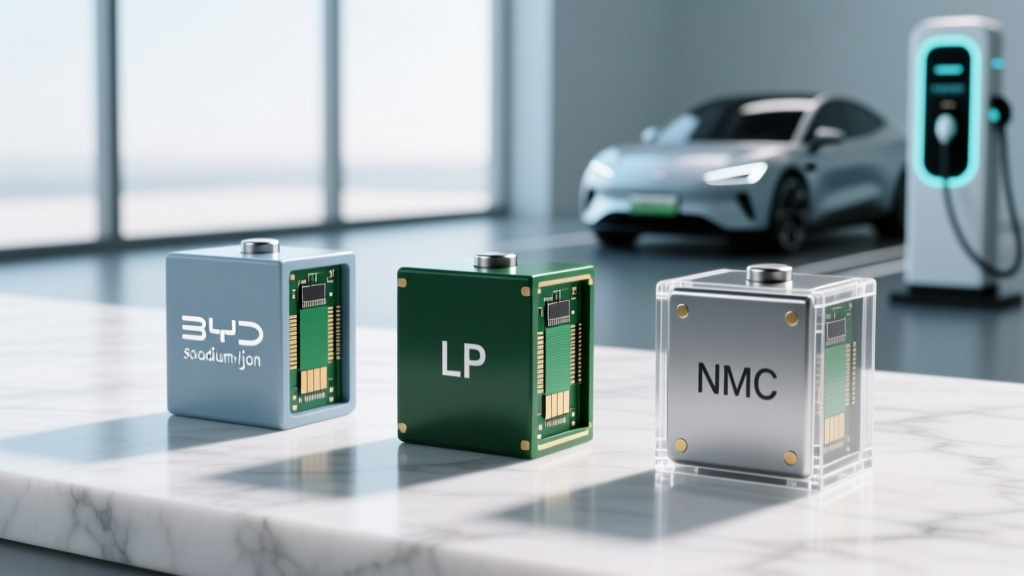
BYD's push into sodium-ion battery production has added a third major chemistry to the EV landscape, sitting alongside the dominant lithium iron phosphate (LFP) and nickel manganese cobalt (NMC/NCA) cells that power most of today's electric vehicles. For buyers, this raises a practical question: does sodium-ion solve real ownership problems, or is it a niche chemistry best suited for budget city cars and energy storage?
This guide breaks down the technical trade-offs between sodium-ion, LFP, and NMC — covering energy density, cycle life, cold-weather performance, degradation data, warranty terms, replacement costs, and the habits that actually preserve battery health over a decade of driving.
Why BYD Is Betting on Sodium-Ion Chemistry
Sodium-ion cells use abundant, cheap sodium instead of lithium for the charge-carrying ion. BYD began limited production of its first-generation sodium-ion pack in late 2024, targeting sub-compact EVs and plug-in hybrids where cost per kWh matters more than maximum range. The Seagull (known as the Dolphin Mini in some markets) has been the primary candidate for early sodium-ion fitment.
The appeal is straightforward: sodium is roughly 400–500 times more abundant in the Earth's crust than lithium, does not require cobalt or nickel, and can use aluminum for the anode current collector instead of copper. That combination cuts raw-material cost and sidesteps the geopolitical supply-chain risks tied to lithium, cobalt, and nickel sourcing — a factor that also affects IRS §30D critical-mineral requirements for the US federal EV tax credit.
The trade-off is energy density. First-generation BYD sodium-ion cells deliver roughly 140–160 Wh/kg at the cell level, compared to 170–200 Wh/kg for LFP and 250–300 Wh/kg for high-nickel NMC. That means a sodium-ion pack must be heavier or physically larger to store the same kWh, which limits its use to vehicles with modest range targets (roughly 180–250 miles EPA equivalent in a compact car).
LFP vs NMC vs Sodium-Ion: Chemistry Trade-Offs
Choosing a chemistry is always a set of compromises. The table below maps the three chemistries across the metrics that matter for real ownership.
| Metric | Sodium-Ion (BYD Gen 1) | LFP (LiFePO₄) | NMC / NCA |
|---|---|---|---|
| Cell-level energy density | 140–160 Wh/kg | 170–200 Wh/kg | 250–300 Wh/kg |
| Typical cycle life (to 80% SoH) | 3,000–5,000 cycles | 3,000–6,000 cycles | 1,000–2,500 cycles |
| Cold performance (-20°C capacity retention) | ~90% | ~60–70% | ~75–85% |
| Fast-charge tolerance (repeated DCFC) | Good (flat curve, low heat) | Very good | Moderate (heat-sensitive) |
| Raw-material cost index | Low (no Li, Co, Ni) | Medium (no Co, Ni) | High (Ni, Co exposure) |
| Thermal stability / safety | Excellent | Excellent | Good (requires BMS cooling) |
| Best-fit vehicle segment | City EVs, PHEVs, storage | Mid-range EVs, standard-range trims | Long-range, performance EVs |
The headline takeaway: sodium-ion wins on cold performance and cycle life per dollar, loses on energy density. If you drive a compact EV in a cold climate and charge daily, sodium-ion is a strong fit. If you need 320+ miles of EPA range in a mid-size SUV, NMC or LFP remain the only realistic options in 2026.
How Long Do EV Batteries Actually Last?
Most modern traction batteries are engineered to outlast the vehicle they're installed in. Real-world fleet data from Tesla, Hyundai/Kia, and independent analysts shows that NMC and LFP packs typically lose 8–15% of original capacity over the first 150,000 miles, with degradation slowing significantly after the initial 20,000–30,000-mile break-in period.
For context, a 2023 study by Geotab tracking over 10,000 EVs found an average annual degradation rate of roughly 1.8% for liquid-cooled packs, with LFP-equipped vehicles trending slightly lower than NMC. Over 10 years, that compounds to about 18% loss — leaving most packs above the 80% state-of-health (SoH) threshold that defines end-of-first-life in automotive use.
Sodium-ion is too new for 10-year fleet data, but lab-cycle testing published by BYD and third-party researchers indicates cycle life in the 3,000–5,000 range to 80% SoH — comparable to or slightly better than LFP. For a 50 kWh pack used in a city EV averaging 3.5 miles per kWh, 4,000 cycles translates to roughly 700,000 miles of theoretical use, far beyond any realistic vehicle lifespan.
- Year 1 / 15,000 mi: ~2–4% loss (initial formation)
- Year 3 / 45,000 mi: ~6–9% loss
- Year 5 / 75,000 mi: ~9–12% loss
- Year 8 / 120,000 mi: ~12–16% loss
- Year 10 / 150,000 mi: ~14–18% loss
Sodium-ion is expected to track the lower end of this range or slightly better, based on cycle-test data, but multi-year fleet validation is still pending.
What Does the EV Battery Warranty Cover?
US federal law (EPA emissions warranty provisions applied to EV powertrains) mandates a minimum of 8 years / 100,000 miles for battery coverage in CARB-adopting states, and most manufacturers match or exceed this nationwide. The warranty typically guarantees the pack will retain a specified percentage of original capacity — usually 70% — and covers defects in materials and workmanship.
| Manufacturer | Term | Minimum SoH Retained | Notes |
|---|---|---|---|
| Tesla (LFP / NMC) | 8 yr / 120,000 mi (varies by model) | 70% | Model 3 RWD (LFP): 100k mi; Long Range/Perf: 120k mi |
| Hyundai / Kia (NMC) | 10 yr / 100,000 mi | 70% | Includes labor; module-level replacement allowed |
| Ford (NMC / LFP) | 8 yr / 100,000 mi | 70% | LFP Mustang Mach-E trims: same term |
| GM (NMC / LFP Ultium) | 8 yr / 100,000 mi | 70% (some trims 60% for fleet) | Modular pack design enables partial replacement |
| BYD (LFP Blade / Sodium-Ion) | 8 yr / 100,000+ mi (market-dependent) | 70% (estimated for US market) | US warranty terms TBD pending market entry |
The critical fine print: warranties cover capacity loss below the threshold, not gradual degradation above it. If your pack drops to 71% SoH at year 7, the warranty has not been triggered. Most owners never approach the threshold under normal use.
How Much Does EV Battery Replacement Cost?
Out-of-warranty battery replacement is rare but not unheard of, typically arising from collision damage, manufacturing defects discovered late, or extreme high-mileage use (ride-share, delivery fleets). Costs vary enormously by pack size and chemistry.
| Vehicle / Pack Size | Chemistry | Replacement Cost Range | Typical Trigger |
|---|---|---|---|
| Chevy Bolt (65 kWh) | NMC | $14,000–$18,000 | Post-recall, post-warranty defect |
| Tesla Model 3 Standard (60 kWh LFP) | LFP | $12,000–$16,000 | Rare; mostly collision |
| Tesla Model S/X (100 kWh) | NMC/NCA | $20,000–$26,000 | High-mileage fleet, older vehicles |
| Ford F-150 Lightning Ext. Range (131 kWh) | NMC | $25,000–$35,000 | Collision, extreme use |
| BYD compact (45 kWh sodium-ion, est.) | Sodium-Ion | $7,000–$11,000 (projected) | Lower material cost; not yet in US market |
The important context: fewer than 2% of EVs in major fleet studies have required traction battery replacement under normal ownership, and the vast majority of those were covered by warranty. For a private owner driving 12,000–15,000 miles per year, a battery replacement is statistically unlikely before the vehicle is retired or sold.
Factors That Actually Affect Battery Lifespan
Battery degradation is driven by chemistry, temperature, and how the pack is cycled. The following habits have the largest measurable impact on long-term state of health.
- Avoid sustained 100% state of charge. For NMC, store between 20–80% SoC for daily use; charge to 100% only when you'll drive immediately. LFP tolerates 100% better and actually benefits from a full charge once per week for cell balancing. Sodium-ion behaves similarly to LFP in this regard.
- Minimize repeated DC fast charging above 150 kW. Occasional road-trip DCFC is fine; daily 350 kW sessions accelerate degradation by generating sustained heat above 40°C in the cells. Preconditioning the pack (most EVs do this automatically when a charger is navigated to) reduces this risk substantially.
- Park in shade or a garage when possible. Calendar degradation roughly doubles for every 10°C increase in average storage temperature. A pack sitting at 45°C in a Phoenix parking lot degrades faster than one at 25°C in a garage — even when not driven.
- Use Level 2 (7–11 kW) for daily charging. The gentle charge rate generates minimal heat and is the single best habit for long-term SoH.
- Don't let the pack sit at 0% for extended periods. Deep discharge below the battery management system's buffer (typically ~2–5% of gross capacity) can trigger cell-level damage that the BMS cannot recover.
- Cold weather is less damaging than heat. Cold temporarily reduces available capacity and slows charging (the BMS limits charge rate to protect cells), but does not cause permanent degradation the way sustained heat does. Sodium-ion's superior cold performance means less range loss and less preconditioning energy in winter.
How to Check and Monitor Battery Health (SoH)
State of Health is a percentage representing current maximum capacity relative to the pack's original capacity when new. A new EV starts at 100% SoH; a pack at 85% SoH can store only 85% of its original kWh.
Most manufacturers do not expose SoH directly on the dashboard, but several methods exist:
- OBD-II diagnostic tools: Apps like LeafSpy (Nissan), TeslaFi or Tessie (Tesla), and CarScanner (general) read the BMS-reported SoH via the OBD-II port. This is the most accurate consumer-accessible method.
- Dealer diagnostic check: Any authorized service center can pull a full battery health report, typically during scheduled service or upon request. Some manufacturers (Hyundai, BMW) include this in periodic maintenance.
- Manual calculation: Charge to 100%, note the displayed range or kWh added from a known low SoC, and compare to the EPA-rated capacity. Less precise but requires no tools.
- Telematics / app data: Tesla, Ford, and GM offer varying levels of battery health visibility in their companion apps. Third-party fleet services like Recurrent provide benchmarked SoH reports for participating owners.
For sodium-ion packs, SoH monitoring is expected to follow the same OBD-II and BMS patterns, though BYD-specific diagnostic apps are not yet widely available outside China.
Emerging Battery Tech: Solid-State, Silicon Anode, and What's Real
Beyond sodium-ion, two technologies dominate forward-looking battery discussion:
Solid-state batteries replace the liquid electrolyte with a solid ceramic, polymer, or sulfide conductor, promising energy densities above 400 Wh/kg and improved safety. Toyota, Nissan, and Samsung SDI have announced pilot production timelines between 2027 and 2030, with initial fitment in limited-run, premium vehicles. Cost per kWh remains several times higher than liquid lithium-ion, and manufacturing yield challenges are unresolved. Treat any vehicle advertised with solid-state before 2029 as preliminary and likely low-volume.
Silicon-dominant anodes (from companies like Sila Nanotechnologies and Group14) replace graphite with silicon to increase energy density by 20–40% at the cell level. Mercedes-Benz's G-Class 580e (announced) is among the first vehicles expected to use silicon-anode cells. This technology is closer to mass production than solid-state and may appear in premium EVs from 2026–2028 onward, initially as a hybrid silicon-graphite anode rather than pure silicon.
Neither technology changes the near-term purchase decision. For vehicles on sale in 2026, LFP, NMC, and (increasingly) sodium-ion are the chemistries you can actually buy.
Frequently Asked Questions
How long do EV batteries last in years and miles?
Most liquid-cooled EV batteries retain 80–85% of original capacity after 10 years or 150,000 miles of typical use. LFP and sodium-ion chemistries trend toward the higher end of that range due to superior cycle life. The vehicle is usually retired or sold before the battery reaches end-of-life.
How much does it cost to replace an EV battery?
Out-of-warranty replacement ranges from roughly $7,000 for a small sodium-ion or LFP pack to $35,000 for a large NMC pack in a truck or luxury SUV. However, fewer than 2% of EVs require replacement under normal ownership, and most failures are covered by the 8–10 year / 100,000-mile warranty.
What does the battery warranty actually cover?
Warranties guarantee the pack will retain a minimum percentage of original capacity (typically 70%) over the warranty term (typically 8 years / 100,000 miles). They also cover manufacturing defects. Gradual degradation above the threshold is considered normal wear and is not covered.
Is LFP better than NMC?
It depends on your priorities. LFP offers longer cycle life, better thermal safety, and lower cost, but lower energy density — meaning heavier packs or shorter range for the same weight. NMC delivers higher energy density for long-range and performance vehicles, at higher material cost and somewhat shorter cycle life. Neither is universally "better"; they serve different vehicle segments.
Where does BYD's sodium-ion battery fit in?
Sodium-ion targets the cost-sensitive, cold-climate, and city-driving segment where energy density is less critical than cycle life, safety, and raw-material independence. It is not a replacement for NMC in long-range vehicles, but it is a credible alternative to LFP in compact EVs and PHEVs — particularly as BYD scales production and drives cost per kWh below LFP levels.
Can I check my EV battery health myself?
Yes, using an OBD-II adapter and a compatible app (TeslaFi, LeafSpy, CarScanner) to read BMS-reported State of Health. Dealers can also pull a full diagnostic report. Sodium-ion packs will follow the same diagnostic patterns, though BYD-specific consumer tools are limited outside China as of 2026.