The electric vehicle battery landscape is shifting fast. While lithium-ion chemistries like NMC and LFP dominate today's EVs, a new contender has entered mass production: sodium-ion. As major sodium battery manufacturers scale up output for automotive applications, buyers and enthusiasts need to understand where this technology fits — and how it compares to the lithium-based cells powering most EVs on the road right now.
This guide breaks down every major EV battery chemistry available in 2026, explains real-world degradation data, covers warranty protections and replacement costs, and examines what sodium-ion and other emerging technologies mean for future EV buyers.
Current EV Battery Chemistries: LFP vs. NMC vs. NCA
Every production EV sold in the U.S. today uses one of three primary lithium-ion cathode chemistries. Understanding the trade-offs between them is essential for making an informed purchase.
NMC (Nickel Manganese Cobalt) and NCA (Nickel Cobalt Aluminum) are energy-dense chemistries used in most long-range EVs. They pack more kWh into a smaller, lighter pack — critical for vehicles targeting 300+ miles of EPA range. Tesla's Model 3 Long Range, the Hyundai Ioniq 5, and the Ford Mustang Mach-E Extended Range all use NMC or NCA variants.
LFP (Lithium Iron Phosphate) trades some energy density for dramatically longer cycle life, lower cost, and improved thermal stability. LFP packs are heavier for the same capacity, but they tolerate frequent 100% charging, resist degradation better, and eliminate cobalt from the supply chain. Tesla's Model 3 RWD, the base Chevrolet Equinox EV, and several BYD models sold globally use LFP.
| Attribute | LFP (LiFePO₄) | NMC / NCA |
|---|---|---|
| Energy Density (cell-level) | 160–180 Wh/kg | 220–300 Wh/kg |
| Typical Cycle Life | 3,000–6,000+ cycles | 1,000–2,500 cycles |
| Cold-Weather Performance | Moderate — slower charge below 32°F | Better low-temp conductivity |
| Thermal Stability | Excellent — resists thermal runaway | Good — requires active management |
| Cost per kWh (cell) | ~$70–$90 (2026) | ~$100–$130 (2026) |
| Charging to 100% Daily | Recommended by most OEMs | Typically limited to 80–90% daily |
| Cobalt / Nickel Content | None | Yes — supply chain risk |
| Typical Applications | Standard-range / city EVs | Long-range / performance EVs |
The bottom line: If you commute short distances and want maximum battery longevity with daily 100% charging, LFP is the stronger pick. If you need 300+ miles of range and faster highway charging, NMC/NCA remains the better fit. Neither is universally "better" — the right choice depends on your driving pattern.
Sodium Battery Manufacturers: Who Is Scaling Sodium-Ion for EVs?
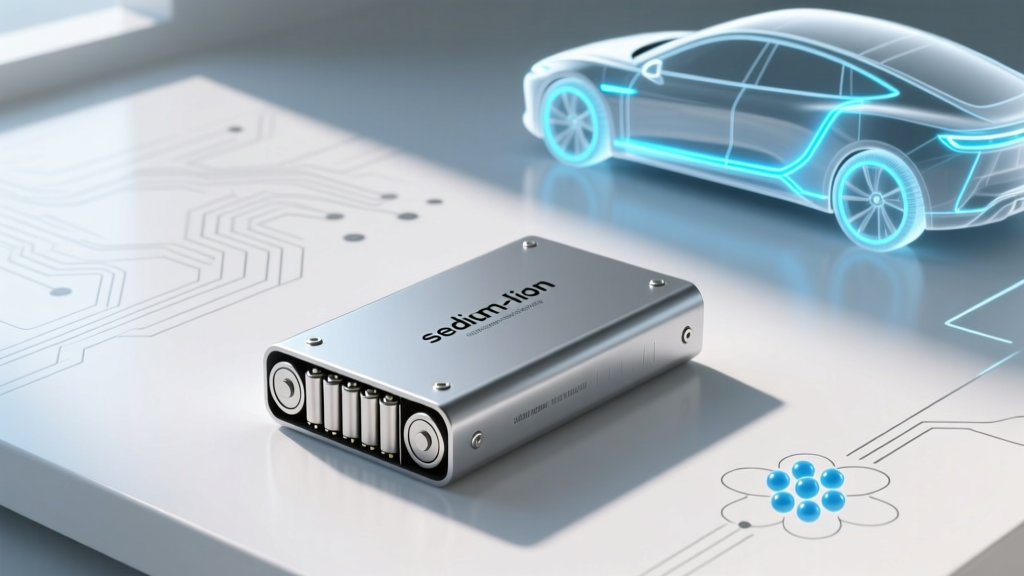
Sodium-ion batteries replace lithium with sodium — an element thousands of times more abundant and inexpensive. After years of lab development, several sodium battery manufacturers have moved into commercial production as of 2025–2026:
- CATL (China): The world's largest battery maker began shipping sodium-ion cells in 2024 and introduced a hybrid LFP/sodium pack architecture that pairs sodium cells (for cold-weather resilience) with LFP cells (for energy density). CATL's first-generation sodium cells deliver ~160 Wh/kg with excellent low-temperature performance — retaining over 90% capacity at −20°C (−4°F).
- HiNa Battery Technology (China): A spin-off from the Chinese Academy of Sciences, HiNa has been a sodium-ion pioneer, supplying cells for early EV and energy-storage deployments in China since 2023.
- BYD (China): While BYD dominates LFP with its Blade Battery, the company has confirmed sodium-ion R&D programs and pilot production lines aimed at entry-level EVs and two-wheelers.
- Northvolt (Sweden): The European battery manufacturer announced sodium-ion cell development targeting energy storage and, eventually, automotive applications in the European market.
- Natron Energy (U.S.): Based in California, Natron focuses on sodium-ion batteries for data-center backup and industrial applications. While not yet automotive-focused, their Prussian Blue electrode chemistry demonstrates the versatility of the sodium platform.
Where sodium-ion fits in 2026: Sodium cells currently offer 140–170 Wh/kg — roughly comparable to LFP but below NMC. The key advantages are raw-material cost (sodium carbonate is a fraction of lithium carbonate's price), superior cold-weather performance, and faster charging capability. The primary limitation is lower energy density, which restricts sodium-ion to shorter-range, budget-oriented EVs. No sodium-ion EV is currently sold in the U.S. market, but Chinese-market models from JAC and Chery have begun using CATL sodium packs.
For U.S. buyers, sodium-ion is a technology to watch over the next 3–5 years, particularly for affordable city EVs and fleet vehicles. It is not a replacement for NMC in long-range applications any time soon.
How Long Do EV Batteries Actually Last?
The most persistent EV myth is that batteries need replacing every few years like a smartphone. The data tells a very different story.
Real-World Degradation Data Points:
- Tesla Model 3/Y (NMC, 2018–2023): Tesla's 2024 Impact Report showed an average of ~12% degradation at 150,000 miles, with most packs retaining 85–90% of original capacity. Data aggregated from fleet telemetry.
- Nissan Leaf (LMO/NMC, passive cooling): Earlier-generation Leafs (2011–2017) with passive air cooling showed 15–25% degradation at 80,000–100,000 miles — a cautionary tale about thermal management. The 2018+ Leaf with improved cooling performs better.
- Chevrolet Bolt EV (NMC, liquid-cooled): Owner-reported data from fueleconomy.gov forums and Recurrent Auto shows ~8–10% degradation at 100,000 miles for liquid-cooled packs.
- LFP-equipped vehicles (Tesla Model 3 RWD, BYD): Early LFP fleet data suggests 5–8% degradation at 100,000 miles, consistent with LFP's superior cycle life.
The realistic answer: A modern, liquid-cooled EV battery will typically lose 10–15% of its original capacity over 150,000–200,000 miles (roughly 12–15 years of average U.S. driving). Most EV batteries will outlast the vehicle they're installed in. Catastrophic failure requiring full replacement is rare — well under 1% of packs in major OEM fleets, according to warranty claim data.
EV Battery Warranty: What's Covered and for How Long
Federal law in the U.S. mandates that EV battery warranties cover a minimum of 8 years / 100,000 miles (10 years / 150,000 miles in California Air Resources Board states). Most manufacturers exceed the minimum.
| Manufacturer | Warranty Period | Capacity Threshold | Notes |
|---|---|---|---|
| Tesla (Model 3/Y NMC) | 8 yr / 120,000 mi | 70% retention | Long Range & Performance trims |
| Tesla (Model 3 RWD LFP) | 8 yr / 100,000 mi | 70% retention | Standard Range |
| Hyundai / Kia (Ioniq 5, EV6) | 10 yr / 100,000 mi | 70% retention | Best-in-class duration |
| Ford (Mach-E, F-150 Lightning) | 8 yr / 100,000 mi | 70% retention | Components + capacity |
| GM (Equinox EV, Blazer EV) | 8 yr / 100,000 mi | 60–70% retention | Varies by model; Ultium platform |
| BMW (i4, iX) | 8 yr / 100,000 mi | 70% retention | Includes thermal management components |
| Rivian (R1T, R1S) | 8 yr / 175,000 mi | 70% retention | Higher mileage cap for adventure use |
What the warranty actually covers: If your battery's usable capacity falls below the stated threshold (typically 70%) within the warranty period, the manufacturer will repair or replace modules or the full pack at no cost. This covers abnormal degradation — not damage from accidents, flooding, or unauthorized modifications. The warranty follows the vehicle, not the owner, which matters for resale value.
Critical nuance: The 70% threshold means a 300-mile EPA-range EV could legally drop to 210 miles of range before a warranty claim is valid. In practice, very few modern liquid-cooled packs degrade that far within the warranty window.
EV Battery Replacement Cost: What to Expect
Full battery replacement is uncommon, but it does happen — usually after collision damage, manufacturing defects discovered out of warranty, or extreme high-mileage use (200,000+ miles). Here's what it costs in 2026:
| Vehicle | Battery Size (kWh) | Chemistry | Replacement Cost Range |
|---|---|---|---|
| Tesla Model 3 RWD | ~60 kWh | LFP | $12,000 – $16,000 |
| Tesla Model Y Long Range | ~75 kWh | NMC | $15,000 – $20,000 |
| Hyundai Ioniq 5 | 77.4 kWh | NMC | $14,000 – $19,000 |
| Ford Mustang Mach-E ER | 91 kWh | NMC | $18,000 – $25,000 |
| Ford F-150 Lightning ER | 131 kWh | NMC | $25,000 – $35,000 |
| Chevrolet Bolt EV | 65 kWh | NMC | $13,000 – $16,000 |
| BMW iX xDrive50 | 111.5 kWh | NMC | $22,000 – $30,000 |
Key context: These costs have declined roughly 30–40% since 2020 as cell prices fell and modular repair techniques improved. Many packs can be partially repaired — replacing individual modules rather than the entire assembly — for $3,000–$8,000. Third-party EV repair shops are increasingly offering module-level service, which is far cheaper than a full pack swap.
For perspective, a typical gasoline vehicle spends $8,000–$12,000 on fuel and $3,000–$5,000 on powertrain maintenance over 150,000 miles. The EV battery replacement scenario, while expensive, is statistically unlikely within normal ownership periods.
Factors That Affect EV Battery Longevity
Not all miles are equal when it comes to battery wear. These are the factors that meaningfully accelerate or slow degradation:
Battery Care Best Practices:
- Limit DC fast charging frequency: Occasional road-trip fast charging is fine. Daily reliance on 150+ kW DC charging accelerates degradation by an estimated 1–3% over the pack's life versus primarily Level 2 home charging. The heat generated at high charge rates stresses cells.
- Avoid sustained 100% or 0% state of charge: For NMC/NCA packs, keeping daily charge between 20–80% minimizes stress. LFP packs are the exception — most OEMs recommend charging to 100% at least weekly for accurate BMS calibration.
- Precondition before fast charging: Use your EV's built-in preconditioning (navigation to a charger triggers this automatically in most 2024+ models) to bring the battery to optimal temperature. Cold batteries charged at high power suffer lithium plating, a permanent degradation mechanism.
- Park in shade or garages in extreme heat: Sustained battery temperatures above 104°F (40°C) accelerate calendar aging. EVs in Phoenix and Las Vegas show slightly higher degradation rates than those in temperate climates.
- Don't leave the car at 0% for extended periods: If storing an EV, leave it at ~50% SoC. A fully depleted battery left for weeks can suffer cell-level damage that the BMS cannot recover.
- Use Level 2 home charging as your primary method: A 7–11 kW Level 2 charger generates far less heat than DC fast charging and is the gentlest routine charging method.
Monitoring Your EV's Battery Health (SoH)
State of Health (SoH) is the percentage of original battery capacity remaining. Here's how to check it:
- In-vehicle displays: Tesla's app shows estimated range at 100% — comparing this to the original EPA figure gives a rough SoH. Hyundai/Kia includes a battery health indicator in the EV menu on 2024+ models. BMW's iDrive displays SoH percentage directly.
- OBD-II diagnostic tools: Devices like the OBDLink SX paired with apps such as EVNotify or LeafSpy (for Nissan) read the BMS-reported SoH directly. This is the most accurate consumer-accessible method.
- Third-party services: Companies like Recurrent Auto provide battery health reports based on telematics data, often used in used-EV transactions.
- Dealer diagnostics: Any authorized dealer can pull a full battery health report during service visits. Request this when buying a used EV.
What SoH means in practice: A 3-year-old Tesla Model 3 Long Range showing 92% SoH has lost roughly 25 miles of its original 310-mile EPA range. This is normal, expected degradation — not a defect. Warranty claims typically require SoH to drop below 70% within the coverage period.
Emerging Battery Technologies: Solid-State, Silicon Anode, and Beyond
Beyond sodium-ion, several next-generation technologies are in development. Here's a realistic assessment of their timelines:
Solid-state batteries replace the liquid electrolyte with a solid conductor, promising higher energy density (potentially 400+ Wh/kg at the cell level), faster charging, and improved safety. Toyota, Samsung SDI, and QuantumScape are leading development. Toyota has announced a 2027–2028 production target for a solid-state EV with ~750 km (WLTP) range. QuantumScape is delivering prototype cells to automotive partners. Realistic U.S. market availability: 2028–2030 at the earliest, initially in premium vehicles.
Silicon-anode batteries replace graphite anodes with silicon, which can store roughly 10x more lithium ions per unit mass. Companies like Sila Nanotechnologies and Group14 Technologies are supplying silicon-dominant anode materials to battery makers. The Mercedes-Benz G-Class EQ (announced) targets silicon-anode cells for improved energy density. Realistic timeline: Partial silicon anodes (5–10% silicon content) are already in production. Dominant silicon anodes: 2027–2029.
Lithium-sulfur (Li-S) offers theoretical energy density above 500 Wh/kg but faces severe cycle-life challenges. Companies like Lyten are developing Li-S for automotive, but commercial viability remains 5+ years away.
None of these technologies are available in production EVs sold in the U.S. as of 2026. They represent genuine progress, but buyers should make purchase decisions based on today's proven LFP and NMC chemistries — which, as the data above shows, are more than adequate for typical ownership periods.
Frequently Asked Questions
How long do EV batteries last in years and miles?
Modern liquid-cooled EV batteries typically last 150,000–200,000 miles (12–15+ years) before reaching 70–80% of original capacity. Many will outlast the vehicle itself. Early-generation EVs with passive cooling (like the 2011–2017 Nissan Leaf) degraded faster, but this is no longer representative of current technology.
How much does an EV battery cost to replace?
Full pack replacement ranges from roughly $12,000 for a ~60 kWh pack (Tesla Model 3 RWD, Chevrolet Bolt) to $35,000 for a 131 kWh pack (F-150 Lightning Extended Range). Module-level repairs cost $3,000–$8,000. However, most EV batteries never need replacement under normal ownership. See the replacement cost table above for model-specific figures.
What does the EV battery warranty cover?
Federal law mandates 8 years / 100,000 miles minimum coverage (10 yr / 150,000 mi in CARB states). The warranty guarantees the battery will retain a minimum percentage of original capacity — typically 70%. If degradation exceeds this threshold within the warranty period, the manufacturer repairs or replaces the pack at no cost. Damage from accidents, misuse, or unauthorized modifications is excluded.
How do I check and maximize my EV battery health?
Check SoH through your vehicle's app, in-car displays, OBD-II diagnostic tools, or dealer service reports. To maximize longevity: rely on Level 2 home charging, avoid daily DC fast charging, keep NMC packs between 20–80% SoC (LFP packs should be charged to 100% weekly), precondition before fast charging, and avoid leaving the car at 0% or 100% for extended periods.
LFP vs. NMC — which battery chemistry is better?
Neither is universally superior. LFP offers longer cycle life (3,000–6,000 cycles vs. 1,000–2,500), lower cost, better thermal safety, and the ability to charge to 100% daily — making it ideal for commuters and city drivers. NMC provides higher energy density, enabling 300+ mile range in lighter, more compact packs — making it better for road-trip-heavy drivers and performance-oriented vehicles. Choose LFP for longevity and cost; choose NMC for range and performance.
Will sodium-ion batteries replace lithium in EVs?
Not entirely. Sodium-ion is positioned as a lower-cost alternative for budget and short-range EVs, with excellent cold-weather performance. Major sodium battery manufacturers like CATL are already producing cells commercially. However, sodium's lower energy density (140–170 Wh/kg) limits it to vehicles where maximum range is not the priority. Expect sodium-ion to complement — not replace — LFP and NMC in the EV market.
Sources: U.S. Department of Energy / fueleconomy.gov, IRS §30D Clean Vehicle Credit guidelines, manufacturer warranty documentation (Tesla, Hyundai, Ford, GM).