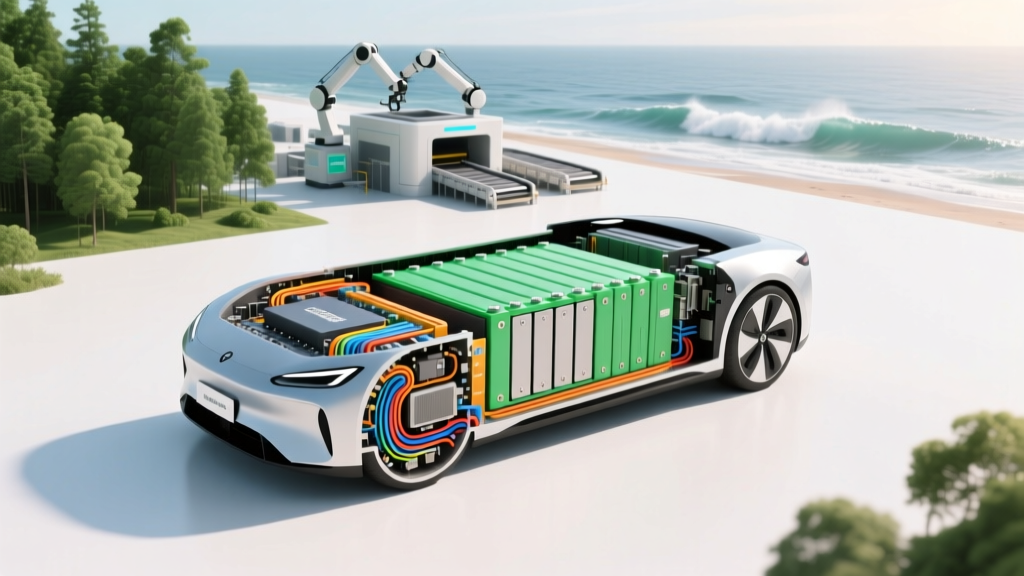
The single most expensive component in any electric vehicle isn't the motor, the interior, or the infotainment system — it's the high-voltage traction battery. A modern lithium ion battery for electric vehicles typically represents 30-40% of the total vehicle cost and is the primary driver of range, charging speed, and long-term ownership satisfaction. Yet battery technology remains one of the most misunderstood aspects of EV ownership.
Buyers routinely ask us: Will the battery outlast the car? How much does replacement actually cost? Is LFP better than NMC? This guide answers those questions with real data — degradation curves from high-mileage fleets, manufacturer warranty terms, out-of-warranty replacement invoices, and chemistry trade-offs that directly affect your daily driving experience.
LFP vs NMC/NCA: The Chemistry Decision That Shapes Your EV
Not all lithium ion batteries are built the same. The cathode chemistry determines energy density, longevity, cold-weather behavior, and cost. In 2026, two chemistry families dominate the US EV market:
- NMC (Nickel Manganese Cobalt) / NCA (Nickel Cobalt Aluminum): Used in most long-range EVs — Tesla Model 3 Long Range, Hyundai Ioniq 5, Ford Mustang Mach-E Extended Range, Chevrolet Equinox EV. These chemistries prioritize energy density, packing more kWh into a lighter, smaller pack.
- LFP (Lithium Iron Phosphate): Found in standard-range and cost-optimized models — Tesla Model 3 RWD, Tesla Model Y RWD (2025+), BYD vehicles entering global markets, and base trims of several upcoming models. LFP trades some energy density for dramatically longer cycle life and lower material cost.
| Attribute | LFP (LiFePO4) | NMC / NCA |
|---|---|---|
| Energy Density | ~160-180 Wh/kg (cell level) | ~220-300 Wh/kg (cell level) |
| Cycle Life (to 80% SoH) | 3,000-5,000+ cycles | 1,000-2,000 cycles |
| Cold-Weather Performance | Moderate — loses more range below 32°F | Better low-temp discharge, aided by heat pumps |
| Recommended Daily SoC | 100% OK — no degradation penalty | 80% preferred for daily; 100% for trips only |
| Thermal Stability | Excellent — highly resistant to thermal runaway | Good — requires robust BMS and cooling |
| Cost (cell level, 2026) | ~$70-85/kWh | ~$100-130/kWh |
| Cobalt Content | None | Varies (low-cobalt NMC trending) |
| Typical Use Case | Standard-range, fleet, daily commuter | Long-range, performance, AWD models |
The practical takeaway: If you drive under 40 miles round-trip daily and can charge at home, an LFP-equipped EV is arguably the smarter long-term buy — you'll charge to 100% every night with virtually no degradation anxiety. If you need 300+ miles of EPA range for road trips or live in a cold climate where every kWh counts, NMC/NCA remains the better fit.
How Long Do EV Batteries Actually Last?
The fear that EV batteries need replacing every few years is not supported by fleet data. According to fueleconomy.gov, most modern EV batteries are engineered to retain 70-80% of their original capacity after 150,000-200,000 miles. Real-world telemetry from high-mileage fleets confirms this trajectory:
Observed Degradation Data Points (Aggregated Fleet Averages):
- Tesla Model 3/Y (NMC, 2018-2022 fleet): ~5% capacity loss at 50,000 miles; ~8-10% loss at 100,000 miles; ~12-15% loss at 200,000 miles (Source: Tesla Impact Report 2024, Recurrent Auto fleet data)
- Chevrolet Bolt EV/EUV (NMC, 2017-2023): ~6-8% loss at 60,000 miles; many packs retaining 88-92% at 100,000 miles. (Note: Bolt's 2021 recall/replacement program reset many packs to near-new condition.)
- Nissan LEAF (LMO/NMC, passively cooled): Higher degradation than liquid-cooled peers — 15-25% loss at 80,000-100,000 miles in hot climates, underscoring the importance of active thermal management.
- Tesla Model 3 RWD (LFP, 2021+ fleet): Minimal measurable degradation at 50,000 miles — many packs showing 97-99% SoH. LFP's cycle-life advantage is evident early.
- Hyundai Ioniq 5 (NMC, 2022+ fleet): ~4-6% loss at 40,000 miles based on owner-reported telemetry; on pace for ~10-12% at 150,000 miles.
What does this mean in plain terms? A 2026 Tesla Model Y Long Range with an EPA-rated 320 miles and an NMC pack losing ~12% over 150,000 miles would still deliver roughly 280 miles of range — more than adequate for most drivers. Battery replacement before 200,000 miles is statistically uncommon for liquid-cooled packs in moderate climates.
EV Battery Warranty Terms: What's Actually Covered
Federal law mandates a minimum 8-year/100,000-mile warranty on EV battery packs (10 years/150,000 miles in CARB states like California, New York, and Massachusetts). But the details matter — specifically the capacity retention threshold that triggers a warranty claim.
| Manufacturer | Warranty Period | Capacity Threshold | Notes |
|---|---|---|---|
| Tesla (Model 3/Y) | 8 yr / 100,000 mi (LR/AWD: 8 yr / 120,000 mi) | 70% retention | LFP and NMC covered equally |
| Hyundai / Kia | 10 yr / 100,000 mi | 70% retention | Among the longest coverage in the industry |
| Ford (Mach-E, F-150 Lightning) | 8 yr / 100,000 mi | 70% retention | Transferable to second owner |
| General Motors (Ultium platform) | 8 yr / 100,000 mi | 70% retention (60% on some commercial) | Covers battery and powertrain components |
| Volkswagen (ID.4) | 8 yr / 100,000 mi | 70% retention | Includes MEB battery management system |
| BMW (i4, iX) | 8 yr / 100,000 mi | 70% retention | Module-level replacement when possible |
Critical nuance: The 70% threshold means you'd need to lose more than 30% of your battery's original capacity for a warranty claim to apply. Based on the degradation data above, very few modern liquid-cooled EVs hit this threshold within the warranty period. The warranty is a safety net, not a prediction.
EV Battery Replacement Cost: What to Budget and When
Out-of-warranty battery replacement remains the biggest fear among prospective EV buyers — and the most exaggerated. Here's what the actual invoices look like in 2026:
| Vehicle | Battery Size | Chemistry | Replacement Cost (parts + labor) | Typical Replacement Trigger |
|---|---|---|---|---|
| Tesla Model 3 RWD | ~60 kWh | LFP | $10,000 - $13,000 | Rare before 250,000+ mi |
| Tesla Model Y Long Range | ~82 kWh | NMC | $14,000 - $18,000 | Cell/module failure, not pure degradation |
| Hyundai Ioniq 5 | ~77.4 kWh | NMC | $12,000 - $16,000 | Module-level service possible |
| Ford Mustang Mach-E ER | ~91 kWh | NMC | $15,000 - $20,000 | Uncommon; module replacement ~$3,000-5,000 |
| Chevrolet Equinox EV | ~85 kWh | NMC (Ultium) | $12,000 - $16,000 | Ultium enables module-level swaps |
| Nissan LEAF (older, passive cooling) | 40-62 kWh | LMO/NMC | $6,500 - $9,000 | Most likely candidate for degradation-based swap |
The honest context: Most EV batteries never need full replacement. When service is required, manufacturers increasingly perform module-level repairs — swapping individual defective modules rather than the entire pack — at costs between $2,000 and $5,000. Full pack replacements are typically driven by manufacturing defects, collision damage, or rare cell failures rather than gradual degradation alone.
Cell prices have also continued their downward trend. According to BloombergNEF, average lithium ion pack prices fell below $120/kWh in 2025 and are projected to approach $90-100/kWh by 2027. This means replacement costs will continue to decline over the life of any EV purchased today.
Factors That Accelerate Battery Degradation
Not all miles are equal when it comes to battery wear. These are the proven accelerants of capacity loss, ranked by impact:
High-Impact Factors:
- Sustained high State of Charge: Storing an NMC battery at 100% SoC for days or weeks accelerates electrolyte decomposition. (LFP is immune to this — charge to 100% freely.)
- Extreme heat exposure: Ambient temperatures above 95°F combined with high SoC is the worst-case scenario. Active liquid cooling mitigates this substantially, but parking in shade or a garage in Phoenix matters.
- Frequent DC fast charging to high SoC: Repeatedly charging above 80% on DC fast chargers generates heat and stress. Occasional road-trip fast charges are fine; daily 100% DCFC sessions are not.
Moderate-Impact Factors:
- Deep discharges to 0%: Letting the battery sit at or near 0% SoC for extended periods can cause copper dissolution in the anode. Keep it above 10% when possible.
- Cold-weather fast charging without preconditioning: Charging a frozen battery at high power causes lithium plating on the anode. Always use your EV's navigation-based preconditioning (Tesla, Hyundai, Ford all offer this) before arriving at a DC fast charger in winter.
Low-Impact Factors:
- Normal daily driving and Level 2 charging: This is what the battery was designed for. Don't overthink it.
- Moderate regen braking: Regen current is well within safe C-rate limits on modern packs.
Monitoring Your Battery's State of Health (SoH)
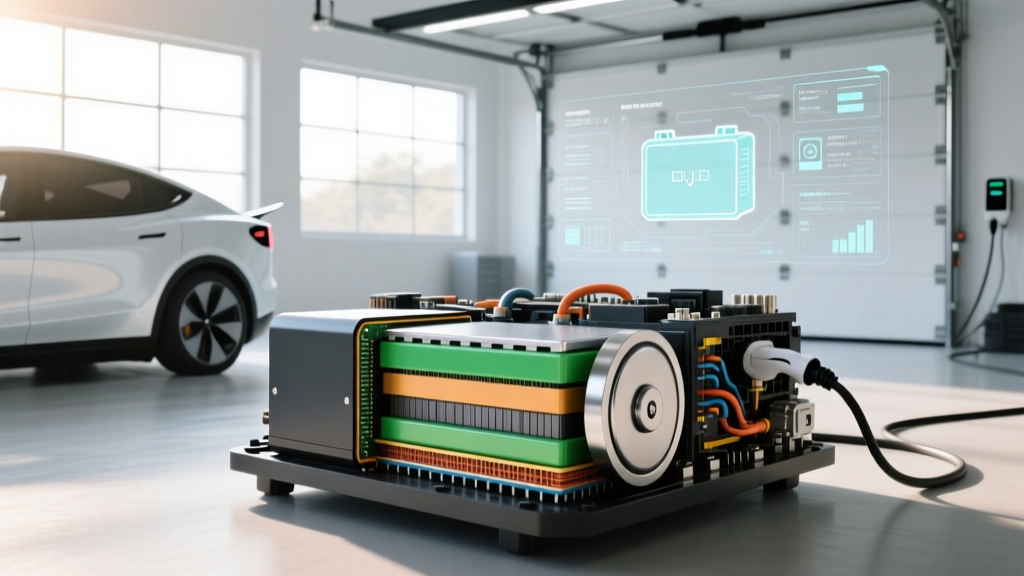
State of Health (SoH) is the percentage of your battery's original usable capacity that remains available. A new EV starts at 100% SoH; a pack at 85% SoH has lost 15% of its original capacity. Here's how to track it:
In-vehicle displays: Tesla provides a battery health estimate in the Service menu (Settings → Service → Battery Health). Hyundai/Kia offers SoH readouts via the dealer diagnostic tool and, on some 2025+ models, through the infotainment system. Ford's MyFordPass app includes battery health monitoring for the F-150 Lightning.
OBD-II diagnostic apps: Third-party tools like OBDeleven (VW/Hyundai/Kia), Scan My Tesla (Tesla), and Leaf Spy Pro (Nissan LEAF) read the battery management system directly, providing real-time SoH, cell voltage variance, and pack temperature data. A $30-50 OBD-II dongle paired with these apps gives you more detail than most dealer service departments volunteer.
Charging-log analysis: Services like Recurrent Auto (free enrollment) analyze your charging patterns and provide battery health reports benchmarked against similar vehicles in their fleet. This is particularly useful for tracking gradual degradation trends over months and years.
Manual calculation: Track your energy consumption over a full charge cycle. If your 77 kWh pack consistently accepts only 68 kWh from 5% to 95% SoC on a Level 2 charger, your SoH is approximately 68/77 = 88%. This isn't perfectly precise (charging losses, buffer size) but provides a reliable trend indicator.
What's Next: Solid-State and Silicon-Anode Batteries
Next-generation battery chemistries are in active development, but timelines matter. Here's where things stand as of 2026:
Silicon-anode lithium ion: Companies like Sila Nanotechnologies and Group14 are replacing graphite anodes with silicon-dominant materials, boosting energy density by 20-40%. These are beginning to appear in limited production — the 2026 Mercedes-Benz G-Class EV uses a silicon-anode pack from Sila. Expect broader adoption across premium EVs by 2027-2028, with mainstream trickledown by 2029-2030.
Solid-state batteries: Toyota, Samsung SDI, and QuantumScape have demonstrated prototype solid-state cells with 400+ Wh/kg energy density and 10-minute fast-charge capability. However, manufacturing scale-up remains the bottleneck. Toyota has announced a 2027-2028 production target for limited-run vehicles; Samsung SDI targets 2027 for sample deliveries to automakers. Realistically, solid-state batteries will not reach mainstream, affordable EVs until 2030 or later.
Sodium-ion batteries: CATL and BYD have begun deploying sodium-ion packs in Chinese-market micro-EVs and energy storage. While energy density is lower than LFP (~120-150 Wh/kg), sodium is abundant and cheap. Watch for sodium-ion in entry-level US-market EVs or as a supplementary pack in dual-chemistry configurations by 2028-2029.
The practical advice: don't delay an EV purchase waiting for solid-state. Today's lithium ion batteries — particularly LFP — already deliver 15-20 year useful lifespans with manageable degradation. The next generation will be incrementally better, not transformationally different for the average buyer.
Frequently Asked Questions
How long do EV batteries last in years and miles?
Modern liquid-cooled EV batteries typically last 15-20 years or 150,000-200,000+ miles before degrading below 70-80% of original capacity. Fleet data from Tesla, Hyundai, and Chevrolet shows average degradation of 8-12% at 100,000 miles for NMC packs and under 5% for LFP packs. Most EV batteries will outlast the vehicle's body, suspension, and interior.
How much does it cost to replace an EV battery?
Full battery pack replacement costs range from $6,500 (Nissan LEAF 40 kWh) to $20,000 (large packs like the Ford F-150 Lightning's 131 kWh Extended Range). Most replacements fall in the $12,000-$16,000 range for mainstream 75-85 kWh packs. However, full replacements are rare — module-level repairs typically cost $2,000-$5,000, and most packs never require service at all during typical ownership.
What does the EV battery warranty actually cover?
Federal law requires a minimum 8-year/100,000-mile warranty covering defects and capacity loss below 70% of original capacity. CARB states extend this to 10 years/150,000 miles. The warranty covers the battery pack, management system, and associated powertrain electronics. It does not cover damage from accidents, flooding, or unauthorized modifications. Some manufacturers (Hyundai, Kia) offer longer coverage voluntarily.
How do I check my EV battery's health?
Use your vehicle's built-in battery health screen (Tesla, some 2025+ Hyundai/Kia models), connect an OBD-II dongle with apps like Scan My Tesla or OBDeleven for detailed SoH and cell-level data, or enroll in a service like Recurrent Auto for automated fleet-benchmarked reports. Manual tracking — comparing kWh accepted during full charges over time — also reveals degradation trends.
LFP vs NMC — which battery chemistry is better?
Neither is universally better; it depends on your driving pattern. Choose LFP if you drive under 50 miles daily, charge at home, want maximum longevity (3,000-5,000 cycles), and don't mind slightly less range. Choose NMC/NCA if you need 300+ miles of EPA range, frequently road-trip, live in extreme cold, or want the lightest possible pack. LFP wins on lifespan and cost; NMC wins on energy density and cold-weather performance.
Does DC fast charging damage my EV battery?
Occasional DC fast charging has minimal impact on modern liquid-cooled packs. The risk comes from frequent high-power charging combined with high SoC and high temperatures. Best practice: use Level 2 home charging for daily needs, reserve DC fast charging for road trips, and avoid charging above 80% on DCFC unless you need the full range. Preconditioning the battery before winter fast charges prevents lithium plating.
Should I charge my EV to 100% every day?
For LFP batteries: yes, daily 100% charging is recommended and causes no measurable extra degradation. For NMC/NCA batteries: limit daily charging to 80% and reserve 100% for road trips or when you need maximum range. Tesla, Ford, and Hyundai all include configurable charge limits in their apps and vehicle settings to automate this.