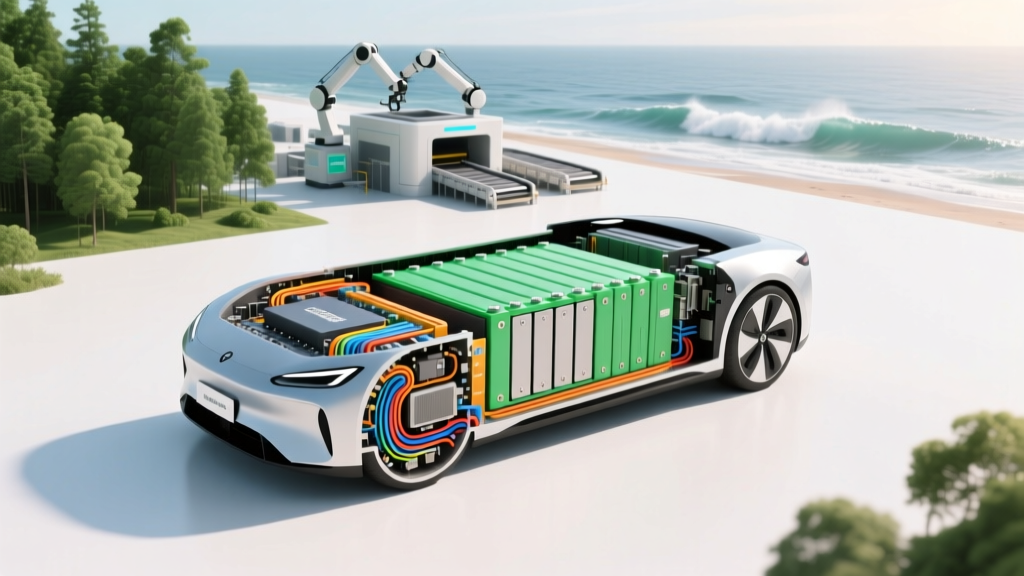
A persistent myth in EV forums and social media threads suggests that millions of spent electric vehicle batteries will be dumped into the sea — a fear often summarized by the phrase "car batteries in the ocean." It's a striking image, and it's almost entirely wrong. The reality of EV battery lifecycle management is far more nuanced, and frankly, far more encouraging than the doom-scrolling suggests.
As of 2026, the vast majority of retired EV traction batteries are either repurposed for stationary energy storage or processed through recycling chains that recover 95% or more of critical minerals like lithium, cobalt, and nickel. Companies like Redwood Materials and Li-Cycle operate large-scale facilities in the U.S. specifically designed to keep battery materials in a closed-loop supply chain — not at the bottom of the Pacific.
But before we get to end-of-life, the more practical question for buyers and owners is: how long will your EV battery actually last, what degrades it, and what does it cost if something goes wrong? Let's get into the data.
How Long Do EV Batteries Actually Last?
The short answer: longer than most buyers expect. Real-world fleet data from high-mileage EVs consistently shows that modern lithium-ion traction batteries retain useful capacity well past 150,000 miles, and many reach 200,000+ miles before dropping below 80% of original capacity.
Here's what the data shows across major chemistries and platforms:
| Vehicle / Platform | Chemistry | Mileage | Capacity Retained | Source |
|---|---|---|---|---|
| Tesla Model 3/Y (2018–2023) | NMC / NCA | 100,000 mi | ~88–92% | Tesla Impact Report 2024 |
| Tesla Model 3 Standard Range (LFP) | LFP | 100,000 mi | ~92–95% | Fleet owner data / Recurrent |
| Nissan Leaf (2013–2017, air-cooled) | NMC | 80,000 mi | ~75–82% | Recurrent Auto |
| Hyundai Ioniq 5 / Kia EV6 | NMC | 60,000 mi | ~93–96% | Owner forums / Recurrent |
| Chevrolet Bolt EV/EUV | NMC (LG) | 80,000 mi | ~90–94% | Recurrent Auto |
The outlier in historical data is the early Nissan Leaf, which used passive air cooling rather than active liquid thermal management. That generation degraded significantly faster in hot climates. Nearly every EV sold since 2018 uses liquid-cooled battery packs, which dramatically slows degradation.
Real-world expectation: A 2025–2026 EV with liquid-cooled thermal management should retain 85–90%+ of its original battery capacity at 150,000 miles under normal use. Most batteries will outlast the vehicle's body and interior.
LFP vs. NMC/NCA: Which Battery Chemistry Is Better — and Why?
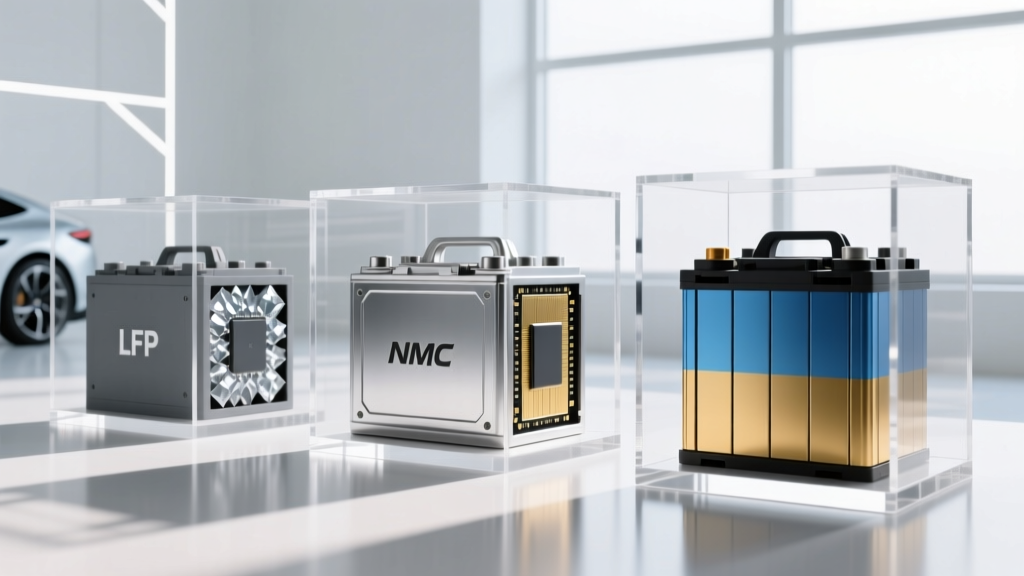
The two dominant lithium-ion chemistries in 2026 EVs are LFP (lithium iron phosphate) and NMC/NCA (nickel manganese cobalt / nickel cobalt aluminum). They have meaningfully different trade-offs, and the "better" choice depends entirely on your driving pattern.
| Attribute | LFP (Lithium Iron Phosphate) | NMC / NCA (Nickel-based) |
|---|---|---|
| Energy Density | Lower (~160–180 Wh/kg cell-level) | Higher (~230–290 Wh/kg cell-level) |
| Typical EPA Range | 220–280 mi (standard-range models) | 280–400+ mi (long-range models) |
| Cycle Life | 3,000–5,000+ cycles | 1,000–2,000 cycles |
| Cold-Weather Performance | More range loss in cold (~30–40% at 20°F) | Better cold performance (~20–30% loss at 20°F) |
| Recommended Daily SoC | 100% daily OK (BMS benefits from full calibrations) | 80% daily recommended; 100% for trips only |
| Cost | Lower (no cobalt or nickel) | Higher (critical mineral cost exposure) |
| Thermal Stability | Excellent — very low thermal runaway risk | Good — requires robust BMS/thermal management |
| Common In (2026) | Tesla Model 3/Y RWD, Ford Mustang Mach-E Select, base Chevy Equinox EV | Tesla Long Range, Hyundai Ioniq 5, Rivian, Ford extended-range |
Choose LFP if: You mostly drive under 250 miles per day, want maximum cycle life and longevity, can charge at home regularly, and live in a moderate or warm climate. LFP's ability to be charged to 100% daily without accelerated degradation is a genuine ownership advantage.
Choose NMC/NCA if: You need maximum range for road trips, live in a cold climate where winter range loss matters, or need the energy density for a larger vehicle (truck, large SUV). NMC packs deliver more miles per charge but benefit from staying between 20–80% SoC for daily use.
What Degrades an EV Battery? Five Factors That Actually Matter
Battery degradation isn't random — it follows predictable electrochemical patterns. Here are the five factors with the largest measured impact on long-term State of Health (SoH):
- 1. Sustained high State of Charge (SoC): Storing an NMC battery at 100% for days or weeks accelerates electrolyte decomposition and cathode structural fatigue. Keep daily SoC at 80% unless you need the full range for a trip. LFP is the exception — 100% is fine and actually helps the BMS calibrate.
- 2. Frequent DC fast charging at high power: Repeatedly pulling 150–350 kW into a battery generates significant internal heat and lithium plating risk. Occasional fast charging is fine (the BMS manages it), but daily 350 kW sessions will accelerate degradation vs. Level 2 home charging. Data from Recurrent Auto shows that vehicles fast-charging more than 3x per week show ~2–3% additional capacity loss over 100,000 miles compared to primarily L2-charged vehicles.
- 3. Extreme heat exposure: Battery packs sitting in 100°F+ ambient temperatures without active cooling degrade faster. This was the early Leaf's problem. Modern liquid-cooled packs manage this well, but parking in shade or a garage in desert climates still helps.
- 4. Deep discharge cycles (below 10% SoC): Regularly draining the battery to near-zero stresses the anode. Try to keep the floor around 10–15% for daily driving.
- 5. Time (calendar aging): Even a garage-kept EV battery slowly loses capacity through calendar aging — typically 1–2% per year regardless of mileage. This is why a 10-year-old EV with 50,000 miles might show similar degradation to one with 120,000 miles.
EV Battery Warranty Terms: What's Actually Covered?
Federal law mandates a minimum 8-year / 100,000-mile warranty on EV battery packs (10 years / 150,000 miles in CARB states like California). Most manufacturers meet or exceed this baseline, but the details matter — especially the capacity retention threshold.
| Manufacturer | Warranty Term | Capacity Threshold | Notes |
|---|---|---|---|
| Tesla (Model 3/Y LFP) | 8 yr / 100,000 mi | 70% | Standard Range; covers defects + excessive degradation |
| Tesla (Model 3/Y LR, Model S/X) | 8 yr / 120,000 mi (S/X: 150k) | 70% | Long Range / Performance |
| Hyundai / Kia (Ioniq 5, EV6, EV9) | 10 yr / 100,000 mi | 70% | Among the longest terms in the industry |
| Ford (Mach-E, F-150 Lightning) | 8 yr / 100,000 mi | 70% | Covers battery components + degradation |
| GM (Chevy Equinox EV, Blazer EV, Silverado EV) | 8 yr / 100,000 mi | 70% | Ultium platform |
| Rivian (R1T, R1S) | 8 yr / 120,000 mi | 70% | Extended mile coverage for adventure use |
| BMW (i4, iX, i7) | 8 yr / 100,000 mi | 70% | Includes battery conditioning system |
Critical nuance: The 70% threshold means the manufacturer replaces or repairs the battery only if it drops below 70% of original capacity within the warranty period. Since most modern liquid-cooled packs retain 85–92% at 100,000 miles, warranty claims for degradation are rare. Most claims involve manufacturing defects (bad cells, BMS faults) rather than normal wear.
The warranty covers the high-voltage traction battery — not the 12V auxiliary battery that powers accessories and computers. That 12V battery is a separate component with its own replacement cycle (typically 3–5 years, similar to any vehicle).
How Much Does It Cost to Replace an EV Battery?
This is the number that generates the most anxiety — and the most misinformation. Replacement costs vary enormously by vehicle, battery size, and whether you need a full pack or a module-level repair.
| Vehicle | Battery Size (kWh usable) | Full Pack Replacement | Module Repair | Typical Need Timeline |
|---|---|---|---|---|
| Tesla Model 3 RWD (LFP) | ~57 kWh | $8,000–$12,000 | $2,500–$5,000 | Rarely before 200k+ mi |
| Tesla Model Y Long Range | ~75 kWh | $12,000–$16,000 | $3,000–$6,000 | Rarely before 200k+ mi |
| Hyundai Ioniq 5 | ~77.4 kWh | $10,000–$15,000 | $3,000–$5,500 | Rarely before 180k+ mi |
| Ford F-150 Lightning Ext. Range | ~131 kWh | $18,000–$25,000 | $5,000–$9,000 | Rarely before 150k+ mi |
| Chevrolet Equinox EV | ~85 kWh | $10,000–$14,000 | $3,000–$5,500 | Rarely before 180k+ mi |
| Rivian R1T (Large Pack) | ~128 kWh | $18,000–$22,000 | $5,000–$8,000 | Rarely before 150k+ mi |
Context that matters: Battery replacement costs have fallen roughly 8–12% per year over the past decade as cell manufacturing scales and module-level diagnostics improve. Many out-of-warranty repairs now involve replacing individual modules (a pack contains 4–12+ modules) rather than the entire pack, cutting costs by 50–70%.
Additionally, the growing market for refurbished and remanufactured packs is creating lower-cost replacement options. By 2028–2030, industry analysts project full-pack replacement costs for mainstream EVs will drop into the $5,000–$10,000 range as second-life battery markets mature.
The honest framing: most EV owners will sell or trade the vehicle before the battery needs replacement. The battery is not a wear item the way brake pads or tires are — it's a slowly degrading component that remains functional for the vehicle's practical lifespan.
How to Check and Maximize Your EV Battery Health
Monitoring your battery's State of Health (SoH) is straightforward, and there are several methods available to owners:
Checking SoH
- In-vehicle displays: Many 2025–2026 EVs (Tesla, Hyundai/Kia, BMW) now include a battery health percentage in the service or energy menu. Tesla's "Battery Health" tile in the app shows estimated max capacity vs. original.
- OBD-II diagnostic tools: Devices like the OBDLink SX paired with apps such as EVnotify or Scan My Tesla can pull real-time SoH data, cell voltage deltas, and pack temperature from the BMS.
- Third-party services: Recurrent Auto offers free battery health reports that compare your degradation curve against fleet averages for your specific model and climate zone.
- Dealer diagnostic: Any authorized service center can run a full battery health report — request this during routine service or before a used-EV purchase.
Maximizing Battery Longevity
- Set daily charge limit to 80% for NMC/NCA; 100% is fine for LFP
- Use Level 2 home charging as your primary method; fast-charge when needed, not by default
- Precondition the battery before fast charging (most EVs do this automatically when a charger is set in navigation)
- Avoid leaving the vehicle at 100% SoC or below 10% SoC for extended periods (days+)
- In extreme heat, park in shade or a garage when possible
- Keep the vehicle plugged in during extreme cold so the thermal management system can maintain pack temperature
The "Car Batteries in the Ocean" Myth: What Actually Happens to Retired EV Batteries
Let's address the keyword directly. The idea that EV batteries are being dumped in the ocean is not supported by evidence or current industrial practice. Here's what actually happens when an EV battery reaches end-of-vehicle-life:
Stage 1 — Second-life stationary storage (60–70% of retired packs): A battery at 70–80% capacity is no longer ideal for a vehicle, but it's perfectly suited for grid energy storage, solar farm buffering, or commercial backup power. Companies like B2U Storage Solutions and Tesla's Megapack program repurpose retired EV modules for 10–15 additional years of stationary use.
Stage 2 — Recycling (remaining 30–40%): When cells are too degraded for any use, hydrometallurgical recycling recovers 95%+ of lithium, 97%+ of cobalt and nickel, and aluminum and copper current collectors. Redwood Materials (Nevada) and Li-Cycle (multiple U.S. facilities) process tens of thousands of tons of battery material annually, feeding recovered minerals back into new battery production.
The EPA and state environmental agencies regulate battery disposal, and lithium-ion batteries are classified as hazardous waste if landfilled — making ocean dumping both illegal and economically irrational when the recovered materials are worth hundreds of dollars per pack.
The real environmental concern isn't disposal — it's mining. Extracting virgin lithium, cobalt, and nickel has documented ecological and human-rights impacts. That's precisely why the recycling infrastructure is scaling so aggressively: every recycled battery reduces the need for new mining.
Emerging Battery Technology: Solid-State and Silicon Anodes
Looking ahead, two technologies are poised to change the battery longevity and performance equation — but neither is available in production EVs as of early 2026.
Solid-state batteries replace the liquid electrolyte with a solid ceramic or polymer layer, promising higher energy density (~400+ Wh/kg cell-level), faster charging, and dramatically reduced fire risk. Toyota has announced solid-state EV prototypes targeting 2027–2028 production, and Samsung SDI is piloting cells for 2028. However, manufacturing yield, cost, and scaling challenges mean solid-state will likely debut in premium/limited-production vehicles before reaching mainstream pricing — realistically 2029–2031 for volume models.
Silicon-dominant anodes (replacing graphite) offer 10x the lithium-ion storage capacity per gram at the anode, enabling smaller, lighter packs with equivalent range. Companies like Sila Nanotechnologies and Group14 are already shipping silicon-anode cells to early automotive partners, with limited production vehicles expected by 2027–2028. The challenge is managing silicon's volume expansion during charge cycles, which historically caused rapid mechanical degradation.
Forward-looking timeline (announced/preliminary — not currently available):
- 2027–2028: First limited-production solid-state and silicon-anode EVs (likely premium Japanese and Korean brands)
- 2029–2031: Solid-state reaches mainstream vehicle pricing ($35k–$50k segment)
- 2032+: Potential for 500+ mile range, 5-minute fast charging, and 500,000-mile cycle life — if manufacturing scales as projected
For buyers shopping today, current-generation LFP and NMC batteries are mature, well-understood, and backed by extensive real-world data. Waiting for solid-state means waiting 3–5+ years for volume availability at non-premium pricing.
Frequently Asked Questions
How long do EV batteries last in years and miles?
Most 2024–2026 EV batteries with liquid thermal management will retain 85–90%+ of original capacity at 150,000 miles (roughly 10–12 years of average U.S. driving at 13,500 mi/yr). Many packs reach 200,000+ miles before dropping to the 70% warranty threshold. Calendar aging adds ~1–2% loss per year regardless of mileage.
How much does an EV battery cost to replace in 2026?
Full pack replacement ranges from approximately $8,000 (smaller LFP packs like Tesla Model 3 RWD) to $25,000 (large packs like the F-150 Lightning Extended Range). Module-level repairs cost $2,500–$9,000 depending on the vehicle. Costs are declining 8–12% annually as manufacturing scales and refurbished options expand.
What does the EV battery warranty actually cover?
Federal law requires at least 8 years / 100,000 miles of coverage (10/150k in CARB states). The warranty covers manufacturing defects and excessive degradation — defined as dropping below 70% of original capacity. It does not cover damage from accidents, flooding, or aftermarket modifications. The 12V auxiliary battery is covered separately under the standard vehicle warranty (typically 3 yr / 36,000 mi).
How do I check my EV battery's State of Health?
Use the vehicle's built-in battery health display (available on most 2025+ models), connect an OBD-II reader with EV-compatible software like EVnotify, or sign up for a free report from Recurrent Auto. Dealers can also pull a comprehensive BMS diagnostic during service visits.
LFP vs NMC — which battery chemistry should I choose?
LFP is better for daily commuting, maximum longevity (3,000–5,000+ cycles), and lower cost — but offers less range and worse cold-weather performance. NMC/NCA is better for road trips, cold climates, and maximum range — but costs more and benefits from staying at 80% SoC daily. Neither is universally "better"; the right choice depends on your driving pattern and climate.
Are EV batteries really dumped in the ocean?
No. Retired EV batteries are either repurposed for 10–15 years of stationary energy storage or recycled through hydrometallurgical processes that recover 95%+ of critical minerals. Lithium-ion batteries are regulated as hazardous waste if landfilled, and the recovered materials are too valuable to discard. Ocean dumping of EV batteries is not documented practice and is illegal under U.S. environmental law.