If you've searched for "2018 Kia Optima battery" you're likely dealing with one of two realities: a 12-volt auxiliary battery that's gone flat, or a high-voltage traction battery concern in the 2018 Kia Optima Plug-In Hybrid (PHEV). This guide addresses both, then zooms out to the bigger question every electrified-vehicle owner asks: how long do EV and PHEV batteries actually last, and what does replacement cost?
We'll cover the Optima PHEV's 9.8 kWh lithium-polymer pack specifically, then pull back to the broader landscape of EV battery chemistry, degradation data, warranty coverage, and care strategies that apply whether you drive a 2018 Kia, a 2026 Hyundai Ioniq 6, or a Tesla Model Y.
The 2018 Kia Optima PHEV Battery: Specs and What to Expect
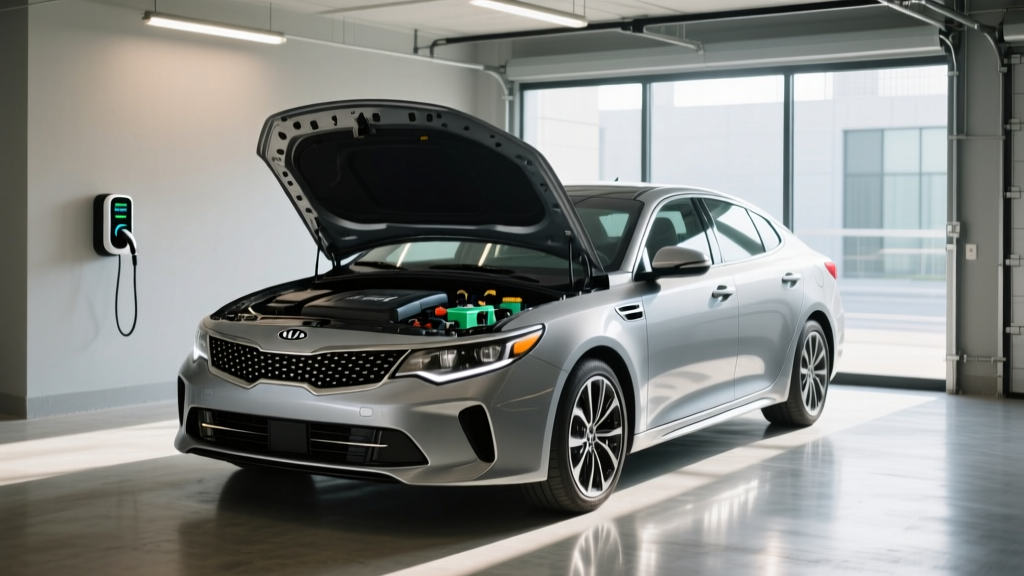
The 2018 Kia Optima PHEV pairs a 2.0-liter four-cylinder engine with a 50 kW electric motor and a 9.8 kWh lithium-polymer (NMC chemistry) battery pack. EPA-rated electric-only range sits at 29 miles, with a combined MPGe of 103 and 41 MPG once the gas engine kicks in.
| Spec | Value |
|---|---|
| Battery Chemistry | Lithium-Polymer (NMC) |
| Battery Capacity | 9.8 kWh (gross) |
| EPA Electric Range | 29 miles |
| Electric Motor | 50 kW (67 hp) |
| Combined System Output | 202 hp |
| Level 2 Charge Time (0–100%) | ~3 hours at 3.3 kW |
| Battery Warranty | 10 yr / 100,000 mi (13 yr / 100,000 mi in CARB states) |
As of 2026, an 8-year-old Optima PHEV battery has likely experienced 10–20% capacity degradation depending on climate, charging habits, and mileage. That means your real-world electric range may have dropped from 29 miles to roughly 23–26 miles. This is normal and does not indicate a failing pack.
A critical distinction: Many "2018 Kia Optima battery" searches relate to the 12V auxiliary battery — the small lead-acell or AGM battery that powers electronics, lights, and the DC-DC converter startup sequence. A dead 12V battery will prevent the car from starting even if the high-voltage pack is fully charged. Replacement for the 12V unit runs $150–$300 and is routine maintenance, unrelated to the traction battery.
EV Battery Chemistry: LFP vs NMC vs NCA Explained
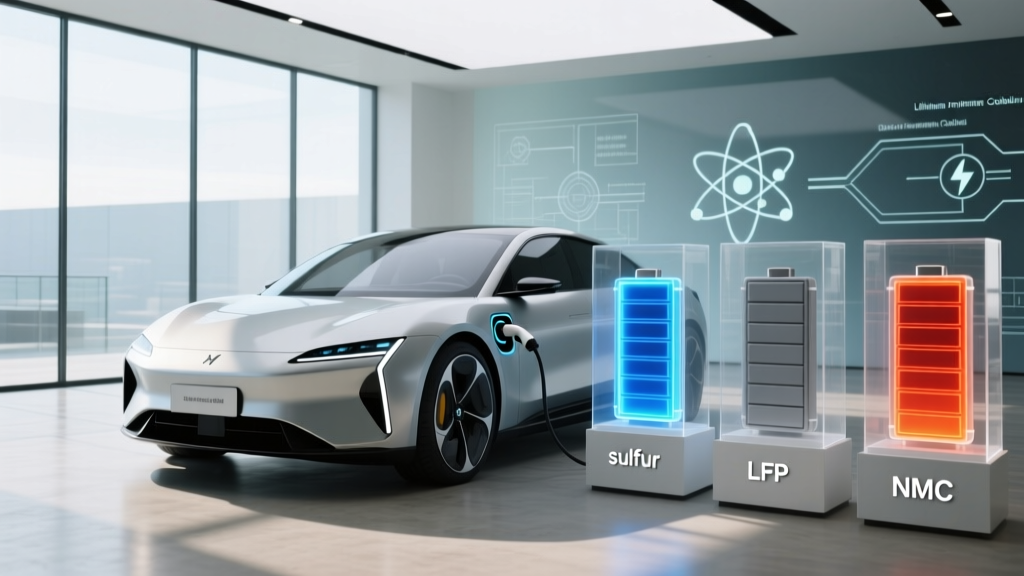
The battery chemistry inside your EV or PHEV determines its energy density, lifespan, cold-weather performance, and cost. The two dominant chemistries in 2026 are NMC/NCA (nickel manganese cobalt / nickel cobalt aluminum) and LFP (lithium iron phosphate).
| Attribute | LFP (Lithium Iron Phosphate) | NMC / NCA (Nickel-Based) |
|---|---|---|
| Energy Density | Lower (~160 Wh/kg cell-level) | Higher (~250–300 Wh/kg cell-level) |
| Cycle Life | 3,000–5,000+ cycles to 80% SoH | 1,000–2,000 cycles to 80% SoH |
| Cold-Weather Performance | Weaker; greater range loss below 32°F | Better low-temp conductivity |
| Cost | Lower (no cobalt or nickel) | Higher (commodity-sensitive) |
| Charging to 100% Daily | Recommended for accurate BMS calibration | Generally discouraged; 80% daily preferred |
| Thermal Stability | Superior (higher runaway threshold) | Good, but requires robust thermal management |
| Typical Applications | Tesla Model 3 RWD, Ford Mustang Mach-E SR, BYD models | Long-range EVs, most PHEVs including Optima |
Which is better? It depends on your use case. NMC/NCA wins for maximum range in a compact package — essential for 300+ mile EVs and PHEVs with limited under-floor space. LFP wins on longevity, cost, and safety, making it ideal for standard-range vehicles and daily commuters who can charge to 100% without penalty. The 2018 Optima PHEV uses NMC lithium-polymer cells, consistent with nearly all PHEVs of that era.
How Long Do EV Batteries Last? Degradation Data
EV and PHEV batteries don't "die" suddenly — they gradually lose capacity over time and charge cycles. Based on fleet data from sources like Geotab's analysis of 10,000+ EVs, here's what real-world degradation looks like:
| Age / Mileage | Average Capacity Retained | Notes |
|---|---|---|
| Year 1 / 15,000 mi | 96–98% | Initial steeper drop, then plateau |
| Year 3 / 45,000 mi | 92–95% | Gradual linear decline |
| Year 5 / 75,000 mi | 88–92% | Still well within warranty threshold |
| Year 8 / 100,000 mi | 82–90% | Warranty period ends; most packs above 80% |
| Year 10 / 150,000 mi | 78–87% | Varies heavily by climate and DCFC use |
| Year 15 / 200,000 mi | 70–82% | Many original packs still functional |
Key takeaways from this data:
- Most EV batteries outlast the vehicles they're installed in. The average car on US roads is 12.6 years old. Battery replacement before end-of-vehicle-life is the exception, not the rule.
- Year-one degradation is the steepest (2–4%), then the curve flattens significantly.
- Hot climates accelerate degradation. Vehicles in Phoenix or Houston show 1–3% more loss at the 5-year mark than those in Seattle or Minneapolis, primarily due to sustained high-temperature exposure.
- Frequent DC fast charging correlates with slightly higher degradation — roughly 1–2% additional loss over 100,000 miles compared to predominantly Level 2 charging.
EV Battery Warranty Coverage: What's Protected
Federal law mandates that EV and PHEV batteries carry a minimum warranty of 8 years / 100,000 miles. In CARB (California Air Resources Board) states, that extends to 10 years / 150,000 miles for PZEV/AT-PZEV components. Many manufacturers exceed these minimums.
| Vehicle | Warranty Term | Capacity Threshold |
|---|---|---|
| 2018 Kia Optima PHEV | 10 yr / 100,000 mi (13/100k CARB) | Below 70% capacity |
| 2026 Tesla Model Y (NMC) | 8 yr / 120,000 mi | Below 70% capacity |
| 2026 Hyundai Ioniq 5 | 10 yr / 100,000 mi | Below 70% capacity |
| 2026 Ford F-150 Lightning | 8 yr / 100,000 mi | Below 70% capacity |
| 2026 Chevrolet Bolt EV (LFP) | 8 yr / 100,000 mi | Below 70% capacity |
What triggers a warranty claim? If your battery's State of Health (SoH) drops below the stated threshold — typically 70% of original capacity — within the warranty period, the manufacturer must repair or replace the pack at no cost. In practice, a dealer will perform a diagnostic scan to confirm capacity loss before authorizing a claim.
Note: warranties cover defects and excessive degradation, not damage from accidents, flooding, or unauthorized modifications. Always keep records of charging habits and service visits in case you need to support a claim.
EV Battery Replacement Cost: What You'll Actually Pay
If your battery degrades beyond the warranty threshold after coverage expires, or if it suffers physical damage, replacement costs depend heavily on pack size and chemistry.
| Vehicle Type | Battery Size | Replacement Cost Range | Typical Need Timeline |
|---|---|---|---|
| PHEV (e.g., Optima PHEV) | 8–15 kWh | $4,000–$8,000 | Rarely needed; 15+ year lifespan |
| Compact EV (e.g., Bolt, Model 3 RWD) | 50–65 kWh | $8,000–$14,000 | 150,000–200,000+ mi |
| Mid-size EV (e.g., Model Y, Ioniq 5) | 75–85 kWh | $12,000–$18,000 | 150,000–200,000+ mi |
| Large EV/Truck (e.g., F-150 Lightning) | 100–130 kWh | $18,000–$28,000 | 200,000+ mi |
Context that matters: According to data from Consumer Reports and warranty claim rates, fewer than 2–3% of EV batteries are replaced under or post-warranty. The vast majority of packs retain 75–85% capacity at 150,000 miles. Most EV batteries are never replaced during the vehicle's useful life.
Additionally, battery prices continue to decline. Pack-level costs have fallen from over $200/kWh in 2018 to approximately $110–$130/kWh in 2026, meaning a replacement pack today costs significantly less than it would have five years ago. Refurbished and remanufactured packs are also increasingly available at 30–50% below new-pack pricing.
Factors That Affect EV Battery Life (and What You Can Control)
Battery degradation is driven by three primary factors: temperature, charge state, and charge speed. Here's how each works and what you can do:
Battery Care Best Practices
- Avoid sustained 100% SoC (NMC/NCA packs): Daily charging to 80% reduces stress on nickel-based cells. Charge to 100% only before long trips. LFP packs are an exception — manufacturers recommend periodic 100% charges for BMS calibration.
- Minimize DC fast charging when possible: Occasional DCFC is fine, but daily 150+ kW sessions generate heat that accelerates degradation. Level 2 home charging (7–11 kW) is gentler and cheaper.
- Park in shade or a garage in hot climates: Sustained battery temperatures above 95°F accelerate chemical wear. Preconditioning while plugged in helps manage thermal load.
- Don't let SoC sit at 0% for extended periods: If storing the vehicle for weeks, aim for 40–60% SoC. Deep discharge damages cells irreversibly.
- Use preconditioning before fast charging: Most modern EVs warm or cool the battery to optimal temperature (~70–85°F) before accepting a DC fast charge. This protects the cells and improves charge speed. If your EV has a "navigate to charger" preconditioning feature, use it.
- Keep tires properly inflated and reduce excess weight: While not directly a battery factor, lower energy demand means fewer charge cycles over the vehicle's life.
How to Check and Monitor Your Battery's State of Health
State of Health (SoH) measures your battery's current maximum capacity relative to its original capacity when new. A brand-new pack is 100% SoH; a pack that held 75 kWh when new but now holds 67.5 kWh is at 90% SoH.
Methods for checking SoH:
- Dealer diagnostic scan: Any authorized dealer can pull a SoH reading from the BMS (Battery Management System). This is the most accurate method and is required for warranty claims.
- OBD-II scanner apps: Tools like Leaf Spy (Nissan), Scan My Tesla, or brand-specific apps can read SoH data via the OBD-II port. For the 2018 Optima PHEV, Kia-specific diagnostic tools or a generic OBD reader with EV PID support may show battery health metrics.
- Manual range tracking: Charge to 100%, note the displayed range, and compare to the EPA sticker. If your Optima PHEV originally showed 29 miles of electric range at full charge and now shows 24, your SoH is approximately 83%. This method is approximate — temperature and driving style affect the displayed range estimate.
- Third-party battery health reports: Services like Recurrent and some used-EV marketplaces now provide battery health certificates based on telematics data.
For the 2018 Optima PHEV specifically, Kia's infotainment system includes an EV energy-flow display that shows real-time battery usage, but it does not display a SoH percentage directly. A dealer visit or OBD-II scan is the most reliable path.
Emerging Battery Tech: Solid-State and Beyond
Looking ahead, several next-generation battery technologies are in development — but none are available in production vehicles as of 2026.
Solid-state batteries replace the liquid electrolyte with a solid material, promising higher energy density (potentially 400+ Wh/kg at the cell level), faster charging, and improved safety. Toyota, Samsung SDI, and QuantumScape have demonstrated prototype cells, but mass production at automotive scale remains estimated for 2028–2030 at the earliest, with initial deployment likely in limited-run or premium vehicles.
Silicon-anode batteries (from companies like Sila Nanotechnologies and Group14) increase the silicon content in the anode to boost energy density by 20–40%. These are closer to commercialization — some are appearing in consumer electronics — but automotive-grade validation is ongoing, with first EV applications expected around 2027–2028.
Sodium-ion batteries offer a low-cost, cobalt-free alternative for budget EVs and stationary storage. CATL has begun production in China, but energy density remains below LFP, limiting range. US-market vehicles using sodium-ion are not yet announced.
For buyers today, current lithium-ion technology (both LFP and NMC) is mature, well-understood, and backed by extensive real-world data. Waiting for solid-state is not a practical strategy — today's batteries already last the life of the vehicle in most cases.
Frequently Asked Questions
How long do EV batteries last in years and miles?
Based on fleet data, most EV and PHEV batteries retain 78–90% of original capacity at 150,000 miles (roughly 10–12 years). Catastrophic failure is rare — fewer than 2–3% of packs are replaced. Many original batteries outlast the vehicles they power.
How much does an EV battery cost to replace?
Replacement costs range from $4,000–$8,000 for a PHEV pack (like the Optima's 9.8 kWh unit) to $12,000–$28,000 for full EV packs depending on size. Battery costs have fallen to ~$110–$130/kWh in 2026, and refurbished packs offer 30–50% savings. Most owners never need a replacement.
What does the EV battery warranty cover?
Federal law requires at least 8 years / 100,000 miles of coverage (10/150k in CARB states). The warranty triggers if capacity drops below ~70% of original. Kia's warranty on the 2018 Optima PHEV is 10 years / 100,000 miles, extending to 13 years in CARB states.
How do I check my EV battery health?
The most accurate method is a dealer BMS diagnostic scan. You can also use OBD-II scanner apps for at-home readings, or manually compare your full-charge displayed range against the EPA-rated figure. For the 2018 Optima PHEV, a Kia dealer can pull the SoH percentage during any service visit.
LFP vs NMC — which battery chemistry is better?
NMC/NCA offers higher energy density (more range per pound) and better cold-weather performance, making it ideal for long-range EVs. LFP offers longer cycle life (3,000–5,000 cycles vs 1,000–2,000), lower cost, and superior thermal stability, but sacrifices some range and cold-weather efficiency. Neither is universally "better" — the right choice depends on your driving patterns and climate.
Does fast charging damage my EV battery?
Occasional DC fast charging has minimal impact. However, daily use of 150+ kW chargers can add 1–2% additional degradation over 100,000 miles compared to Level 2 charging. Preconditioning the battery before fast charging and avoiding charging above 80% on DCFC sessions reduces wear.
Is the 2018 Kia Optima PHEV battery covered under warranty in 2026?
Yes — Kia's 10-year / 100,000-mile battery warranty means a 2018 Optima PHEV is covered through the 2028 model year or 100,000 miles, whichever comes first. In CARB states (including CA, NY, MA, WA, and others), coverage extends to 13 years / 100,000 miles, potentially through 2031. Check your state's status and your odometer to confirm eligibility.