The single biggest fear for prospective EV buyers isn't range or charging speed — it's the battery. Specifically: how long do electric batteries last, what happens when they degrade, and will a replacement cost more than the car is worth? These are legitimate questions that deserve data-driven answers, not marketing reassurance.
After tracking fleet data, manufacturer warranty claims, and independent battery-health reports through 2026, the short answer is encouraging: most modern EV traction batteries are designed to outlast the useful life of the vehicle itself. But "most" isn't "all," and chemistry choices, charging habits, and climate play measurable roles in how your pack ages. Here's what the numbers actually say.
The Real Answer: How Long Do EV Batteries Last?
EV batteries don't "die" the way a phone battery might — they don't suddenly stop working. Instead, they gradually lose capacity over time and use, meaning your 300-mile EV might deliver 270 miles of range after several years. The industry standard for "end of life" is when a battery can no longer hold 70–80% of its original capacity, and even then, it still functions — just with reduced range.
Based on aggregated fleet data from sources like Recurrent Auto, which tracks over 15,000 EVs in real-world conditions, here's what typical degradation looks like across model years 2020–2025:
Typical EV Battery Degradation Curve
| Vehicle Age | Average Capacity Retained | Range Impact (on 300-mi EPA vehicle) |
|---|---|---|
| Year 1 | 95–97% | ~285–291 mi |
| Year 2 | 93–95% | ~279–285 mi |
| Year 3 | 91–94% | ~273–282 mi |
| Year 5 | 88–92% | ~264–276 mi |
| Year 8 | 85–90% | ~255–270 mi |
| Year 10 | 82–88% | ~246–264 mi |
Note: Degradation is steepest in the first 1–2 years (initial formation losses), then slows considerably. Liquid-cooled packs (Tesla, Hyundai/Kia, BMW) tend to cluster at the higher end of these ranges; passively cooled packs (older Nissan Leaf) trend lower.
In practical terms, a well-maintained EV battery from a major manufacturer in 2026 should deliver 15–20 years or 200,000+ miles of service before dropping below the 70% threshold that most warranties use. Many will exceed that. The Chevrolet Bolt EV fleet, for example, has shown packs still holding 85%+ capacity at 100,000 miles in moderate climates.
LFP vs NMC/NCA: Which Battery Chemistry Lasts Longer?
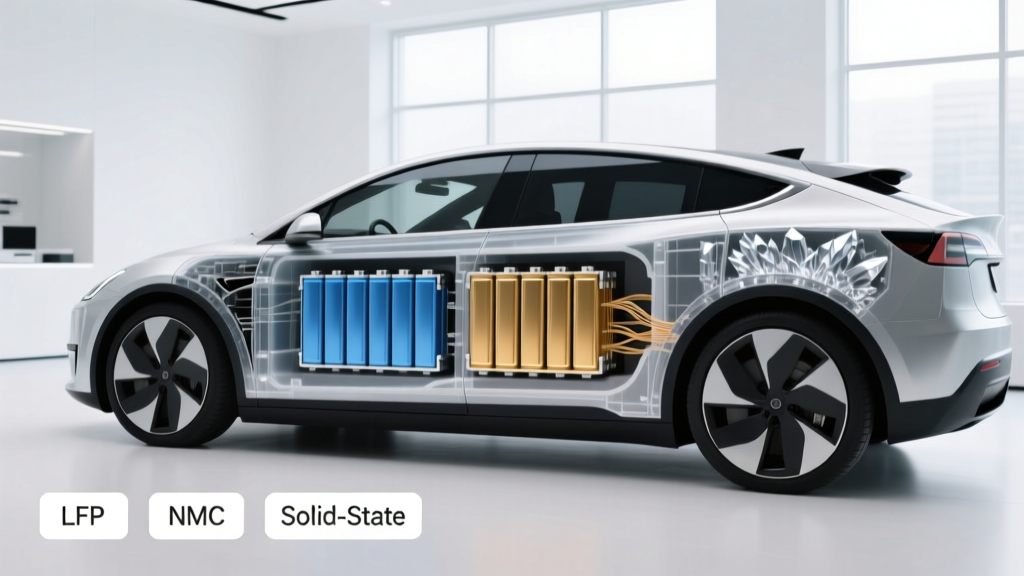
Not all EV batteries are built the same. The two dominant lithium-ion chemistries in 2026 — LFP (lithium iron phosphate) and NMC/NCA (nickel manganese cobalt / nickel cobalt aluminum) — have meaningfully different aging profiles, and choosing between them affects both longevity and daily usability.
Battery Chemistry Trade-Offs at a Glance
| Attribute | LFP (Lithium Iron Phosphate) | NMC / NCA (Nickel-based) |
|---|---|---|
| Cycle life | 3,000–5,000+ cycles | 1,000–2,500 cycles |
| Energy density | Lower (~160 Wh/kg cell-level) | Higher (~250–300 Wh/kg cell-level) |
| Cold-weather performance | Weaker — more range loss below freezing, slower cold charging | Better — less range drop, faster cold-weather DC charging |
| Cost | ~15–25% cheaper per kWh | Higher — nickel and cobalt add cost |
| Degradation profile | Very flat — minimal loss over thousands of cycles | Gradual — steeper early loss, then flattens |
| Optimal daily SoC | 100% OK (manufacturers recommend periodic full charges for BMS calibration) | 80% recommended for daily use; 100% for road trips |
| Common in (2026 models) | Tesla Model 3/Y RWD, Ford Mustang Mach-E Select, BYD models, base Chevy Equinox EV | Tesla Long Range, Hyundai Ioniq 5/6, Kia EV6/EV9, BMW iX, Rivian, Lucid |
Which is better? It depends on your use case. If you prioritize maximum battery lifespan, drive in moderate climates, and don't need every last mile of range, LFP is the longevity champion — Tesla's LFP packs have shown less than 5% degradation at 100,000 miles in fleet data. If you need maximum range per charge, live in cold climates, or tow frequently, NMC/NCA offers better energy density and cold-weather behavior, and modern thermal management has narrowed the lifespan gap considerably.
What Does the EV Battery Warranty Actually Cover?
Federal law in the United States mandates that EV batteries carry a minimum warranty of 8 years / 100,000 miles (10 years / 150,000 miles in California Air Resources Board states). Most major manufacturers meet or exceed this baseline. Here's how the major brands stack up in 2026:
2026 EV Battery Warranty Comparison
| Manufacturer | Warranty Period | Mileage Cap | Capacity Threshold |
|---|---|---|---|
| Tesla (Model 3/Y RWD – LFP) | 8 years | 100,000 mi | 70% retention |
| Tesla (Model 3/Y LR, S, X) | 8 years | 120,000–150,000 mi | 70% retention |
| Hyundai / Kia | 10 years | 100,000 mi | 70% retention |
| Ford (Mach-E, F-150 Lightning) | 8 years | 100,000 mi | 70% retention |
| GM (Chevy, Cadillac, GMC) | 8 years | 100,000 mi | 70% retention (some trims 60% for commercial) |
| BMW | 8 years | 100,000 mi | 70% retention |
| Rivian | 8 years | 175,000 mi | 70% retention |
| Volkswagen (ID.4) | 8 years | 100,000 mi | 70% retention |
Source: Manufacturer warranty documentation, model year 2026. CARB states (CA, CO, CT, ME, MD, MA, NJ, NY, OR, RI, VT, WA) may mandate 10 yr / 150,000 mi. Always confirm with your dealer.
The key detail is the capacity retention threshold — typically 70%. If your battery's usable capacity drops below 70% of its original kWh within the warranty period, the manufacturer is obligated to repair or replace it (often with a refurbished pack of equivalent capacity). In practice, warranty claims remain rare: Tesla's 2025 Impact Report noted a battery replacement rate of under 1% across its fleet for packs still under warranty.
How Much Does an EV Battery Replacement Cost?
This is the question that generates the most anxiety — and the most misinformation. Yes, a full battery pack replacement is expensive. But context matters enormously: most EVs will never need one, and costs have been declining steadily.
Estimated Out-of-Warranty Battery Replacement Costs (2026)
| Vehicle / Pack Size | Battery Capacity | Estimated Replacement Cost (Parts + Labor) |
|---|---|---|
| Chevrolet Bolt EV / EUV | 65 kWh (NMC) | $14,000–$16,500 |
| Tesla Model 3 RWD | 60 kWh (LFP) | $12,000–$15,000 |
| Tesla Model Y Long Range | 82 kWh (NMC) | $16,000–$20,000 |
| Hyundai Ioniq 5 | 77.4 kWh (NMC) | $15,000–$19,000 |
| Ford F-150 Lightning (Extended) | 131 kWh (NMC) | $25,000–$32,000 |
| Rivian R1T / R1S (Max Pack) | 149 kWh (NMC) | $28,000–$35,000 |
| BMW iX xDrive50 | 111.5 kWh (NMC) | $22,000–$28,000 |
Costs based on 2025–2026 service estimates from manufacturer service centers and independent EV repair shops. Labor typically accounts for $1,500–$3,000. Refurbished or remanufactured packs can reduce parts cost by 30–40%. Module-level repair (replacing individual failed modules rather than the full pack) is increasingly available for $3,000–$8,000 depending on the vehicle.
When is replacement actually needed? Almost never within the first 10 years for liquid-cooled packs from major manufacturers. The vehicles most likely to face out-of-pocket replacement are early-generation EVs with passive air cooling (2011–2017 Nissan Leaf, first-gen Fiat 500e) that have been driven hard in hot climates. For any 2022+ EV with active thermal management, a full pack replacement before 200,000 miles is statistically unlikely.
What Kills an EV Battery? Five Degradation Factors
Even though modern EV batteries are remarkably durable, they aren't immortal. Understanding what accelerates degradation lets you make informed choices — without obsessing over every charge cycle.
1. Extreme Heat Exposure
Heat is the number one enemy of lithium-ion longevity. Sustained battery temperatures above 95°F (35°C) accelerate chemical side reactions that permanently reduce capacity. This is why liquid-cooled packs (which actively regulate temperature) dramatically outperform passively cooled ones. If you live in Phoenix or Dubai, parking in shade and preconditioning while plugged in are meaningful habits.
2. Frequent DC Fast Charging at High Power
DC fast charging at 150+ kW generates significant internal heat and forces lithium ions to move rapidly, which stresses the anode. Occasional road-trip fast charging is perfectly fine — the battery management system (BMS) throttles charging speed to protect the pack. But if you exclusively DC fast-charge daily (because you lack home charging), expect 2–4% more degradation over 5 years compared to Level 2 home charging. Studies from the Idaho National Laboratory found that vehicles charged exclusively on DC fast chargers showed ~10% degradation at 50,000 miles vs. ~7% for Level 2–charged counterparts.
3. Sustained High or Low State of Charge
For NMC/NCA batteries, sitting at 100% SoC for extended periods (days or weeks) stresses the cathode. Similarly, leaving an EV at 0% SoC for prolonged periods can cause copper dissolution in the anode. The practical advice: for daily driving, set your charge limit to 80% (NMC) or 100% (LFP), and don't leave the car unplugged at very low SoC for more than a few days.
4. Cold-Weather Fast Charging Without Preconditioning
Charging a cold battery at high power can cause lithium plating — a condition where metallic lithium deposits on the anode surface, permanently reducing capacity. Modern EVs with navigation-based preconditioning (Tesla, Hyundai/Kia, BMW) warm the battery before you arrive at a charger. If your EV lacks this feature, drive for 15–20 minutes before fast-charging in sub-40°F weather.
5. High-Mileage Calendar Compression
Rideshare and delivery vehicles that rack up 50,000+ miles per year and fast-charge multiple times daily will see accelerated wear. Even so, Tesla's fleet data shows its high-mileage vehicles (150,000+ miles) averaging 85–88% capacity retention — well above the 70% warranty threshold.
Battery Care Checklist: Maximize Your Pack's Life
- Daily charging: Set limit to 80% for NMC/NCA; 100% is fine for LFP
- Home charging: Use Level 2 (7–11 kW) as your primary charging method
- DC fast charging: Use for road trips and when needed — don't avoid it, but don't rely on it exclusively if you have alternatives
- Hot climates: Park in shade/garage when possible; precondition while plugged in
- Cold climates: Use navigation-based preconditioning before DC charging; plug in when parked overnight in extreme cold
- Storage: If leaving the car for 2+ weeks, set SoC to ~50% and leave it plugged in (the BMS will maintain it)
- Avoid: Leaving the car at 0% or 100% SoC for days at a time (NMC/NCA); repeated 0–100% full cycles
How to Check Your EV Battery Health (State of Health)
State of Health (SoH) is the metric that tells you what percentage of original capacity your battery can still hold. Monitoring it is straightforward in 2026, though methods vary by brand:
- Tesla: The in-car service menu (hold the model badge on the "Software" screen) shows battery health percentage. Third-party tools like TeslaFi or Stats log detailed SoH data from the vehicle's API.
- Hyundai / Kia: The infotainment system's EV diagnostics page shows SoH. The dealer can pull a detailed BMS report during service visits.
- Ford: The FordPass app displays battery health status. A full diagnostic report is available at the dealer.
- GM (Ultium-based): The myChevrolet/myCadillac app shows battery condition. OnStar diagnostics include SoH reporting.
- BMW: The iDrive system includes a battery health indicator. Dealers can generate a BMW Battery Health Certificate (useful for resale).
- OBD-II tools: Universal scan tools like the OBDLink SX paired with apps such as EV-BatMon or Car Scanner can read SoH from most EVs' BMS via the OBD-II port.
Check your SoH every 6–12 months, or before and after a long road trip season. If you see a sudden drop (more than 2–3% in a short period), have the dealer pull the full BMS log — it may indicate a module imbalance that can be corrected under warranty.
What's Next? Solid-State, Silicon Anodes, and Future Battery Tech
If you're shopping today, you're buying lithium-ion — and that's fine, because the technology is mature, proven, and warrantied. But the industry is moving toward several next-generation improvements:
- Silicon-dominant anodes: Companies like Sila Nanotechnologies and Group14 are already shipping silicon-blend anodes that boost energy density by 15–20%. These are appearing in limited production vehicles (Mercedes-Benz G580 with EQ Technology uses Sila cells) and should reach broader availability by 2027–2028.
- Solid-state batteries: Toyota, Samsung SDI, and QuantumScape have all demonstrated solid-state prototypes with 2–3x cycle life and faster charging. Toyota has announced a 2027–2028 production timeline for limited models; broader market availability is more realistically 2029–2031. Solid-state is promising but not yet purchasable in a production EV as of 2026.
- Sodium-ion batteries: CATL and BYD have begun limited production of sodium-ion packs for budget EVs in China. Lower energy density but significantly cheaper and free of lithium, cobalt, and nickel. US-market availability remains uncertain, likely 2028+ for entry-level models.
- LFP improvements: CATL's second-generation LFP ("Shenxing" cells) now supports 4C charging (10–80% in ~15 minutes) with improved cold performance, narrowing the gap with NMC. These are arriving in 2026–2027 global-market vehicles.
None of these technologies should delay a 2026 EV purchase. Current lithium-ion packs are already delivering 200,000+ mile lifespans with minimal degradation, and the cost-per-kWh has fallen to roughly $115–$130 at the cell level — down from $400+ in 2010, per BloombergNEF tracking.
Frequently Asked Questions
How long do electric car batteries last in years and miles?
Most EV batteries from 2022 onward will last 15–20 years or 200,000+ miles before dropping below 70% of original capacity. Real-world fleet data shows average degradation of roughly 1.5–2% per year for liquid-cooled packs in moderate climates. Many packs will still function (with reduced range) well beyond the 70% threshold.
How much does an EV battery cost to replace?
Full pack replacement ranges from approximately $12,000 for a smaller pack (Tesla Model 3 RWD, ~60 kWh) to $35,000 for a large pack (Rivian Max Pack, ~149 kWh). However, module-level repairs — replacing individual failed modules rather than the entire pack — are increasingly available for $3,000–$8,000. Most EVs never need a battery replacement during typical ownership.
What does the EV battery warranty cover?
Federal law requires a minimum 8-year / 100,000-mile warranty (10 years / 150,000 miles in CARB states). The warranty covers battery capacity loss below a specified threshold — typically 70% of original capacity. If your battery falls below this threshold within the warranty period, the manufacturer must repair or replace it at no cost to you. The warranty covers defects and excessive degradation, not damage from accidents, flooding, or improper modifications.
LFP vs NMC — which battery chemistry is better for longevity?
LFP (lithium iron phosphate) offers significantly longer cycle life — 3,000–5,000+ cycles vs. 1,000–2,500 for NMC — and can be charged to 100% daily without accelerated degradation. However, LFP has lower energy density (less range per kWh), worse cold-weather performance, and slower DC charging in freezing temperatures. If longevity is your top priority and you live in a moderate climate, LFP is the better choice. If you need maximum range and cold-weather capability, NMC with modern thermal management is still excellent and will comfortably last 200,000+ miles.
Does fast charging damage my EV battery?
Occasional DC fast charging does not meaningfully damage modern EV batteries — the battery management system actively manages temperature and tapers charge rate to protect the pack. However, exclusive reliance on DC fast charging (150+ kW) does accelerate degradation by roughly 2–4% over 5 years compared to Level 2 charging. The best practice: use Level 2 at home for daily charging, and DC fast charge on road trips or when needed.
How do I check my EV's battery State of Health?
Most modern EVs display SoH through the infotainment system, a companion app (FordPass, myChevrolet, Tesla app), or the dealer diagnostic system. You can also use OBD-II scan tools with apps like EV-BatMon or Car Scanner to read SoH directly from the battery management system. Check SoH every 6–12 months and before selling the vehicle.
Will my EV battery need to be replaced before I sell the car?
Statistically, no. According to data from Recurrent Auto and manufacturer warranty reports, fewer than 1.5% of EVs from 2020 onward have required battery replacement within the warranty period. For vehicles with liquid-cooled packs (the vast majority of EVs sold since 2020), the battery is one of the most reliable components in the car — far less likely to fail than a conventional automatic transmission or turbocharger in a gas vehicle.
The bottom line on how long electric batteries last: modern EV batteries are an engineering success story, not a ticking time bomb. With basic care — Level 2 home charging, sensible SoC limits, and preconditioning in extreme temperatures — your battery will almost certainly outlast your ownership of the vehicle. And if it doesn't, the warranty has you covered for the better part of a decade.