If you owned a 2007 Hyundai Sonata, you probably remember swapping its 12V lead-acid battery every three to five years — a $150 inconvenience at the auto-parts store. That 2007 Hyundai Sonata battery was simple: crank the engine, power the lights, and die quietly in a Minnesota winter. Nearly two decades later, the automotive battery conversation has transformed entirely. Today's electric vehicles carry high-voltage lithium-ion traction batteries packing 60 to 120 kWh of usable energy, engineered to last 15–20 years and 150,000+ miles while retaining the vast majority of their original capacity.
This guide covers everything a modern EV buyer or owner needs to know about battery technology in 2026 — chemistry choices, real degradation data, warranty protections, replacement economics, and daily habits that extend pack life. We'll also touch on what's coming next with solid-state and silicon-anode cells.
LFP vs NMC vs NCA: Which Chemistry Powers Your EV?
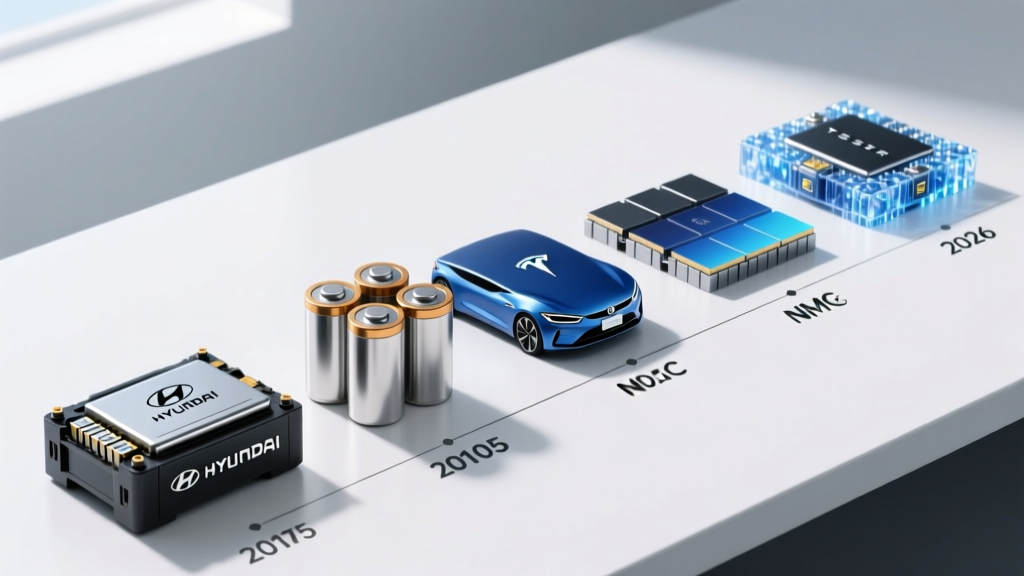
Not all lithium-ion batteries are the same. The cathode chemistry determines energy density, lifespan, cost, cold-weather behavior, and safety profile. In 2026, three chemistries dominate the EV market:
- LFP (Lithium Iron Phosphate): Used in the Tesla Model 3 RWD, Model Y RWD, BYD vehicles, and many affordable EVs. No cobalt or nickel.
- NMC (Nickel Manganese Cobalt): Found in the Hyundai Ioniq 5/6, VW ID.4, Ford F-150 Lightning extended-range, and most long-range EVs.
- NCA (Nickel Cobalt Aluminum): Primarily used by Tesla in Long Range and Performance trims, and by Lucid.
| Attribute | LFP | NMC | NCA |
|---|---|---|---|
| Energy Density | Lower (~160 Wh/kg cell) | Higher (~250 Wh/kg cell) | Highest (~260–280 Wh/kg cell) |
| Cycle Life | 3,000–5,000+ cycles | 1,000–2,000 cycles | 1,000–1,500 cycles |
| Cold Performance | Moderate (slower charging below 32°F) | Better low-temp discharge | Good low-temp discharge |
| Cost per kWh | Lowest (~$80–100/kWh pack) | Mid (~$110–140/kWh pack) | Highest (~$120–150/kWh pack) |
| Safety (Thermal Runaway) | Best — higher onset temp | Moderate | Moderate |
| Recommended Daily SoC | 100% OK | 80% for daily, 100% for trips | 80% for daily, 100% for trips |
| Typical Vehicles (2026) | Tesla Model 3 RWD, BYD Seal, Rivian Standard | Hyundai Ioniq 5, VW ID.4, Ford Mach-E ER | Tesla Model 3 LR, Lucid Air, BMW iX |
Which is better? It depends on your use case. If you want maximum range per charge and don't mind managing state of charge, NMC/NCA delivers. If you want a battery you can charge to 100% daily without worry, prioritize longevity, and save money upfront, LFP is the pragmatic pick — provided you can accept slightly less range and live with slower DC fast charging in freezing weather.
How Long Do EV Batteries Actually Last?
The short answer: longer than most people expect, and usually longer than the rest of the car. Modern EV traction batteries are engineered for 15–20 years of service or 150,000–200,000+ miles before degradation becomes a practical concern.
Real-World Degradation Data Points (aggregated from fleet studies and owner reports through 2025–2026):
- Tesla Model 3/Y (NCA/NMC): ~5% capacity loss at 50,000 miles, ~8–10% at 100,000 miles, plateauing around 88–92% State of Health (SoH) at 150,000 miles (Tesla Impact Report 2024).
- Nissan Leaf (NMC, passively cooled): Earlier models (2011–2017) showed 10–20% loss by 60,000 miles in hot climates due to lack of active thermal management. Post-2018 models with larger packs fare better.
- Hyundai Ioniq 5 (NMC, actively cooled): Owner-reported data shows ~3–5% loss at 40,000 miles, tracking well within warranty thresholds.
- LFP packs (Tesla Model 3 RWD, BYD): Early fleet data suggests <3% loss at 50,000 miles, consistent with LFP's superior cycle-life rating.
Degradation follows a curve, not a straight line. Most capacity loss occurs in the first 20,000–30,000 miles (the "break-in" phase), then slows dramatically. A pack that shows 95% SoH at 30,000 miles is likely on track to retain 85–90% at 150,000 miles.
For context: the average American drives ~13,500 miles per year (FHWA data). At that rate, a modern EV battery should outlast a 12-year ownership cycle — a far cry from the 2007 Hyundai Sonata battery you'd replace two or three times in that same span.
What Does the Battery Warranty Actually Cover?
Federal law mandates that EV battery warranties cover a minimum of 8 years / 100,000 miles (10 years / 150,000 miles in California and states adopting CARB standards). Here's how major manufacturers structure their coverage in 2026:
| Manufacturer | Warranty Term | Capacity Retention Threshold | Notes |
|---|---|---|---|
| Tesla (Model 3/Y RWD, LFP) | 8 yr / 100,000 mi | 70% | Covers defects + capacity below threshold |
| Tesla (Model 3/Y LR/Perf) | 8 yr / 120,000 mi | 70% | Longer mileage for NCA packs |
| Hyundai / Kia | 10 yr / 100,000 mi | 70% | Among the longest terms |
| Ford (F-150 Lightning, Mach-E) | 8 yr / 100,000 mi | 70% | Standard across BEV lineup |
| Volkswagen (ID.4) | 8 yr / 100,000 mi | 70% | Covers cell-module replacement |
| Rivian | 8 yr / 175,000 mi | 70% | Higher mileage cap for R1T/R1S |
| GM (Ultium platform) | 8 yr / 100,000 mi | 70% | Covers Bolt EUV, Equinox EV, etc. |
Key details buyers miss:
- The 70% threshold means the manufacturer replaces or repairs the battery only if it drops below 70% of original capacity within the warranty period. Normal gradual degradation above 70% is expected and not covered.
- Warranties cover defects and abnormal degradation, not damage from accidents, flooding, or improper modifications.
- Some manufacturers replace individual modules rather than the entire pack, which is more cost-effective and reduces waste.
- Warranty is transferable to subsequent owners, which supports EV resale values.
How Much Does an EV Battery Cost to Replace?
This is the question that generates the most anxiety — and the most misinformation. Here are the realistic numbers for 2026:
| Vehicle / Pack Size | Full Pack Replacement Cost (Parts + Labor) | Typical Need Timeline |
|---|---|---|
| Nissan Leaf 40 kWh | $6,500 – $9,000 | Rare before 150k mi; older models may need it |
| Tesla Model 3 RWD (LFP, ~60 kWh) | $8,000 – $12,000 | Extremely rare under 200k mi |
| Hyundai Ioniq 5 (77.4 kWh NMC) | $12,000 – $18,000 | Rare under 200k mi |
| Ford F-150 Lightning Ext. Range (131 kWh) | $20,000 – $30,000 | Too new for data; under warranty for most owners |
| Chevy Bolt EV (65 kWh) | $14,000 – $16,000 (post-recall updated pack) | Recall replacements done at no cost |
| Tesla Model S/X (100 kWh) | $15,000 – $22,000 | Some early packs replaced at 120k–180k mi |
Critical context: The vast majority of EV owners will never pay for a traction battery replacement out of pocket. Pack failure rates within the warranty period are low (under 1–2% across major manufacturers), and most packs outlast the vehicle's useful economic life. Battery prices have also fallen roughly 90% since 2010 (per BloombergNEF), meaning replacement costs continue trending downward.
Compare this to the 2007 Hyundai Sonata battery: a $130 lead-acid unit you'd buy at AutoZone. The EV pack costs 50–100× more, but it's engineered to last the lifetime of the vehicle rather than 3–5 years.
Factors That Accelerate (or Preserve) Battery Life
EV battery degradation isn't random — it's driven by measurable factors you can control. Here's what the electrochemistry actually responds to:
Habits That Maximize Battery Longevity
- Avoid sustained 100% SoC (NMC/NCA): Store and commute between 20–80% state of charge. Charge to 100% only when you need the full range for a trip, and drive away shortly after reaching full.
- LFP owners: charge to 100% weekly. LFP cells benefit from periodic full charges for cell balancing, and the chemistry tolerates high SoC better than NMC.
- Minimize DC fast charging when Level 2 is available. Occasional DCFC is fine; daily 150+ kW sessions generate sustained heat that accelerates calendar aging. Use home Level 2 (7–11 kW) for routine charging.
- Precondition in cold weather. Use your EV's scheduled departure feature to warm the battery before driving and charging. A cold battery (below 40°F) charges slower and experiences more stress during regen braking.
- Avoid letting SoC sit at 0% or below 5% for extended periods. Deep discharge stresses the anode. Plug in if you're parking for more than a week.
- Park in shade or a garage in extreme heat. Sustained pack temperatures above 95°F accelerate calendar degradation, especially at high SoC.
Habits That Accelerate Degradation
- Frequent DC fast charging in hot weather without preconditioning
- Routinely charging NMC/NCA to 100% and letting it sit for days
- Repeatedly draining below 10% SoC
- Towing heavy loads in high ambient temperatures (sustained high C-rate discharge)
- Aftermarket modifications that override thermal management settings
How to Check Your Battery's State of Health (SoH)
State of Health (SoH) is the percentage of original capacity your battery currently holds. A new pack is 100%; a pack at 90% SoH holds 90% of its original kWh.
How to check SoH by brand:
- Tesla: The in-car energy app shows range vs. SoC, which lets you estimate SoH. Third-party tools like TeslaFi or Scan My Tesla (via OBD-II) pull the exact SoH percentage from the BMS.
- Hyundai/Kia: Some models display SoH in the dealer diagnostic menu. The Hyundai Bluelink app may show battery health status. OBD-II readers with EV-specific PIDs (like the OBDLink SX + LeafSpy-style apps adapted for Hyundai) can read SoH directly.
- Nissan Leaf: The dashboard "health bars" (12 bars = 100%) are a rough SoH indicator. LeafSpy via OBD-II gives a precise percentage.
- General (all brands): A dealership service department can run a full battery health report during scheduled maintenance. Request this if you're buying a used EV.
Quick SoH estimate without tools: Charge to 100%, note the displayed range, and compare it to the original EPA range. If your Ioniq 5 originally showed 303 miles at 100% and now shows 280 miles, your rough SoH is ~92%. (Note: displayed range varies with recent driving efficiency, so this is approximate.)
What's Next: Solid-State, Silicon Anode, and Beyond
Next-generation battery technologies are in active development, but none are widely available in consumer EVs as of 2026. Here's a realistic timeline assessment:
- Silicon-anode lithium-ion: Companies like Sila Nanotechnologies and Group14 are replacing graphite anodes with silicon-dominant materials, boosting energy density 20–40%. Limited production vehicles (e.g., Mercedes G-Class EV with partial silicon anode) are appearing in 2025–2026, but broad adoption is expected by 2028–2030.
- Solid-state batteries: Toyota, Samsung SDI, and QuantumScape target 2027–2030 for initial production vehicles. Solid-state promises faster charging (10–80% in under 10 minutes), higher energy density, and improved safety. However, manufacturing scale-up and cost remain significant hurdles. This technology is not yet available in any mass-market EV.
- Sodium-ion batteries: CATL and BYD are deploying sodium-ion cells in affordable Chinese-market EVs. Lower energy density than LFP, but cheaper and free of lithium/cobalt. Possible US-market entry in budget EVs by 2028–2029.
- LMFP (Lithium Manganese Iron Phosphate): An LFP evolution adding manganese for ~15–20% more energy density while retaining LFP's safety and cycle life. Expected in Tesla and other vehicles by 2027.
Practical takeaway: If you're buying an EV in 2026, don't wait for solid-state. Current lithium-ion technology — especially LFP and modern NMC — is mature, well-warrantied, and more than adequate for 15+ years of ownership. The 2007 Hyundai Sonata battery didn't get a revolutionary replacement; it just faded into history. Today's EV packs will likely outlive the cars they're installed in.
EV Battery FAQ
How long do EV batteries last in years and miles?
Modern EV batteries (2020 and newer) are designed to last 15–20 years or 150,000–200,000+ miles while retaining 70–85% of original capacity. Real-world fleet data from Tesla, Hyundai, and others confirms that most packs will outlast the vehicle's economic life. Active thermal management (liquid cooling/heating) is the key differentiator vs. older passively cooled designs.
How much does it cost to replace an EV battery?
Full pack replacement ranges from ~$6,500 (Nissan Leaf) to $20,000–$30,000 (large packs like the F-150 Lightning 131 kWh). However, the vast majority of owners never pay this — warranty coverage (8 years/100,000 miles minimum) and low failure rates mean out-of-pocket replacement is rare. Costs continue declining as battery manufacturing scales.
What does the EV battery warranty cover?
Manufacturer warranties cover defects and abnormal degradation below a stated capacity threshold (typically 70% of original capacity) for 8 years/100,000 miles (10 years/150,000 miles in CARB states). Normal gradual degradation above the threshold is expected and not covered. Warranties are transferable to second owners.
How do I maximize my EV battery's health?
For NMC/NCA: keep daily SoC between 20–80%, charge to 100% only for trips, use Level 2 charging for routine needs, precondition in cold weather, and avoid prolonged storage at 0% or 100%. For LFP: charge to 100% at least weekly for cell balancing, and follow the same temperature and storage guidelines.
LFP vs NMC — which battery chemistry is better for me?
Choose LFP if you want maximum longevity, lower cost, the ability to charge to 100% daily, and superior thermal safety — and can accept slightly less range. Choose NMC/NCA if you need maximum range per charge, better cold-weather fast-charging performance, and don't mind managing state of charge (20–80% daily). Neither is universally "better" — it's a trade-off matched to your driving pattern.
Is the EV traction battery the same as the 12V battery?
No. Every EV has two batteries: a high-voltage traction battery (400V or 800V, 60–130+ kWh) that powers the motor, and a 12V auxiliary battery that runs the lights, infotainment, and computers — just like the 12V battery in a 2007 Hyundai Sonata. The 12V battery can still die and may need replacement every 4–6 years, but it's a standard ~$200 part, not the expensive traction pack.
Can extreme cold permanently damage my EV battery?
No. Cold reduces available range temporarily (expect 20–30% range loss at 20°F vs. 70°F) and slows charging speeds, but it does not cause permanent damage. The battery management system (BMS) limits regen and charging power when the pack is cold to protect the cells. Preconditioning restores normal performance.
Sources: EPA Fuel Economy, Tesla Impact Report, manufacturer warranty documentation, BloombergNEF Battery Price Survey.