If you're researching a battery powered car, the single biggest ownership question isn't range or charging speed — it's whether the high-voltage traction battery will outlast the vehicle itself. The short answer, backed by a decade of fleet data: most modern EV batteries will last 15–20 years or 200,000+ miles before degrading to the point where replacement becomes economically justified. But the details — chemistry choice, charging habits, climate exposure, and warranty fine print — matter enormously for your specific situation.
This guide dissects every aspect of EV battery ownership in 2026: the two dominant chemistries (LFP and NMC/NCA), real-world degradation curves from manufacturer and fleet data, what warranties actually cover, what a replacement costs if you ever need one, and the habits that maximize your pack's lifespan. We'll also separate hype from reality on emerging technologies like solid-state cells.
LFP vs NMC/NCA: Which Battery Chemistry Powers Your EV?
Every battery powered car on sale in 2026 uses one of two dominant lithium-ion chemistries for its high-voltage traction pack: LFP (lithium iron phosphate) or NMC/NCA (nickel manganese cobalt / nickel cobalt aluminum). The choice isn't just academic — it determines your vehicle's range, charging behavior, cold-weather performance, and long-term degradation profile.
NMC/NCA packs offer higher energy density, meaning more kWh packed into a lighter, smaller physical footprint. This translates to longer EPA range in a given vehicle platform. Most long-range EVs — the Tesla Model 3 Long Range, Hyundai Ioniq 5, Ford Mustang Mach-E Extended Range — use NMC variants. The trade-off: NMC chemistries are more sensitive to sustained high states of charge and extreme temperatures, which accelerates degradation if you habitually charge to 100% or live in hot climates.
LFP packs sacrifice roughly 15–20% energy density for dramatically longer cycle life and greater thermal stability. Tesla's Model 3 RWD, the base Chevrolet Bolt (2026 refresh), and several BYD models use LFP. LFP tolerates daily 100% charging without significant penalty — Tesla explicitly recommends periodic full charges for LFP vehicles to keep the battery management system (BMS) calibrated. LFP also avoids cobalt entirely, which reduces supply-chain ethical concerns and material costs.
| Attribute | LFP (Lithium Iron Phosphate) | NMC / NCA (Nickel-Based) |
|---|---|---|
| Energy Density | ~160–180 Wh/kg (cell-level) | ~220–260 Wh/kg (cell-level) |
| Typical Cycle Life | 3,000–5,000+ cycles to 80% SoH | 1,000–2,000 cycles to 80% SoH |
| Daily Charging Recommendation | 100% OK; periodic full charge required for BMS | 80% daily; 100% only for trips |
| Cold-Weather Performance | Weaker below 32°F; more range loss | Better low-temp conductivity |
| Thermal Stability | Excellent; higher thermal runaway threshold | Good; requires active thermal management |
| Cost per kWh (pack-level) | ~$95–$115 (2026) | ~$120–$145 (2026) |
| Common Vehicles | Tesla Model 3 RWD, BYD Dolphin, base Bolt | Model 3 LR, Ioniq 5, Mach-E ER, Rivian R1S |
Which is better? If you commute daily, charge at home, and want a vehicle you'll keep 10+ years, LFP's cycle-life advantage is significant. If you need maximum range in a single charge, frequently drive in cold climates, or tow, NMC's energy density wins. Neither chemistry is universally superior — the right choice depends on your driving pattern.
How Long Do EV Batteries Actually Last?
"Battery life" means something specific: the point at which a pack's State of Health (SoH) drops below 70–80% of its original capacity, reducing usable range enough to affect daily usability. Complete failure (the battery stops working entirely) is exceedingly rare in modern EVs; gradual capacity loss is the norm.
Real-world degradation data from multiple fleet operators and manufacturer reports shows a consistent pattern. The steepest capacity loss occurs in the first 1–2 years (roughly 2–5%), as the solid electrolyte interphase (SEI) layer stabilizes on the anode. After that, degradation slows to a roughly linear 1–2% per year for NMC packs, and 0.5–1.5% per year for LFP packs under normal use.
Typical Degradation Curve: NMC vs LFP
| Vehicle Age / Mileage | NMC Pack SoH (Typical) | LFP Pack SoH (Typical) |
|---|---|---|
| Year 1 / 15,000 mi | 96–98% | 97–99% |
| Year 3 / 45,000 mi | 92–95% | 95–97% |
| Year 5 / 75,000 mi | 88–92% | 93–96% |
| Year 8 / 120,000 mi | 82–88% | 89–93% |
| Year 10 / 150,000 mi | 78–85% | 86–91% |
| Year 15 / 225,000 mi | 70–78% | 80–87% |
Sources: Geotab fleet data, Tesla Impact Reports, Recurrent Auto battery health database. Figures represent median values; individual results vary based on climate, charging habits, and thermal management system quality.
At a 70% SoH threshold — the point at which most manufacturers consider a battery "degraded" under warranty — a typical NMC pack reaches this at roughly 200,000–250,000 miles or 15–20 years. LFP packs may never reach 70% under normal ownership conditions. Most EV batteries will outlast the vehicle's body, suspension, and interior.
What Does the EV Battery Warranty Actually Cover?
Federal law in the United States mandates a minimum battery warranty of 8 years / 100,000 miles for all EVs sold. California Air Resources Board (CARB) states extend this to 10 years / 150,000 miles. Most manufacturers meet or exceed these minimums, but the details of what triggers a warranty claim vary significantly.
| Manufacturer | Warranty Term | Capacity Retention Threshold | Notes |
|---|---|---|---|
| Tesla (Model 3/Y RWD, LFP) | 8 yr / 100,000 mi | 70% | Standard NMC LR gets 8yr/120k mi |
| Tesla (Model S/X) | 8 yr / 150,000 mi | 70% | Higher mileage cap for premium models |
| Hyundai / Kia (E-GMP) | 10 yr / 100,000 mi | 70% | Among the longest time-based coverage |
| Ford (Mach-E, F-150 Lightning) | 8 yr / 100,000 mi | 70% | Component coverage separate from capacity |
| GM (Ultium platform) | 8 yr / 100,000 mi | 70% (estimated) | Blazer EV, Equinox EV, Silverado EV |
| Rivian (R1T / R1S) | 8 yr / 175,000 mi | 70% | Highest mileage threshold among mainstream OEMs |
| Volkswagen (MEB platform) | 8 yr / 100,000 mi | 70% | ID.4, ID. Buzz |
Critical fine print: The 70% threshold means your battery must lose more than 30% of its original capacity before the manufacturer is obligated to repair or replace it. A vehicle with a 300-mile EPA range that degrades to 210 miles (70% SoH) is still functional — and most owners will sell or trade the vehicle before reaching this point. Warranties cover defects and abnormal degradation; they do not cover damage from accidents, flooding, or unauthorized modifications. Always read the specific warranty booklet for your model year, as terms can change annually.
EV Battery Replacement Cost: What You'd Actually Pay
If your battery degrades beyond the warranty threshold, or if it suffers physical damage not covered by insurance, replacement is expensive — but far less common than internet forums suggest. According to Recurrent Auto, fewer than 1.5% of EVs have required battery replacement under warranty, and most of those were early-adopter vehicles with manufacturing defects rather than age-related degradation.
| Vehicle / Platform | Battery Size (kWh) | Estimated Replacement Cost | When Typically Needed |
|---|---|---|---|
| Tesla Model 3 RWD (LFP) | 60 kWh | $8,000–$12,000 | Rarely before 250k+ mi |
| Tesla Model Y Long Range (NMC) | 75 kWh | $12,000–$16,000 | 200k–300k mi |
| Hyundai Ioniq 5 (NMC) | 77.4 kWh | $11,000–$15,000 | 200k+ mi |
| Ford F-150 Lightning ER (NMC) | 131 kWh | $18,000–$25,000 | 200k+ mi; large pack = high cost |
| Chevrolet Equinox EV (Ultium NMC) | 85 kWh | $10,000–$14,000 | 200k+ mi |
| Nissan Ariya (NMC) | 87 kWh | $12,000–$16,000 | 200k+ mi |
These figures include the battery pack and labor but exclude ancillary components (coolant lines, contactors, BMS modules) that may also need service. Costs have declined roughly 40–50% since 2018 as pack-level pricing has dropped below $130/kWh for NMC and under $100/kWh for LFP. Module-level repair — replacing only the degraded cells rather than the entire pack — is increasingly available through specialized EV shops and can cut costs by 40–60%.
Context that matters: The average American keeps a vehicle for 8.4 years and drives roughly 13,500 miles per year (per FHWA data). That's about 113,000 miles over average ownership — well within the warranty period and far below the mileage where significant degradation occurs. Most EV batteries are never replaced; they're recycled when the vehicle is retired.
Factors That Accelerate or Slow Battery Degradation
Battery longevity isn't purely a function of time — your habits and environment play a measurable role. Research from the National Renewable Energy Laboratory (NREL) and fleet data from Geotab identify these primary degradation accelerants:
- Extreme heat exposure: Sustained ambient temperatures above 95°F (35°C) accelerate electrolyte decomposition. Vehicles in Phoenix, Houston, or Riyadh degrade 1.5–2× faster than those in temperate climates unless equipped with active liquid cooling (standard on most 2026 EVs, but not all).
- Frequent DC fast charging: Exclusive reliance on DC fast charging (150+ kW) rather than Level 2 home charging adds approximately 0.5–1% additional annual degradation, per Idaho National Laboratory testing. Occasional road-trip fast charging has negligible impact; daily fast-charging as your only charging method is what causes measurable harm.
- Sustained high state of charge (NMC only): Storing an NMC battery at 100% SoC for days or weeks accelerates calendar aging. Daily charging to 80% and only charging to 100% when you need the full range for a trip is the single most impactful habit for NMC owners.
- Deep discharges: Regularly driving the battery to 0% or leaving it at very low SoC for extended periods stresses the anode. Try to keep SoC above 10% when possible.
- High-power launch habits: Repeated full-throttle acceleration generates heat in the cells. Occasional hard acceleration is fine; daily drag-racing is not.
Battery Care Checklist: Maximize Your Pack's Lifespan
- ✅ NMC owners: Set daily charge limit to 80%; charge to 100% only before long trips, and drive off promptly after reaching full.
- ✅ LFP owners: Charge to 100% at least once per week for BMS calibration; daily 100% is acceptable.
- ✅ Precondition before fast charging: Use your vehicle's navigation to route to a DC fast charger — most EVs will automatically warm the battery for optimal charge speed and reduced stress.
- ✅ Use Level 2 for daily charging: A home 240V Level 2 charger (7–11 kW) is the gentlest charging method and the cheapest per kWh.
- ✅ Avoid parking in extreme heat when possible: A shaded garage or carport reduces calendar aging significantly in hot climates.
- ✅ Don't store at 100% or 0%: If leaving the vehicle for 2+ weeks, set SoC to 50–60% (NMC) or 50% (LFP).
- ✅ Keep software updated: OTA updates often include BMS refinements that improve longevity.
How to Check Your EV Battery's State of Health
State of Health (SoH) is the percentage of original capacity your battery can still hold. A new EV has 100% SoH; a pack at 85% SoH holds 85% of its original kWh. Monitoring SoH helps you track degradation trends and catch abnormal loss early.
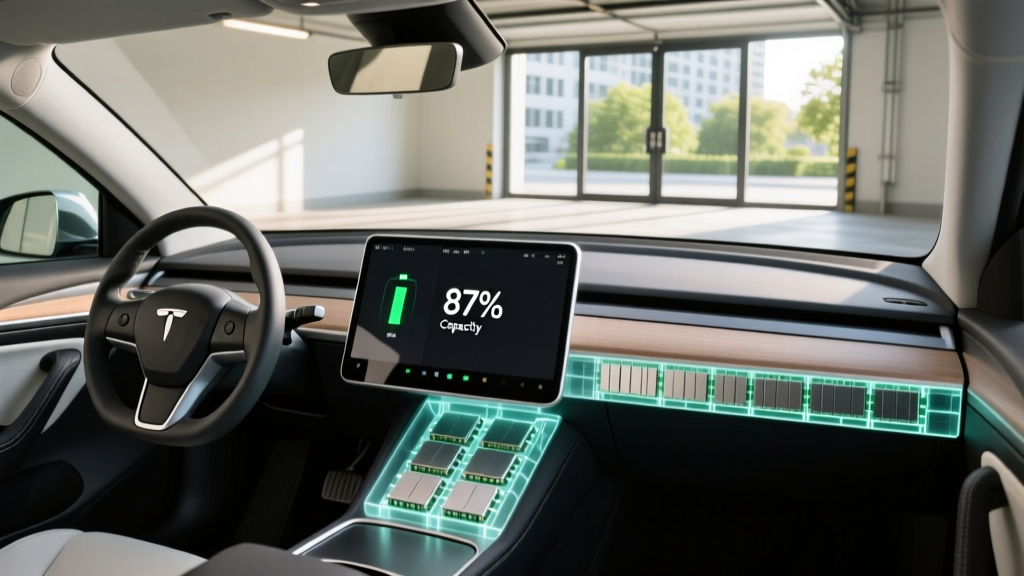
Built-in vehicle tools: Some manufacturers provide SoH readouts directly in the infotainment system. Tesla displays battery health in the service menu (accessible via the car's touchscreen). Hyundai/Kia includes a battery health indicator in the EV settings menu on E-GMP vehicles. Nissan's Leaf (though now discontinued) historically offered SoH "bars" on the dashboard.
OBD-II diagnostic apps: For vehicles without a native SoH display, an OBD-II dongle paired with apps like Scan My Tesla, LeafSpy (Nissan), or ABRP (A Better Route Planner) OBD integration can read the BMS directly and report SoH, cell voltage variance, and pack temperature. These tools cost $30–$80 for the hardware and provide dealer-level data.
Dealer diagnostic reports: Request a battery health report during annual service visits. Most dealerships can run a full pack diagnostic in 15–20 minutes and provide a printed SoH reading. This is especially useful before purchasing a used EV — always ask for a battery health check as a condition of sale.
Third-party services: Companies like Recurrent Auto offer free battery health reports by connecting to your vehicle's telematics data (with your permission). These reports compare your degradation curve against a fleet of identical vehicles, flagging abnormal loss.
Emerging Battery Technologies: Solid-State, Silicon Anode, and Beyond
Next-generation battery chemistries promise step-change improvements in energy density, charge speed, and safety — but realistic timelines matter. Here's where the technology stands as of 2026:
Solid-state batteries replace the liquid electrolyte with a solid ceramic, polymer, or glass separator. Benefits include higher energy density (potentially 400+ Wh/kg at the cell level), faster charging without lithium plating risk, and near-zero fire risk. Toyota, Samsung SDI, and QuantumScape are leading development. Toyota has announced limited solid-state production for 2027–2028, but initial deployment will be in low-volume, premium vehicles with packs likely exceeding $30,000. Broad commercial availability at mainstream price points remains a 2030+ prospect.
Silicon-dominant anodes replace graphite with silicon, which can store roughly 10× more lithium ions per unit mass. Companies like Sila Nanotechnologies and Group14 are shipping silicon-composite anodes in limited applications (the Mercedes G-Class EV uses a Sila-supplied anode). Expect silicon-anode NMC cells to become mainstream in 2027–2029 model-year vehicles, offering 15–25% more range in the same pack volume.
Sodium-ion batteries use abundant sodium instead of lithium, eliminating critical-mineral supply constraints. CATL and BYD are producing sodium-ion packs for low-cost, short-range vehicles in China. US-market availability is uncertain before 2028–2029, and energy density (currently ~120–140 Wh/kg) limits sodium-ion to urban commuter vehicles and energy storage.
These technologies are genuine advances, not vaporware — but none are available in a vehicle you can buy today. If you're purchasing a battery powered car in 2026, current LFP and NMC chemistries are mature, well-understood, and backed by a decade of real-world data. Waiting for solid-state means waiting at least 3–5 years for limited availability and significantly higher cost.
Frequently Asked Questions
How long do EV batteries last in years and miles?
Most modern EV batteries (2020 and later) will retain 70–85% of their original capacity after 15 years or 200,000 miles. LFP chemistries typically outperform NMC in cycle life. Complete battery failure is rare; gradual capacity loss is the norm. Many EV batteries will outlast the vehicle they're installed in.
How much does it cost to replace an EV battery?
Out-of-warranty replacement costs range from approximately $8,000 for a 60 kWh LFP pack (Tesla Model 3 RWD) to $25,000 for a 131 kWh NMC pack (F-150 Lightning Extended Range). Module-level repair, where only degraded cells are replaced, can reduce costs by 40–60%. However, fewer than 1.5% of EVs have ever required battery replacement, and most are covered under the 8-year/100,000-mile federal warranty minimum.
What does the EV battery warranty cover?
EV battery warranties cover capacity loss below a specified threshold (typically 70% of original capacity) and manufacturing defects. Federal law requires a minimum of 8 years / 100,000 miles; CARB states require 10 years / 150,000 miles. Warranties do not cover damage from accidents, flooding, improper charging equipment, or unauthorized modifications. Check your specific model-year warranty booklet for exact terms.
Is LFP or NMC better for my battery powered car?
LFP is better if you want maximum longevity, charge at home daily, don't need the longest possible single-charge range, and live in a moderate-to-warm climate. NMC is better if you need maximum range, frequently drive in cold weather, tow heavy loads, or take regular road trips requiring fast charging. Both chemistries are proven and reliable — the choice depends on your use case.
How do I maximize my EV battery's lifespan?
For NMC: charge to 80% daily, avoid storing at 100%, precondition before fast charging, and use Level 2 home charging as your primary method. For LFP: charge to 100% periodically for BMS calibration. For all EVs: avoid prolonged exposure to extreme heat, don't let the battery sit at 0% SoC, keep software updated, and limit exclusive reliance on DC fast charging.
Does fast charging damage my EV battery?
Exclusive reliance on DC fast charging (never using Level 2) adds approximately 0.5–1% additional annual degradation compared to primarily Level 2 charging, per Idaho National Laboratory research. Occasional fast charging during road trips has negligible impact on battery health. Modern BMS and thermal management systems actively protect the pack during fast charging by modulating charge rate based on temperature.
Can I check my battery health myself?
Yes. Some vehicles (Tesla, Hyundai/Kia E-GMP) display SoH in the infotainment system. For others, an OBD-II dongle ($30–$80) paired with apps like Scan My Tesla or LeafSpy reads the BMS directly. You can also request a battery health report from your dealer during service visits, or use third-party services like Recurrent Auto for fleet-comparison data.