If you own a 2008 Hyundai Santa Fe and are searching for battery information, you likely fall into one of two camps: you need a new 12-volt starting battery for your V6 SUV, or you're considering whether upgrading to a modern hybrid or fully electric vehicle makes financial sense as your Santa Fe approaches the 18-year mark. This guide addresses both realities — the immediate 12V replacement you may need today, and the high-voltage EV and hybrid battery technology that defines the vehicles you might buy next.
The 2008 Santa Fe was offered with a 2.7L V6 or a 3.3L V6, both paired with conventional lead-acid 12V batteries (Group 121R or 24F depending on engine). These batteries typically last 3–5 years and cost $130–$220 to replace. But understanding how modern electrified vehicle batteries work — from lithium-ion traction packs in hybrids like the Hyundai Tucson Hybrid to full BEVs like the Ioniq 5 — is essential for any buyer weighing their next purchase.
The 2008 Hyundai Santa Fe 12V Battery: What You Need Now
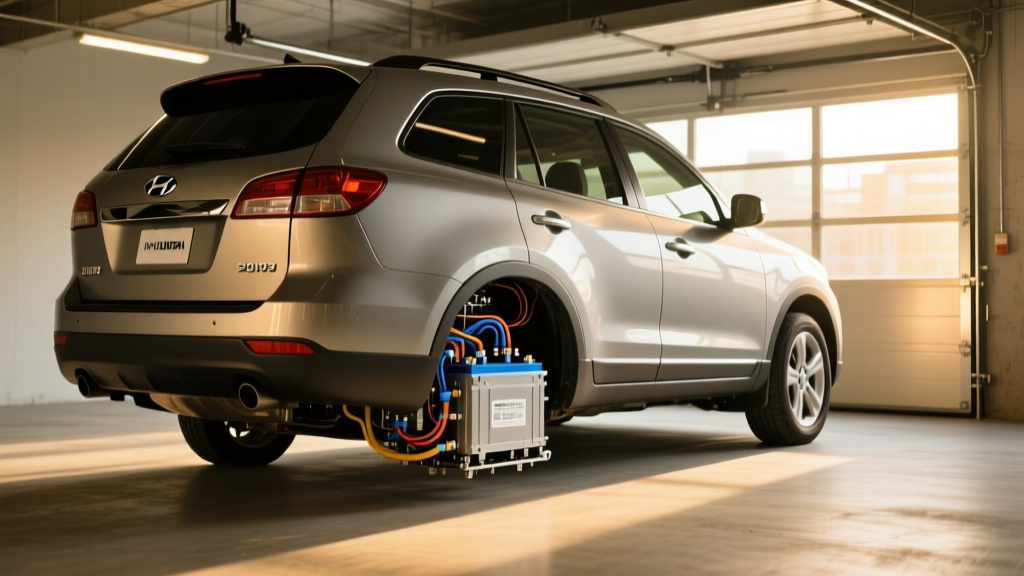
The 2008 Santa Fe uses a standard flooded lead-acid 12V battery. This is not a traction battery — it powers the starter motor, electronics, and accessories. Here are the exact specifications by engine:
| Engine | Group Size | CCA (Cold Cranking Amps) | Avg. Cost | Typical Lifespan |
|---|---|---|---|---|
| 2.7L V6 | 121R | 550–650 CCA | $130–$180 | 3–5 years |
| 3.3L V6 | 24F | 600–700 CCA | $150–$220 | 3–5 years |
Signs your 12V battery is failing include slow cranking, dimming headlights, and dashboard warning lights. Auto parts retailers like AutoZone, Advance Auto Parts, and Interstate Batteries can test your battery's health for free. If you plan to keep the Santa Fe running, an AGM (absorbed glass mat) upgrade costs $40–$60 more but offers better vibration resistance and longer life in extreme climates.
From 12V to High-Voltage: How EV and Hybrid Batteries Differ
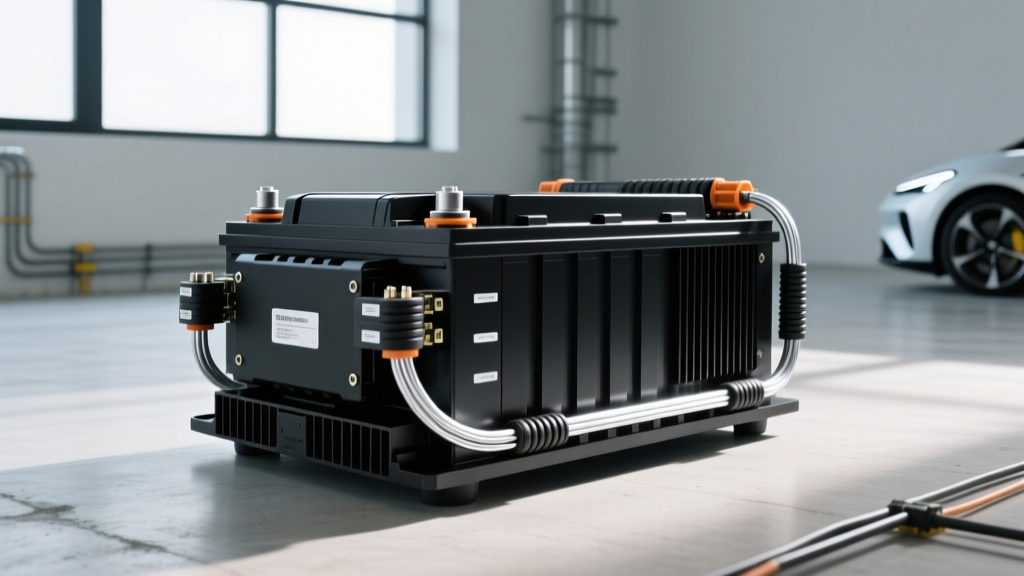
The jump from a 2008 Santa Fe's 12V system to a modern electrified vehicle's high-voltage traction battery is enormous — both in capability and complexity. A 12V battery stores roughly 0.6 kWh (kilowatt-hours, a unit of energy). A modern EV battery pack stores between 58 kWh and 130 kWh — roughly 100 to 200 times more energy.
In hybrid vehicles like the 2026 Hyundai Tucson Hybrid, a smaller lithium-ion battery (typically 1.5–2.0 kWh) assists the gasoline engine and enables brief electric-only driving. In plug-in hybrids (PHEVs) like the Tucson PHEV, a larger 13.8 kWh battery provides roughly 33 miles of EPA-rated electric-only range. In full battery-electric vehicles (BEVs) like the Hyundai Ioniq 5, a 77.4 kWh or 84.0 kWh pack delivers 290–360+ miles of range.
The critical distinction: kW (kilowatts) measures power — how fast energy flows, like the rate of water from a hose. kWh (kilowatt-hours) measures energy — how much total energy is stored, like the volume of a tank. An EV battery's capacity is always measured in kWh; its charging speed is measured in kW.
Battery Chemistry: LFP vs NMC vs NCA Explained
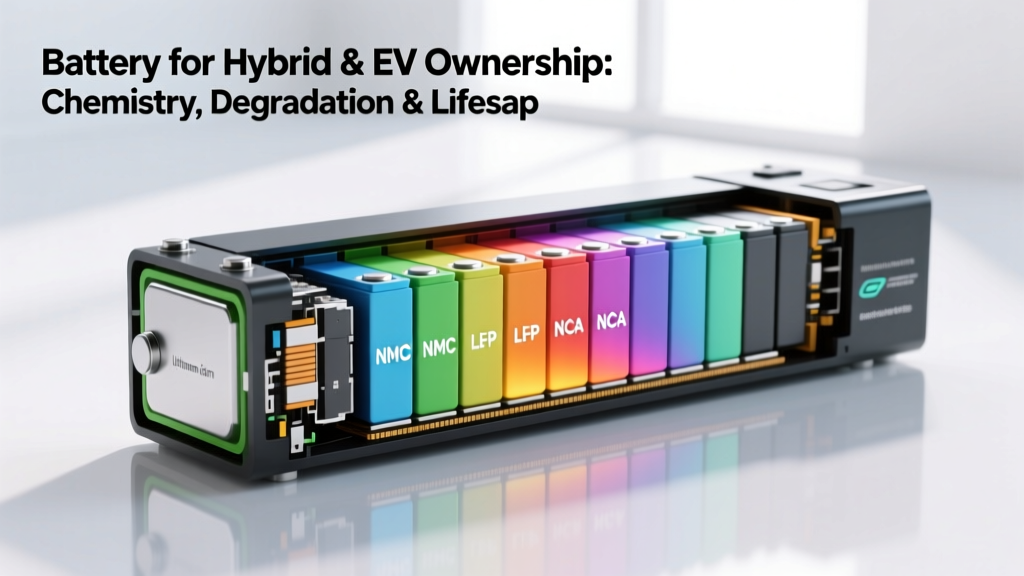
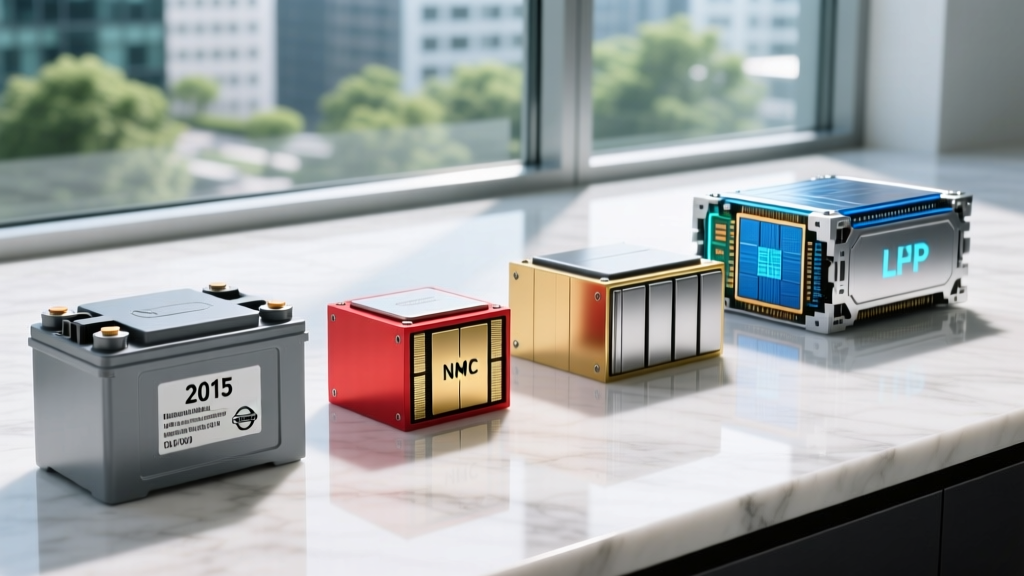
Not all lithium-ion batteries are the same. The cathode chemistry determines energy density, lifespan, cost, and cold-weather performance. The two dominant chemistries in 2026 are LFP (lithium iron phosphate) and NMC/NCA (nickel manganese cobalt / nickel cobalt aluminum).
| Attribute | LFP (Lithium Iron Phosphate) | NMC / NCA (Nickel-based) |
|---|---|---|
| Energy Density | Lower (~150–170 Wh/kg) | Higher (~220–300 Wh/kg) |
| Cycle Life | 3,000–6,000+ cycles | 1,000–2,500 cycles |
| Cold-Weather Performance | Moderate; greater range loss below 32°F | Better low-temperature discharge |
| Cost per kWh | ~$80–$100 (2026 pricing) | ~$110–$140 |
| Thermal Stability | Excellent; very low thermal runaway risk | Good; requires robust BMS |
| SoC Charging Habit | Can charge to 100% daily safely | Best kept 20–80% for daily use |
| Common Applications | Tesla Model 3/Y RWD, BYD, standard-range EVs | Long-range EVs, performance trims, PHEVs |
| Cobalt Content | None | Varies; NCA has less than NMC |
Which is better? It depends on your priorities. LFP wins on longevity and cost — ideal for daily commuters who charge at home and don't need maximum range. NMC wins on energy density and cold-weather performance — better for long-range drivers in northern climates. Tesla's standard-range Model 3 and Model Y use LFP; their Long Range variants use NMC/NCA. Hyundai's Ioniq 5 uses NMC chemistry across its lineup.
How Long Do EV Batteries Actually Last?
This is the most common concern among prospective EV buyers — and the one with the most misinformation. Data from millions of miles of real-world operation shows that modern EV batteries degrade far more slowly than most consumers fear.
Typical Degradation Curve (NMC Battery, Moderate Climate):
- Year 1: 2–4% capacity loss (initial formation loss)
- Years 2–4: ~1–2% per year (gradual linear decline)
- Years 5–8: ~0.5–1.5% per year
- Year 10 projection: 85–92% original capacity retained
- Year 15 projection: 78–88% original capacity retained
According to data compiled by Recurrent Auto, which tracks over 15,000 EVs in real-world conditions, the median EV battery retains approximately 90% of its original capacity after 5 years and 80,000+ miles. Geotab's analysis of 6,300 fleet EVs found an average annual degradation rate of just 1.8% — meaning a 300-mile EV would still deliver roughly 250 miles of range after a decade.
LFP batteries often show even slower degradation. Tesla's 2024 Impact Report noted that Model 3/Y vehicles with LFP packs retained an average of 92% capacity at 100,000 miles. The key takeaway: most EV batteries will outlast the vehicle they're installed in. Complete battery failure before 150,000 miles is statistically rare in liquid-cooled modern packs.
Battery Warranty Terms: What Manufacturers Guarantee
Federal law mandates that EV and hybrid battery warranties cover a minimum of 8 years / 100,000 miles (10 years / 150,000 miles in California and states adopting CARB standards). Most manufacturers meet or exceed these minimums. Here's how major brands compare as of 2026:
| Manufacturer | Warranty Period | Capacity Retention Threshold | Chemistry |
|---|---|---|---|
| Hyundai / Kia | 10 yr / 100,000 mi | 70% of original capacity | NMC |
| Tesla (Model 3/Y LFP) | 8 yr / 120,000 mi | 70% of original capacity | LFP |
| Tesla (Long Range) | 8 yr / 120,000 mi | 70% of original capacity | NMC/NCA |
| Ford (Mustang Mach-E) | 8 yr / 100,000 mi | 70% of original capacity | NMC |
| Chevrolet (Equinox EV) | 8 yr / 100,000 mi | 70% of original capacity | NMC (Ultium) |
| BMW (iX / i4) | 8 yr / 100,000 mi | 70% of original capacity | NMC |
| Toyota (bZ4X) | 8 yr / 100,000 mi | 70% of original capacity | NMC |
What the warranty actually covers: If your battery's usable capacity drops below the stated threshold (usually 70%) within the warranty period, the manufacturer will repair or replace it at no cost. This covers defects and abnormal degradation — not damage from accidents, flooding, or improper modifications. Importantly, a battery that degrades from 100% to 72% capacity over 8 years is functioning normally and would not trigger a warranty claim.
EV Battery Replacement Costs: The Real Numbers
When an EV battery does need replacement outside of warranty — typically at very high mileage (150,000–200,000+ miles) or due to physical damage — the cost is significant but declining. Here are current estimates for 2026:
| Vehicle / Battery Size | Battery Capacity | Replacement Cost (Parts + Labor) | Typical Need Timeline |
|---|---|---|---|
| Hybrid (Toyota Prius) | ~1.3 kWh | $2,500–$4,000 | 150,000–200,000+ mi |
| PHEV (Hyundai Tucson PHEV) | ~13.8 kWh | $6,000–$9,000 | 150,000–200,000+ mi |
| Standard-range BEV (Tesla Model 3 RWD) | ~60 kWh (LFP) | $8,000–$12,000 | 200,000+ mi (rare) |
| Long-range BEV (Hyundai Ioniq 5) | 77.4 kWh (NMC) | $12,000–$18,000 | 200,000+ mi (rare) |
| Large BEV (Ford F-150 Lightning Ext.) | 131 kWh (NMC) | $18,000–$28,000 | 200,000+ mi (rare) |
For context, a 2008 Hyundai Santa Fe owner has likely already spent $3,000–$6,000 on transmission, timing belt, and major engine repairs over the vehicle's life. A modern EV eliminates timing belts, oil changes, and most transmission issues entirely. The U.S. Department of Energy notes that EVs have significantly fewer moving parts than internal combustion vehicles, which offsets the higher battery replacement cost over a vehicle's full lifespan.
It's also worth noting that module-level repair is increasingly common. Rather than replacing an entire battery pack, specialized shops can identify and replace individual degraded modules for $2,000–$5,000 — a fraction of a full pack replacement.
How to Maximize Your EV Battery's Lifespan
Battery degradation is inevitable, but the rate is heavily influenced by how you charge, drive, and store your vehicle. Here are evidence-based practices for extending battery health:
- Avoid frequent DC fast charging. Occasional road-trip fast charging is fine, but daily use of 150+ kW chargers accelerates degradation. Studies show vehicles that fast-charge more than 3 times per week degrade roughly 2–3% faster over 5 years. Rely on Level 2 home charging for daily needs.
- Maintain 20–80% SoC for daily use (NMC/NCA). Storing a battery at 100% for extended periods stresses the cells. Most EVs let you set a charge limit — use it. LFP batteries are an exception: manufacturers like Tesla and BYD recommend periodic 100% charges to help the BMS calibrate.
- Minimize exposure to extreme heat. Battery degradation accelerates above 95°F ambient, especially when combined with high SoC. If you live in Arizona or Texas, park in shade or a garage when possible and precondition while plugged in.
- Precondition in cold weather. Most EVs can warm the battery before driving or charging. This reduces energy wasted on cold cells and enables faster DC charging. A preconditioned battery at 32°F charges up to 2× faster than a cold-soaked one.
- Don't let SoC sit at 0% or 100% for days. If leaving the car unused for a week or more, aim for ~50% SoC. This is the lowest-stress state for lithium-ion chemistry.
- Use regenerative braking moderately in cold weather. Aggressive regen on a cold battery can cause lithium plating. Many EVs automatically limit regen when the battery is cold — let the system do its job.
Monitoring Battery Health: State of Health (SoH) Explained
State of Health (SoH) is a percentage metric that indicates how much usable capacity your battery retains compared to when it was new. A SoH of 92% means your 77.4 kWh Ioniq 5 battery now holds approximately 71.2 kWh of usable energy.
How to check SoH:
- In-vehicle diagnostics: Some manufacturers (Hyundai, Kia, BMW) display battery health metrics in the infotainment or instrument cluster. Tesla provides range-based estimates but not a direct SoH percentage in the standard UI.
- OBD-II apps: Tools like LeafSpy (Nissan), TeslaFi, or OBDeleven (VW Group) can read detailed battery telemetry including SoH, cell voltage variance, and cumulative charge/discharge data.
- Dealer diagnostic scan: Any authorized service center can pull a full battery health report. Request this before purchasing a used EV.
- Third-party services: Companies like Recurrent Auto offer free battery health reports for participating owners, benchmarking your degradation against thousands of identical vehicles.
For used-EV buyers, SoH is the single most important data point. A 5-year-old EV with 95% SoH has been well cared for; one at 82% may have been repeatedly fast-charged or stored at high SoC in hot climates. Always request a battery health report before purchase.
Emerging Battery Technology: What's Next (2027 and Beyond)
Several next-generation battery technologies are in advanced development, though none are yet available in production vehicles as of 2026:
Solid-state batteries replace the liquid electrolyte with a solid material, promising 30–50% higher energy density, faster charging, and improved safety. Toyota has announced plans for a solid-state EV by 2027–2028, and Samsung SDI targets 2027 production. However, manufacturing scalability remains a significant challenge. Realistic expectation: limited production vehicles by 2028, mainstream availability not before 2030.
Silicon-dominant anodes replace graphite anodes with silicon, which can store roughly 10× more lithium ions per gram. Companies like Sila Nanotechnologies and Group14 are supplying early production cells. This technology is expected to incrementally boost energy density by 15–25% in vehicles arriving from 2027 onward.
Sodium-ion batteries use abundant, inexpensive sodium instead of lithium. CATL has begun producing sodium-ion packs for Chinese-market vehicles. These offer lower energy density but dramatically lower cost — potentially enabling sub-$20,000 EVs. U.S. availability is projected for 2028+ in entry-level models.
For a 2008 Santa Fe owner considering an EV purchase in the near term, these future technologies don't change today's calculus. Current lithium-ion batteries are mature, reliable, and backed by robust warranties. Waiting for solid-state means waiting at least 3–5 more years for meaningful U.S. availability.
Should You Replace the Santa Fe Battery or Upgrade to an EV?
If your 2008 Santa Fe needs a $150–$220 12V battery and is otherwise running well, replacing it is the obvious short-term move. But if you're facing larger repairs — timing chain service ($1,200–$2,000), transmission work ($2,500–$4,500), or mounting rust and suspension costs — the math shifts.
A 2026 Hyundai Tucson Hybrid starts at approximately $34,000 and delivers a combined 38 MPG with a 1.6L turbo hybrid powertrain. A 2026 Hyundai Ioniq 5 SE Standard Range starts around $42,000 (before incentives) and offers 290 miles of EPA range, 150 kW DC fast charging, and a 10-year / 100,000-mile battery warranty. With the federal §30D clean vehicle credit (up to $7,500 for qualifying buyers and vehicles, subject to MSRP caps, income limits, and battery sourcing requirements — always verify current eligibility on IRS.gov), effective pricing can drop significantly.
The 2008 Santa Fe delivers roughly 18–22 MPG combined. At $3.30/gallon and 12,000 miles/year, that's approximately $1,800–$2,200 in annual fuel costs. The Ioniq 5, charged at the U.S. average electricity rate of $0.16/kWh and consuming 30 kWh/100 miles, costs roughly $575 per year to fuel — a savings of $1,200–$1,600 annually.
Frequently Asked Questions
How long do EV batteries last in years and miles?
Modern liquid-cooled EV batteries typically last 15–20 years and 150,000–250,000+ miles before dropping below 70% capacity. Real-world fleet data from Geotab and Recurrent Auto shows an average degradation rate of 1.5–2.0% per year under normal use. Most EV batteries will outlast the vehicle they're installed in.
How much does an EV battery cost to replace?
Full battery pack replacement costs range from $8,000 to $28,000 depending on pack size, plus $1,000–$2,500 in labor. However, most replacements occur only after 200,000+ miles, and module-level repairs ($2,000–$5,000) are increasingly available. Battery prices have declined roughly 90% since 2010 and continue falling.
What does the EV battery warranty actually cover?
Federal law requires a minimum 8-year / 100,000-mile warranty (10/150,000 in CARB states). The warranty covers capacity loss below a threshold (typically 70% of original capacity) and manufacturing defects. It does not cover accident damage, improper modifications, or normal gradual degradation above the threshold.
How do I check my EV's battery health?
Use the vehicle's built-in diagnostics (if available), OBD-II apps like TeslaFi or OBDeleven, dealer diagnostic scans, or third-party services like Recurrent Auto. For used-EV purchases, always request a full battery health report showing State of Health (SoH) percentage and cell voltage variance.
LFP vs NMC — which battery chemistry is better?
LFP batteries offer longer cycle life (3,000–6,000 cycles), lower cost, and better thermal stability, making them ideal for daily commuters who charge at home. NMC batteries provide higher energy density and better cold-weather performance, making them better for long-range drivers and northern climates. Neither is universally "better" — the right choice depends on your driving patterns and climate.
Can I put an EV battery in my 2008 Hyundai Santa Fe?
No — the 2008 Santa Fe was designed as a conventional gasoline vehicle with no hybrid or EV variant. The only battery it requires is a standard 12V lead-acid starting battery (Group 121R or 24F). If you want Hyundai's electrified technology, the Tucson Hybrid, Tucson PHEV, and Ioniq 5 are the current equivalents.
Does frequent DC fast charging damage the battery?
Exclusive reliance on DC fast charging can accelerate degradation by 2–3% over 5 years compared to primarily Level 2 charging. Occasional fast charging on road trips has negligible impact. For daily charging, a home Level 2 charger (7–11 kW) is the best practice for long-term battery health.