When Enphase Energy reported its 2023 battery shipments, the headline number — roughly 1.8 GWh of lithium iron phosphate (LFP) home-storage capacity shipped globally — landed in a very different market than the one we're navigating in 2026. That figure, often searched as enphase 2023 battery kwh shipped, represented a sharp ramp in residential storage adoption and a decisive bet on LFP chemistry. For EV shoppers and owners, the relevance is twofold: it validates the same LFP chemistry now used in vehicles like the Tesla Model 3 RWD and base Model Y, and it highlights how stationary and automotive battery supply chains are increasingly intertwined.
This guide uses that shipment milestone as a starting point to explain what actually matters for EV batteries in 2026 — chemistry trade-offs, real degradation data, warranty fine print, replacement costs, and the monitoring tools you can use today. If you're weighing an LFP-chemistry EV, a home-storage add-on for solar, or both, the underlying cell-level story is the same.
Why Enphase's 2023 kWh Shipment Number Matters to EV Buyers
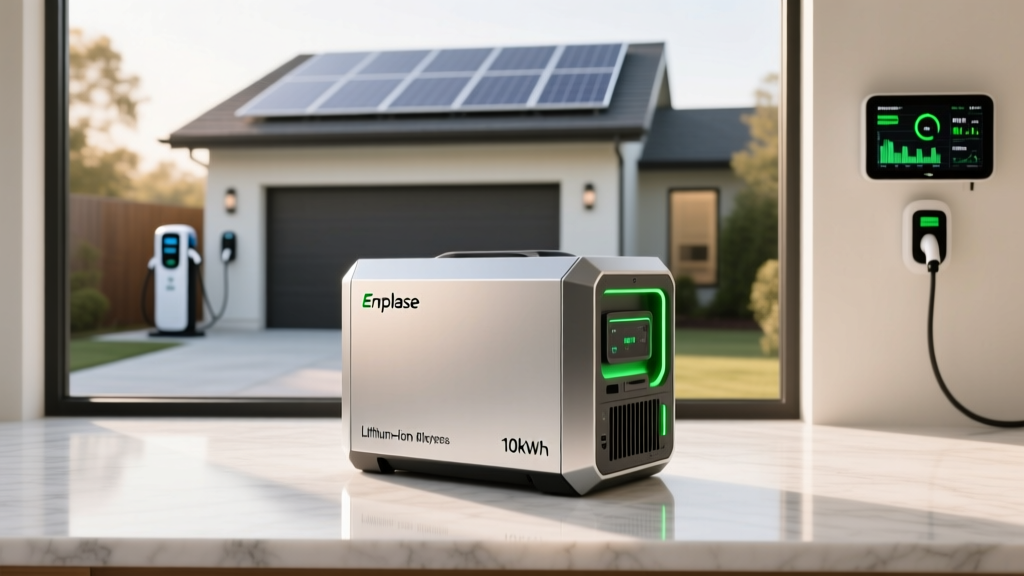
Enphase's IQ 5P and IQ 10 (and 10C) batteries are LFP-based home-storage products, not EV traction packs. But the 2023 shipment ramp — disclosed across Enphase's Q4 2023 and FY 2023 earnings materials — signaled three things that directly affect the EV market:
- LFP supply-chain maturity. Enphase's pivot from NMC (the earlier IQ 3, 3T, 10) to LFP for its current-generation products mirrored Tesla's own shift in the standard-range Model 3 and Model Y. By late 2023, LFP had become the volume chemistry for cost-sensitive, long-cycle applications — both in garages and driveways.
- Price compression. Pack-level LFP pricing fell roughly 30–40% between 2022 and end-of-2023, per BloombergNEF and industry trackers, a trend that carried into 2024–2025 vehicle MSRPs.
- Cross-market cell sourcing. The same tier-1 manufacturers (CATL, BYD, EVE, Gotion) supplying Enphase's home batteries also supply automotive OEMs. Shipment volume in one segment signals capacity and pricing leverage in the other.
So when you see a search like "enphase 2023 battery kwh shipped," read it as a proxy for LFP's arrival as the mainstream chemistry — the same chemistry you'll encounter on an EV window sticker in 2026.
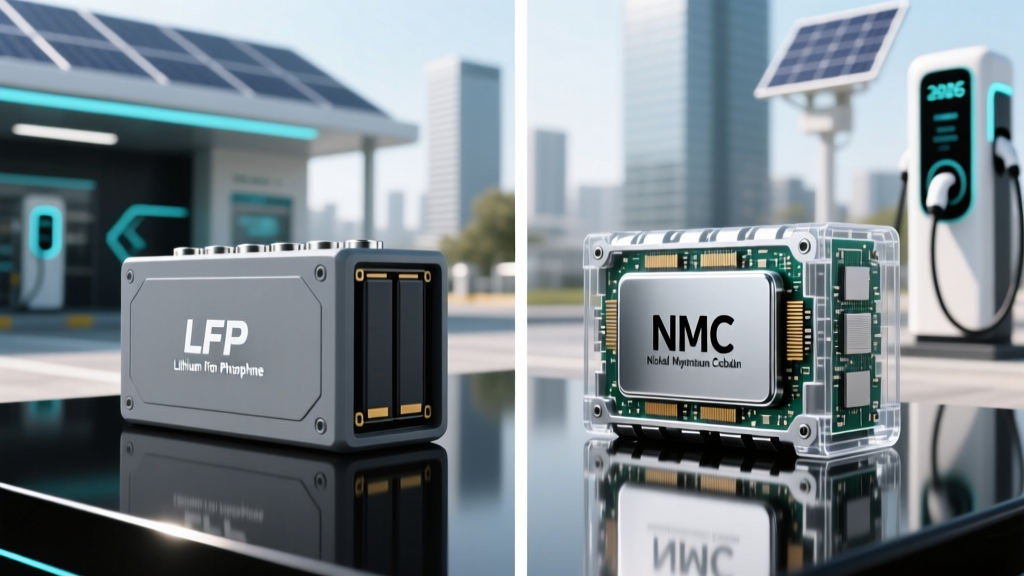
LFP vs. NMC/NCA: The Chemistry Trade-Offs That Actually Matter
Almost every EV sold in the U.S. today uses one of two lithium-ion chemistries: lithium iron phosphate (LFP) or nickel-manganese-cobalt / nickel-cobalt-aluminum (NMC/NCA). The right choice depends on how you drive, where you live, and how long you plan to keep the car.
| Attribute | LFP (LiFePO₄) | NMC / NCA |
|---|---|---|
| Energy density (cell-level) | ~160–190 Wh/kg | ~220–300 Wh/kg |
| Typical cycle life | 3,000–6,000+ cycles to 80% SoH | 1,000–2,500 cycles to 80% SoH |
| Recommended daily SoC | 100% OK (periodic top-up encouraged) | 80% daily, 100% for trips |
| Cold-weather performance | Weaker below ~32°F; preconditioning essential | Better low-temp power and charge acceptance |
| Thermal stability / safety | Higher thermal runaway threshold (~270°C) | Lower threshold; more BMS mitigation needed |
| Critical-mineral exposure | No nickel or cobalt — easier §30D sourcing | Nickel + cobalt supply chain more constrained |
| Cost (2026 pack-level) | ~$90–110/kWh | ~$115–145/kWh |
| Common 2026 U.S. vehicles | Tesla Model 3/Y RWD, Ford Mustang Mach-E Select (LFP pack), BYD-market imports | Hyundai Ioniq 5/6, Kia EV6/EV9, Rivian, Ford extended-range, most luxury BEVs |
Bottom line: Choose LFP if you want maximum cycle life, can charge at home daily to 100%, and live in a moderate climate or have garage parking. Choose NMC/NCA if you need the longest single-charge range, regularly drive in sub-freezing weather, or want the lightest pack for a given capacity. Enphase's 2023 shipment mix — overwhelmingly LFP for home storage — is exactly the use case where cycle life and safety outweigh energy density.
How Long Do EV Batteries Actually Last? Real Degradation Data
The question "how long do EV batteries last" has a boring, reassuring answer: in most cases, longer than the rest of the car. But the shape of degradation matters more than the headline number.
Based on fleet data published by telematics providers (Geotab's multi-year study of ~10,000 vehicles remains the most-cited public dataset) and OEM warranty claims, typical degradation looks like this:
| Timeframe / Mileage | Average Capacity Retained (SoH) | Notes |
|---|---|---|
| Year 1 / ~12,000 mi | ~97–98% | Initial "break-in" drop; mostly calendar aging |
| Year 3 / ~36,000 mi | ~93–95% | Curve flattens after year 1 |
| Year 5 / ~60,000 mi | ~89–92% | LFP packs typically outperform NMC here |
| Year 8 / ~100,000 mi | ~83–88% | Still above most warranty thresholds |
| Year 10+ / 150,000+ mi | ~75–82% | Wide spread; driven by heat and DCFC habits |
Two patterns drive the spread:
- Average annual loss is roughly 1.5–2.0% across the mainstream fleet after the first year, per Geotab's 2024 update. That's far below the 5–10% annual losses early-2010s LEAF owners experienced with passive-air-cooled NMC packs.
- Outliers cluster around heat and DCFC abuse. Vehicles in hot climates (Phoenix, Las Vegas) that DC fast-charge daily show roughly 0.5–1.0 percentage points more annual loss than cooler-climate counterparts.
The practical implication: a 2026 EV with a 300-mile EPA rating should still deliver roughly 250–260 miles at year eight, assuming typical use. That's not a cliff — it's a slow slope.
What the Battery Warranty Actually Covers (and What It Doesn't)
Federal law effectively mandates an 8-year / 100,000-mile minimum on EV battery warranties in the U.S., and CARB states (California and the states that follow its rules) push that to 10 years / 150,000 miles for certain components. But the fine print varies meaningfully.
| Manufacturer | Term | Capacity Retention Threshold | Notes |
|---|---|---|---|
| Tesla (Model 3/Y LFP) | 8 yr / 120,000 mi | 70% | Covers defects + capacity below threshold |
| Tesla (Model S/X, LR AWD) | 8 yr / 150,000 mi | 70% | Longer mileage on larger packs |
| Hyundai / Kia (E-GMP) | 10 yr / 100,000 mi | 70% | Longer term, shorter mileage than Tesla |
| Ford (Mustang Mach-E, F-150 Lightning) | 8 yr / 100,000 mi | 70% | Standard across BEV lineup |
| GM (Ultium-based) | 8 yr / 100,000 mi | 70% | Blended-module replacement strategy |
| Rivian | 8 yr / 175,000 mi (Large Pack) | 70% | Highest mileage threshold in mainstream market |
What's covered: defects in materials/workmanship, and capacity falling below the stated threshold (typically 70% of original usable kWh) as measured by the OEM's diagnostic tool.
What's usually excluded: cosmetic damage, damage from accidents or floods, use outside published operating limits, aftermarket modifications, and — critically — range loss caused by normal aging that remains above the threshold. A pack at 72% SoH at year 7 is, by contract, "within spec," even if the real-world range sting is noticeable.
EV Battery Replacement Cost: What to Budget, and When It's Actually Needed
The sticker-shock number you see in headlines — "$15,000 to $25,000 for a battery swap" — is real but rarely relevant to the first or second owner. Most packs outlive the vehicle's economic life. For context, the average U.S. vehicle age is now 12.6 years (S&P Global Mobility, 2024), and very few EVs sold in the last decade have required out-of-warranty pack replacements.
| Vehicle Class / Pack Size | Parts (Pack) | Labor | Total Installed |
|---|---|---|---|
| Compact BEV, 50–65 kWh (e.g., Bolt, base Model 3) | $8,000–$12,000 | $1,200–$2,500 | $9,200–$14,500 |
| Mid-size BEV, 75–90 kWh (Model Y LR, Ioniq 5, EV6) | $11,000–$16,000 | $1,500–$3,000 | $12,500–$19,000 |
| Large BEV / truck, 100–135 kWh (F-150 Lightning Ext, Rivian Max, Hummer EV) | $16,000–$24,000 | $2,000–$4,000 | $18,000–$28,000 |
| Module-level repair (where supported) | $1,500–$4,500 | $800–$1,800 | $2,300–$6,300 |
Two cost-mitigating trends to watch in 2026:
- Module-level service. GM's Ultium architecture and newer E-GMP revisions allow individual module swaps rather than full-pack replacement, cutting the typical repair bill by 60–75% when only one module has degraded abnormally.
- Remanufactured packs. A growing secondary market (Redwood Materials, Spiers New Technologies, OEM-certified programs) offers remanufactured packs at roughly 40–55% of new-pack cost, with 3–5 year warranties.
Five Factors That Actually Shorten (or Extend) Battery Life
Battery degradation is driven more by how you use the pack than by how much you drive. Here's the ranked list, based on published cell-test data and fleet telemetry:
- 1. Sustained high state of charge. Storing an NMC pack at 100% SoC for days or weeks — especially in heat — accelerates calendar aging dramatically. LFP is more tolerant; OEMs like Tesla recommend periodic 100% charges for LFP specifically to help BMS cell-balancing.
- 2. Heat, not cold. Cold reduces range temporarily; heat degrades the pack permanently. Garage parking in hot climates is the single highest-ROI habit for longevity.
- 3. DC fast-charging frequency. Occasional DCFC is fine. Daily DCFC, especially at peak rates above 1C on a hot pack, measurably increases loss. Plan home Level 2 as the default; reserve DCFC for road trips.
- 4. Depth of discharge extremes. Regularly running NMC packs below 10% SoC stresses the anode. A 20–80% daily window remains the conservative sweet spot.
- 5. Thermal preconditioning. Using the vehicle's preconditioning routine before DCFC (or before a cold morning departure) keeps cells in the ideal 20–35°C window, protecting both life and charge speed.
How to Check and Monitor Your Battery's State of Health
State of Health (SoH) is the percentage of original usable capacity the pack currently holds. There are three ways to measure it, in order of increasing precision:
- In-dash SoC / range readout. The least precise. Range fluctuates with temperature, driving style, and recent trip history. Useful for trend-watching, not diagnosis.
- OEM app or service-menu SoH. Tesla's service mode (under "Battery Health"), Hyundai/Kia's diagnostic screen, and Ford's dealer tool all expose a SoH percentage. This is the number that matters for warranty claims.
- OBD-II telemetry with a third-party app. Tools like Tessie (Tesla-specific), ABRP OBD dongles, and Car Scanner (broad EV support) read BMS-reported kWh remaining, cell voltage delta, and pack temperature — giving a far richer picture than the dash alone.
For used-EV buyers, a documented SoH reading at point of sale — ideally from a dealer scan tool — is now as important as a Carfax. A 2022 Model 3 RWD at 96% SoH with 32,000 miles is a very different proposition than one at 89% SoH, even if both are "in spec."
Solid-State, Silicon Anodes, and Other Forward-Looking Tech
A realistic 2026 snapshot of next-generation chemistries:
- Solid-state batteries. Toyota has announced commercialization for limited 2027–2028 production vehicles (primarily in Japan), with claims of ~750 km WLTP range and 10-minute 10–80% charging. U.S.-market availability remains unconfirmed, and early deployments will be low-volume and premium-priced. Treat any "solid-state EV on sale now" claim as misleading.
- Silicon-dominant anodes. Companies like Sila Nanotechnologies and Group14 are shipping silicon-anode cells in limited production (Porsche's Taylan program, Mercedes-AMG's upcoming EQ applications). Energy-density gains of 15–25% at the cell level are real, but cost and cycle-life trade-offs keep these out of mainstream 2026 models.
- Sodium-ion. CATL and BYD are shipping sodium-ion packs in Chinese-market city cars. Lower energy density (~140 Wh/kg) limits use to sub-200-mile vehicles, but the cost and critical-mineral profile is attractive for fleet and urban applications. U.S. availability is not on the 2026 roadmap.
For buyers deciding today, LFP and NMC remain the only proven, warrantied options — and both are meaningfully better in 2026 than the same chemistries were in 2020.
Enphase IQ Batteries vs. EV Packs: A Side-by-Side Chemistry Check
If you're considering an Enphase IQ home battery alongside an EV purchase, here's how the specs stack up against representative 2026 vehicle packs — useful context if you're sizing a solar-plus-storage system around an EV charging load.
| Attribute | Enphase IQ 10C (home) | Tesla Model 3 RWD (LFP) | Hyundai Ioniq 5 (NMC) |
|---|---|---|---|
| Usable capacity | ~10.1 kWh (per unit, stackable) | ~57.5 kWh | ~77.4 kWh (LR AWD) |
| Chemistry | LFP | LFP (CATL) | NMC (SK On) |
| Warranty | 15 years, 70% retention | 8 yr / 120,000 mi, 70% | 10 yr / 100,000 mi, 70% |
| Cycle-life design target | 7,000+ cycles | ~3,000–5,000 cycles | ~1,500–2,500 cycles |
| Primary use case | Daily solar self-consumption, backup | Daily driving | Daily + road-trip driving |
Note the warranty gap: Enphase's 15-year stationary-storage warranty is longer than any automotive pack warranty, because stationary packs run cooler, at lower C-rates, and with far less mechanical stress. That's also why the 2023 Enphase shipment number was such a strong LFP signal — the chemistry's longevity advantage is most visible in stationary, daily-cycle applications.
FAQ: EV Batteries in 2026
How long do EV batteries last in years and miles?
Most modern EV packs (2020 onward) are designed to outlast the vehicle's typical first- and second-owner life. Expect 15–20 years or 200,000+ miles before a pack reaches 70–75% SoH under normal use. Early-2010s vehicles (first-gen LEAF, early Model S) degraded faster due to passive cooling and less stable NMC formulations — those are not representative of current products.
How much does an EV battery cost to replace in 2026?
Out of warranty, a full pack replacement runs roughly $9,000–$19,000 for mainstream sedans and crossovers, and $18,000–$28,000 for large trucks and SUVs with 100+ kWh packs. Module-level repairs, where supported, drop that to $2,300–$6,300. Most owners never face this bill — the car is typically retired or traded before the pack needs replacement.
What does the EV battery warranty actually cover?
Minimum 8 years / 100,000 miles federally, with a 70% capacity-retention threshold in almost every OEM contract. CARB states extend this to 10/150,000 for certain components. Warranties cover defects and abnormal degradation — not range loss from normal aging that stays above the threshold. Read your specific OEM's battery warranty booklet; the exclusions section matters.
How do I check and maximize my EV battery's health?
Check SoH via the OEM service menu or a trusted OBD-II app (Tessie, ABRP, Car Scanner). Maximize longevity by: keeping NMC packs between 20–80% SoC daily, charging LFP to 100% periodically for balancing, avoiding daily DC fast-charging, parking in shade or a garage in hot climates, and always using the vehicle's preconditioning routine before fast charging in cold weather.
LFP vs. NMC — which is better for my next EV?
Neither is universally better. LFP wins on cycle life, safety, cost, and daily-charge convenience (100% OK). NMC wins on energy density, cold-weather performance, and single-charge range. If you charge at home nightly and don't regularly drive in sub-freezing weather, LFP is the more durable and lower-stress choice in 2026. If you road-trip frequently in winter or need maximum range from the smallest pack, NMC remains the right tool.
Does Enphase's home battery use the same chemistry as my EV?
Yes, in many cases. Current-generation Enphase IQ batteries use LFP — the same chemistry in the Tesla Model 3 RWD, standard-range Model Y, and an expanding list of 2026 models. The cells are stationary-spec and warrantied longer (15 years vs. 8), but the underlying chemistry and its trade-offs are identical.
Sources: Enphase Energy Q4 2023 and FY 2023 earnings disclosures; Geotab EV Battery Degradation Study (2024 update); OEM battery warranty booklets (Tesla, Hyundai, Ford, GM, Rivian, 2026 model year); fueleconomy.gov for vehicle-level EPA data; IRS §30D clean-vehicle credit guidance for critical-mineral sourcing context.